
Ocular sonography in emergency room
Reading File
Now let me search the library and PubMed in parallel for ocular sonography in the emergency setting.
Finding Sources
Finding Sources
Searching PubMed
ocular ultrasound emergency department point-of-care
Good. Now let me read the main textbook sections on bedside ocular ultrasound in parallel.
Reading File
Reading File
Excellent. Now let me read more of the Roberts & Hedges section (the dedicated ocular ultrasound chapter) and fetch the key images.
Reading File
Loading Image
Loading Image
Now let me get the OPTIC NERVE SHEATH section and ICP measurement details, plus look for specific findings images.
Finding Sources
Finding Sources
Now let me read the Tintinalli section on ocular US and the ONSD ICP section, plus get the Rosen's section.
Reading File
Reading File
Now let me fetch the key diagnostic images and read the Tintinalli ONSD/ICP section.
Loading Image
Reading File
Let me fetch the remaining key images (ONSD measurement and vitreous hemorrhage).
Loading Image
Loading Image
I now have comprehensive content from three major emergency medicine textbooks plus real sonographic images. Let me compose the full answer.
Ocular Sonography in the Emergency Room
Bedside ocular ultrasound (point-of-care ultrasound, POCUS) has become a standard skill for emergency physicians since the first published series by Blaivas et al. in 2000. It is fast, non-invasive, radiation-free, and can be performed at the bedside without moving a trauma patient or waiting for radiology.
Indications
Ocular POCUS is appropriate in any patient presenting with:
- Altered vision or sudden vision loss
- Ocular or periorbital pain
- Eye trauma (blunt or penetrating)
- Suspected intraocular foreign body (FB)
- Head injury or altered mental status
- Headache (to assess raised intracranial pressure)
- Periorbital edema or hematoma obscuring fundoscopy
Conditions reliably diagnosed include: globe rupture, intraocular FB, vitreous hemorrhage, retinal detachment, lens dislocation, and elevated intracranial pressure (via optic nerve sheath diameter).
- Roberts and Hedges' Clinical Procedures in Emergency Medicine, p. 1484
Equipment
A linear array transducer (7.5-10 MHz or higher) is preferred. The high frequency provides superior resolution of the superficial globe structures. A curvilinear probe can be used but gives inferior detail. The machine should be set to the ocular/ophthalmic preset (which limits thermal index and mechanical index to safer values - recommended exposure limits are half those of fetal imaging).
Technique: The No-Pressure Method
This is the single most important safety point - excessive pressure on a potentially ruptured globe can cause vitreous extrusion.
- Patient recumbent or semi-reclined to prevent gel runoff
- Instruct patient: eyes closed, relaxed, gazing straight ahead
- Place a large piece of clear Tegaderm over the closed eyelid as a barrier
- Apply a copious amount of gel over the dressing - enough to fill the orbital sulcus so the probe floats in gel without touching the eyelid
- Rest the scanning hand on the patient's forehead, bridge of nose, or maxilla for stabilization
- Touch probe to gel without applying any pressure (no-pressure technique)
- Scan in transverse then longitudinal planes; adjust gain and depth
- Identify: anterior chamber, iris, lens, vitreous, retina, optic nerve sheath
- Roberts and Hedges', p. 1485
- Rosen's Emergency Medicine, 9e
Sonographic Findings by Diagnosis
1. Retinal Detachment
Sensitivity 97-100%, specificity 83-92% when performed by emergency physicians.
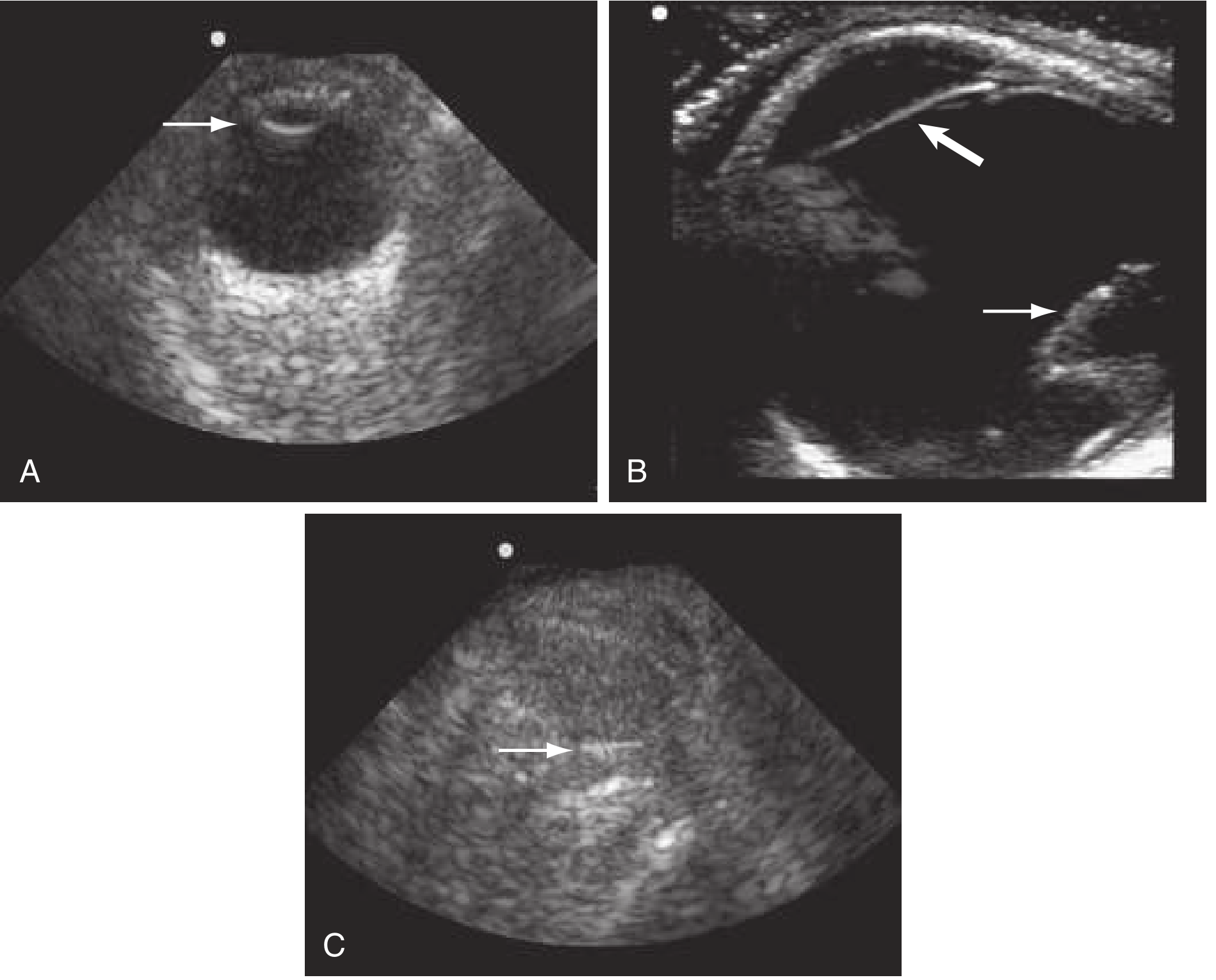
Appears as a hyperechoic, undulating membrane in the posterior-to-lateral globe, protruding into the vitreous. It remains tethered at the ora serrata anteriorly and the optic disc posteriorly. Critically, unlike choroidal detachment, retinal detachment moves with eye movements - dynamic scanning (asking the patient to look side to side) helps confirm this.
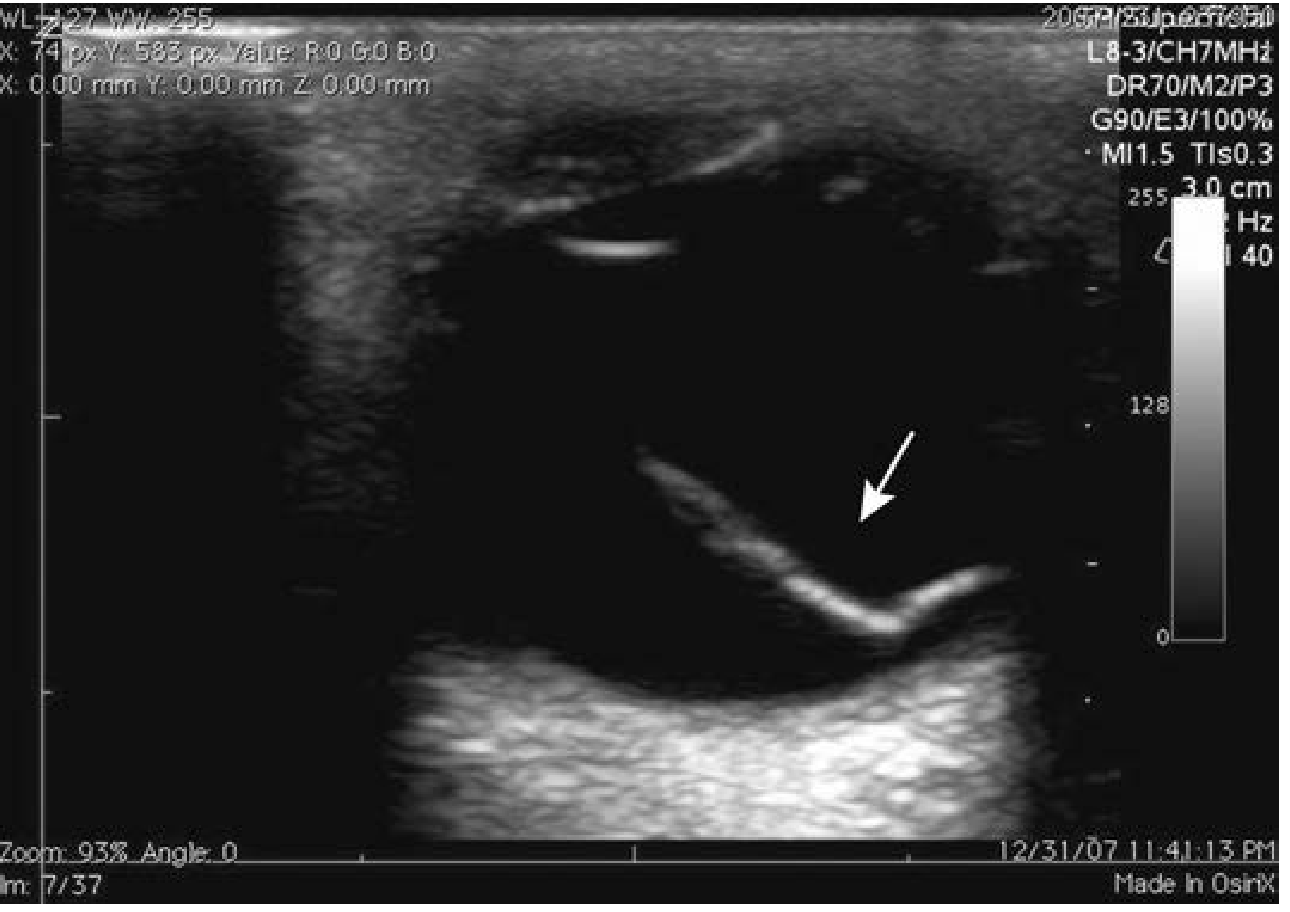
The panel below shows (A) normal eye with lens visible, (B) retinal detachment (large arrow = lens, small arrow = detachment), and (C) ruptured globe:
- Tintinalli's Emergency Medicine, p. 1600
2. Vitreous Hemorrhage
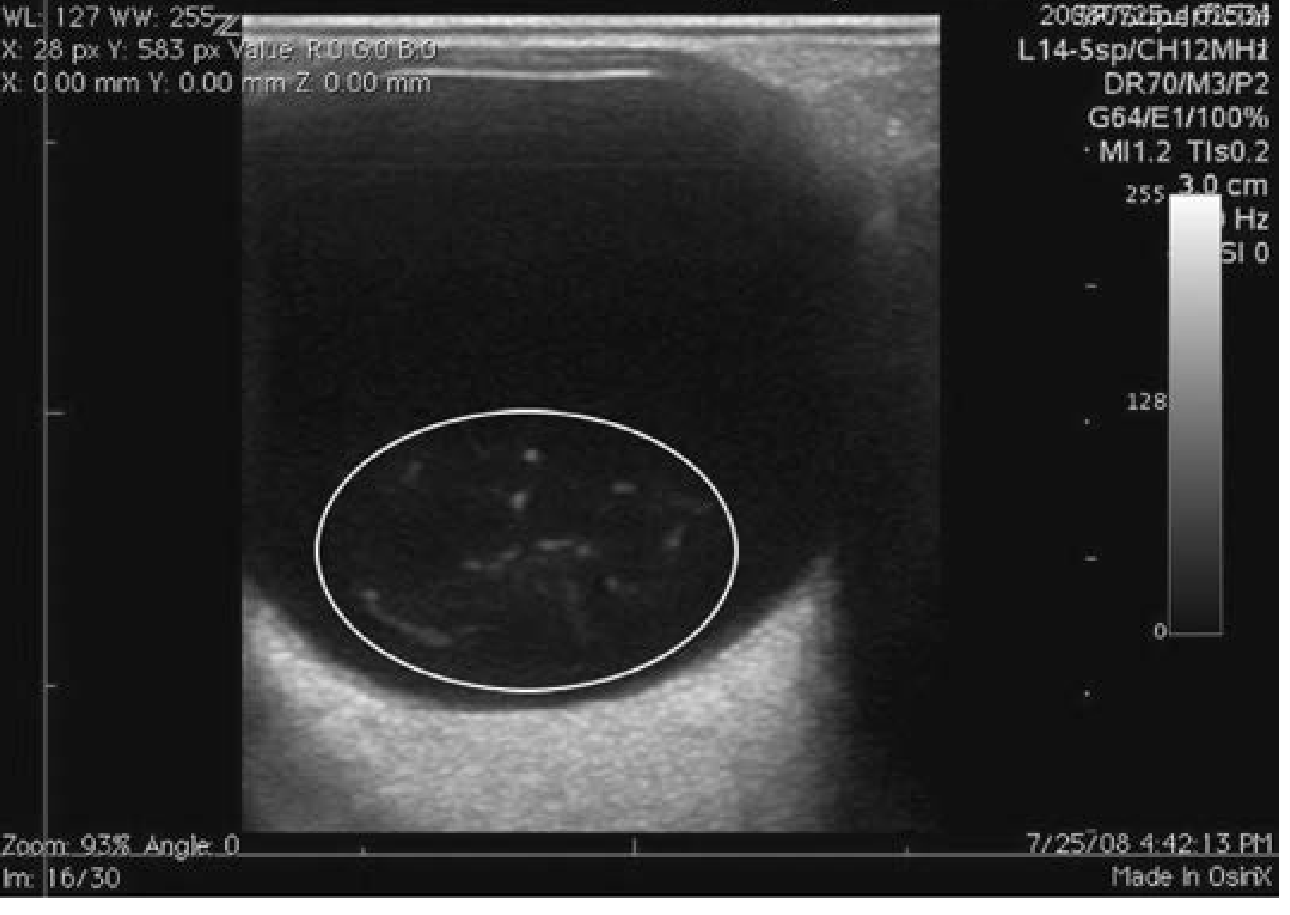
Appears as echogenic material in the posterior chamber. Appearance depends on age and severity:
- Acute/mild: small dots or low-amplitude mobile opacities (increase gain to detect)
- Organized: thick mobile membranes, multiple large echoes filling the vitreous
- Due to gravity, opacities may layer inferiorly
3. Globe Rupture
Look for:
- Loss of normal spherical globe shape / globe deformity
- "Flat tire" sign (flattening of the anterior globe contour)
- Vitreous collapse
- Intraocular air
If globe rupture is suspected clinically, perform the no-pressure technique with extreme caution. If the exam obviously confirms open globe, stop - the risk of vitreous extrusion outweighs further imaging benefit. CT of orbits is the gold standard in that scenario.
4. Intraocular Foreign Body
Metallic FBs are especially visible - bright echogenic focus with posterior shadowing or reverberation (comet-tail) artifact in the echolucent vitreous. Wood is more difficult to detect. A track of hemorrhage may mark the path of FB penetration. Dynamic scanning helps localize size and position.
5. Lens Dislocation
The lens appears as a biconvex echogenic structure in the anterior globe. Dislocation is confirmed when it is found displaced posteriorly or floating in the vitreous. High-resolution US has 94% correlation with CT in detecting lens dislocation and other traumatic ocular injuries.
- Rosen's Emergency Medicine, p. 415
6. Optic Nerve Sheath Diameter (ONSD) - Elevated ICP Screening
This is one of the most powerful non-trauma applications of ocular POCUS. The optic nerve sheath communicates with the subarachnoid space and expands when CSF pressure rises.
Technique:
- Ask the patient to deviate the examined eye ~10 degrees laterally (aligns the nerve with the beam)
- Measure the sheath width 3 mm posterior to the retina (best contrast and reproducibility at this point)
- Average at least 2-3 measurements per eye
Normal values:
| Population | Upper limit of normal ONSD |
|---|---|
| Adults | 5.0 mm |
| Children | 4.5 mm |
| Infants | 4.0 mm |
Diagnostic thresholds: A cutoff of 5.7-6.0 mm for ICP > 20 mmHg gives sensitivity 87-95% and specificity 79-100%. A diameter > 5 mm is considered widened and suspicious for raised ICP.
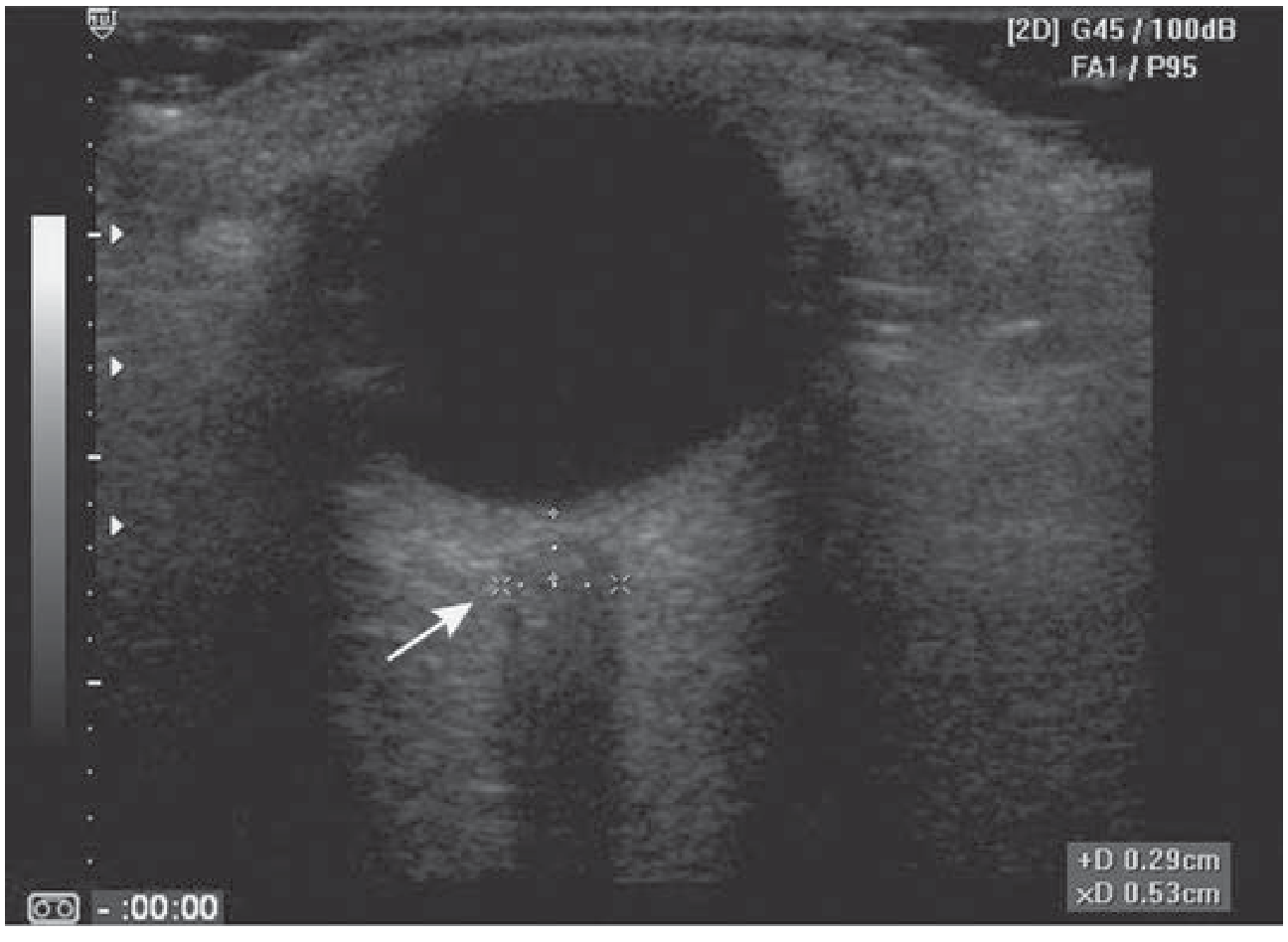
The differential for an enlarged ONSD includes: elevated ICP, anterior orbital mass, optic neuritis, trauma, and cavernous sinus mass.
- Tintinalli's Emergency Medicine, p. 1601
- Rosen's Emergency Medicine - ONSD > 5 mm guideline to delay LP in suspected meningitis
Contraindications and Cautions
There are no absolute contraindications, but important cautions include:
| Situation | Caution |
|---|---|
| Suspected open globe | Use no-pressure technique; if exam confirms rupture, stop scanning |
| Orbital emphysema | Air artifact will obscure globe contents |
| Air bubbles in vitreous | May mimic intraocular FB |
| Examination duration | Limit time, especially with spectral/color Doppler (thermal risk) |
Relative contraindication: If physical exam obviously confirms open globe, do not scan - risk of vitreous extrusion even with minimal compression.
Summary Table of Sonographic Findings
| Condition | Sonographic Appearance | Key Feature |
|---|---|---|
| Retinal detachment | Hyperechoic undulating membrane, posterior globe | Moves with eye movements |
| Choroidal detachment | Hyperechoic membrane, more peripheral | Does NOT move with eye movements |
| Vitreous hemorrhage | Echogenic dots/membranes in vitreous | Mobile, gravity-dependent layering |
| Globe rupture | Deformed globe, "flat tire" sign | No pressure exam; consider CT |
| Intraocular FB | Bright echogenic focus + shadowing/comet tail | Metallic best seen; wood difficult |
| Lens dislocation | Biconvex structure displaced into vitreous | Displaced from normal anterior position |
| Elevated ICP (ONSD) | Optic sheath width > 5 mm at 3 mm depth | >5.7-6 mm = ICP likely > 20 mmHg |
Key Clinical Pearls
- Always use the no-pressure (flotation) technique - never apply direct probe pressure to the globe
- Scan in at least two planes (transverse and longitudinal) and through the full arc of the globe
- Increase gain to detect early/acute vitreous hemorrhage (can be nearly anechoic initially)
- Dynamic scanning (asking patient to move their eye) differentiates retinal from choroidal detachment
- ONSD measurement is a bedside surrogate for ICP - use it to triage patients with head injury, altered mental status, or suspected meningitis before LP
- Orbital emphysema and air bubbles are sources of false-positive FB findings
Sources: Roberts and Hedges' Clinical Procedures in Emergency Medicine | Tintinalli's Emergency Medicine: A Comprehensive Study | Rosen's Emergency Medicine: Concepts and Clinical Practice
Recent literature: A 2024 review in Emerg Med Clin North Am (Pierre et al., PMID 39326993) provides an up-to-date overview of ocular US in the ED. A 2025 review in Adv Emerg Nurs J (Gonzalez et al., PMID 39641540) specifically addresses point-of-care US for ocular emergencies from a nursing/advanced practice perspective.
This is a shared conversation. Sign in to Orris to start your own chat.