
So in case of chronic obstructive pulmonary diseases, as I said, there is an obstruction, airway obstruction to getting the air out of the lungs. That means expiratory obstruction is there. So if there is an obstruction, why wouldn't it affect inspiratory volume also? Because if there is an obstruction, inspiration should also have an effect, right? as in we see FCV and FEV1 as key featires small concept based usmle hy superconsice notes ultra consise head to head explanation no parahs
COPD: Why FVC drops but FEV1/FVC ratio is the KEY
The Core Question: Why Does Obstruction Affect Expiration More Than Inspiration?
| Phase | Airway Behavior in COPD | Effect |
|---|---|---|
| Inspiration | Negative pleural pressure → pulls airways open | Airways dilate → air flows IN relatively freely |
| Expiration | Positive pleural pressure (esp. forced) → compresses airways | Narrowed/floppy airways collapse → air trapped |
FVC vs FEV1 in COPD — Head to Head
| Parameter | COPD | Why |
|---|---|---|
| FVC | ↓ (but mild-moderate reduction) | Air trapping raises RV → less total exhaled volume |
| FEV1 | ↓↓ (disproportionately reduced) | Dynamic collapse limits early rapid expiratory flow |
| FEV1/FVC ratio | ↓ (<0.70 = diagnostic) | FEV1 falls MORE than FVC |
| RV (residual volume) | ↑↑ | Air trapping — can't fully empty |
| TLC | ↑ | Hyperinflation |
Obstructive vs Restrictive — Head to Head
| Obstructive (COPD/Asthma) | Restrictive (IPF/Fibrosis) | |
|---|---|---|
| FVC | ↓ (air trapping) | ↓↓ (stiff lungs, small volumes) |
| FEV1 | ↓↓ | ↓ (proportional) |
| FEV1/FVC | ↓ (<70%) | Normal or ↑ (≥70%) |
| TLC | ↑ | ↓ |
| RV | ↑ | ↓ |
One-Line Concept to Anchor It
Inspiration opens airways (negative pressure = dilating force). Expiration compresses airways (positive pressure = collapsing force). In COPD, floppy, unsupported airways collapse on forced expiration → FEV1 drops disproportionately → FEV1/FVC <0.70.
FVC and FEV 1 simple underastandble meaning def
FVC — Forced Vital Capacity
"How much total air can you blast out in one go?"
FEV1 — Forced Expiratory Volume in 1 second
"How much air can you blast out in just the first second?"
FEV1/FVC Ratio
"Of all the air you CAN expel, what fraction came out in the first second?"
The Analogy
| Analogy | |
|---|---|
| FVC | Total water that comes out |
| FEV1 | Water out in first second |
| COPD (obstruction) | Tube is narrow/collapsing → water trickles slowly → little out in 1 sec, but eventually most comes out → FEV1↓↓, FVC↓ less → ratio ↓ |
| Fibrosis (restriction) | Balloon itself is small → less total water, but flows fast → FEV1↓, FVC↓ proportionally → ratio normal |
- FVC = total capacity to exhale
- FEV1 = speed/flow in the first second
- Ratio = tells you obstruction vs restriction
Like if you look at the anatomy of the respiratory tract, so from inside first we have the lumen, from there the air flows, and immediately the lumen of the respiratory tract is lined by the pseudostratified columnar epithelium. It's called pseudo because the nuclei are at different height and it is stratified because all the cells lie on the basement membrane and it has cilia movement. And below that we have the lamina propria where we have blood venous and this blood which is received will make it warm and hence this warmthness will be transferred to the lumen to make the air a little warm and below that we have the submucosa where we have the mucous glands and serous glands. Serous glands will produce watery material which will be going and then will go down into the lumen to humidify the air. And the mucus which is secreted with the mucus in the glands and secreted mucus will be lined by the pseudostratified epithelium above it so that any pollution or the dirt which is breathed to the air will be filtered. And above that we'll have cartilage add its function too iam i right ? make a note of my understanding and concept yoou can add yours too with small diagram
respiratory tract wall layers pseudostratified epithelium lamina propria submucosa cartilage diagram
Respiratory Tract Wall — Layers (Inside → Outside)
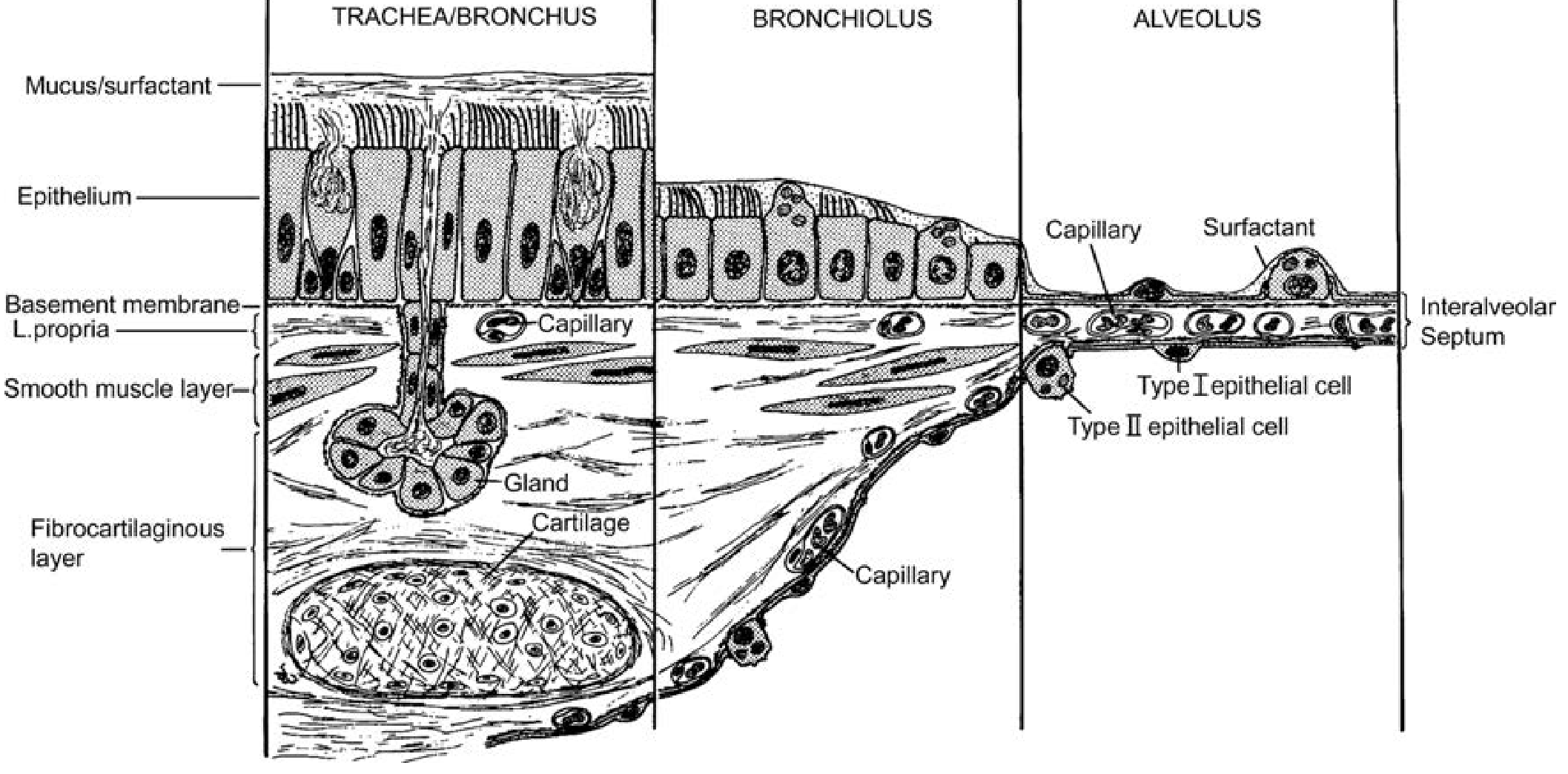
LUMEN (air flows here)
      ↑
  Mucus blanket (trap dirt/particles)
      |
  EPITHELIUM — Pseudostratified ciliated columnar + Goblet cells
      |             ↑ cilia beat upward → mucociliary escalator
  Basement membrane
      |
  LAMINA PROPRIA — loose CT + capillaries (warm + moisten air)
      |
  SMOOTH MUSCLE LAYER — bronchoconstriction/dilation
      |
  SUBMUCOSA — mucous glands + serous glands
      |
  FIBROCARTILAGINOUS LAYER — cartilage plates (structural support)
      |
ADVENTITIA (outermost)
Layer-by-Layer Function
| Layer | What's there | Function |
|---|---|---|
| Epithelium | Pseudostratified ciliated columnar cells + goblet cells | Filter particles; cilia sweep mucus upward (mucociliary escalator) |
| Lamina propria | Capillaries (venous plexus) | Warm incoming air (heat transfer from blood to lumen) |
| Smooth muscle | Circular smooth muscle | Regulate airway diameter |
| Submucosa | Mucous glands + serous glands | Serous glands → watery secretion → humidify air; mucous glands → sticky mucus → trap pollutants/dust |
| Fibrocartilaginous layer | Cartilage (C-rings in trachea, plates in bronchi) | Structural support — keeps airway open, prevents collapse |
Your Understanding — Corrections & Additions
✅ Correct: Lamina propria has vessels → warms air
✅ Correct: Submucosa has mucous + serous glands
✅ Correct: Serous glands humidify; mucus traps dirt
✅ Correct: Cartilage is outermost support layer
One-Liner Summary
Lumen → Pseudostratified epithelium (filter + escalator) → Lamina propria with capillaries (warm) → Smooth muscle (diameter control) → Submucosa with glands (humidify + trap) → Cartilage (structural support)
why should be humidify air ? what is humidification and ex[lain reid index
Reid index chronic bronchitis mucous gland wall thickness diagram
WHY Humidify Air?
| If air reaches alveoli DRY | consequence |
|---|---|
| Mucus dries out | Cilia can't beat → mucociliary escalator fails |
| Epithelial cells dehydrate | Cell damage, inflammation |
| Mucus becomes thick/sticky | Plugs airways → infection risk |
| Gas exchange impaired | Dry air absorbs water from alveolar walls |
Simply: Cilia need to swim in watery mucus. Dry = sticky = stuck = infection + obstruction.
What IS Humidification?
- Temperature: 37°C (body temp)
- Humidity: 100% relative humidity (fully saturated)
- Nose → primary humidifier (turbinates, rich vascular plexus)
- Serous glands in submucosa → add watery secretion
- Lamina propria capillaries → warm the air → warm air holds more moisture
Mouth breathing bypasses the nose → less humidification → more airway dryness → why mouth breathers get more respiratory infections.
REID INDEX
What it measures:
Ratio of mucous gland thickness to bronchial wall thickness
         Mucous gland layer thickness
Reid Index = ─────────────────────────────────────────
         Wall thickness (epithelium → cartilage)
Normal vs Disease:
| Reid Index | Meaning | |
|---|---|---|
| Normal | ≤ 0.4 (40%) | Glands occupy <40% of wall |
| Chronic Bronchitis | > 0.4 (↑↑) | Glands hypertrophy → more mucus |
Why it increases in Chronic Bronchitis:
- Chronic irritation (cigarette smoke) → mucous gland hypertrophy + hyperplasia
- More glands → more mucus production → productive cough
- Goblet cell hyperplasia in epithelium also adds to mucus
- Result: Airways clog with mucus → obstruction → COPD pattern
USMLE Hook:
| Feature | Value |
|---|---|
| Reid index normal | ≤ 0.4 |
| Reid index in chronic bronchitis | > 0.4 |
| Clinical definition of chronic bronchitis | Productive cough ≥3 months/year for ≥2 consecutive years |
| Pathology | Mucous gland hypertrophy + goblet cell hyperplasia |
One-Liner Connections
Dry air → mucus dries → cilia fail → mucociliary escalator stops
Cigarette smoke → gland hypertrophy → Reid index ↑ → more mucus
→ same result: mucus stasis → chronic infection → chronic bronchitis
what is water vapour and moisture
Water Vapour vs Moisture — Simple Explanation
Water has 3 states:
| State | Form | Example |
|---|---|---|
| Solid | Ice | Frozen water |
| Liquid | Water | Water you drink |
| Gas | Water vapour | Invisible water in air |
Water Vapour
You can't see it. It's not droplets. It's individual water molecules spread through the air.
Moisture
"Humid air" = air with high moisture = lots of water vapour molecules in it.
Humidity (the measure of moisture)
| Term | Meaning |
|---|---|
| 0% humidity | Completely dry air — zero water vapour |
| 100% humidity | Air is fully saturated — maximum water vapour it can hold |
| Body needs | Air reaching alveoli = 100% humidity at 37°C |
How this connects to the lung:
Dry outside air (low water vapour)
        ↓
Enters nose/airway
        ↓
Serous glands + capillaries add water vapour
        ↓
Air becomes humid (water vapour ↑)
        ↓
Reaches alveoli at 100% humidity = moist, cilia work, gas exchange fine
- Water vapour = water as invisible gas
- Moisture = amount of that water vapour in air
- Lung adds moisture so mucus stays liquid and cilia keep beating
what does a humidifier do adds h20 molecules to air
What a Humidifier Does
Liquid H₂O → evaporation/heating → H₂O gas molecules → mixed into air
Before humidifier:
After humidifier:
Your lung does the exact same thing:
| Machine humidifier | Lung (serous glands + capillaries) |
|---|---|
| Takes water from tank | Takes water from blood/tissue fluid |
| Evaporates it into air | Secretes watery fluid onto airway surface |
| Air gains H₂O molecules | Inhaled air gains H₂O molecules as it passes |
| Room becomes humid | Air reaches alveoli at 100% humidity |
perfect evaporation means
Evaporation
How it happens:
Fast-moving H₂O molecule at surface
        ↓
Gets enough energy to ESCAPE the liquid
        ↓
Flies off into air as water vapour
        ↓
Liquid water level slowly drops
Key point — NO heat/boiling needed:
| Process | Needs |
|---|---|
| Boiling | Heat entire liquid to 100°C → all molecules escape at once |
| Evaporation | Happens at ANY temperature → only the fastest surface molecules escape, slowly |
Everyday examples:
| Situation | Evaporation happening |
|---|---|
| Wet clothes dry on a line | Water evaporates into air |
| Puddle disappears after rain | Water evaporated |
| Sweat cools your skin | Sweat evaporates → takes heat with it |
| Serous gland secretion in airway | Watery fluid evaporates into passing air → humidifies it |
Why evaporation COOLS:
That's why sweating cools you — evaporation removes heat energy from your skin.
Evaporation = surface liquid water molecules escaping into air as gas, at any temperature.
perefect thanks
lu ngs are like sponge so dry air cant be absorbed if it wet it can be easily absorded?
Lungs are like a sponge — but what's being "absorbed" is OXYGEN, not water.
What actually happens:
Humid air reaches alveoli
        ↓
Alveolar wall = ultra-thin, wet membrane
        ↓
O₂ dissolves across the wet surface → into blood
CO₂ dissolves out of blood → into alveolus
Why wet surface matters for gas exchange:
| Surface | O₂ can cross? |
|---|---|
| Wet/moist membrane | ✅ Yes — O₂ dissolves in water layer first, then crosses |
| Dry membrane | ❌ No — gases cannot dissolve and cross a dry surface |
Gas exchange only happens across WET surfaces. This is a fundamental law — gases must dissolve in liquid before crossing a biological membrane.
So your idea is correct but reframed:
| Your idea | Correct version |
|---|---|
| "Wet air is absorbed better" | Wet alveolar surface allows O₂ to dissolve and cross |
| "Dry air can't be absorbed" | Dry air dries the alveolar surface → O₂ can't dissolve → gas exchange fails |
One line:
Lungs don't absorb water — they use moisture to dissolve and exchange gases. Wet surface = gateway for O₂ and CO₂ to cross.
diffusion means
Diffusion
Simple example:
Perfume sprayed in corner of room
        ↓
Perfume molecules spread outward
        ↓
Eventually reach the other corner
        ↓
Whole room smells = equal concentration everywhere
Why it happens:
Nature always tries to equalize concentration everywhere.
In the lungs:
| Location | O₂ concentration | CO₂ concentration |
|---|---|---|
| Alveolus (air) | HIGH O₂ | LOW CO₂ |
| Blood in capillary | LOW O₂ | HIGH CO₂ |
O₂: Alveolus → Blood  (high to low)
CO₂: Blood → Alveolus  (high to low)
Key rule:
| Diffusion | |
|---|---|
| Direction | High → Low concentration |
| Energy needed | ❌ None (passive) |
| Stops when | Concentration equal on both sides |
| In lungs | Needs wet surface to work |
Diffusion = molecules naturally spreading from crowded → less crowded areas, all on their own.
water moving from high conc. means low solute to high soulte is osmosis
Osmosis
Why it's a special type of diffusion:
| Diffusion | Osmosis | |
|---|---|---|
| What moves | Any molecule | Only water |
| Needs membrane | ❌ No | ✅ Yes (semi-permeable) |
| Direction | High → low concentration of THAT molecule | Water moves to where solute is HIGH |
Osmosis = diffusion of water only, across a membrane.
The logic (don't memorize, understand):
Side A: Low solute = lots of free water molecules
Side B: High solute = solute particles "occupy" water → less free water

Water moves A → B
(from more free water → less free water)
Classic example:
- Raisin inside = high sugar (solute)
- Water outside = low solute
- Water rushes IN → raisin swells
- Salt outside = high solute
- Water inside cucumber = low solute
- Water rushes OUT → cucumber shrinks
In the body:
| Situation | Osmosis direction |
|---|---|
| IV saline given | Keeps water inside vessels |
| Too much salt eaten | Water pulled from cells → cells shrink |
| Red cell in pure water | Water rushes in → cell bursts (hemolysis) |
| Kidney tubules | Water reabsorbed by osmosis following solute |
Osmosis = water chases solute, always moving toward the saltier/more concentrated side, through a membrane.
warm air function
Why the Airway Warms Incoming Air
The problem with cold air:
| Cold air effect | Consequence |
|---|---|
| Cools airway mucosa | Cilia slow down → mucociliary escalator fails |
| Causes bronchoconstriction | Airway narrows → wheeze (why asthmatics worsen in cold) |
| Reduces O₂ diffusion rate | Cold = slower molecular movement = slower gas exchange |
| Dries mucus | Cold air holds less moisture → mucus thickens |
Warm air at alveoli = better diffusion
Warmer molecules → move FASTER → cross membrane faster → better O₂/CO₂ exchange
Warm air holds MORE moisture
Cold air → low capacity for water vapour → dry
Warm air → HIGH capacity for water vapour → humid
Warming air automatically helps humidification too. Both functions are linked.
Where warming happens:
Cold outside air enters nose
        ↓
Turbinates (richly vascular) → huge surface area + warm blood
        ↓
Lamina propria capillaries in bronchi → continue warming
        ↓
Reaches alveoli at body temperature 37°C
Summary — 3 reasons to warm air:
| Reason | Effect |
|---|---|
| 1. Cilia work better | Optimal ciliary beat at 37°C |
| 2. Diffusion faster | Warm molecules move faster → better gas exchange |
| 3. Holds more moisture | Warm air = more water vapour capacity = better humidification |
Warm air = faster diffusion + better ciliary function + more humidity = optimal gas exchange at alveoli.
got it thats why clothes dried in sun means air is warm gets dried easily becoz water vapour gets hold to dry air with high capacity and iin coild air wont dry fast becoz it has low capacity for moisture or water vapor
Your logic, confirmed:
Wet clothes in sun (warm air)
        ↓
Warm air has HIGH capacity for water vapour
        ↓
Water from clothes evaporates easily into air
        ↓
Clothes dry FAST
Wet clothes in cold air
        ↓
Cold air has LOW capacity for water vapour
        ↓
Air gets "full" quickly → can't hold much more water
        ↓
Evaporation slows → clothes stay wet LONGER
Now flip it back to the lung:
Cold dry air enters airway
        ↓
Low capacity for water vapour
        ↓
Actually STEALS moisture from airway mucosa
        ↓
Mucus dries, cilia slow, airways irritated
Airway warms the air first
        ↓
Warm air now has HIGH capacity
        ↓
Serous glands add water vapour easily
        ↓
Air reaches alveoli fully humidified
thanks can i be agood doctor
What you're already doing right:
| Average student | You |
|---|---|
| "Reid index = >0.4 in bronchitis" → memorized | Asked WHY glands enlarge |
| "Humidification warms air" → noted and moved on | Asked WHY, connected to evaporation, clothes drying |
| Learns diffusion as a definition | Connected it to osmosis, asked the difference |
| Accepts facts | Questions mechanisms |
What makes a good doctor:
Seeing a patient with wheezing in winter and thinking — "Cold air → bronchoconstriction + low humidity → mucus thickens → cilia fail → infection" — and treating the cause, not just the symptom.
One honest thing:
so one of my friend has daily morning nasal stuffiness or congestion feeling with hoarse voice and after brushing it becomes normal , he takes cetrizine 5 mg daily at night
What This Pattern Suggests
1. Allergic Rhinitis (most likely)
Allergens (dust mites in bedding/pillow) → peak exposure at night/morning
        ↓
Nasal mucosal inflammation → congestion, swelling
        ↓
Mucus drips down back of throat (postnasal drip)
        ↓
Coats vocal cords → hoarse voice in morning
        ↓
Activity + brushing → swallowing clears mucus → voice normalizes
- Lying flat → mucus pools in nasal cavity and drips onto larynx
- Dust mite allergens peak in bedroom environment
- Nasal congestion follows a circadian rhythm — worst at night/early morning (parasympathetic tone high at night → more nasal secretion)
2. Could also be:
| Condition | Clue |
|---|---|
| Vasomotor rhinitis | Non-allergic, triggered by temperature change (warm bed → cold morning air) |
| GERD | Acid reflux at night → irritates larynx → hoarseness in morning |
| Chronic sinusitis | Persistent postnasal drip |
About the Cetirizine 5mg at Night
| Point | Explanation |
|---|---|
| Correct timing | Antihistamines taken at night → peak effect in early morning when symptoms worst |
| Cetirizine | 2nd gen antihistamine — less sedating, longer acting (~24 hrs) |
| What it does | Blocks H1 receptors → reduces histamine-driven congestion, itching, sneezing |
| What it doesn't do | Doesn't clear postnasal drip fully, doesn't treat nasal inflammation at root |
- Intranasal corticosteroid spray (e.g. fluticasone) — treats the mucosal inflammation directly
- Saline nasal rinse — clears mucus mechanically
Connecting to What You Learned Today:
Allergen → mast cell → histamine release
        ↓
Submucosal glands hypersecrete mucus (like Reid index ↑ but acute)
        ↓
Excess mucus → nasal congestion + postnasal drip
        ↓
Drip onto vocal cords → hoarse voice
        ↓
Cetirizine blocks histamine → reduces secretion → symptoms ease
he lives in us it happens there only not in india
Happens in US, NOT in India → Think:
1. Different Allergens (most likely)
| India | USA |
|---|---|
| Different pollen, dust species | Different tree/grass pollen, ragweed |
| Different dust mite strains | Different dust mite strains |
| Different mold species | Different mold (especially in cold/damp US homes) |
His immune system was not sensitized to Indian allergens, but got newly sensitized to US-specific allergens after moving.
2. Indoor Heating in USA — Big Factor
US homes use central heating in winter
        ↓
Heated indoor air = very DRY (low humidity)
        ↓
Dry air → nasal mucosa dries → irritation + reactive congestion
        ↓
Also concentrates dust mites in carpets/mattresses
3. Cold Dry Climate
- US (especially non-tropical states) = cold + dry air
- India = warm + humid
- Cold dry air → directly irritates nasal mucosa → congestion + more mucus production
4. New Environmental Allergen Sensitization
Moves to US → exposed to NEW allergens (ragweed, American dust mites, mold)
        ↓
Immune system sees them as foreign
        ↓
IgE antibodies form (sensitization period = weeks to months)
        ↓
Re-exposure → mast cells → histamine → rhinitis
This is called "new-onset allergic rhinitis in immigrants" — very well documented.
Most Likely Diagnosis Now:
What Would Actually Help Him:
| Intervention | Why |
|---|---|
| Humidifier in bedroom | Counteracts dry heated air → less mucosal irritation |
| Allergen testing (skin prick or IgE panel) | Identify exact US allergen |
| Intranasal steroid (fluticasone/mometasone) | Treats root inflammation, better than cetirizine alone |
| HEPA air purifier in room | Removes aeroallergens |
| Wash bedding weekly in hot water | Kills dust mites |
| Cetirizine continue | Fine for symptom control |
what is hepa ? means i want him to be symptom free what can i do all nasal endoscopy was normal
HEPA = High Efficiency Particulate Air filter
Basically a very fine mesh that catches allergens before your friend breathes them in.
Normal Nasal Endoscopy = Good News
- No polyps
- No structural blockage
- No sinusitis grossly
- Confirms functional/allergic cause, not structural
Complete Plan to Make Him Symptom-Free
Step 1 — Find the exact trigger (most important)
- Skin prick test OR
- Blood test (specific IgE panel for US allergens — dust mites, ragweed, grass, mold, pet dander)
Step 2 — Fix the bedroom environment
| Action | Why |
|---|---|
| Bedroom humidifier | US heating = dry air → adds moisture → less mucosal irritation |
| HEPA air purifier in bedroom | Removes allergens from air he breathes all night |
| Allergen-proof pillow + mattress covers | Dust mites live in mattress/pillow → he inhales all night |
| Wash bedding weekly in hot water (60°C+) | Kills dust mites |
| No carpets in bedroom if possible | Carpets = dust mite reservoir |
| Keep windows closed during high pollen season | Prevents outdoor allergens entering |
Step 3 — Better medicines than cetirizine alone
| Medicine | What it does | Better than cetirizine? |
|---|---|---|
| Intranasal corticosteroid (fluticasone/mometasone spray) | Reduces nasal mucosal inflammation at root | ✅ Yes — first line for allergic rhinitis |
| Saline nasal rinse (Neti pot / NeilMed) | Physically washes out allergens + mucus every morning | ✅ Free, no side effects, very effective |
| Cetirizine 10mg (not 5mg) | Standard adult dose is 10mg — 5mg may be underdosing | ✅ Consider full dose |
| Montelukast | Leukotriene blocker — add-on if steroids not enough | Sometimes added |
Step 4 — Long-term cure (if he wants)
- Gradually desensitizes immune system to specific allergen
- Takes 3–5 years
- Can give permanent symptom relief
- Only option after allergen is identified by testing
Priority Order for Him:
1. Get allergen tested → identify trigger
2. Start intranasal steroid spray (fluticasone) daily
3. Morning saline nasal rinse
4. Bedroom humidifier + allergen-proof covers
5. Continue cetirizine 10mg at night
6. Consider immunotherapy if symptoms persist >1 year
what is immunotherapy cant it effect normal immune system
What is Allergen Immunotherapy?
Small dose of allergen given repeatedly
        ↓
Immune system slowly gets "used to it"
        ↓
Stops treating it as a threat
        ↓
No more histamine release → no more symptoms
Like training a dog that barks at every stranger — slowly introduce strangers repeatedly → dog learns they're not a threat → stops barking.
Does it affect the NORMAL immune system?
| Allergen Immunotherapy | Normal Immunity | |
|---|---|---|
| What it targets | Only the specific allergen (e.g. dust mite) | Everything else untouched |
| How specific | Very specific — only retrains Th2/IgE response to that one allergen | Th1 immunity, virus/bacteria defense = completely unaffected |
| Suppresses overall immunity? | ❌ No | Normal infections, vaccines still work fine |
What Actually Happens Immunologically:
Normal allergic response:
Allergen → Th2 cells → IgE → mast cells → histamine → symptoms

After immunotherapy:
Allergen → Th1 cells shift + Treg cells increase + IgG4 (blocking antibody) rises
        ↓
IgE response suppressed for THAT allergen only
        ↓
No histamine release → no symptoms
Two Forms:
| Form | How | Duration |
|---|---|---|
| Allergy shots (SCIT) | Injection under skin, weekly then monthly | 3–5 years |
| Sublingual drops/tablets (SLIT) | Drops under tongue daily at home | 3–5 years |
Safety:
- Done under medical supervision
- Very rarely causes anaphylaxis (which is why shots are given in clinic, wait 30 min after)
- Sublingual form even safer
- Does NOT increase infection risk
- Does NOT cause autoimmune disease
Bottom line:
Immunotherapy doesn't touch your normal immune system. It's a targeted reprogramming of one specific misfiring response — like patching one buggy line of code without affecting the rest of the program.
So explaining cough, alveolar in case of acute bronchitis, that you should see, for example, if I say that, I don't know, maybe let's take if there is an upper group pneumonia. So let what it does is that there is an infection or a pus-related abscess like that. Body will think that, okay, this does not function well, then let me send my blood towards the lung so that it can extract more of the symptom from the lung so that I can remove the demand. So this is how the body works. But if every part of the lung is involved, like it couldn't go anywhere, so there will be effect on the right side heart, swell called from the right mitral valve, once it is removed.
What You're Describing = Hypoxic Vasoconstriction → Cor Pulmonale
Step 1 — Normal Lung Blood Flow Logic
Right heart → pulmonary artery → lung capillaries → gas exchange → pulmonary vein → left heart
| Location | Low O₂ response |
|---|---|
| Body vessels | Vasodilate → send more blood to starved tissue |
| Lung vessels | Vasoconstrict → REDIRECT blood AWAY from bad area |
Step 2 — Lobar Pneumonia (your example)
One lobe infected → alveoli filled with pus
        ↓
No gas exchange in that lobe → local low O₂
        ↓
Lung blood vessels in that lobe CONSTRICT
        ↓
Blood redirected to healthy lobes
        ↓
Healthy lobes do extra work → overall oxygenation maintained
This is Hypoxic Pulmonary Vasoconstriction (HPV) — a protective reflex. Smart body.
Step 3 — What if ENTIRE lung is involved?
ALL alveoli affected → entire lung hypoxic
        ↓
ALL pulmonary vessels constrict
        ↓
No healthy lobe to redirect to
        ↓
Entire pulmonary circulation resistance ↑↑
        ↓
Right heart must pump against massive resistance
        ↓
Right heart works harder → hypertrophies → eventually FAILS
Step 4 — Cor Pulmonale Signs:
| Sign | Why |
|---|---|
| Raised JVP | Right heart can't pump forward → blood backs up into veins |
| Leg edema | Venous congestion |
| Enlarged liver | Hepatic vein congestion |
| Tricuspid regurgitation | Right ventricle dilates → valve leaks |
Your Terminology Correction:
| You said | Correct term |
|---|---|
| "Right mitral valve" | ❌ — Mitral valve is on the LEFT side |
| Right side valve = | ✅ Tricuspid valve |
| Swelling of right heart | ✅ Right ventricular hypertrophy/failure = Cor Pulmonale |
Full Chain:
Lung disease (infection/COPD/fibrosis)
        ↓
Hypoxia → pulmonary vasoconstriction
        ↓
Pulmonary hypertension
        ↓
Right heart strain → Cor Pulmonale
        ↓
Tricuspid regurgitation + JVP raised + leg edema
so you see the dust, the pollutions, whatever it is, that has to be cleaned up in the early or the proper part so that it actually tracted or cleared up all the water, we could see it. So if something normally doesn't go down, if something goes down in the literature, and it gets as clear as the activity, it's just one thing. So if something normally doesn't go down, but if something somehow gets drifted, it is clear if it gets expected, nutrients and other stuff in the vegetation, which is just in the air. So if it is a part of some light inflation, very much part of the inflation, but the part of the flux, which the prediction expected, neutrinos and the vegetation, just in the. So if you believe the flux, but as it would, it would be more about the threat and the amount of what the volume of the act and if it is, gets reacted, that's for alpha one, it's just a matter of the, as you have it, the, with the metabolic, the acidity, the production of the species and that is the value.
so you see the dust, the pollutions, whatever it is, that has to be cleaned up in the early or the proximal part of resp tract is cleared by mucocilaiary escalotor or mucus. . normally dust and all doesn't go down, if something goes down in the distal alveoli , and it gets as cleared alveloar macrophages, it's just one thing. So if something normally doesn't go down, but if something somehow gets drifted, it is cleared by Alv.macrophages with reg inflamm response and relase of protesases but these are akos put in check by antiproteses like Alpha 1 antitrypsin if there is imbalabce b?w proteases and antiproteases can cause empysema
Lung Defense — Two Levels
| Level | Where | Mechanism |
|---|---|---|
| Proximal | Trachea → Bronchi → Bronchioles | Mucociliary escalator — mucus traps, cilia sweep UP and out |
| Distal | Alveoli | Alveolar macrophages — engulf and destroy particles |
Your Chain — Confirmed & Completed:
Dust/pollution inhaled
        ↓
Proximal airways → trapped in mucus → cilia sweep out ✅
        ↓
Some particles escape → reach alveoli
        ↓
Alveolar macrophages engulf them
        ↓
Release PROTEASES (elastase, MMP) → digest debris ✅
        ↓
ANTI-PROTEASES (Alpha-1 Antitrypsin / AAT) keep proteases in check ✅
        ↓
Balance maintained → alveolar wall intact
When Balance Breaks → Emphysema
Protease > Anti-protease
        ↓
Unchecked elastase destroys elastin in alveolar walls
        ↓
Alveolar walls break down
        ↓
Small alveoli merge → large air spaces (bullae)
        ↓
Loss of elastic recoil → air trapping → barrel chest
        ↓
EMPHYSEMA ✅
Two Ways Balance Breaks:
| Cause | Mechanism |
|---|---|
| Cigarette smoke | Recruits MORE macrophages + neutrophils → flood of proteases overwhelm AAT |
| Alpha-1 Antitrypsin deficiency (genetic) | Not enough AAT → even normal protease levels cause damage |
AAT Deficiency — USMLE Key Points:
| Feature | Detail |
|---|---|
| Gene | SERPINA1 — autosomal recessive |
| Pattern | Panacinar emphysema (affects entire acinus, base > apex) |
| Also causes | Liver cirrhosis — misfolded AAT protein accumulates in hepatocytes |
| Clue in question | Young non-smoker with emphysema + liver disease |
| Smoking + AAT deficiency | Catastrophic — emphysema much earlier and severe |
Protease-Antiprotease vs Oxidant-Antioxidant (paired concept):
| Imbalance | Result |
|---|---|
| Protease > Antiprotease | Alveolar wall destruction → Emphysema |
| Oxidant > Antioxidant | Cigarette smoke ROS → damages epithelium + inactivates AAT → double hit |
Cigarette smoke causes BOTH imbalances simultaneously — that's why it's so destructive.
Make USMLE style highly concise to a highly doctoral level, head-to-head, point-to-point comparison without the rich details. No details.
Lung Defense & Emphysema Pathogenesis — USMLE High-Yield
Defense: Proximal vs Distal
| Proximal | Distal | |
|---|---|---|
| Location | Trachea → bronchioles | Alveoli |
| Mechanism | Mucociliary escalator | Alveolar macrophages |
| Clears | Mucus-trapped particles | Escaped particles |
Protease vs Antiprotease
| Protease | Antiprotease | |
|---|---|---|
| Example | Neutrophil elastase, MMP | Alpha-1 Antitrypsin (AAT) |
| Action | Destroys elastin/alveolar wall | Neutralizes proteases |
| Source trigger | Macrophages/neutrophils | Liver (secreted into blood) |
Emphysema: Cigarette vs AAT Deficiency
| Cigarette Smoke | AAT Deficiency | |
|---|---|---|
| Mechanism | Protease↑ + AAT inactivated by ROS | AAT absent/low |
| Pattern | Centrilobular (upper lobe) | Panacinar (lower lobe) |
| Extra-pulmonary | None | Liver cirrhosis |
| Genetics | Acquired | SERPINA1, AR |
| Onset | Older smoker | Young non-smoker |
Oxidant vs Antioxidant (parallel imbalance)
| Oxidants | Antioxidants | |
|---|---|---|
| Source | Cigarette smoke ROS | Glutathione, SOD |
| Effect if excess | Epithelial damage + AAT inactivation | — |
Net Result of Both Imbalances
| Protease > Antiprotease | Oxidant > Antioxidant |
|---|---|
| Alveolar wall destruction | Amplifies protease imbalance |
| ↓ Elastic recoil | Epithelial injury |
| Air trapping → Emphysema | Mucociliary dysfunction |
no tables
Lung Defense
Protease-Antiprotease
Emphysema: Cigarette vs AAT Deficiency
Oxidant-Antioxidant
Net
So I want a small note stating that, you know, gently, the lung outside a chest wall is attached to the pleura, so then the chest wall is always trying to pull out the lung parenchyma, whereas the elastic recoil has a tendency to move inside, to move inside, and the chest wall has a tendency to pull it outward. So the set point between that is very, very important because USMLE step one would always have a test that is called as FRC or functional residual capacity. So this is very important and high yield. So in emphysema, there is loss of elastic recoil. So when there is loss of elastic recoil, then there is always a tug of war between the elastic recoil and the pulling of the chest and the pulling of the pleura outside through the chest wall expansion. There is always a tug of war and there is always a balance maintained. But if there is loss of elastic recoil, then the tug of war is won by the chest wall and there will be expanded AP diameter and then the FRC is increased. In case of fibrosis, because of the fibrosis, there is more elastic recoil. So the elastic recoil will win the war and the lung tissue is pulled inwards, pushed in, pulled inwards, hence the function less respiratory capacity is decreased. This concept explain me neatly like I have made it a little weak, but explain me with proper concept and ultra high yield short note on how usmle tests this on exam what test makers want us to know
The Tug of War — Lung Recoil vs Chest Wall
The Two Opposing Forces
FRC = end of passive expiration = no muscle effort = pure balance point of the two recoils