
How to measure bp procedure
Reading File
Searching sources...
Finding Sources
Searching the Web
blood pressure measurement procedure steps technique 2024
Reading File
Reading File
Reading File
Loading Image
Here is a complete, evidence-based guide to blood pressure (BP) measurement procedure, sourced from Harrison's Principles of Internal Medicine 22nd Edition (2025) and Brenner & Rector's The Kidney:
Blood Pressure Measurement Procedure
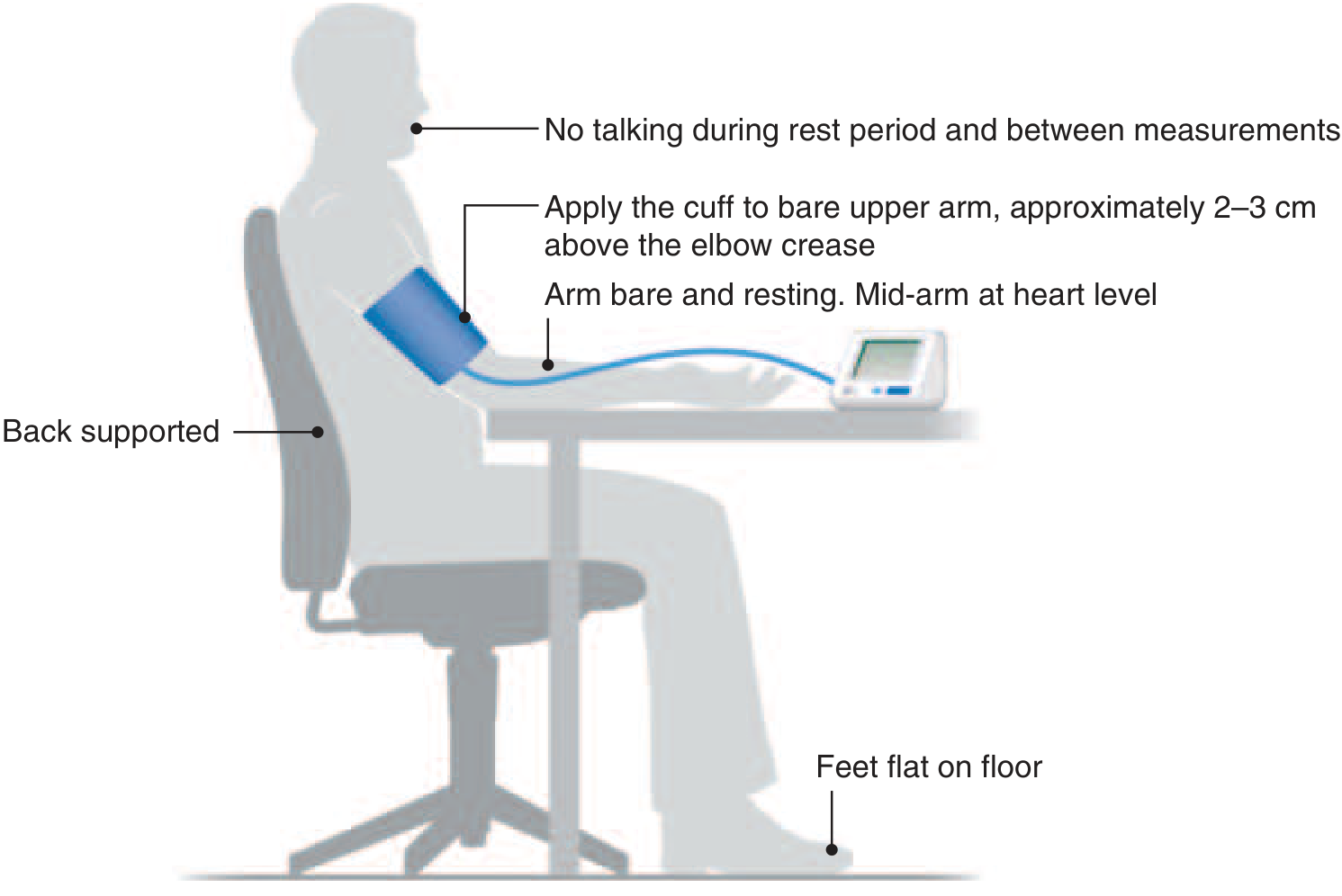
Correct positioning for office BP measurement (Harrison's, 22nd Ed.)
1. Patient Preparation (Before Measurement)
- Have the patient avoid caffeine, smoking, alcohol, and exercise for at least 30 minutes prior.
- Patient should have an empty bladder.
- Use a quiet room with a comfortable ambient temperature.
- Explain the procedure to the patient, including the number of readings.
- Allow the patient to rest quietly for 3-5 minutes before the first reading - no talking, no phone use during rest or measurement.
2. Positioning the Patient
- Seat the patient in a chair with upright back support.
- Feet should be flat on the floor (not crossed).
- The measurement arm should be comfortably supported on a surface.
- The cuff must be at heart level (mid-brachial level). If the arm hangs freely or is held up, readings will be falsely low or high.
3. Equipment Selection
- Use a clinically validated device - preferably an automated oscillometric device.
- Choose the correct cuff size for the patient's arm circumference. An undersized cuff gives falsely high readings; an oversized cuff gives falsely low readings.
- Aneroid and electronic oscillometric devices should be calibrated every 12 months.
| Cuff type | Indication |
|---|---|
| Standard adult | Most adults |
| Large adult | Obese arm |
| Thigh cuff | Upper extremity contraindications (in prone position) |
4. Cuff Application
- Apply the cuff to the bare upper arm (no clothing underneath).
- Position the cuff approximately 2-3 cm above the elbow crease (antecubital fossa).
- The cuff bladder should be centered over the brachial artery.
- Ensure the cuff fits snugly - you should be able to slip two fingers under it.
5. Auscultatory Method (Manual Sphygmomanometer)
This remains the standard manual technique, using Korotkoff sounds:
- Estimate systolic pressure first - palpate the radial pulse while inflating the cuff; note the pressure at which the pulse disappears. Add 30 mmHg to this value to set your inflation target (prevents auscultatory gap errors).
- Place the stethoscope over the brachial artery in the cubital fossa (do not tuck it under the cuff).
- Inflate the cuff to the estimated systolic pressure + 30 mmHg.
- Deflate slowly at ~2 mmHg/second.
- Systolic BP = pressure at which the first tapping sound (Korotkoff Phase I) is heard.
- Diastolic BP = pressure at which sounds disappear (Korotkoff Phase V).
- Deflate completely and record both values.
6. Recording and Averaging
- Take at least 2 readings, separated by 1-2 minutes, and record the average.
- At the first visit, measure BP in both arms; use the arm with the higher reading for all subsequent visits.
- A difference >10-15 mmHg between arms warrants investigation (e.g., subclavian stenosis).
- Use an average of two or more readings at two or more visits to estimate the patient's usual BP level.
7. Special Situations
Orthostatic BP measurement:
- Measure after the patient has been supine for 5 minutes.
- Repeat at 1 minute and 3 minutes after standing.
- A drop of ≥20 mmHg systolic or ≥10 mmHg diastolic = orthostatic hypotension.
White-coat effect:
- Some patients have elevated office BP but normal readings outside (white-coat hypertension).
- Automated multiple readings with the patient alone in the room help eliminate this effect.
- Ambulatory BP monitoring (ABPM) or home BP monitoring are superior for true BP burden assessment.
ACC/AHA BP Classification (Adults)
| Category | Systolic (mmHg) | Diastolic (mmHg) | |
|---|---|---|---|
| Normal | <120 | and | <80 |
| Elevated | 120-129 | and | <80 |
| Stage 1 Hypertension | 130-139 | or | 80-89 |
| Stage 2 Hypertension | ≥140 | or | ≥90 |
Source: Harrison's Principles of Internal Medicine, 22nd Ed., Table 288-1
Key Points to Avoid Errors
| Error | Effect on Reading |
|---|---|
| Cuff too small | Falsely HIGH |
| Arm below heart level | Falsely HIGH |
| Patient talking | Falsely HIGH |
| Cuff over clothing | Falsely HIGH |
| Back unsupported / legs crossed | Falsely HIGH |
| Deflating too fast | Underestimates systolic, overestimates diastolic |
- Harrison's Principles of Internal Medicine, 22nd Ed., pp. 288
- Brenner & Rector's The Kidney, Box 46.1
- Gray's Anatomy for Students
Create a quick reference checklist for BP measurement
Asking for Preferences
What format would you like the checklist in?
Here is your quick reference checklist:
✅ Blood Pressure Measurement - Quick Reference Checklist
🔲 BEFORE YOU START — Patient Preparation
- No caffeine, smoking, alcohol, or exercise for 30 min prior
- Bladder emptied
- Patient resting in quiet room for 3-5 minutes
- No talking or phone use during rest and measurement
- Explain the procedure to the patient
🔲 EQUIPMENT CHECK
- Validated BP device (automated oscillometric preferred)
- Correct cuff size selected for arm circumference
- Device calibrated (within last 12 months)
| Arm Circumference | Cuff Size |
|---|---|
| 22-26 cm | Small adult |
| 27-34 cm | Standard adult |
| 35-44 cm | Large adult |
| 45-52 cm | Adult thigh cuff |
🔲 PATIENT POSITIONING
- Seated in chair with back fully supported
- Feet flat on floor (not crossed)
- Bare arm resting on a flat surface
- Mid-arm (cuff) at heart level
🔲 CUFF APPLICATION
- Applied to bare skin (no sleeve underneath)
- Positioned 2-3 cm above elbow crease
- Bladder centred over brachial artery
- Snug fit (2 fingers slip underneath)
🔲 TAKING THE READING (Auscultatory Method)
- Estimate systolic first by palpating radial pulse while inflating
- Inflate to estimated systolic + 30 mmHg
- Stethoscope placed over brachial artery in cubital fossa
- Deflate slowly at ~2 mmHg/second
- Record systolic = first Korotkoff sound (Phase I)
- Record diastolic = sounds disappear (Phase V)
- Deflate cuff completely
🔲 RECORDING & AVERAGING
- Take ≥ 2 readings, 1-2 min apart
- Record the average of the readings
- At first visit: measure both arms; use the higher arm going forward
- Arm difference >15 mmHg → investigate further
- Diagnose only after readings from ≥ 2 separate visits
🔲 INTERPRET & COMMUNICATE
- Share result with patient immediately
| Category | Systolic | Diastolic | |
|---|---|---|---|
| Normal | <120 | and | <80 |
| Elevated | 120-129 | and | <80 |
| Stage 1 HTN | 130-139 | or | 80-89 |
| Stage 2 HTN | ≥140 | or | ≥90 |
⚠️ COMMON ERRORS TO AVOID
| ❌ Error | Effect |
|---|---|
| Cuff over clothing | Falsely HIGH |
| Cuff too small | Falsely HIGH |
| Arm below heart level | Falsely HIGH |
| Back unsupported / legs crossed | Falsely HIGH |
| Patient talking | Falsely HIGH |
| Deflating too fast | Inaccurate both values |
🔲 SPECIAL CHECKS (when indicated)
Orthostatic BP:
- Measure after 5 min supine
- Repeat at 1 min and 3 min after standing
- Drop ≥20 mmHg systolic OR ≥10 mmHg diastolic = orthostatic hypotension
White-coat effect suspected:
- Consider automated unattended readings (patient alone in room)
- Refer for ABPM or home BP monitoring
Based on ACC/AHA guidelines and Harrison's Principles of Internal Medicine, 22nd Ed.
This is a shared conversation. Sign in to Orris to start your own chat.