
Eczema
Reading File
Eczema (atopic dermatitis) is a chronic, relapsing inflammatory skin condition characterized by intense itching, dry skin, and a characteristic distribution pattern that varies with age. It involves a defective skin barrier, immune dysregulation (Th2-skewed), and is closely associated with the "atopic triad" (asthma, allergic rhinitis, atopic dermatitis).
Searching sources...
Finding Sources
Searching PubMed
"atopic dermatitis"[MeSH Terms] AND treatment
Reading File
Reading File
Searching PubMed
"atopic dermatitis" AND treatment
Reading File
Reading File
Reading File
Reading File
Reading File
I now have a comprehensive set of information from the textbooks. Let me compile the full answer.
Loading Image
Here is a comprehensive overview of eczema (atopic dermatitis):
Eczema (Atopic Dermatitis)
Definition
Atopic dermatitis (AD) is a chronic, inflammatory skin disease characterized by pruritus and a relapsing-remitting course. It is the most common chronic skin condition in children and is closely linked to asthma, allergic rhinoconjunctivitis, and food allergies - collectively called the "atopic march." - Andrews' Diseases of the Skin
Epidemiology
- Affects up to 20% of children in developed countries; worldwide cumulative prevalence ~20%
- 50% of cases appear in the first year of life; the vast majority before age 5
- Girls are slightly more affected; in the US, African and Asian infants show increased early risk
- Prevalence plateaued in developed nations in the 1990s but continues rising in developing countries
- Risk is increased by: Western diet, first-born status, cesarean delivery, prenatal antibiotic exposure (all disrupt gut microbiome)
- Dog ownership before age 1 year is protective; cat ownership has no effect
- Eczema resolves or improves in >75% of patients by adulthood
Pathogenesis
Skin Barrier Defect
- Filaggrin (FLG) mutations on chromosome 1q21 are the major genetic defect. Filaggrin is processed into "natural moisturizing factor" (NMF) during keratinocyte differentiation
- Null FLG mutations reduce NMF, increase transepidermal water loss (TEWL), and impair the lipid bilayer (especially ceramide) - causing xerosis
- Inheriting two null FLG mutations dramatically increases risk; 42-79% of carriers develop AD
- FLG mutations are also associated with allergic rhinitis, keratosis pilaris, and hyperlinear palms
Immune Dysregulation (Th2 Skew)
- AD patients show a Th2-dominant immune phenotype: elevated IgE, eosinophils on biopsy, positive skin prick tests
- Key cytokines: IL-4 and IL-13 (drive inflammation and sensitization), IL-31 (binds nerves directly causing itch, also downregulates filaggrin), TSLP (keratinocyte-derived, promotes Th2 response via OX40L)
- The JAK-STAT pathway amplifies the Th2 response and itch signaling
- IL-17 plays a role in some patients, particularly those with more severe/early-onset disease
Diagnostic Criteria (Hanifin & Rajka)
Must have 3 of 4 major criteria AND 3+ minor criteria:
Major Criteria
- Pruritus
- Typical morphology and distribution (flexural lichenification in adults; facial/extensor in infants)
- Chronic or chronically relapsing course
- Personal or family history of atopic disease
Minor Criteria (selected)
- Xerosis
- Ichthyosis / hyperlinear palms / keratosis pilaris
- Elevated serum IgE / positive RAST
- Early age of onset
- Susceptibility to cutaneous infections (S. aureus, HSV - eczema herpeticum)
- Dennie-Morgan infraorbital fold
- Nipple eczema, cheilitis, recurrent conjunctivitis
- Pityriasis alba, white dermatographism
- Food hypersensitivity, itch with sweating, intolerance to wool
- Andrews' Diseases of the Skin, p. 83
Clinical Presentation by Age
The classic finding is the "itch that rashes" - itch precedes the rash, and the itch-scratch cycle perpetuates the disease.
| Age Group | Distribution | Morphology |
|---|---|---|
| Infantile (<2 yrs) | Cheeks, scalp, forehead, extensor surfaces; diaper area spared | Erythema, scaling, weeping, crusting |
| Childhood (2-12 yrs) | Antecubital & popliteal fossae, flexor wrists, ankles, eyelids | Lichenified plaques, excoriated papules |
| Adolescent/Adult | Hands, feet, flexures | Lichenified, localized changes |
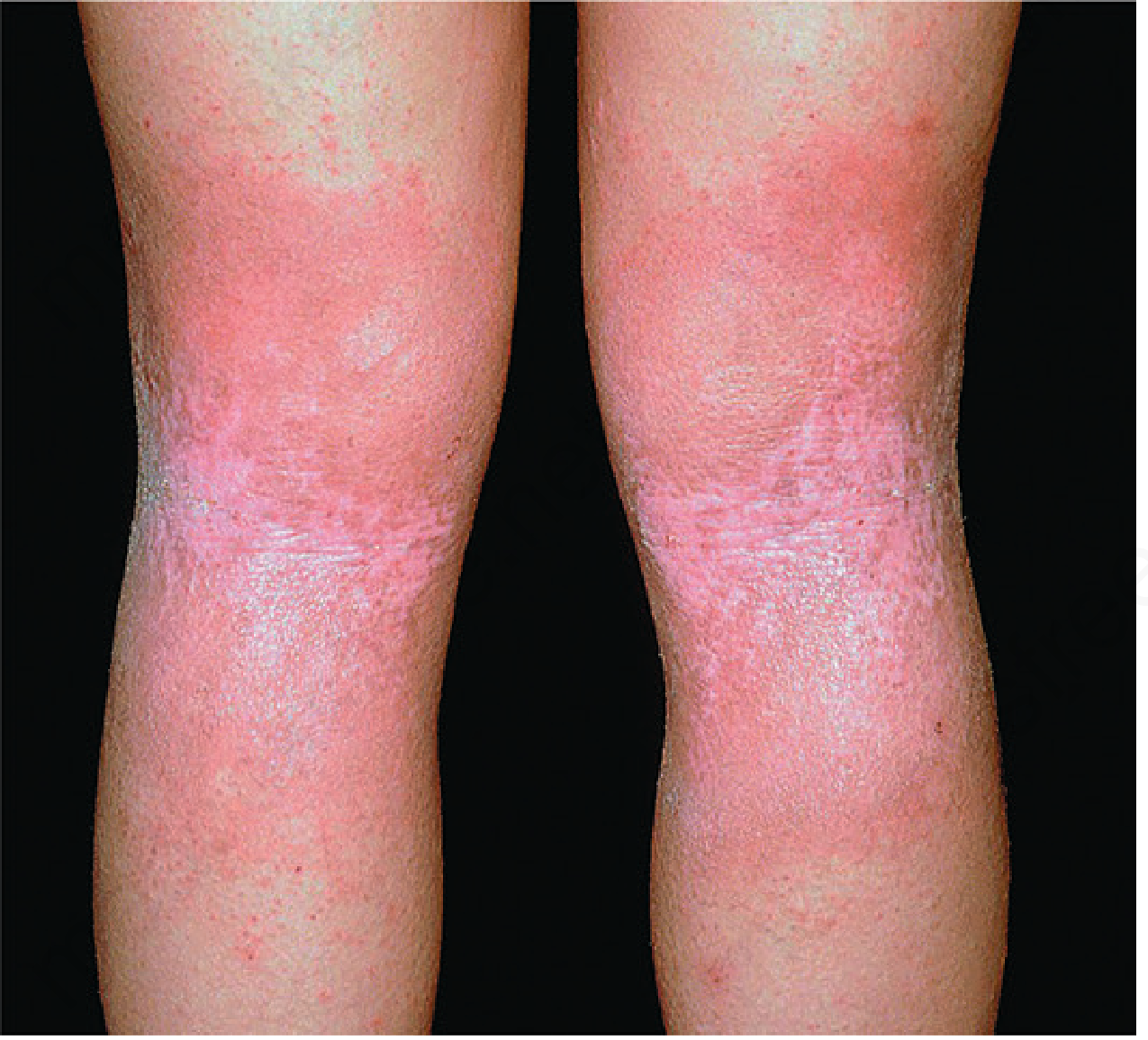
Acute lesions: erythematous, edematous plaques with vesicles
Subacute lesions: scaling, crusting
Chronic lesions: lichenification (skin thickening with accentuated markings from chronic rubbing)
Complications
- Eczema herpeticum (Kaposi's varicelliform eruption): widespread HSV superinfection - a dermatologic emergency
- Bacterial superinfection: Staphylococcus aureus (presents with crusting, exudates); treat with cephalexin or dicloxacillin
- Cataracts (anterior subcapsular) and keratoconus (corneal ectasia) in severe/chronic AD
- Progression of the atopic march to asthma and allergic rhinitis
Treatment
1. Lifestyle & Trigger Avoidance
- Avoid harsh soaps, fragrances, alcohol-based products, wool, sweat, and known allergens
- Avoid scratching (itch-scratch cycle perpetuates disease)
- Keep bathing brief (<5 min), lukewarm, with gentle soap; pat dry - do not rub
2. Skin Hydration (Cornerstone)
- Apply emollients within 2 minutes of bathing ("soak and smear")
- Use bland emollients with minimal water content: Vaseline, Aquaphor (avoid lotions - high water content worsens dryness)
- "Wet dressings" for severe cases to increase medication absorption
3. Topical Corticosteroids (First-Line Anti-inflammatory)
| Severity | Steroid | Example |
|---|---|---|
| Mild / intertriginous | Low potency | Hydrocortisone 2.5% ointment |
| Moderate | Medium potency | Triamcinolone 0.1% |
| Severe | High potency | Clobetasol 0.05% |
- Ointments are the most effective vehicle; creams are acceptable
- Low-medium potency: 7 days per flare; taper afterward
- Avoid high-potency steroids on face, genitalia, or skin folds (atrophy risk)
4. Topical Calcineurin Inhibitors (TCIs)
- Tacrolimus (Protopic) and pimecrolimus (Elidel)
- Steroid-sparing; preferred for face, eyelids, and intertriginous areas
- Can be used as proactive/maintenance therapy 2-3x/week on previously affected skin
5. Anti-itch Measures
- Sedating antihistamines (diphenhydramine, hydroxyzine): useful for nighttime sedation only; little direct effect on AD itch
- Non-sedating antihistamines: helpful for comorbid urticaria/allergic rhinitis, not AD itch itself
6. Bleach Baths
- Diluted bleach baths 1-2x/week (¼ cup bleach in full tub, soak 10 min, rinse) - reduce S. aureus colonization
7. Systemic Treatment (Moderate-Severe / Refractory)
- Oral corticosteroids: short courses for acute severe flares (prednisone 40-60 mg/day adults; 1-2 mg/kg/day children); avoid long-term use
- Dupilumab (anti-IL-4Rα): blocks IL-4 and IL-13 signaling; FDA-approved biologic; highly effective for moderate-severe AD
- JAK inhibitors (abrocitinib, upadacitinib, baricitinib): approved for adults with moderate-severe AD refractory to other treatments
- Cyclosporine, methotrexate, azathioprine, mycophenolate mofetil: older systemic immunosuppressants used off-label
- Phototherapy (UVB, narrowband UVB, PUVA): effective, especially for widespread disease
Key Points Summary
| Feature | Detail |
|---|---|
| Gene | FLG (filaggrin), chromosome 1q21 |
| Immune axis | Th2, IL-4, IL-13, IL-31, TSLP |
| Hallmark symptom | Pruritus (itch-scratch cycle) |
| Infantile distribution | Face, cheeks, extensors |
| Childhood distribution | Flexures (cubital, popliteal) |
| Diagnostic criteria | Hanifin & Rajka (3 major + 3 minor) |
| Skin barrier finding | Increased TEWL, reduced ceramide, reduced NMF |
| Most dangerous complication | Eczema herpeticum |
| First-line treatment | Emollients + topical corticosteroids |
| Targeted biologic | Dupilumab (anti-IL-4Rα) |
Sources: Andrews' Diseases of the Skin (Clinical Dermatology), The Harriet Lane Handbook 23rd ed., Tintinalli's Emergency Medicine
Recent literature note: A 2024 review in J Allergy Clin Immunol Pract (PMID 39251015) covers highlights from the 2023 AD guidelines, and a 2026 review in Ann Intern Med (PMID 41802250) provides updated evidence - both worth consulting for the latest management recommendations.
This is a shared conversation. Sign in to Orris to start your own chat.