
Lap appendectomy consent for young pt
laparoscopic appendectomy informed consent young patient risks benefits 2024
Laparoscopic Appendectomy - Consent Discussion Guide
1. Diagnosis & Indication
- Acute appendicitis - inflammation of the appendix requiring surgical removal
- Surgery is indicated because appendectomy remains the standard definitive treatment; antibiotic-only management is an alternative but has a 27-40% failure rate at 1 year and up to 39% require eventual appendectomy at 5 years (APPAC trial)
- Delay risks perforation, abscess, and peritonitis - risk rises significantly after 24 hours of symptoms
2. The Procedure
- 3 small incisions (5-12 mm each), typically at umbilicus, suprapubic, and RLQ
- CO2 gas inflates abdomen to create working space
- Camera + instruments remove the appendix, which is ligated at its base
- Specimen removed in a bag; port sites closed
- Duration: typically 30-60 minutes under general anaesthesia
3. Benefits (vs. Open Appendectomy)
| Advantage | Detail |
|---|---|
| Lower wound infection rate | ~0.6% lap vs ~10% open |
| Less post-op pain | Smaller incisions |
| Faster recovery | Typically discharge in 24-48h, return to school/activity in 1-2 weeks |
| Better cosmesis | Important for young patients |
| Better diagnostic utility | Can visualise entire abdomen - especially relevant in young females (can identify ovarian pathology mimicking appendicitis) |
4. Risks - Intraoperative
| Risk | Rate | Notes |
|---|---|---|
| Conversion to open surgery | 5-10% | Anatomical difficulty, dense adhesions, unclear anatomy |
| Bleeding / haemorrhage | Rare | Mesoappendix vessels - usually controlled laparoscopically |
| Bowel / ureter injury | Rare | Adjacent structures |
| Anaesthetic risks | Low in young pts | Teeth/throat/larynx injury; medication reaction; nausea |
5. Risks - Post-operative
| Risk | Notes |
|---|---|
| Intra-abdominal abscess | ~3x more common after lap vs open (~2-3%); presents days later with fever, pain |
| Wound infection | Lower than open (0.6%) |
| Ileus | Temporary bowel slowdown |
| Stump leak / fistula | Rare; appendix stump breakdown |
| Port-site hernia | Particularly at 12mm umbilical port; more relevant for single-port technique |
| DVT / PE | Low in young patients; still mentioned |
| Anaesthesia awareness | Very rare |
6. Special Considerations for Young Patients
- Laparoscopy allows direct inspection of ovaries and fallopian tubes - a significant advantage, as ovarian pathology (torsion, cyst, PID) can mimic appendicitis
- If pregnant or possibly pregnant - risk of fetal loss exists, must be discussed explicitly; fetal loss risk with laparoscopic approach should not be minimised
- Assent (patient agreement) should be sought alongside parental consent
- Cosmetic outcome is particularly meaningful - smaller scars matter
- Single-incision laparoscopic (SILS) option may be offered at some centres - additional discussion of hernia risk and surgeon learning curve required
- Antibiotics will continue post-op (minimum 3 days)
- Drain may be left in place
- Longer hospital stay expected
7. Alternatives
- Antibiotics alone (non-operative management) - ~73% success at 2 weeks without surgery; 39% eventually need appendectomy at 5 years; not standard in patients with contraindications or complicated disease
- Open appendectomy - may be preferred if multiple prior abdominal surgeries, obesity, or bowel not visualisable
- No treatment - not safe; risk of perforation, peritonitis, sepsis, death
8. What to Expect After Surgery
- Discharge: usually same day or next morning for uncomplicated cases
- Diet: light initially, normal within 1-2 days
- Activity: walking same day; avoid heavy lifting/PE for 2 weeks
- Return to school: typically 1 week
- Watch for: fever >38°C, increasing abdominal pain, vomiting, wound redness - signs of abscess or stump leak - return to ED
9. Documentation Points
- Patient (and parent/guardian if minor) confirm understanding of diagnosis, procedure, risks, benefits, and alternatives
- Opportunity for questions was given
- Consent freely given without coercion
- Note this in the operative note as well as the consent form
Make a visual poster of common post-op complications and warning signs
A clean medical education poster titled "After Your Appendix Surgery: Warning Signs to Watch For" designed for young patients. The poster has a white background with a teal and orange color scheme. It is divided into sections with icons: 1. FEVER section with thermometer icon - "Temperature above 38°C (100.4°F) - especially after day 2" in red alert box 2. WOUND SIGNS section with bandage icon - bullet points: Increasing redness around incisions, Swelling or warmth, Discharge or pus, Wound opening up 3. ABDOMINAL PAIN section with stomach icon - bullet points: Pain getting WORSE instead of better after day 2, New or spreading pain, Rigid or board-like abdomen 4. DIGESTIVE ISSUES section with gut icon - bullet points: Vomiting that won't stop, Unable to pass gas or have bowel movement after day 3, Bloating getting worse 5. OTHER RED FLAGS section - bullet points: Feeling faint or dizzy, Swollen or painful leg (DVT), Difficulty breathing or chest pain, Yellow skin or eyes (jaundice - rare) 6. A bright red EMERGENCY box at the bottom: "GO TO EMERGENCY IMMEDIATELY if you have: High fever + severe abdominal pain, Rigid abdomen, Vomiting blood, Difficulty breathing" 7. A green NORMAL section: "Normal to have: Mild soreness at incision sites, Tiredness for 1-2 weeks, Constipation from pain medication, Small amount of bruising" Footer: "Return to school in ~1 week. No heavy lifting for 2 weeks. If unsure - always call your surgeon." Clean, modern medical infographic style with clear icons and readable fonts for a teenage/young adult audience.
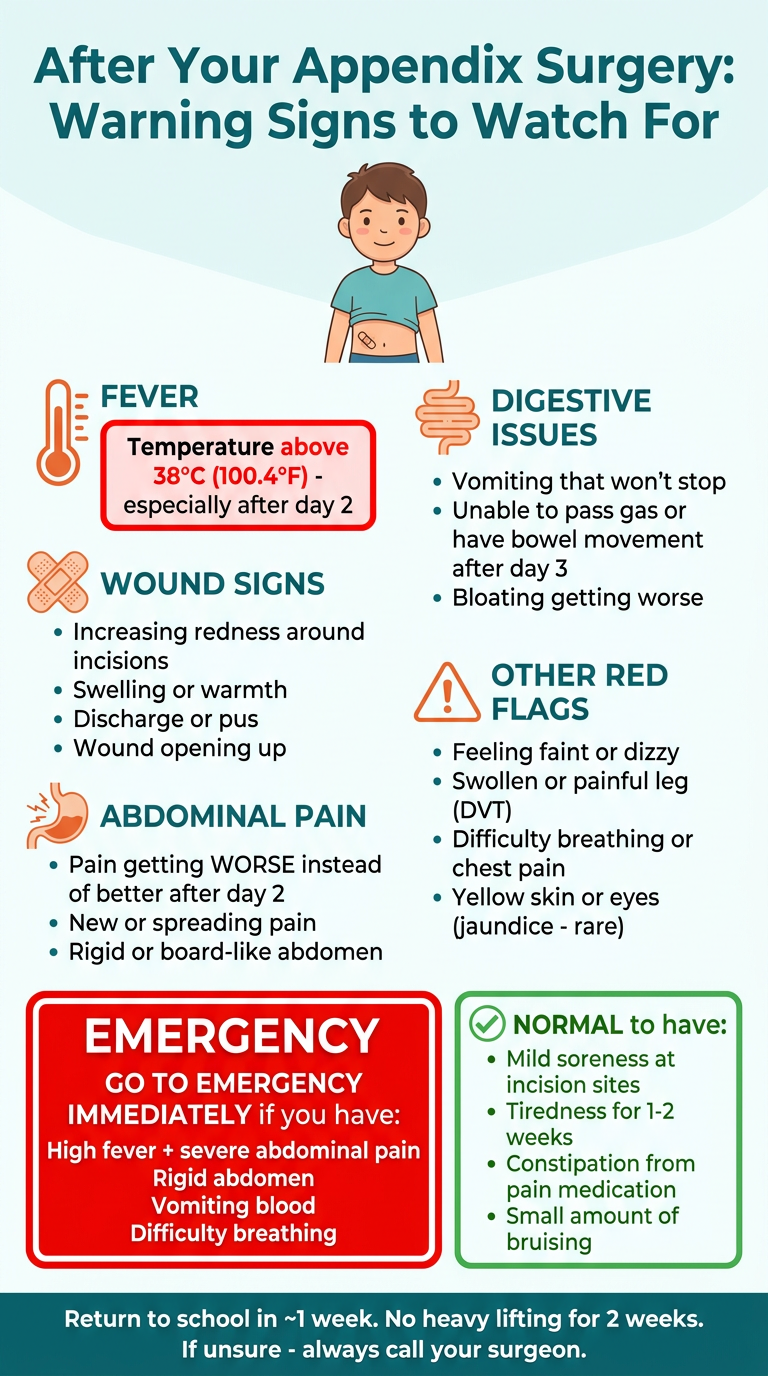
- Fever - the most common early sign of intra-abdominal abscess (the most common serious complication after lap appy)
- Wound signs - infection indicators at port sites
- Worsening pain - flag for stump leak, abscess, or ileus
- Digestive issues - ileus vs. obstruction red flags
- Systemic red flags - DVT, PE, jaundice (portal pyemia - rare but serious)
- Emergency box - clear action trigger for immediate ED return
- Normal section - helps reduce unnecessary anxiety about expected symptoms