
Febrile seizure in pediatrics
I'll start by reading the medical library skill, then search for febrile seizure content in parallel.
Reading File
Now I'll search the library and PubMed in parallel.
Finding Sources
Searching PubMed
"febrile seizure"[MeSH Terms] AND management
Searching Images
febrile seizure pediatric management
Excellent - three dedicated sections found. I'll read all three in parallel.
Reading File
Reading File
Reading File
Good content gathered. Let me do a deeper search for complex/simple febrile seizure content including risk factors, EEG, and recurrence to get a fuller clinical picture.
Finding Sources
Finding Sources
Excellent content. Now I'll read the most clinically comprehensive sections - Rosen's EM, Bradley & Daroff Neurology, Harriet Lane, and Swanson's Family Medicine in parallel.
Reading File
Reading File
Reading File
Reading File
Rich content from multiple authoritative sources. Let me also read the Rosen's discharge guidance and the Goodman & Gilman pharmacotherapy section, plus check for a Tintinalli febrile seizure management block.
Reading File
Reading File
Reading File
I now have rich, comprehensive content from 6 authoritative sources. Let me also fetch the status epilepticus flowchart image that appeared in Rosen's.
Loading Image
I now have all the information needed to write a comprehensive, well-cited answer. Here it is:
Febrile Seizures in Pediatrics
Definition and Epidemiology
A febrile seizure is a seizure triggered by fever (≥38°C / 100.4°F) in children aged 6 to 60 months, in the absence of CNS infection, metabolic disturbance, or prior history of afebrile seizures. It is the most common seizure disorder of childhood, affecting 2–5% of children, with peak incidence at 14–18 months of age. About one-third will have at least one recurrence over their lifetime. - Tintinalli's Emergency Medicine, p. 936; Goodman & Gilman's, p. 1266
Classification
1. Simple Febrile Seizure (majority of cases)
Defined by ALL of the following criteria (AAP definition):
| Feature | Criterion |
|---|---|
| Seizure type | Generalized (tonic-clonic) |
| Duration | < 15 minutes |
| Recurrence | Does NOT recur within 24 hours |
| Age | 6–60 months |
| Neurological exam | Normal, returns to baseline |
2. Complex (Complicated) Febrile Seizure
Defined by ANY ONE of the following:
-
Focal ictal features or lateralized postictal weakness (Todd's paralysis)
-
Duration > 15 minutes (febrile status epilepticus if > 30 minutes)
-
Recurs within 24 hours or within the same febrile illness
-
Occurs in a child < 6 months or > 6 years without signs of serious infection
-
Harriet Lane Handbook, p. 741; Bradley & Daroff's Neurology, p. 863; Tintinalli's, p. 936
Etiology / Triggers
Common causes of the underlying fever include:
-
Viral URTIs (most common)
-
Roseola (HHV-6) - classically associated
-
Otitis media
-
Post-vaccination fever (especially MMR, MMRV, and combined influenza + PCV13 or DTaP - small increased risk, but vaccines overall protect by preventing febrile illness)
-
Goodman & Gilman's, p. 1265
Risk Factors for Recurrence
~30–50% of children < 12 months will have a recurrence (30% if > 12 months). Predictors include:
-
Age < 1 year at first febrile seizure
-
Family history of febrile seizures or epilepsy in first-degree relatives
-
Attendance at daycare (greater febrile illness exposure)
-
Developmental delay
-
First febrile seizure with a low peak temperature
-
Most recurrences occur within 1 year of the initial event
-
Bradley & Daroff's Neurology, p. 863; Tintinalli's, p. 936
Risk of Later Epilepsy
Febrile seizures mildly increase the risk of epilepsy, but the absolute risk remains low:
| Scenario | Epilepsy Risk |
|---|---|
| Simple febrile seizure | ~1% (same as general population) |
| Any complex feature present | 6–8% |
| Two complex features | 17–22% |
| All three complex features | ~49% |
| Any febrile seizure (overall) | Up to 7% by age 25 |
Additional risk factors for epilepsy: pre-existing neurodevelopmental abnormality, family history of epilepsy, recurrent febrile seizures. Complex features predict focal epilepsy; large number of recurrences + family history of epilepsy predicts generalized epilepsy. - Bradley & Daroff's Neurology, p. 864
Febrile Status Epilepticus and the Hippocampus
Febrile status epilepticus (> 30 min) may injure the hippocampus - ~11.5% of affected children show unilateral increased hippocampal T2 signal on MRI acutely, often followed by hippocampal sclerosis on follow-up imaging, a known substrate for mesial temporal lobe epilepsy. - Bradley & Daroff's Neurology, p. 865
Dravet Syndrome - Red Flag
When febrile seizures are prolonged, asymmetrical, and begin before 15 months, consider Dravet syndrome (SCN1A or GABRG2 mutation). These children progress to afebrile seizures and neurological decline - very different prognosis from typical febrile seizures. - Bradley & Daroff's Neurology, p. 865
Evaluation
Simple Febrile Seizure - What is NOT needed
Per AAP guidelines (confirmed across multiple sources):
| Investigation | Recommended? |
|---|---|
| Blood work (CBC, electrolytes, glucose) | No (not routine) - only if evaluating fever source |
| Urine culture / UA | Only to identify fever source |
| Neuroimaging (CT / MRI) | No |
| EEG | No |
| Routine LP | No (if well-appearing, fully immunized, no meningeal signs) |
When to Perform Lumbar Puncture
Strongly indicated / mandatory:
- Clinical signs or symptoms of meningitis (neck stiffness, Kernig/Brudzinski, bulging fontanelle, petechiae, ill-appearing)
- Febrile status epilepticus
Should be considered:
-
Age < 6–12 months
-
Incomplete immunization for H. influenzae type b or S. pneumoniae
-
Child pretreated with antibiotics (can mask meningitis signs)
-
Tintinalli's, p. 936; Harriet Lane Handbook, p. 741; Rosen's Emergency Medicine, p. 3206
Complex Febrile Seizure Workup
The Harriet Lane Handbook recommends for complex seizures:
- EEG (obtain)
- Nonemergent MRI (to evaluate for associated focal lesion)
- LP if concern for CNS infection
- Consider prescribing rectal diazepam for home emergency use
Treatment
Acute Management
For a seizure that is ongoing at the time of evaluation, treat as per convulsive status epilepticus protocol:
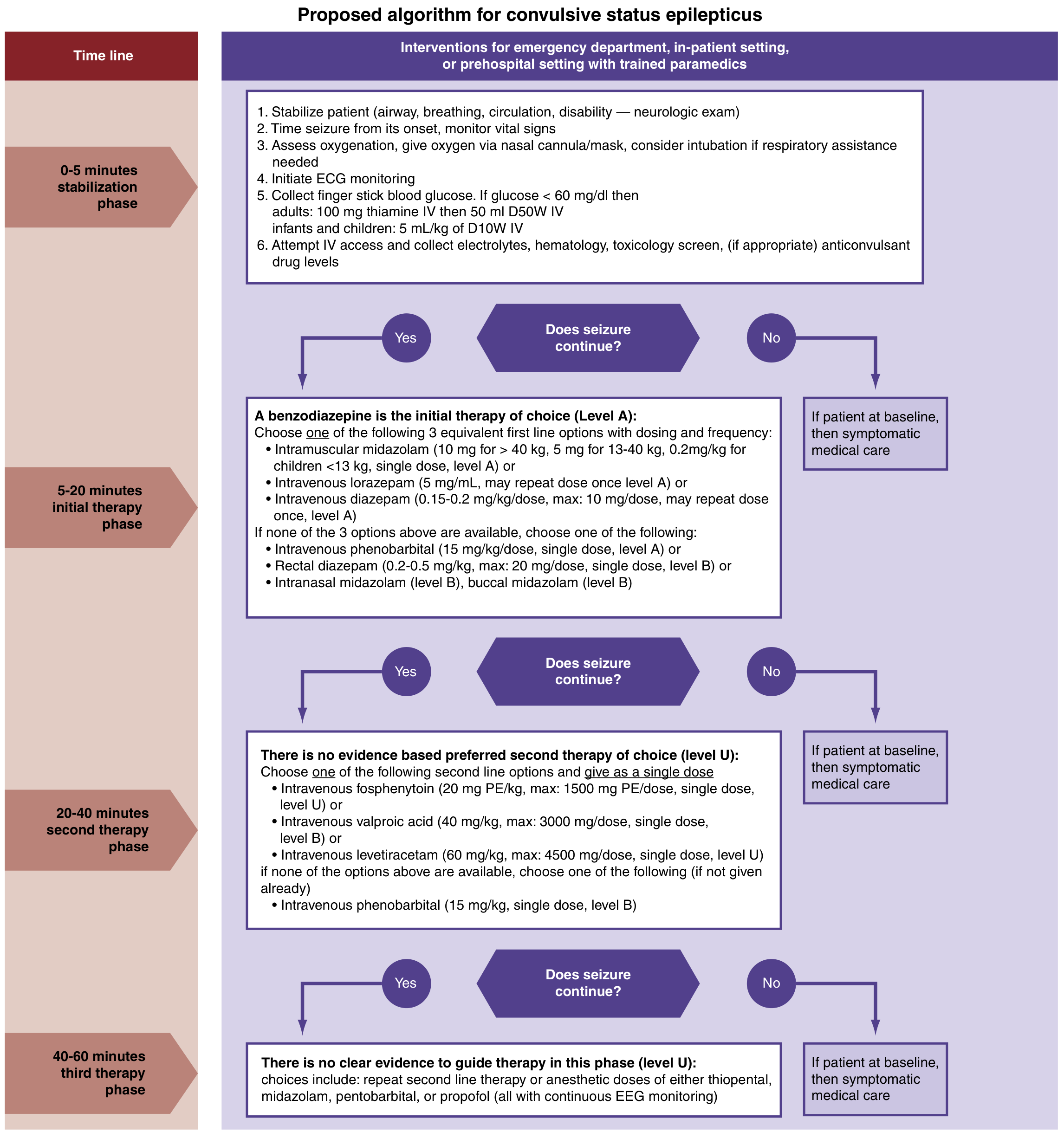
Key steps from the American Epilepsy Society algorithm (Rosen's, Fig. 169.3):
0–5 min (Stabilization): Airway, breathing, circulation; O₂; ECG monitoring; check glucose (give D10W 5 mL/kg if hypoglycemic); IV access; labs.
5–20 min (Initial Therapy) - Benzodiazepines (Level A):
- IM midazolam: 10 mg (>40 kg), 5 mg (13–40 kg), 0.2 mg/kg (<13 kg)
- IV lorazepam: 0.1 mg/kg (may repeat once)
- IV diazepam: 0.15–0.2 mg/kg (max 10 mg, may repeat once)
- If IV unavailable: rectal diazepam 0.2–0.5 mg/kg (max 20 mg) or intranasal/buccal midazolam
20–40 min (Second Therapy):
- IV fosphenytoin 20 mg PE/kg (max 1500 mg PE)
- IV valproate 40 mg/kg (max 3000 mg)
- IV levetiracetam 60 mg/kg (max 4500 mg)
40–60 min (Third Therapy / Refractory): Anesthetic doses of thiopental, midazolam, pentobarbital, or propofol under continuous EEG monitoring.
Antipyretics
Treat the fever with antipyretics, but there is no evidence that antipyretics prevent subsequent febrile seizures. - Tintinalli's, p. 936
Long-term Anticonvulsant Prophylaxis
Not recommended for simple febrile seizures. Side effects (especially cognitive effects of phenobarbital) outweigh the minor risk of recurrence. Prophylaxis does not prevent later epilepsy. - Goodman & Gilman's, p. 1267
For high-risk children with recurrent febrile seizures: rectal or oral diazepam at the time of fever onset is the preferred intermittent prophylactic agent, used to abort seizures rather than as chronic therapy. - Swanson's Family Medicine, p. 313; Goodman & Gilman's, p. 1268
Discharge and Family Counseling
Children who fully recover after a simple febrile seizure can almost always be sent home. Key counseling points:
-
High likelihood of recurrence (> 33%) - parents must be aware
-
Small increased risk of epilepsy (2–5%, or roughly double the baseline) - but absolute risk is low
-
Extensive anticipatory guidance and reassurance
-
Teach fever control measures and seizure first aid
-
Consider prescribing rectal diazepam for home emergency use in complex or recurrent cases
-
Close follow-up with their pediatrician
-
Specialty referral (neurology) if complex features are present
-
Rosen's Emergency Medicine, p. 3287
Genetic Basis
Febrile seizures have a strong genetic influence - inheritance is usually polygenic, but autosomal dominant transmission occurs in some families. Key genetic syndromes:
- GEFS+ (Generalized Epilepsy with Febrile Seizures Plus): autosomal dominant, heterogeneous expression, febrile seizures persisting beyond age 6
- Dravet syndrome: SCN1A truncating mutation, begins as prolonged febrile seizures in infancy, progresses to refractory epilepsy
- Bradley & Daroff's Neurology, p. 869
Recent Evidence Note
A 2024 systematic review (Corsello et al., Pediatric Neurology, PMID 38653182) comparing different international guidelines on febrile seizures confirmed broad consensus that routine workup (EEG, neuroimaging, LP, antiseizure drugs) is not indicated for simple febrile seizures in well-appearing children. This is consistent with all textbook guidance above.
This is a shared conversation. Sign in to Orris to start your own chat.