
Management of snake bite
Reading File
Quick Answer: Snake bite management involves first aid (immobilize limb, calm patient, avoid tourniquets/incisions), rapid clinical assessment for envenomation signs, and antivenom as the definitive treatment. Supportive care addresses coagulopathy, neurotoxicity, and renal failure. Local wound care and tetanus prophylaxis are also needed.
Searching sources...
Finding Sources
Searching PubMed
"snake bite" AND management
Good - Pye's Surgical Handicraft has the most comprehensive snake bite coverage. Let me read the main sections in parallel.
Reading File
Finding Sources
Excellent - multiple authoritative sources found. Let me read the key management sections from Harrison's, Tintinalli's, and the rest of Pye's in parallel.
Reading File
Reading File
Reading File
Let me read the treatment/management sections from Harrison's and Tintinalli's, and the antivenom + surgical sections from Pye's.
Reading File
Reading File
Reading File
Now let me get the antivenom dosing details, indications, and treatment of complications from Harrison's and Pye's.
Reading File
Reading File
I now have comprehensive information from multiple authoritative sources. Let me compile the full management guide.
Loading Image
I now have all the content needed for a comprehensive, well-structured answer. Here it is:
Management of Snake Bite
Epidemiology & Context
Snake bite is primarily an occupational hazard of agricultural workers and hunters in rural tropical areas. Mortality has declined sharply in countries like Brazil and Thailand where locally produced antivenom is widely available. Incidence shows seasonal peaks linked to farming cycles. The "Big Four" in the Indian subcontinent are: Naja naja (cobra), Bungarus caeruleus (krait), Vipera russelli (Russell's viper), and Echis carinatus (saw-scaled viper).
- Pye's Surgical Handicraft, 22nd Ed.
Step 1: Immediate Field (Prehospital) Management
The single most important action is rapid transport to a medical facility.
DO:
- Move patient well beyond striking range (many victims are bitten a second time trying to capture the snake)
- Keep patient calm - movement increases venom absorption
- Remove jewelry and tight clothing near the bite (anticipate swelling)
- Immobilize the bitten limb in a neutral position, below the level of the heart
- Clean wound with soap and running water; cover with sterile dressing
- Apply a splint to limit movement
- Establish IV access in the unaffected limb
- Administer supplemental oxygen
DO NOT:
| Dangerous Practice | Reason to Avoid |
|---|---|
| Incision and suction | Damages nerves, arteries, tendons; little efficacy |
| Tourniquet | Obstructs arterial flow; causes ischemia; may worsen necrosis |
| Ice/cold water immersion | Worsens venom injury |
| Electric shock | Dangerous and ineffective |
| Mouth suction | Introduces oral flora into wound |
Pressure Immobilization Bandage (PIB): A compression pad over the bite site + snug elastic wrap + immobilization. This is recommended for elapid (neurotoxic) bites (cobra, krait, coral snake, Australian elapids) but generally avoided for viperid (cytotoxic) bites because it may worsen local pain and tissue damage.
Constriction band (not a tourniquet): May be used if medical care is not immediately available. Applied snugly enough to restrict superficial venous/lymphatic flow while maintaining distal pulses. Should be easy to insert 1-2 fingers underneath. Do not remove until antivenom is available.
- Tintinalli's Emergency Medicine, Harrison's Principles of Internal Medicine 22E*
Step 2: Clinical Assessment at Hospital
History
- Time of bite
- Description of snake (species, if known)
- First aid measures applied
- Symptoms since bite (local pain, systemic symptoms)
Severity Grading
| Grade | Features |
|---|---|
| None (dry bite) | Fang marks only, no envenomation |
| Mild | Local pain, non-progressive swelling, ecchymosis; no systemic effects |
| Moderate | Clearly progressing swelling, systemic symptoms, laboratory abnormalities |
| Severe | Neurologic dysfunction, respiratory distress, cardiovascular instability/shock |
Physical Examination
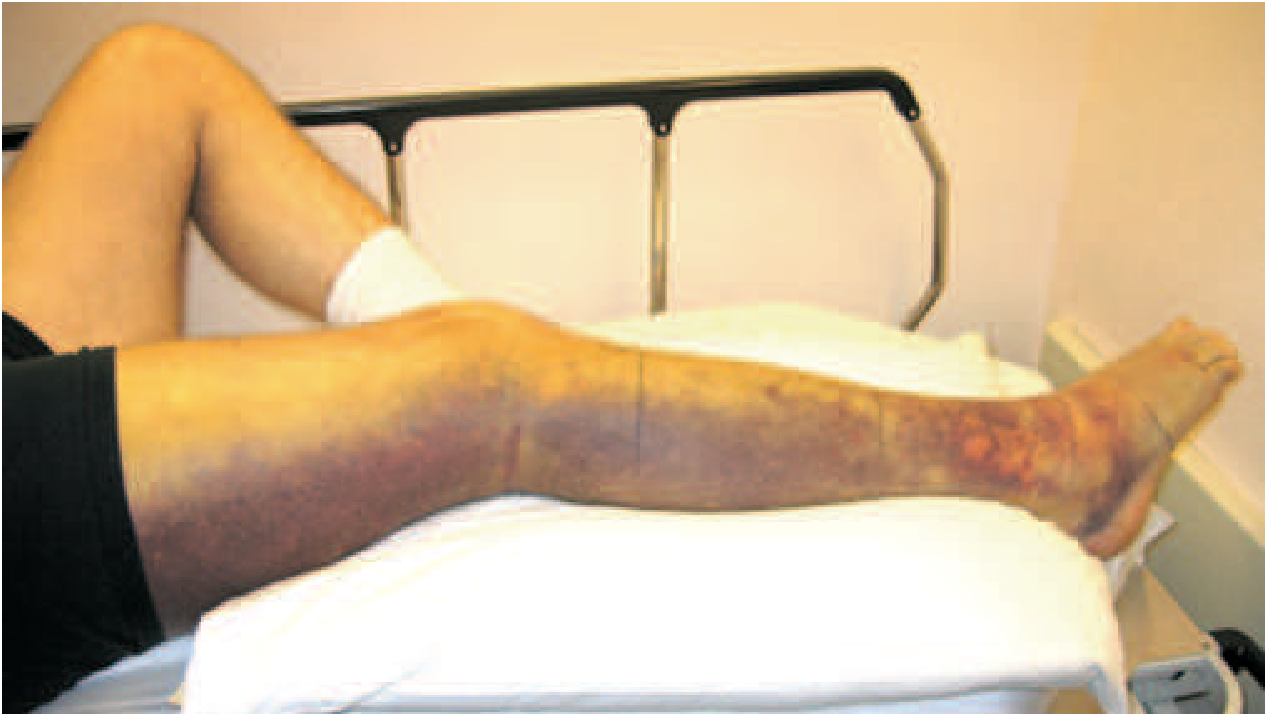
- Mark the leading edge of swelling, ecchymosis, and tenderness with a pen
- Measure limb circumference at 3 points (bite site, proximal joint, distal joint) every 15 min until stabilized, then every 1-2 h
- Elevate bitten extremity above the level of the heart
- For neurotoxic envenomation: monitor for cranial nerve signs (ptosis is an early warning of impending airway compromise)
- Palpate regional lymph nodes for lymphatic spread
Investigations
- Full blood count (hemorrhage, hemolysis, thrombocytopenia)
- Blood type and cross-match
- Coagulation studies: PT, fibrinogen, D-dimer
- Renal function (urea, creatinine)
- Liver function tests
- CK (rhabdomyolysis)
- Urine for myoglobin/blood
- ECG and CXR in severe cases
20-Minute Whole Blood Clotting Test (20WBCT): In resource-limited settings, place 1-2 mL of venous blood in a clean dry glass tube, leave undisturbed for 20 minutes, then invert. If blood is still liquid = coagulopathy present (positive for viper envenomation). This is an invaluable bedside test.
- Harrison's Principles of Internal Medicine 22E
Step 3: Antivenom - The Definitive Treatment
Antivenom is the mainstay of treatment for significant envenomation.
Antivenoms are produced by immunizing horses or sheep with snake venoms, then isolating the antibodies. The goal is to bind and neutralize circulating venom before it attaches to target tissues.
Types
- Monospecific (monovalent): Against one snake species - preferred when species is known
- Polyspecific (polyvalent): Against several regional species - used when species is unknown
- Antivenoms rarely cross-protect against unrelated species; selection must match the offending snake
Indications for Antivenom
Administer antivenom when any of the following are present:
- Progressive local swelling beyond the bite site
- Systemic envenomation signs (hypotension, coagulopathy, neurotoxicity, renal failure, rhabdomyolysis)
- Abnormal coagulation (20WBCT positive)
- Hemolysis or thrombocytopenia
Dosing (North American Crotalid Example)
- Moderate: CroFab® 4-6 vials OR Anavip® 10 vials
- Severe: CroFab® 6 vials OR Anavip® 10 vials
- Dilute in 250 mL normal saline; infuse IV over 1 hour
- Start at 25-50 mL/h for first 10 min; if no allergic reaction, increase to 250 mL/h
- Recheck labs every 6 hours until clinical stability
- Additional doses: CroFab® 2 vials every 6 h for 3 doses; Anavip® 4 vials for recurrent coagulopathy
Children receive the same dose as adults (the venom dose is the same; body weight does not reduce it).
Managing Antivenom Reactions
-
Acute reaction: Stop infusion immediately; treat with epinephrine (IM, or IV only in severe hypotension), IV antihistamines, IV glucocorticoids; restart at 5-10 mL/h once reaction controlled
-
Serum sickness (delayed, 5-10 days later): Fever, rash, arthralgias; treat with prednisone 1 mg/kg/day PO tapered over 1-2 weeks
-
Harrison's 22E; Tintinalli's Emergency Medicine; Goldman-Cecil Medicine
Step 4: Supportive Care by Complication
Neurotoxic Paralysis
- Progressive descending flaccid paralysis from neuromuscular junction blockade
- Early signs: ptosis, dysphagia, dysarthria
- Management: close airway monitoring; early intubation and mechanical ventilation if respiratory failure; anticholinesterases (neostigmine + atropine) may partially reverse postsynaptic neurotoxicity
- Prolonged ventilatory support may be needed
Coagulopathy / Disseminated Intravascular Coagulation (DIC)
- Antivenom first - blood products should only be given after antivenom
- Fresh frozen plasma (FFP) for severe coagulopathy with bleeding
- Platelet transfusion for severe thrombocytopenia with bleeding
- Cryoprecipitate for hypofibrinogenemia
Hypotension / Shock
- IV isotonic crystalloid rapidly for fluid resuscitation
- Vasopressors if fluid-refractory
Acute Kidney Injury
- Common with Russell's viper, sea snake, and some African viper bites
- Causes: direct nephrotoxicity, DIC, hemolysis, rhabdomyolysis, hypotension
- Strict fluid balance monitoring; urinary catheterization
- Dialysis (hemodialysis or peritoneal dialysis) if oliguric/anuric renal failure develops
Local Wound Care
- Clean wound thoroughly; leave blisters intact unless very large (then aspirate with fine needle; do not de-roof)
- Nurse limb elevated (sling for arm)
- Avoid occlusive dressings
- Tetanus prophylaxis (toxoid booster)
- Prophylactic antibiotics: generally not recommended unless wound has been incised or mouth suction applied; if wound contaminated, use penicillin/erythromycin ± gentamicin
Intracompartmental Syndrome
- Suspect if: limb pain out of proportion, tense swelling, pain on passive stretch, loss of pulses
- Confirm with intracompartmental pressure measurement (>30 mmHg or within 30 mmHg of diastolic BP)
- Antivenom first (venom may be causing pressure; antivenom often reverses it)
- Fasciotomy is reserved for cases where antivenom fails to reduce pressure - results can be disfiguring; strong antivenom therapy usually prevents the need
Step 5: Surgical Management
Early aggressive surgery (excision of bite site, extensive fasciotomy, irrigation of tendon sheaths) has been advocated but remains controversial. Evidence favoring early surgery over adequate antivenom is limited.
Indications for surgery:
- Fasciotomy: only if proven compartment syndrome unresponsive to antivenom
- Debridement: at earliest signs of frank tissue necrosis (may be far more extensive than surface appearances suggest)
- Split-skin grafting: immediate grafting recommended after debridement to prevent chronic ulceration
- Abscess formation: aspirate or incise and drain + broad-spectrum antibiotics
- Large blisters threatening to rupture: aspirate dry with fine needle
Amputation should be a last resort. Every effort should be made to preserve the limb.
- Pye's Surgical Handicraft, 22nd Ed.
Step 6: Disposition
| Situation | Action |
|---|---|
| Dry bite (no envenomation signs) | Observe 8-12 hours; discharge with instructions to return if swelling/pain/bleeding develop |
| Mild/moderate envenomation | Admit to general ward after antivenom course |
| Severe/life-threatening envenomation | ICU admission |
| Neurotoxic envenomation | Admit regardless of initial severity (effects may be delayed hours) |
| Discharge criteria | Swelling resolving, coagulopathy reversed, patient ambulatory |
At discharge: warn patient about possible recurrent coagulopathy (especially with CroFab), schedule follow-up labs, advise on serum sickness symptoms, physical therapy for the bitten part once swelling resolves.
Special Situations
Elapid (Neurotoxic) Bites
- Cobra, krait, coral snake, mamba, Australian elapids
- Minimal or absent local signs
- Krait bites may not wake the sleeping victim; sea snake bites may go unnoticed by wading fishermen
- Pressure immobilization bandage recommended
- Admit all potential elapid bite victims even without symptoms (effects can be delayed)
- Coral snake (US): give 3-5 vials antivenom early; do not wait for symptoms to develop
Spitting Cobras
- Venom in eyes: irrigate extensively with water or saline; topical analgesia; check for corneal ulceration
Sea Snakes
- Local pain (variable), generalized myalgias, trismus, rhabdomyolysis, progressive paralysis
- Manifestations can be delayed several hours
- Specific sea snake antivenom preferred; tiger snake antivenom is an alternative
Prevention
- Wear boots, long trousers, and socks in endemic areas
- Carry a light at night
- Sleep off the ground when camping
- Never handle a snake, even apparently dead ones (severed heads can still bite)
- Avoid collecting firewood or moving logs/rocks without checking first
- Expeditions to remote areas should carry appropriate antivenom
Sources:
- Harrison's Principles of Internal Medicine, 22E (2025) - Chapter 471
- Tintinalli's Emergency Medicine: A Comprehensive Study - Chapter 212
- Pye's Surgical Handicraft, 22nd Ed. - Chapter 28
- Goldman-Cecil Medicine (International Ed.) - Snakebite chapter
This is a shared conversation. Sign in to Orris to start your own chat.