
Sliding scale for diabetes
Reading File
The sliding scale for insulin (SSI) is a reactive method of dosing short-acting insulin based on a patient's current blood glucose reading. It gives a fixed dose at set glucose thresholds rather than calculating based on carbohydrate intake or insulin-to-carb ratios.
Searching sources...
Finding Sources
Searching PubMed
"sliding scale insulin" AND inpatient
Reading File
Reading File
Here is a thorough breakdown of the sliding scale for insulin (SSI) in diabetes management:
What Is a Sliding Scale?
A sliding scale for insulin is a table of pre-set short- or rapid-acting insulin doses that are given based on a patient's current blood glucose (BG) reading. The "scale" slides up - higher BG gets a higher insulin dose. It is primarily used in inpatient settings.
How a Typical Sliding Scale Looks
| Blood Glucose (mg/dL) | Regular or Rapid-Acting Insulin Dose |
|---|---|
| < 70 | Hold insulin; treat hypoglycemia |
| 70 - 140 | 0 units |
| 141 - 180 | 2 units |
| 181 - 240 | 4 units |
| 241 - 300 | 6 units |
| 301 - 350 | 8 units |
| > 350 | 10 units; notify physician |
Scales are typically low, medium, or high sensitivity versions depending on the patient's insulin resistance and weight.
When Is It Used?
- Postoperative glucose management (short-term)
- Patients on total parenteral nutrition (TPN) who develop hyperglycemia - give two-thirds of total daily SSI dose via the TPN solution
- Patients on enteral nutrition
- As an add-on correction dose alongside a scheduled basal-bolus regimen, NOT as a standalone strategy
Important Clinical Points
1. SSI alone is inferior to basal-bolus therapy
Per multiple guidelines and textbooks, scheduled insulin with basal, nutritional, and correction components provides superior glycemic control compared to correction/"sliding scale" insulin alone.
- The Washington Manual of Medical Therapeutics, p. 888
A randomized controlled trial cited in Barash's Clinical Anesthesia confirms that basal-bolus treatment improved glycemic control and reduced hospital complications compared to SSI alone.
2. When SSI is acceptable as a standalone
- Patients who are NPO or eating poorly (no scheduled premeal insulin is appropriate)
- Short-term use: Tintinalli's Emergency Medicine notes SSI should not be used for more than 12 hours in admitted patients
- Diet-controlled diabetics undergoing minor procedures
- Patients with T1DM already on an insulin pump (continue pump if policy allows)
3. Monitoring is mandatory
Patients on SSI must be monitored regularly. Persistent hyperglycemia on SSI is a signal to convert to a basal-bolus regimen. - Washington Manual, p. 41
4. Bedtime correction - be cautious
The glucose threshold for a sliding scale correction dose should be higher at bedtime (e.g., only correct if BG > 200-250 mg/dL at night) or omitted entirely at bedtime to avoid nocturnal hypoglycemia.
5. Hypoglycemia protocol
Any BG < 70 mg/dL should be treated with oral or IV glucose, rechecked every 10 minutes until > 100 mg/dL. Scheduled doses should be reassessed for risk factors: declining renal function, hepatic impairment, poor oral intake.
Sliding Scale in Specific Scenarios
| Setting | Recommendation |
|---|---|
| General surgical ward | Basal insulin > SSI alone; add correction scale on top of basal |
| Critical care / ICU | IV insulin infusion preferred; SSI alone is inadequate |
| Perioperative (Type 1 DM) | Basal insulin + SSI (RISS); or IV insulin infusion |
| Perioperative (Type 2 DM) | Give 50% of usual long-acting dose on day of surgery; SSI for corrections |
| TPN patients | Start with SSI; shift total 24-h SSI requirement to TPN bag |
| Target BG goal (inpatient) | < 180 mg/dL in most non-pregnant, non-ICU patients |
The Bottom Line
Sliding scale insulin is a reactive, corrective tool - it fixes high glucose after the fact rather than preventing it. Modern guidelines recommend it only as a supplement to a scheduled basal-bolus regimen, not as the sole insulin strategy. A 2025 systematic review in Diabetes Care (PMID 40117466) on inpatient diabetes management guidelines reinforces that basal-bolus therapy is the standard of care, with SSI used only for short-term or adjunctive correction.
Management chart for DKA?
Searching sources...
Finding Sources
Searching PubMed
"diabetic ketoacidosis" AND management
Reading File
Finding Sources
Reading File
Loading Image
Here is the full DKA management chart, built from multiple authoritative textbook sources:
DKA Management Chart
Step 1 - Diagnosis (Confirm DKA)
| Criterion | Value |
|---|---|
| Blood glucose | > 250 mg/dL (or known DM with euglycemic DKA if on SGLT2i) |
| Serum bicarbonate | < 18 mmol/L |
| Arterial pH | < 7.3 |
| Ketonemia/ketonuria | Present (significant) |
| Anion gap | Elevated (> 12) |
Initial workup: BMP/electrolytes, ABG, CBC with differential, urinalysis, serum ketones, ECG, chest X-ray (if indicated), lipase (if pancreatitis suspected).
Step 2 - Fluid Resuscitation
| Phase | Fluid | Rate |
|---|---|---|
| First 1-2 hours | 0.9% Normal Saline (NS) | 1-2 L over 1-3 h (Children: 20 mL/kg in first hour) |
| Ongoing | 0.9% NS or 0.45% NS | 15-20 mL/kg/h; monitor sodium |
| Once BG < 250 mg/dL | Add Dextrose 5% (D5W) | 100 mL/h alongside insulin |
Total fluid deficit anticipated: 4-10 L. Use Ringer's lactate or 0.45% NS for gradual replacement after initial resuscitation.
Step 3 - Insulin
Critical rule: Do NOT start insulin if K+ < 3.3 mEq/L - replace potassium first.
| Severity | Route | Dose |
|---|---|---|
| Mild-Moderate DKA | Subcutaneous (SQ) | 0.3 U/kg rapid-acting insulin; check BG q2h; target BG < 200 mg/dL |
| Severe DKA | IV infusion | 0.1 U/kg/h continuous; check BG q1h |
| If BG does not fall ≥10% in first hour | IV bolus, then resume infusion | 0.1 U/kg bolus, then continue 0.1 U/kg/h |
| When BG reaches 250 mg/dL | Reduce infusion + add dextrose | Continue insulin until ketoacidosis resolved; do NOT stop insulin early |
Alternatively: Regular insulin 10-unit IV bolus, then infusion at (Blood Glucose ÷ 150) units/h.
Step 4 - Potassium Replacement
| Serum K+ (mEq/L) | Action |
|---|---|
| < 3.3 | Hold insulin. Give 20-40 mEq KCl/h IV; recheck before starting insulin |
| 3.3 - 3.5 | 20 mEq KCl/h IV |
| 3.5 - 5.3 | Add 20-40 mEq KCl to each liter of IV fluid |
| > 5.3 | No potassium replacement; monitor BMP q4h until stable |
Key concept: Total body K+ is depleted (deficit ~3-5 mEq/kg), but initial serum K+ may appear normal/high due to acidosis shifting K+ extracellularly. As insulin and fluids correct the acidosis, K+ shifts back into cells rapidly - watch for sudden hypokalemia.
Correction tip: Subtract 0.6 mEq/L from measured K+ for every 0.1 drop in pH to estimate true K+. (e.g., K+ = 5.0 at pH 6.94 → corrected K+ ≈ 2.0 mEq/L - severe hypokalemia)
Step 5 - Bicarbonate
| pH | Action |
|---|---|
| ≥ 7.0 | Not indicated - evidence shows no benefit and may worsen hypokalemia |
| < 7.0 (no hemodynamic instability) | 100 mmol NaHCO₃ in 400 mL H₂O + 20 mEq KCl over 2 hours |
| < 7.1 with hemodynamic instability | Give bicarbonate |
Step 6 - Other Electrolytes
| Electrolyte | Management |
|---|---|
| Phosphorus | Usually not required; replace if severe (risk of ventilatory failure from muscle weakness) - use K-Phosphate |
| Magnesium | Replace if symptomatic; initial levels often falsely elevated |
| Sodium | Correct with NS or 0.45% NS; add 1.6 mEq/L to reported Na+ for every 100 mg/dL glucose above normal to get true Na+ |
Guideline Algorithm (from Mulholland & Greenfield Surgery)
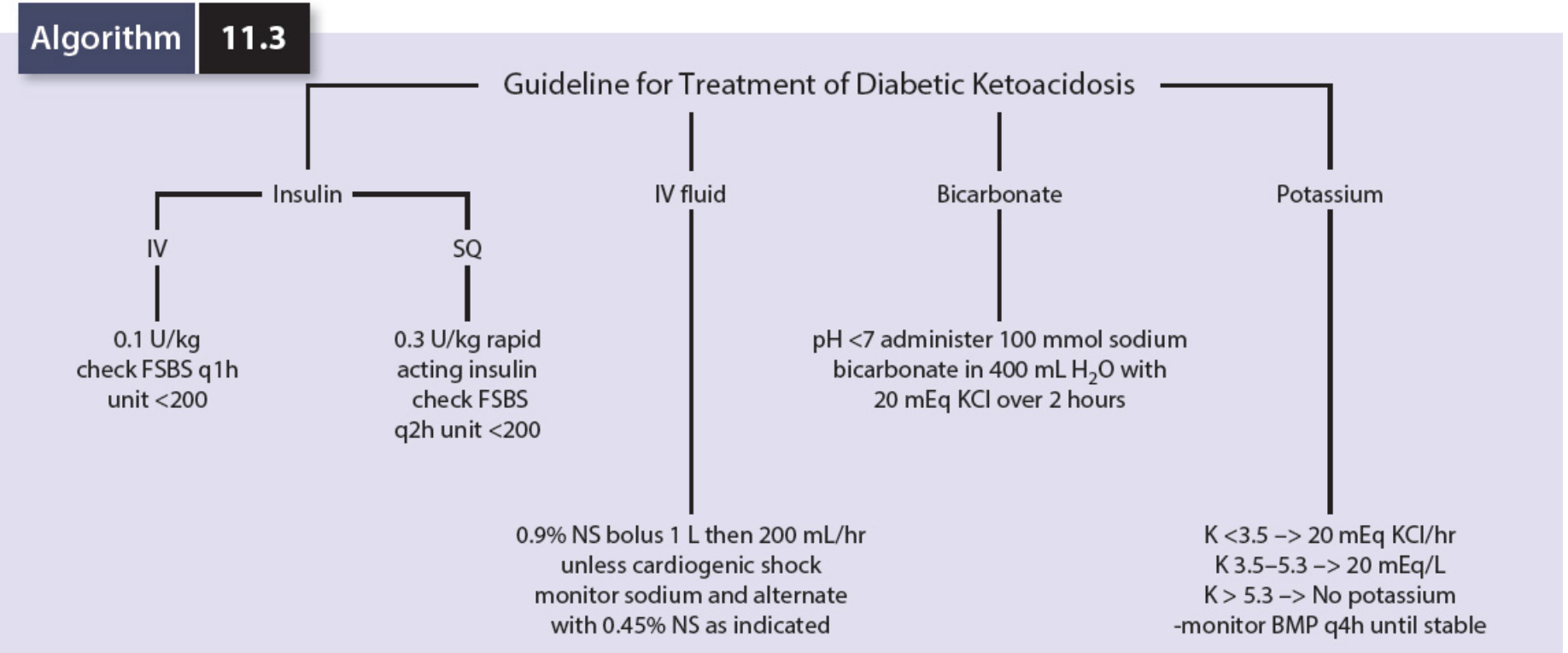
Resolution Criteria (Transition to SQ Insulin)
- Blood glucose < 200 mg/dL
- Serum bicarbonate ≥ 15 mEq/L
- Venous pH > 7.3
- Anion gap ≤ 12
- Patient tolerating oral intake
When transitioning: give first SQ dose 1-2 hours before stopping IV insulin infusion to avoid gap in coverage.
Special Situations
| Scenario | Note |
|---|---|
| Euglycemic DKA (SGLT2i use) | BG may be < 250; SGLT2i effect persists 10-14 days post-discontinuation; risk of relapse if nutrition not established |
| Pediatric DKA | Slower fluid replacement to reduce cerebral edema risk; 20 mL/kg NS in first hour |
| Concurrent lactic acidosis | Suspect if acidosis present but ketones low/absent; check serum lactate; suggests poor perfusion or sepsis |
- Barash Clinical Anesthesia 9e, p. 4059 | Rosen's Emergency Medicine Box 115.1 | Washington Manual of Medical Therapeutics
Management of hepatic encephalopathy
Searching sources...
Finding Sources
Searching PubMed
"hepatic encephalopathy" AND treatment
Finding Sources
Reading Article
PMID: 41773757
Reading File
Reading File
Finding Sources
Reading File
Reading File
Here is a comprehensive management chart for hepatic encephalopathy (HE):
Hepatic Encephalopathy - Management Chart
Classification
By Type:
| Type | Cause |
|---|---|
| Type A | Acute liver failure (ALF) |
| Type B | Portosystemic bypass/shunting (e.g., TIPS) |
| Type C | Cirrhosis (most common) |
By Grade (West Haven Criteria):
| Grade | Features |
|---|---|
| Grade I (Covert) | Sleep reversal, mild confusion, irritability, asterixis, subtle tremor |
| Grade II (Overt) | Lethargy, disorientation, inappropriate behavior, asterixis |
| Grade III (Overt) | Somnolence, severe confusion, aggressive behavior, asterixis |
| Grade IV (Overt) | Coma |
Step 1 - Identify & Treat Precipitating Factors (ALWAYS First)
| Precipitant | Action |
|---|---|
| GI bleeding | Stop bleeding; bowel purge; avoid blood retention in gut |
| Infection (SBP, UTI, pneumonia) | Cultures + appropriate antibiotics; SBP → cefotaxime 2g IV q8h |
| Electrolyte disturbance (hypokalemia, alkalosis) | Correct K+, Mg2+; review diuretics |
| Dehydration/overdiuresis | Volume replacement |
| Constipation | Cathartics, lactulose |
| Drugs (opioids, benzodiazepines, sedatives) | Discontinue; consider flumazenil if BZD-precipitated |
| High protein diet / excess exogenous protein | Dietary adjustment |
| Hypotension/hypoxia | Hemodynamic support, O₂ |
| Medication noncompliance (lactulose) | Resume therapy |
Step 2 - General Supportive Care
- IV resuscitation and rehydration
- Nutritional support - protein restriction is NOT recommended (worsens sarcopenia and malnutrition in cirrhosis)
- Target 1.2-1.5 g/kg/day of protein; prefer vegetable or dairy protein over animal protein
- Bowel purge with cathartics and/or enemas to clear nitrogenous compounds
- Airway protection for Grade III-IV (aspiration risk; consider intubation)
Step 3 - Pharmacological Treatment
A. First-Line: Non-absorbable Disaccharides
| Drug | Dose | Goal |
|---|---|---|
| Lactulose (1st choice) | Acute: 30 mL q1-2h until bowel movement, then titrate down; Maintenance: 15-45 mL PO bid-qid | 2-3 soft stools/day |
| Lactulose enema | 300 mL lactulose + 700 mL distilled water | For patients unable to take orally |
| Lactitol | Alternative to lactulose; similar efficacy, less flatulence | 2-3 soft stools/day |
Mechanism: Acts as osmotic cathartic; metabolized by colonic bacteria → acidic pH → traps NH₃ as NH₄⁺ → excreted in stool.
Caution: Do NOT give oral lactulose if ileus or bowel obstruction suspected. Excessive use causes hypovolemia and hypernatremia.
B. Second-Line: Add Rifaximin (if no improvement in 24h on lactulose)
| Drug | Dose | Notes |
|---|---|---|
| Rifaximin | 550 mg PO bid (some sources: 400 mg PO q8h) | Non-systemic broad-spectrum antibiotic; minimal adverse effects |
Evidence: Addition of rifaximin to lactulose → complete reversal of HE in 76% vs 50.8% with lactulose alone; reduced mortality (23.1% vs 49.1%). - Mulholland & Greenfield's Surgery 7e
Mechanism: Reduces urease-producing gut bacteria → less ammonia production.
C. Adjunct / Alternative Agents
| Agent | Dose / Notes | Use |
|---|---|---|
| L-Ornithine L-Aspartate (LOLA) | IV or oral | Lowers postprandial ammonia; useful post-TIPS |
| Branched-chain amino acids (BCAAs) | Dietary supplement / IV infusion | Corrects BCAA:aromatic AA ratio; improves recovery; no increased mortality |
| L-Carnitine | Oral supplementation | Reduces ammonia levels; improves cognitive deficits |
| Neomycin | 500 mg q6h (short courses) | Fallen out of favor - risk of nephrotoxicity + ototoxicity |
| Metronidazole | 7-day courses | Associated with neurotoxicity; rarely used now |
| Polyethylene glycol (PEG) | Bowel prep solution | Emerging evidence as alternative bowel cleanser |
| Flumazenil | IV (short-acting) | Reverses BZD-precipitated HE; not for routine use |
| Probiotics (e.g., Lactobacillus acidophilus) | Oral | Complementary; modifies gut flora |
| Zinc supplementation | For zinc-deficient patients | Cofactor in urea cycle enzymes |
Step 4 - Maintenance / Secondary Prophylaxis
After any episode of overt HE, treat indefinitely:
| Therapy | Regimen |
|---|---|
| Lactulose | Titrate to 2-3 stools/day (first-line) |
| + Rifaximin 550 mg bid | Add for recurrent or refractory HE |
Step 5 - Definitive Treatment
| Option | Indication |
|---|---|
| Orthotopic Liver Transplantation (OLT) | End-stage liver disease with recurrent/refractory HE; definitive cure |
| TIPS occlusion/revision | If HE is TIPS-related (Type B) |
Key Pearls
| Point | Detail |
|---|---|
| Ammonia level | NOT reliably sensitive or specific for diagnosis; clinical assessment + EEG (slow triphasic waves) more useful |
| Asterixis | Present in Grades I-III; absent in Grade IV coma; not specific to HE |
| ACE inhibitors / ARBs | Avoid in decompensated cirrhosis - impair renal function |
| Corrected Na+ | Add 1.6 mEq/L per 100 mg/dL glucose above normal (relevant if concurrent hyperglycemia) |
| 2026 ACG Guideline | 24 recommendations published in ACG 2026 Clinical Guideline (PMID 41773757) - emphasizes that covert HE is underweighted in transplant listing criteria |
Sources: Washington Manual of Medical Therapeutics p. 747 | Mulholland & Greenfield's Surgery 7e p. 2891-2893 | Rosen's Emergency Medicine | Goldman-Cecil Medicine | ACG 2026 Clinical Guideline PMID 41773757
This is a shared conversation. Sign in to Orris to start your own chat.