
Difference between pediatric airway and adult airway
Reading File
The pediatric airway differs from the adult in several key ways: it is smaller and funnel-shaped (narrowest at the cricoid), the larynx sits higher (C3-C4 vs C5-C6), the epiglottis is omega-shaped and floppy, the tongue is relatively larger, and the occiput is prominent causing passive neck flexion. These differences have major implications for intubation and airway management.
Searching sources...
Finding Sources
Finding Sources
Reading File
Reading File
Finding Sources
Loading Image
Reading File
Reading File
I now have excellent material from multiple authoritative sources. Here is the comprehensive answer:
Pediatric vs. Adult Airway: Key Differences
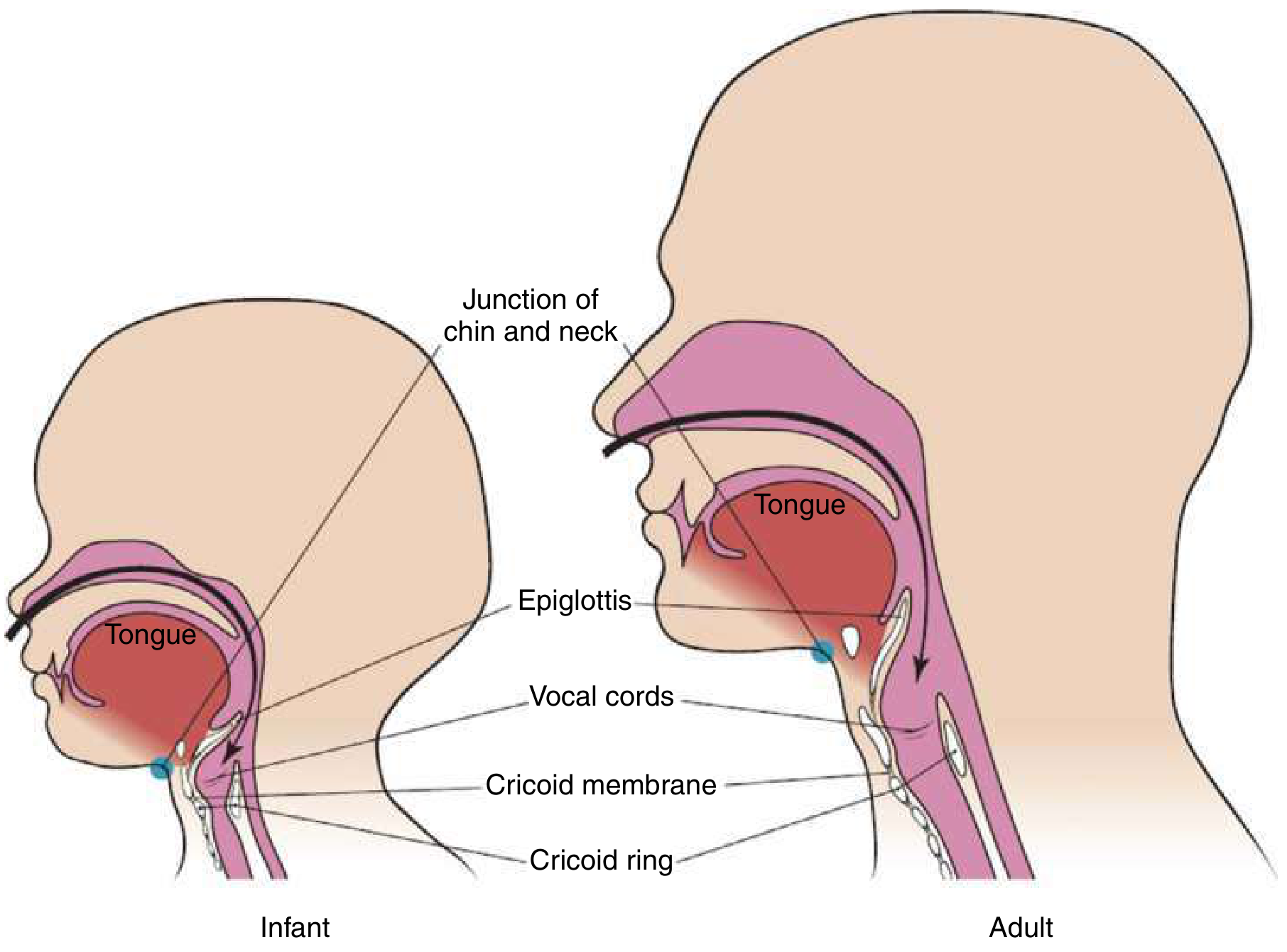
Fig. High, anterior airway of the small child vs. the adult (ROSEN's Emergency Medicine)
1. Position of the Larynx
| Feature | Pediatric | Adult |
|---|---|---|
| Laryngeal level | C2-C3 (infant) | C4-C6 |
| Glottis orientation | Angulated anteriorly; plane of glottis less parallel to horizontal | More horizontal, easier to align |
The infant larynx is higher and more anterior, making correct positioning before direct laryngoscopy critical for intubation success. - Fishman's Pulmonary Diseases and Disorders; ROSEN's Emergency Medicine, p. 4096
2. Shape and Size of the Epiglottis
| Feature | Pediatric | Adult |
|---|---|---|
| Shape | Omega-shaped (U-shaped), floppy, longer | Flat, leaf-like, stiffer |
| Implications | Requires a straight blade (Miller) to lift it directly | Curved blade (Macintosh) placed in vallecula is sufficient |
The adult epiglottis, with its wider arc and ligamentous attachments, can be lifted by placing a curved laryngoscope blade into the vallecula. The pediatric epiglottis, being omega-shaped and less stiff, often requires lifting with a straight blade. - Fishman's Pulmonary Diseases and Disorders, p. 1292
3. Narrowest Point of the Airway
| Feature | Pediatric | Adult |
|---|---|---|
| Narrowest point | Subglottic (cricoid ring) - functionally | Glottis (at level of vocal cords) |
| Shape | Elliptical subglottis | Circular |
Although recent CT studies show anatomic narrowing at the vocal cords in children, the non-distensible cricoid cartilage means the subglottis functionally remains the narrowest part in the spontaneously breathing child. This makes it a critical point for endotracheal tube sizing. - ROSEN's Emergency Medicine, p. 4098
4. Head and Occiput
- The infant/toddler has a large prominent occiput, causing passive neck flexion when supine.
- In adults, the neutral or "sniffing" position requires a pillow under the head.
- In infants, a small shoulder roll is often needed to extend the neck and achieve alignment.
5. Tongue and Oral Cavity
- The pediatric tongue is proportionally larger relative to the oral cavity, making it more likely to obstruct the view during laryngoscopy.
- In adults, the tongue is smaller relative to the pharyngeal space.
6. Trachea
| Feature | Pediatric | Adult |
|---|---|---|
| Compliance | More flexible, prone to dynamic collapse | Stiffer, less collapsible |
| Risk | Hyperextension can actually kink and obstruct the trachea | Hyperextension generally improves airway |
The pediatric trachea can narrow due to upper airway pathology (e.g., croup, bacterial tracheitis). Positive pressure via BMV can stent it open. - ROSEN's Emergency Medicine, p. 4102
7. Adenotonsillar and Lymphoid Tissue
- Children have relatively prominent tonsillar and adenoidal tissue that bleeds easily with minor trauma.
- This is why blind nasotracheal intubation is relatively contraindicated in children under 10 years old.
- In adults, blind nasal intubation is a viable alternative technique.
8. Cricothyroid Membrane and Surgical Airway
| Feature | Pediatric | Adult |
|---|---|---|
| Cricothyroid membrane | Small, difficult to identify in short neck | Larger, palpable |
| Emergency surgical airway | Needle cricothyrotomy preferred | Surgical cricothyrotomy preferred |
Because anatomic landmarks are difficult to identify and the membrane is small in infants and young children, needle cricothyrotomy is the recommended invasive emergency airway, not surgical cricothyrotomy. - ROSEN's Emergency Medicine, p. 4106
9. Respiratory Mechanics and Physiology
- Small children are diaphragm-dependent for breathing; gastric insufflation during BMV can impede diaphragmatic excursion.
- Low gastroesophageal sphincter tone makes children more prone to aspiration.
- Resistance to flow increases exponentially when airflow is turbulent (as in a crying child), because resistance ~ 1/r⁴ (Poiseuille's law) - even small reductions in airway radius cause dramatic resistance increases.
10. Endotracheal Tube Choice
- Historically, uncuffed ETTs were used in small children due to the funnel shape and concern about subglottic trauma from stiff cuffs.
- Current recommendation: cuffed ETTs are now acceptable and often preferred (especially in high airway pressure situations like asthma, pneumonia, ARDS), provided cuff pressures are monitored carefully.
- The shift is supported by modern low-pressure, high-volume cuff technology. - ROSEN's Emergency Medicine, p. 4100
Summary Table
| Feature | Pediatric | Adult |
|---|---|---|
| Larynx position | C2-C3, high & anterior | C4-C6 |
| Epiglottis shape | Omega-shaped, floppy, long | Flat, stiff, leaf-like |
| Laryngoscope blade | Straight (Miller) preferred | Curved (Macintosh) |
| Narrowest airway | Subglottis (cricoid) | Glottis (vocal cords) |
| Occiput | Large, causes neck flexion | Smaller |
| Tongue | Relatively large | Proportionate |
| Trachea | Compliant, collapsible | Stiff |
| Adenoids/tonsils | Prominent, bleed easily | Less prominent |
| Surgical airway | Needle cricothyrotomy | Surgical cricothyrotomy |
| ETT type | Cuffed (modern); historically uncuffed | Always cuffed |
| Nasal intubation | Avoid (<10 years) | Acceptable |
This is a shared conversation. Sign in to Orris to start your own chat.