
Shentons line
Reading File
Shenton's line is a radiological landmark used on anteroposterior (AP) pelvis X-rays to assess the hip joint - specifically to detect hip dislocation or developmental dysplasia of the hip (DDH). It is a smooth, continuous curved line traced along the inferior border of the femoral neck and continuing along the superior border of the obturator foramen.
Searching sources...
Finding Sources
Searching the Web
Shenton's line hip radiology anatomy clinical significance
Reading File
Reading File
Loading Image
Loading Image
Reading File
Shenton's Line
Definition
Shenton's line (also called the Menard-Shenton line) is an imaginary smooth, continuous curved arc drawn on an AP (anteroposterior) pelvis X-ray. It runs along:
- The superior/upper border of the obturator foramen, and continues
- Along the inferior/medial border of the femoral neck
In a normal hip, these two structures form a smooth, unbroken arc. Any disruption of this curve indicates pathology.
- S Das Manual on Clinical Surgery, p. 248
- THIEME General Anatomy and Musculoskeletal System, p. 7073
Radiographic Image
The image below shows Shenton's line highlighted (yellow arcs) on both hips of a normal pelvis AP X-ray. Note the smooth continuous curve from the obturator foramen onto the femoral neck on each side:
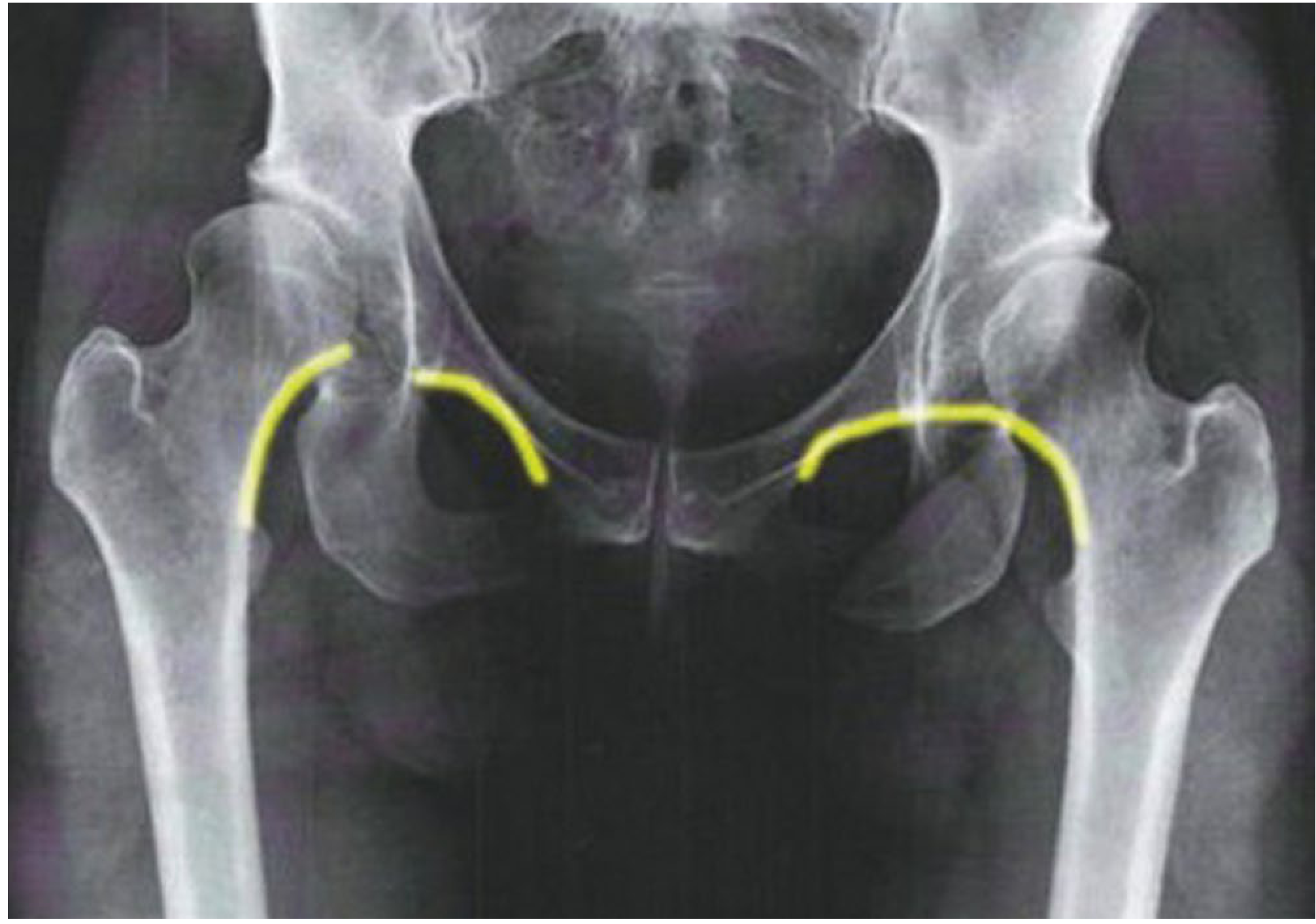
Campbell's Operative Orthopaedics 15th Ed - Figure 7.36
Clinical Significance - When is it disrupted?
A broken or disrupted Shenton's line indicates displacement of the femoral head relative to the acetabulum. Causes include:
| Condition | Mechanism |
|---|---|
| Developmental Dysplasia of Hip (DDH) | Superior and lateral subluxation/dislocation of femoral head |
| Fractured neck of femur | Proximal femur displaces superiorly; arc is broken |
| Perthes' disease | Femoral head flattens/collapses, disrupting the arc |
| Pathological dislocation | Any cause of hip dislocation (septic arthritis, tuberculosis) |
| Hip subluxation | Partial displacement shifts the femoral neck inferiorly |
"In Perthes' disease or in tuberculous arthritis where destruction of the head of the femur becomes obvious, this line will be slightly distorted; but in pathological dislocation this line will be grossly distorted." - S Das Manual on Clinical Surgery
Image: Disrupted Shenton's Line (Perthes' Disease)
The right hip shows disruption of the line - the solid arc on the left (normal) does not match up on the affected right side:
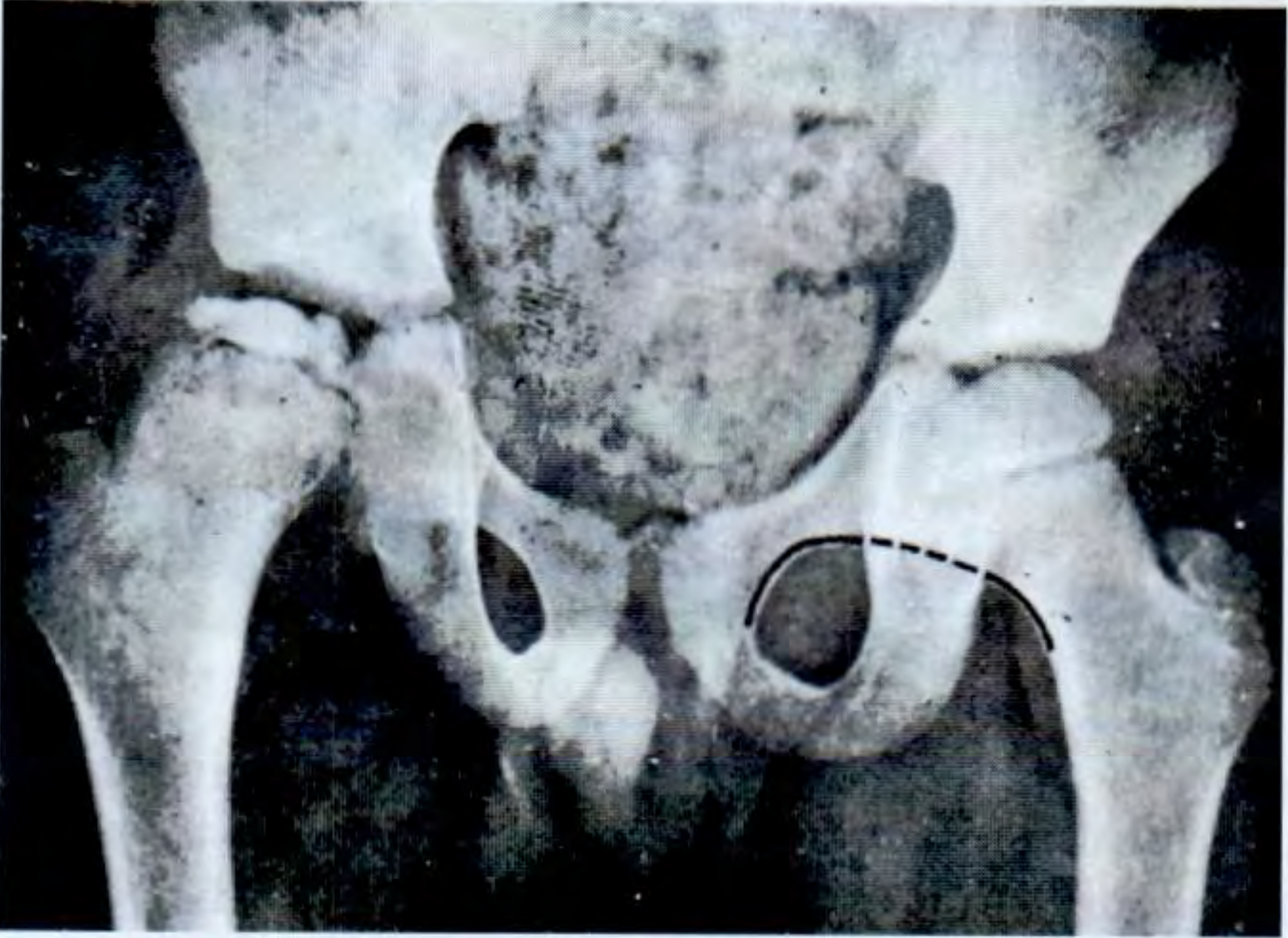
S Das Manual on Clinical Surgery, Fig. 15.44 - Shenton's line drawn on normal left side; disrupted on the right (Perthes' disease)
Use Alongside Other Lines
On a pediatric hip X-ray, Shenton's line is used in combination with:
- Hilgenreiner line - horizontal line connecting both triradiate cartilages
- Perkins-Ombredanne line - vertical line from the lateral acetabular rim, perpendicular to Hilgenreiner line
- Acetabular index (Hilgenreiner) - normally ~35° at birth, <10° by age 15
In DDH: the Shenton line is discontinuous, the acetabular angle is increased, and the Perkins-Ombredanne line runs medial to the femoral shaft.
- THIEME General Anatomy and Musculoskeletal System, p. 7079
- Campbell's Operative Orthopaedics 15th Ed 2026, Fig. 7.36
Key Points for Exams
- Normal = smooth continuous arc from obturator foramen to inferior femoral neck
- Disruption = femoral head displacement (superior in fracture/dislocation; inferior less common)
- Used on AP pelvis X-ray (not lateral)
- Named after Edward Warren Shenton (British radiologist, early 20th century)
- Also called Menard-Shenton line (Menard described it alongside Shenton in some literature)
This is a shared conversation. Sign in to Orris to start your own chat.