
Lyons hypothesis
The Lyon hypothesis (also called X-inactivation or lyonization) states that in female mammals, one of the two X chromosomes in each somatic cell is randomly and permanently inactivated early in embryonic development. This results in females being mosaics, with some cells expressing the maternal X and others the paternal X.
Searching sources...
Reading File
Searching the Web
Lyon hypothesis X-inactivation lyonization mechanism genetics
Finding Sources
Reading File
Reading File
Loading Image
Lyon Hypothesis (X-Inactivation / Lyonization)
Proposed by Mary Lyon in 1961-1962, the Lyon hypothesis describes the mechanism by which females achieve dosage compensation for X-linked genes.
Core Postulates
In 1961, Mary Lyon outlined X-inactivation with three key statements:
- Only one X chromosome per somatic cell is genetically active - the other is inactivated
- Inactivation is random - in any given cell, either the maternal (Xm) or paternal (Xp) X may be inactivated
- Inactivation is permanent and heritable - once inactivated in a cell, the same X chromosome remains inactive in all daughter cells (clonal propagation)
- Robbins & Kumar Basic Pathology, block 1
When Does It Occur?
Inactivation happens very early in fetal development - approximately 16 days after conception (around the 16-cell stage of the embryo). Before this point, both X chromosomes are active in the zygote.
The Diagram
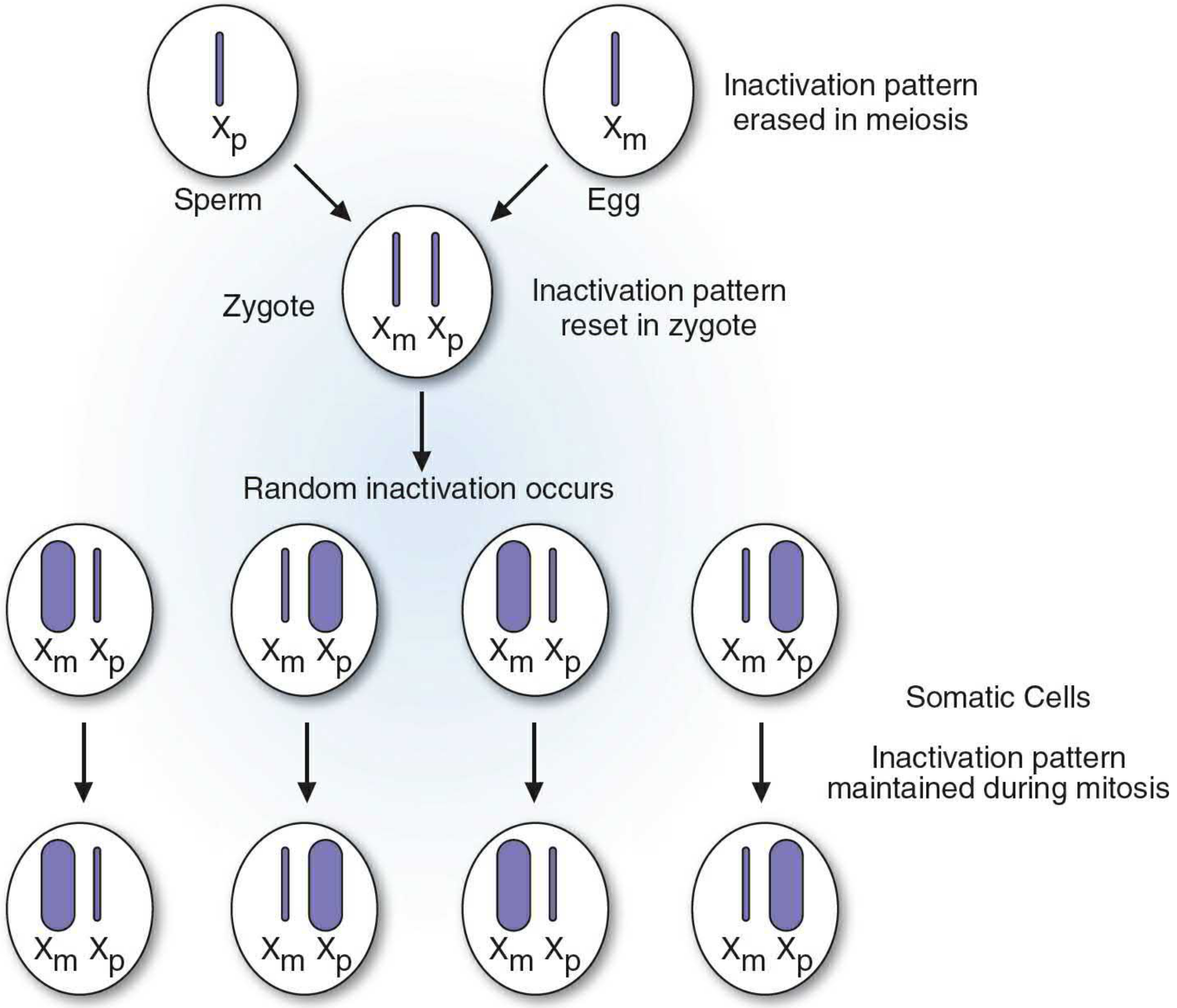
The diagram illustrates:
-
In the zygote, both Xm and Xp are active
-
Random inactivation occurs in early embryonic cells
-
The inactivation pattern is reset in meiosis (gametes carry active X)
-
The pattern is maintained stably through mitosis in somatic cells
-
Basic Medical Biochemistry - A Clinical Approach, p. 646
Molecular Mechanism
The inactive X is physically condensed into a structure called the Barr body (sex chromatin). The molecular mediator is the XIST gene (X-Inactive Specific Transcript), which encodes a long noncoding RNA (lncRNA). This RNA:
- Is transcribed from and "coats" the X chromosome to be inactivated
- Silences the genes on that chromosome via chromatin remodeling
- The XIST allele on the active X is switched off, allowing expression from only one X
Dosage Compensation Purpose
Without this mechanism, females (XX) would express X-linked genes at twice the level of males (XY). X-inactivation equalizes gene dosage between the sexes. The Barr body count rule: Number of Barr bodies = Total X chromosomes - 1
| Karyotype | Barr Bodies |
|---|---|
| 46,XX (normal female) | 1 |
| 46,XY (normal male) | 0 |
| 47,XXX | 2 |
| 45,X (Turner syndrome) | 0 |
| 47,XXY (Klinefelter) | 1 |
Why Females Are Mosaics
Because inactivation is random and clonally propagated, females end up as mosaics with two intermingled cell populations - some expressing the maternal X, others the paternal X. This has important clinical implications:
- A female carrier of an X-linked recessive disorder (e.g., hemophilia A, Duchenne muscular dystrophy) may be mildly symptomatic or asymptomatic depending on which X was predominantly inactivated
- Skewed X-inactivation (non-random predominance of one allele) can cause manifesting carriers to be more severely or more mildly affected
- The classic example used by Lyon herself was patchy coat color in mice heterozygous for X-linked coat color genes
Subsequent Modifications to the Hypothesis
The original hypothesis assumed complete silencing of all genes on the inactive X. This has since been revised:
-
Roughly ~30% of genes on Xp (short arm) escape X-inactivation
-
A smaller number (~3% on Xq) also escape
-
These "escaping" genes contribute to the phenotype of Turner syndrome (45,X), explaining why monosomy X is not embryonic lethal like autosomal monosomies but still produces a recognizable phenotype
-
Robbins & Kumar Basic Pathology, block 1
Clinical Relevance
| Condition | Relevance to Lyon Hypothesis |
|---|---|
| Turner syndrome (45,X) | One X; genes that escape inactivation are hemizygous - explains phenotype |
| Klinefelter syndrome (47,XXY) | One X inactivated; but some genes escape - explains tall stature/hypogonadism |
| X-linked recessive (e.g., hemophilia) | Female carriers can be manifesting due to skewed inactivation |
| X-linked dominant | Females less severely affected due to mosaicism |
| 48,XXXX female | 3 Barr bodies visible in somatic cells |
The NHGRI definition of Lyonization and the Embryo Project's profile of Mary Lyon both emphasize that understanding lyonization has been foundational for developing gene therapies for X-linked disorders.
This is a shared conversation. Sign in to Orris to start your own chat.