
When to treat hypertension and in what way?
"hypertension" AND "treatment guidelines"
hypertension treatment algorithm blood pressure management
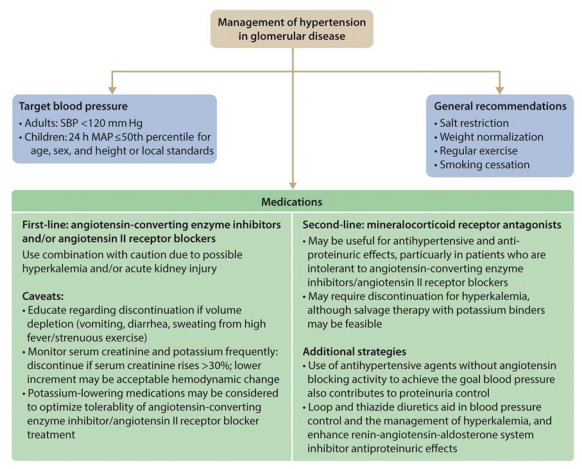
Summary : This flowchart outlines the management of hypertension in glomerular disease, detailing target blood pressure goals, general lifestyle recommendations, and a tiered medication strategy with specific caveats and additional strategies. flowchart: # Nodes : • Management of hypertension in glomerular disease (rectangle, top central node) • Target blood pressure (rectangle, left branch) – Adults: SBP <120 mm Hg – Children: 24 h MAP <50th percentile for age, sex, and height or local standards • General recommendations (rectangle, right branch) – Salt restriction – Weight normalization – Regular exercise – Smoking cessation • Medications (rectangle, central lower node) – First-line: angiotensin-converting enzyme inhibitors and/or angiotensin II receptor blockers • Use combination with caution due to possible hyperkalemia and/or acute kidney injury • Caveats: – Educate regarding discontinuation if volume depletion (vomiting, diarrhea, sweating from high fever/strenuous exercise) – Monitor serum creatinine and potassium frequently; discontinue if serum creatinine rises >30%; lower increment may be acceptable hemodynamic change – Potassium-lowering medications may be considered to optimize tolerability of angiotensin-converting enzyme inhibitor/angiotensin II receptor blocker treatment – Second-line: mineralocorticoid receptor antagonists • May be useful for antihypertensive and anti-proteinuric effects, particularly in patients who are intolerant to angiotensin-converting enzyme inhibitors/angiotensin II receptor blockers • May require discontinuation for hyperkalemia, although salvage therapy with potassium binders may be feasible – Additional strategies: • Use of antihypertensive agents without angiotensin blocking activity to achieve the goal blood pressure also contributes to proteinuria control • Loop and thiazide diuretics aid in blood pressure control and the management of hyperkalemia, and enhance renin-angiotensin-aldosterone system inhibitor antiproteinuric effects # Connectors : • Downward arrows from "Management of hypertension in glomerular disease" to "Target blood pressure", "General recommendations", and "Medications". • "Medications" node branches into "First-line", "Second-line", and "Additional strategies" sections. # Layout : • Central top node ("Management of hypertension in glomerular disease") with three downward branches: left ("Target blood pressure"), right ("General recommendations"), and center ("Medications"). • "Medications" node is subdivided into first-line, second-line, and additional strategies, each with bullet-pointed details. # Analysis : • The flowchart provides a structured, stepwise approach to managing hypertension in glomerular disease, emphasizing both non-pharmacological and pharmacological interventions. • It prioritizes angiotensin system blockers as first-line therapy, with careful monitoring for adverse effects, and offers alternatives and adjuncts for patients with intolerance or inadequate response. • The chart highlights the importance of individualized care, monitoring, and lifestyle modification alongside medication.
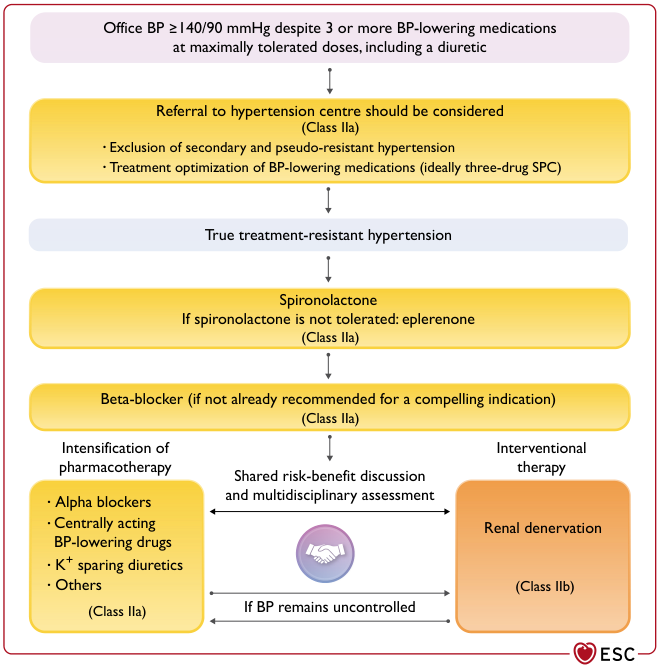
Summary : This flowchart outlines the recommended management pathway for patients with office blood pressure (BP) ≥140/90 mmHg despite taking three or more BP-lowering medications at maximally tolerated doses, including a diuretic, according to the European Society of Cardiology (ESC) guidelines. It details steps for referral, medication optimization, and further interventions for true treatment-resistant hypertension. flowchart: # Nodes : • Office BP ≥140/90 mmHg despite 3 or more BP-lowering medications at maximally tolerated doses, including a diuretic (rounded rectangle, top) • Referral to hypertension centre should be considered (rounded rectangle, yellow) – Exclusion of secondary and pseudo-resistant hypertension – Treatment optimization of BP-lowering medications (ideally three-drug SPC) – (Class IIa) • True treatment-resistant hypertension (rectangle, light blue) • Spironolactone (rounded rectangle, yellow) – If spironolactone is not tolerated: eplerenone – (Class IIa) • Beta-blocker (if not already recommended for a compelling indication) (rounded rectangle, yellow) – (Class IIa) • Intensification of pharmacotherapy (rounded rectangle, yellow, left branch) – Alpha blockers – Centrally acting BP-lowering drugs – K+ sparing diuretics – Others – (Class IIa) • Shared risk-benefit discussion and multidisciplinary assessment (circle, handshake icon, centre) • Renal denervation (rounded rectangle, orange, right branch) – (Class IIb) • If BP remains uncontrolled (arrow leading to shared risk-benefit discussion node) # Connectors : • Downward arrows connect each step in sequence from top to bottom. • After beta-blocker, two branches: – Left: Intensification of pharmacotherapy – Right: Interventional therapy (Renal denervation) • Both branches connect to shared risk-benefit discussion and multidisciplinary assessment. • If BP remains uncontrolled, loop back to shared risk-benefit discussion node. # Layout : • Vertical flow from top (initial criteria) to bottom (shared assessment). • After beta-blocker, splits into two parallel branches (pharmacotherapy intensification on left, interventional therapy on right). • Central node (shared risk-benefit discussion) connects both branches. • Colour coding: yellow for recommended steps, orange for interventional therapy, light blue for diagnostic confirmation. # Analysis : • The flowchart provides a stepwise escalation for managing resistant hypertension, starting with referral and medication optimization, then adding spironolactone or eplerenone, followed by beta-blockers if indicated. • If BP remains uncontrolled, further intensification of pharmacotherapy or consideration of renal denervation is recommended, with shared decision-making and multidisciplinary assessment. • The process emphasizes exclusion of secondary causes and optimization before moving to advanced therapies. • Class IIa recommendations dominate, with renal denervation as a Class IIb option. • The workflow is linear with a split into two parallel escalation pathways, converging on shared decision-making.
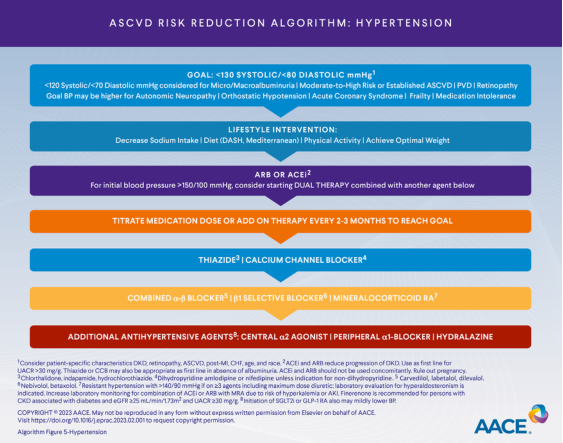
Summary : This flowchart presents the ASCVD (Atherosclerotic Cardiovascular Disease) risk reduction algorithm for hypertension management, outlining stepwise goals, interventions, and medication options. flowchart: # Nodes : • GOAL: <130 SYSTOLIC/<80 DIASTOLIC mmHg (rectangle, blue) • LIFESTYLE INTERVENTION: Decrease Sodium Intake | Diet (DASH, Mediterranean) | Physical Activity | Achieve Optimal Weight (rectangle, blue) • ARB OR ACE: For initial blood pressure >150/100 mmHg, consider starting DUAL THERAPY combined with another agent below (rectangle, purple) • TITRATE MEDICATION DOSE OR ADD ON THERAPY EVERY 2-3 MONTHS TO REACH GOAL (rectangle, orange) • THIAZIDE | CALCIUM CHANNEL BLOCKER (rectangle, blue) • COMBINED α-β BLOCKER | β1 SELECTIVE BLOCKER | MINERALOCORTICOID RA (rectangle, orange) • ADDITIONAL ANTIHYPERTENSIVE AGENTS: CENTRAL α2 AGONIST | PERIPHERAL α1-BLOCKER | HYDRALAZINE (rectangle, red) # Connectors : • Top-down linear flow from goal setting, lifestyle intervention, initial medication choice, titration, and escalation to additional agents. • ARB/ACE node includes a branch for dual therapy if initial BP is >150/100 mmHg. • Medication escalation proceeds in order: thiazide/calcium channel blocker → combined blockers/mineralocorticoid RA → additional antihypertensive agents. # Layout : • Vertically stacked rectangles, each representing a step in the algorithm. • Colour-coded sections: blue for goals/lifestyle/first-line agents, purple for ARB/ACE, orange for titration/combination, red for additional agents. • Footnotes and references are included at the bottom for clinical context and special considerations. # Analysis : • The algorithm emphasizes a stepwise approach: starting with lifestyle changes, then progressing to medication based on blood pressure severity and response. • Dual therapy is recommended for very high initial BP (>150/100 mmHg). • Medication titration and escalation are structured, with clear options for combination and additional agents. • Colour coding visually separates intervention types and escalation steps. • The flowchart provides a comprehensive, guideline-based pathway for hypertension management in ASCVD risk reduction.
hypertension treatment guidelines 2024 2025 when to treat blood pressure thresholds
When to Treat Hypertension and How
1. Classification and Thresholds (2025 AHA/ACC Guideline)
| Category | SBP | DBP |
|---|---|---|
| Normal | <120 | <80 mm Hg |
| Elevated | 120-129 | <80 mm Hg |
| Stage 1 Hypertension | 130-139 | 80-89 mm Hg |
| Stage 2 Hypertension | ≥140 | ≥90 mm Hg |
| Hypertensive Crisis | >180 | >120 mm Hg |
2. When to Start Treatment
A. Pharmacotherapy is recommended immediately when:
- SBP ≥ 140 mm Hg or DBP ≥ 90 mm Hg in ANY adult with hypertension - regardless of CVD risk (Class I, Level A)
- SBP ≥ 130/80 mm Hg in adults who have ANY of the following high-risk conditions:
- Established CVD (prior MI, stroke, coronary artery disease)
- Diabetes mellitus
- Chronic kidney disease (CKD)
- 10-year CVD risk ≥ 7.5% by the new PREVENT equation (replaces the old Pooled Cohort Equations)
B. Lifestyle first, then medication (lower-risk patients):
- Adults with Stage 1 hypertension (130-139/80-89 mm Hg) and 10-year CVD risk <7.5%: try lifestyle modification for 3-6 months first; if BP remains ≥130/80 mm Hg, start pharmacotherapy (Class I)
Key 2025 update: The PREVENT calculator now uses renal function, statin use, and social deprivation index - this expanded Stage 1 treatment eligibility from ~57% to ~73% of affected adults compared to the 2017 guideline.
3. Lifestyle Modifications (Non-pharmacologic Treatment)
| Modification | Recommendation | Approximate SBP Reduction |
|---|---|---|
| Weight loss | BMI 18.5-24.9 kg/m² | 5-20 mm Hg per 10 kg lost |
| DASH diet | High fruits, vegetables, low-fat dairy; low saturated fat | 8-14 mm Hg |
| Sodium restriction | <2,300 mg/day (100 mmol/day) | 2-8 mm Hg |
| Aerobic exercise | ≥30 min/day, most days of the week | 5-8 mm Hg |
| Dynamic resistance | 90-150 min/wk, 3-5×/week | 4 mm Hg |
| Alcohol moderation | ≤2 drinks/day (men), ≤1 drink/day (women) | 2-4 mm Hg |
| Smoking cessation | Complete cessation | Overall CVD risk reduction |
4. Pharmacologic Treatment
Major Drug Classes
| Drug Class | Examples | Key Compelling Indications |
|---|---|---|
| ACE Inhibitors (ACEi) | Lisinopril, Ramipril | CKD with proteinuria, diabetes, heart failure, post-MI |
| Angiotensin II Receptor Blockers (ARBs) | Losartan, Valsartan | Same as ACEi; used when ACEi causes cough |
| Calcium Channel Blockers (CCBs) | Amlodipine (DHP), Diltiazem (non-DHP) | Elderly, African-American patients, angina |
| Thiazide Diuretics | Hydrochlorothiazide, Chlorthalidone | Most hypertension; combined with other agents |
| Beta-Blockers | Metoprolol, Bisoprolol | Post-MI, heart failure with reduced EF, arrhythmias |
Starting Strategy
- Monotherapy: Typical response is SBP reduction of 12-15 mm Hg and DBP reduction of 8-10 mm Hg. Reassess in 2-4 weeks.
- Combination therapy: Start if BP is >20 mm Hg SBP or >10 mm Hg DBP above goal. This shortens time to goal and is preferred over maximizing one drug first. Common combinations:
- ACEi/ARB + CCB + thiazide diuretic (triple therapy, the "ABC" regimen)
- ACEi + CCB is particularly effective and well-tolerated
Special Population Choices
| Condition | Preferred Agent(s) |
|---|---|
| CKD + proteinuria | ACEi or ARB (first-line) |
| Diabetes | ACEi or ARB (renoprotective) |
| Heart failure (HFrEF) | ACEi/ARB + beta-blocker + MRA |
| Post-MI | ACEi + beta-blocker |
| Systolic dysfunction | Avoid CCBs (verapamil/diltiazem) |
| Pregnancy | Labetalol, Nifedipine, Methyldopa (avoid ACEi/ARB) |
| African-American patients | CCB or thiazide preferred as initial agents |
5. Resistant Hypertension
- Exclude pseudo-resistance (white coat effect, nonadherence - up to 50% of "resistant" cases) - National Kidney Foundation Primer, 8e
- Screen for secondary causes (primary aldosteronism - now recommended for all Stage 2 or resistant hypertension per 2025 guidelines)
- Add spironolactone (Class IIa) - most effective 4th agent
- Add beta-blocker if not already indicated (Class IIa)
- Consider alpha-blockers, centrally acting agents, or additional diuretics (Class IIa)
- Renal denervation (RDN) is a Class IIb option (now formally included in 2025 AHA/ACC guidelines) for selected resistant hypertension patients
6. Treatment Goals Summary
| Patient Group | BP Target |
|---|---|
| General adults | <130/80 mm Hg (aim <120/80 mm Hg) |
| CKD (adults) | SBP <120 mm Hg (per KDIGO/SPRINT data) |
| Glomerular disease | SBP <120 mm Hg |
| Pregnancy/Institutional care | Individualized (≥130/80 mm Hg threshold for treatment) |
| Acute ICH (SBP 150-220 mm Hg) | Lower to 130-140 mm Hg over ≥7 days |
- National Kidney Foundation Primer on Kidney Diseases, 8e, pp. 2528-2560
- 2025 AHA/ACC Hypertension Guideline overview - PMC
- JACC 2025 Guideline-at-a-Glance