
SLE
I'll look up SLE (Systemic Lupus Erythematosus) from the medical library for a thorough overview.
Reading File
Now let me search the library for SLE content in parallel:
Finding Sources
Searching PubMed
"systemic lupus erythematosus"[MeSH Terms] AND management
Let me search specifically for the rheumatology/internal medicine textbook content on SLE:
Finding Sources
Searching PubMed
"lupus erythematosus" AND treatment
Excellent - I found SLE in Harrison's (2025) and Firestein & Kelley's Rheumatology. Let me read both in parallel:
Reading File
Reading File
Now let me get the core SLE pathogenesis/diagnosis/management content from Harrison's:
Finding Sources
Finding Sources
Let me now read the comprehensive SLE chapter from Goldman-Cecil Medicine and Harrison's in parallel:
Reading File
Finding Sources
Let me read the main Harrison's SLE chapter and continue with the Goldman-Cecil classification criteria:
Reading File
Reading File
Excellent - I have rich content from Goldman-Cecil. Let me now read the treatment section and the classification criteria table:
Reading File
I now have comprehensive information. Let me also fetch the malar rash image from Harrison's to include in the answer:
Loading Image
I now have all the material needed for a thorough, well-structured answer. Here is the comprehensive overview of SLE:
Systemic Lupus Erythematosus (SLE)
Definition & Epidemiology
SLE is a highly complex, multisystem autoimmune disease characterized by autoimmunity directed against nucleic acids and nucleic acid-binding proteins. It involves nearly all components of the immune system and causes damage to multiple organs. The disease has a striking female predominance (8-10:1 female-to-male ratio) and disproportionately affects women of childbearing age, as well as people of African, Hispanic, and Asian ancestry.
Pathogenesis
The pathogenesis follows a cumulative hit model involving:
-
Genetic susceptibility - Monozygotic twin concordance ~24%; ~44% of SLE risk is heritable. Key associations include:
- Complement deficiencies (C1q, C2, C4A mutations)
- HLA-DR3 and HLA-DR15 alleles (strongest MHC associations)
- 80+ non-HLA SNPs identified in large GWAS studies
- Polymorphisms in TLR pathways (IRF5, IRF7) and Fc receptor genes (FCGR2A, FCGR3A)
-
Type I Interferon Pathway - Central to SLE. Impaired clearance of apoptotic debris exposes endogenous nucleic acids, which trigger TLR-mediated innate immune activation, leading to massive type I interferon production.
-
Environmental triggers - UV light (photosensitivity), infections (EBV), certain drugs, microbiome changes, oxidative stress
-
Immune dysregulation - Results in production of autoantibodies (especially anti-dsDNA, anti-Sm), immune complex formation and deposition in tissues, complement activation, and end-organ damage.
-
Sex - Impaired X-chromosome inactivation partially explains the female predominance.
Clinical Manifestations
SLE is the "great imitator." Organs involved include:
| Manifestation | Approximate Frequency |
|---|---|
| Cutaneous | 88% |
| Arthritis/arthralgias | 76% |
| Neuropsychiatric | 66% |
| Pleurisy/pericarditis | 63% |
| Anemia | 57% |
| Raynaud phenomenon | 44% |
| Vasculitis | 43% |
| Atherosclerosis | 37% |
| Nephritis | 31% |
| Thrombocytopenia | 30% |
| Sensorimotor neuropathy | 28% |
| Cardiac valvular disease | 18% |
| Pulmonary alveolar hemorrhage | 12% |
(Goldman-Cecil Medicine, p. 2811)
Cutaneous Manifestations
Classified into acute, subacute, and chronic types:
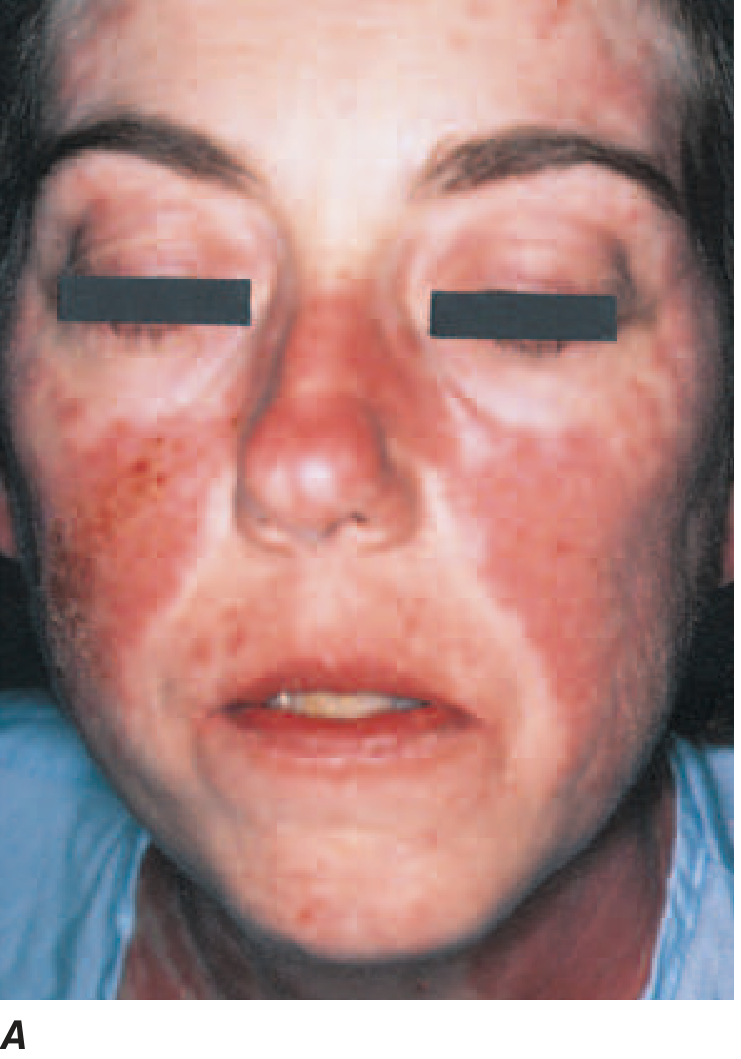
Acute cutaneous LE - The classic butterfly (malar) rash - erythema of the nose and malar eminences, sparing the nasolabial folds. Often sudden in onset, with edema and fine scale, and strongly correlated with systemic flares.
Subacute cutaneous LE (SCLE) - Widespread photosensitive, non-scarring eruption. Papulosquamous (psoriasiform) or annular/polycyclic pattern on the upper back, chest, and shoulders. Strongly associated with anti-Ro/SSA antibodies. Often drug-induced (hydrochlorothiazide, calcium channel blockers, PPIs, antifungals).
Chronic cutaneous LE (Discoid LE) - Scarring plaques, follicular plugging, dyspigmentation; may occur without systemic disease.
Musculoskeletal
- Arthralgias and non-erosive arthritis in >85% - PIP, MCP joints, knees, wrists most common
- Jaccoud arthropathy (periarticular tissue damage with deformity) in ~10%
- Osteonecrosis (most commonly hip) from disease vasculopathy or corticosteroid use
- Fibromyalgia commonly coexists
Renal (Lupus Nephritis)
- Affects >50% of patients at some point
- Ranges from asymptomatic proteinuria to nephrotic syndrome to rapidly progressive GN
- WHO/ISN classification: Class I-VI (Class III and IV = proliferative, most serious)
- Renal biopsy guides management
Cardiovascular
- Pericarditis - most common cardiac manifestation (substernal pain relieved by leaning forward)
- Libman-Sacks endocarditis - sterile nodules on atrial side of mitral valve; can cause regurgitation
- Accelerated premature atherosclerosis is a major cause of long-term morbidity and mortality
Neuropsychiatric SLE (NPSLE)
- Peripheral neuropathy in 2-27%
- Spectrum includes: cognitive dysfunction, psychosis, seizures, stroke (often from antiphospholipid antibodies), mononeuritis multiplex, GBS/CIDP-like syndrome
- Seizures carry 5 points in EULAR/ACR classification
Hematologic
- Autoimmune hemolytic anemia, leukopenia, lymphopenia, thrombocytopenia
- Antiphospholipid antibody syndrome - arterial/venous thrombosis, recurrent pregnancy loss
Serositis
- Pleuritis and pericarditis common; characteristic pleuritic chest pain
Autoantibodies in SLE
| Antibody | Significance |
|---|---|
| ANA | Screening test; present in >95% but not specific |
| Anti-dsDNA | Highly specific (~70%); titres correlate with disease activity and nephritis |
| Anti-Sm | Highly specific (~25-30%); not correlated with activity |
| Anti-Ro/SSA | Associated with SCLE, neonatal lupus, complete heart block |
| Anti-La/SSB | Associated with neonatal lupus |
| Antiphospholipid (aCL, anti-β2GPI, lupus anticoagulant) | Thrombosis, pregnancy loss |
| Anti-histone | Drug-induced lupus |
| Low C3/C4 | Active disease, especially nephritis |
Classification Criteria (2019 EULAR/ACR)
Step 1: ANA titer ≥1:80 is the mandatory entry criterion. If absent, do NOT classify as SLE.
Step 2: Score additional criteria (count only the highest-weighted item within each domain):
| Domain | Criterion | Points |
|---|---|---|
| Constitutional | Fever | 2 |
| Neuropsychiatric | Delirium | 2 |
| Psychosis | 3 | |
| Seizure | 5 | |
| Mucocutaneous | Non-scarring alopecia | 2 |
| Oral ulcers | 2 | |
| Subacute cutaneous or discoid LE | 4 | |
| Acute cutaneous LE | 6 | |
| Musculoskeletal | Joint involvement | 6 |
| Serosal | Pleural or pericardial effusion | 5 |
| Acute pericarditis | 6 | |
| Hematologic | Leukopenia | 3 |
| Thrombocytopenia | 4 | |
| Autoimmune hemolysis | 4 | |
| Renal | Proteinuria >0.5 g/24h | 4 |
| Biopsy: Class II or V nephritis | 8 | |
| Biopsy: Class III or IV nephritis | 10 | |
| Antiphospholipid Ab | aCL or anti-β2GPI or lupus anticoagulant | 2 |
| Complement | Low C3 or C4 | 3 |
| Low C3 AND C4 | 4 | |
| SLE-specific Ab | Anti-dsDNA | 6 |
| Anti-Sm | 6 |
Classify as SLE if total score ≥10 points. (Goldman-Cecil Medicine, p. 2811)
Treatment
Treatment is guided by organ involvement and disease severity:
General Principles
- Hydroxychloroquine (HCQ) - cornerstone of SLE management for nearly all patients; reduces flares, prevents organ damage, improves survival, safe in pregnancy
- Sun protection - mandatory; UV triggers flares
- Monitoring for and treating cardiovascular risk factors (premature atherosclerosis)
Mild-Moderate Disease
- NSAIDs for arthritis and serositis
- Topical glucocorticoids + antimalarials for skin disease
- Low-dose prednisone for symptom control
Moderate-Severe / Organ-Threatening Disease
- Systemic glucocorticoids - rapid disease control but long-term toxicity limits use
- Immunosuppressives: azathioprine, mycophenolate mofetil (MMF), cyclophosphamide (reserved for severe nephritis/CNS disease)
Biologic Therapies
- Belimumab (anti-BLyS/BAFF) - approved for active SLE and lupus nephritis; reduces flares and organ damage
- Anifrolumab (anti-IFN-α receptor) - approved for moderate-to-severe SLE; targets the type I interferon pathway
- Voclosporin - calcineurin inhibitor approved in combination with MMF for lupus nephritis
- Rituximab (anti-CD20) - used off-label for refractory disease
Lupus Nephritis
- Induction: MMF + glucocorticoids (or cyclophosphamide for severe Class III/IV)
- Maintenance: MMF or azathioprine
Antiphospholipid Syndrome
- Thrombosis prophylaxis/treatment with anticoagulation (warfarin)
- Aspirin for pregnancy-related complications
Emerging (2024-2026)
- CAR-T cell therapy and B-cell depletion strategies are showing early promise in refractory SLE, with recent reviews in Annals of Rheumatic Diseases (PMID 38777374) and Molecular Biomedicine (PMID 39472388) highlighting targeted therapy approaches.
Monitoring & Prognosis
- Disease activity tools: SLEDAI (Systemic Lupus Erythematosus Disease Activity Index), BILAG
- Labs to monitor: CBC, urinalysis, anti-dsDNA titres, complement (C3/C4), creatinine
- Major causes of death: infection (from immunosuppression), renal failure, cardiovascular disease
- Prognosis has improved markedly; 10-year survival now >90% in developed countries
Sources: Goldman-Cecil Medicine International Edition, p. 2810-2811 | Harrison's Principles of Internal Medicine 22E (2025) | Firestein & Kelley's Textbook of Rheumatology
This is a shared conversation. Sign in to Orris to start your own chat.