

Explain the answer
Reading File
search_medical_text
Terry's nails Lindsay's nails half and half nails nail signs clinical
search_medical_image
Terry's nails half and half nails clinical sign fingernail
GradeResponse
GradeResponse
Terry's Nails
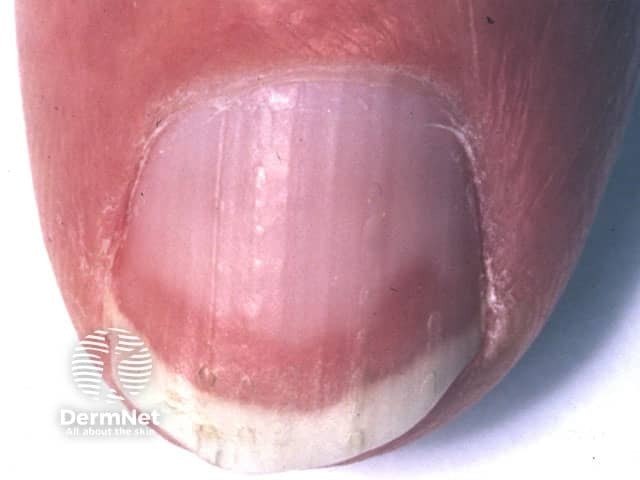
The image shows Terry's nails — a clinical sign characterized by:
- Proximal ~80% of the nail bed appears white/pale
- Narrow distal pink or red-brown band (1–3 mm) at the free edge
- The lunula is obscured and not separately visible
- Nail surface is smooth (no pitting or ridging)
Why It Occurs
The whitish discoloration results from:
- Reduced vascularity of the nail bed
- Connective tissue changes beneath the nail plate
- Hypoalbuminemia causing edema of the nail bed stroma, which compresses the capillaries and makes them less visible
Associations (Classic "Terry's Triad" and beyond)
| Condition | Notes |
|---|---|
| Liver cirrhosis | Most classic association (Terry's original description, 1954) |
| Congestive heart failure | Reduced perfusion |
| Type 2 Diabetes mellitus | Microvascular disease |
| Malnutrition / Hypoalbuminemia | Nail bed edema |
| Aging | Can be a benign finding in elderly |
| Renal failure | Overlap with Lindsay's nails |
How to Distinguish from Similar Signs
| Sign | Appearance | Association |
|---|---|---|
| Terry's nails | ~80% white proximally + narrow distal pink band | Liver disease, CHF, DM |
| Lindsay's nails (half-and-half) | Exactly 50% white + 50% brown/pink distally | Chronic kidney disease |
| Muehrcke's lines | Paired white transverse bands, nail bed normal | Hypoalbuminemia |
| Leukonychia | True white of the nail plate itself | Trauma, hypoalbuminemia |
Clinical Workup When Terry's Nails Are Found
- Liver function tests (AST, ALT, bilirubin, albumin)
- Serum albumin and total protein (nutritional status)
- Echocardiography / BNP (cardiac function)
- Fasting glucose / HbA1c (diabetes)
- Renal function panel (creatinine, BUN)
Terry's nails are a noninvasive bedside biomarker that should prompt a systemic workup, as they often reflect significant underlying organ dysfunction before overt symptoms appear.
This is a shared conversation. Sign in to Orris to start your own chat.