
from Guyton and Hall Textbook of Medical Physiology (4th South Asia Edition) write a proper 5 mark short note on Motor aphasia.
Reading File
Finding Sources
Finding Sources
Reading File
Reading File
Motor Aphasia (Guyton and Hall Textbook of Medical Physiology, 4th South Asia Edition)
Definition
Motor aphasia is a disorder of language output in which a person is able to decide what they want to say and has formulated the thought correctly, but is unable to make the vocal apparatus produce the appropriate words — the vocal system emits noises rather than coordinated speech.
Site of Lesion
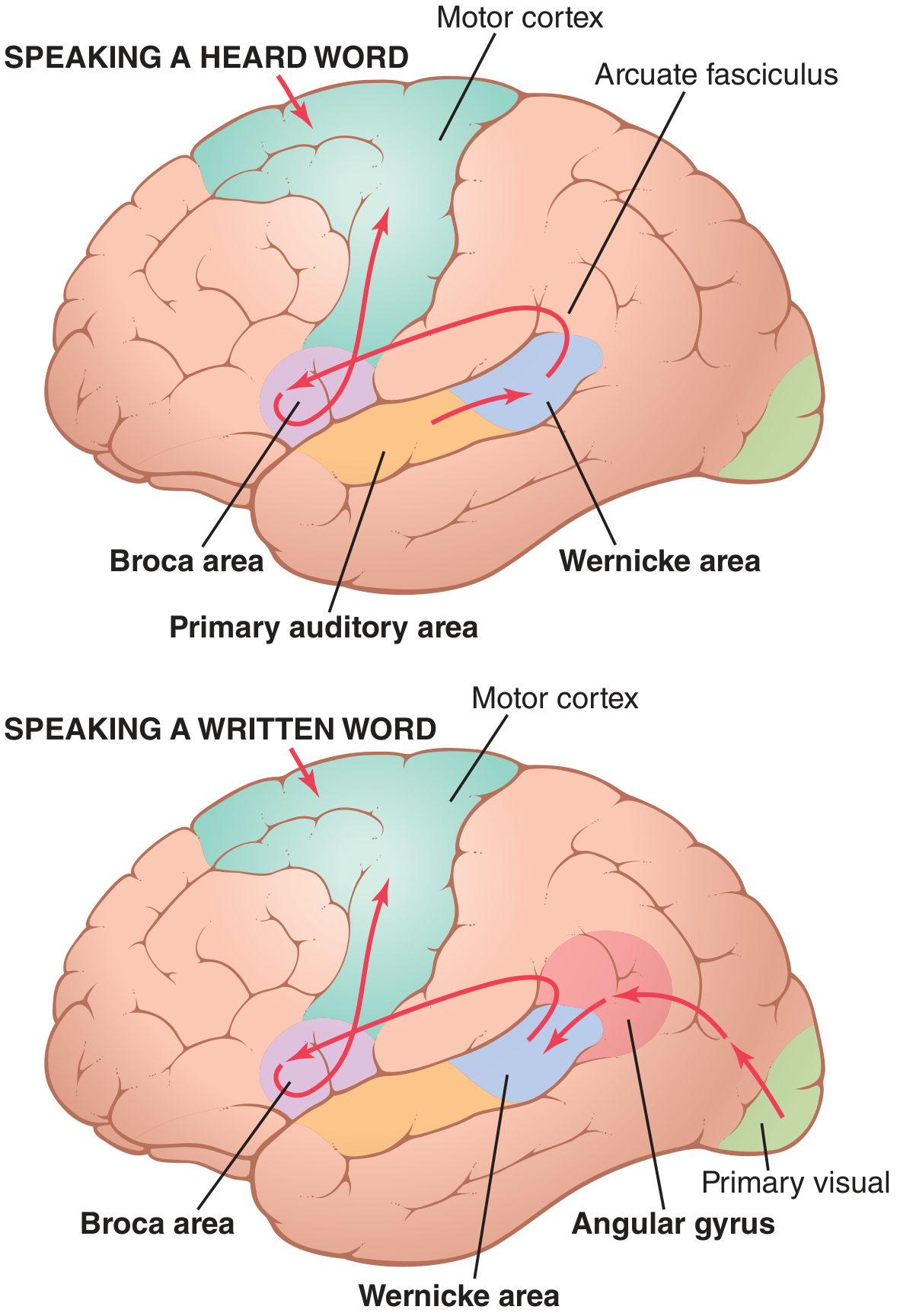
It results from damage to the Broca area, located in the prefrontal and premotor facial regions of the cerebral cortex. This area lies in the dominant hemisphere in about 95% of people (usually the left hemisphere).
Mechanism
- Speech involves two stages: (1) formation of thoughts and choice of words (function of the Wernicke area and sensory association cortex), and (2) motor control of vocalization (function of the Broca area).
- The Broca area initiates the skilled motor patterns required to control the larynx, lips, mouth, respiratory system, and other accessory muscles of speech.
- When this area is destroyed, the person can still think the words and understand language normally, but cannot coordinate the muscular movements needed to articulate them - hence it is also regarded as the "motor cortex for speech."
Clinical Features
- Comprehension of spoken and written language is preserved (unlike Wernicke aphasia).
- The person knows exactly what they want to say but speech is halting, effortful, or reduced to unintelligible sounds/noises rather than words.
- Distinguished from disorders of articulation, which involve destruction of the facial/laryngeal motor cortex, cerebellum, or basal ganglia (causing total or partial inability to speak distinctly even though word selection and Broca-area function are intact).
Distinction from Wernicke/Global Aphasia
Wernicke aphasia (posterior superior temporal gyrus lesion) impairs the understanding and formulation of thought/language, while global aphasia (widespread Wernicke-area damage extending into the angular gyrus and temporal lobe) causes near-total loss of language comprehension and communication. Motor (Broca) aphasia, in contrast, spares comprehension and thought formulation but selectively cripples the motor execution of speech.
- Guyton and Hall Textbook of Medical Physiology, Ch. 58 "Function of the Brain in Communication - Language Input and Language Output," p. 722
This is a shared conversation. Sign in to Orris to start your own chat.