
Difference between huners syndrome and hurlers syndrome
Hurler Syndrome vs Hunter Syndrome
Both are mucopolysaccharidoses (lysosomal storage disorders) caused by defective breakdown of glycosaminoglycans (GAGs), but they differ in genetics, enzyme deficiency, and clinical severity.
| Feature | Hurler Syndrome (MPS I) | Hunter Syndrome (MPS II) |
|---|---|---|
| Enzyme deficient | Alpha-L-iduronidase | Iduronate-2-sulfatase |
| Inheritance | Autosomal recessive | X-linked recessive (affects males) |
| Severity | More severe | Generally milder |
| Corneal clouding | Present | Absent (a key distinguishing sign) |
| Developmental delay | Severe | Less severe |
| Facial/skeletal features | Coarse facies, macrocephaly, short neck, pectus excavatum, kyphosis, dwarfism, joint stiffness | Similar coarse features but typically less pronounced, progresses more slowly |
| Skin findings | Can show dermal melanocytosis (Mongolian spots), hirsutism | Pebbly skin lesions can occur, characteristic of Hunter syndrome |
| Survival | Often death in childhood (by age 6-10 in severe form) | Variable - can survive into adulthood depending on severity |
As Adams and Victor's Principles of Neurology summarizes it: "The Hurler and Hunter syndromes are clinically alike except that the Hunter form is milder: developmental delay is less severe... Unlike the Hurler and other types, the Hunter form (MPS II) is transmitted as an X-linked trait" - Adams and Victor's Principles of Neurology, 12th Edition.
Robbins & Kumar Basic Pathology adds: "MPS type II, or Hunter syndrome, is caused by a deficiency of L-iduronate sulfatase. It differs from Hurler syndrome in its mode of inheritance (X-linked), the absence [of corneal clouding], and clinically milder course" - Robbins & Kumar Basic Pathology.
Both conditions share overlapping features because they involve accumulation of similar GAGs (dermatan sulfate and heparan sulfate), leading to organomegaly, skeletal dysostosis, and coarse facial features - but the X-linked inheritance and absence of corneal clouding are the most reliable clinical clues to distinguish Hunter from Hurler.
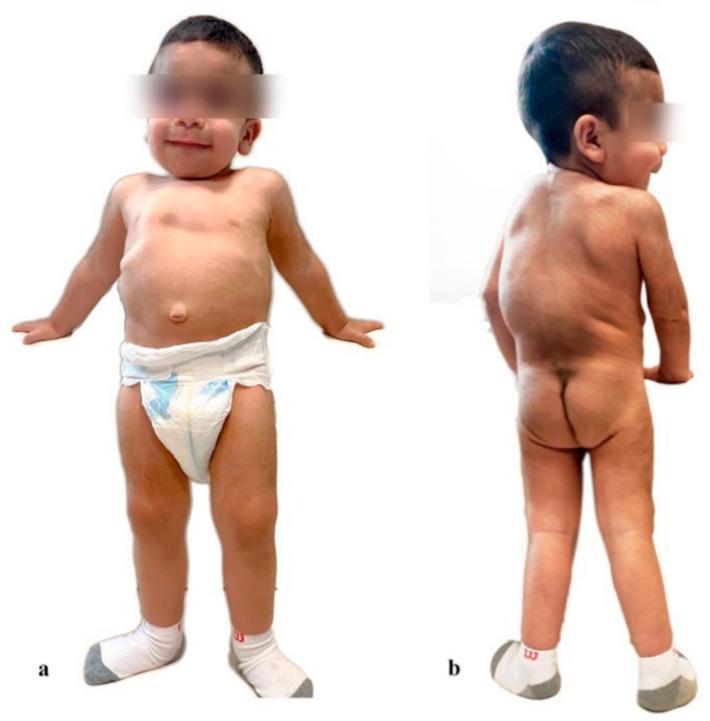
Image shows macrocephaly, short neck, pectus excavatum, umbilical hernia, dorsal kyphosis, and lumbosacral Mongolian spot characteristic of Hurler syndrome.
Difference between huners syndrome and hurlers syndrome for 3 mark questions in easy words
Difference between Hunter Syndrome and Hurler Syndrome (3 Marks)
| Point | Hurler Syndrome | Hunter Syndrome |
|---|---|---|
| 1. Enzyme deficient | Alpha-L-iduronidase enzyme is missing | Iduronate-2-sulfatase enzyme is missing |
| 2. Inheritance | Autosomal recessive (affects both boys and girls) | X-linked recessive (mainly affects boys) |
| 3. Severity & special sign | More severe; clouding of the cornea (eyes become cloudy) is present; children die earlier | Milder; NO corneal clouding (eyes stay clear); children may live longer |
Easy way to remember: Both are types of Mucopolysaccharidosis (MPS) caused by the body's inability to break down sugar chains called GAGs, which then build up in cells and cause coarse facial features, big head, short stature, and organ enlargement.
- Hurler = MPS I -> Autosomal recessive + cloudy cornea + severe
- Hunter = MPS II -> X-linked + clear cornea + milder
That covers genetics, enzyme, and clinical distinction - the three key points examiners look for.
This is a shared conversation. Sign in to Orris to start your own chat.