
What is potts fracture
Reading File
Searching for information on Pott's fracture now.
search_medical_text
Pott's fracture ankle bimalleolar classification
GradeResponse
GradeResponse
Pott's Fracture
Pott's fracture is a historic eponym coined after the English surgeon Percivall Pott (1714–1788), who famously sustained this injury himself after falling from his horse. The term refers to a bimalleolar fracture of the ankle — a fracture involving both the medial malleolus (distal tibia) and the lateral malleolus (distal fibula), often with associated ligamentous injury and lateral displacement of the foot.
Anatomy Involved
- Medial malleolus — the bony projection on the inner side of the ankle (distal tibia)
- Lateral malleolus — the bony projection on the outer side of the ankle (distal fibula)
- Deltoid ligament — medial stabilizer (may be torn instead of a bony fracture)
- Ankle mortise — the joint formed by tibia, fibula, and talus; disrupted in Pott's fracture
Mechanism of Injury
Typically caused by eversion/external rotation forces on the ankle:
- Twisting falls
- Sports injuries
- Road traffic accidents
- The talus levers outward, fracturing the fibula (lateral malleolus) and then the medial malleolus — or tears the deltoid ligament medially
Classification (Danis-Weber / AO System)
Modern classification uses the Weber system based on the level of fibular fracture relative to the syndesmosis:
| Weber Type | Fibular Fracture Level | Syndesmosis | Stability |
|---|---|---|---|
| A | Below syndesmosis | Intact | Stable |
| B | At the level of syndesmosis | Partially torn | Variable |
| C | Above syndesmosis | Disrupted | Unstable |
The Lauge-Hansen classification (based on mechanism) is also widely used:
- Supination-Adduction (SA)
- Supination-External Rotation (SER) — most common (~60%)
- Pronation-Abduction (PA)
- Pronation-External Rotation (PER)
Clinical Features
- Pain and tenderness over both malleoli
- Swelling and bruising around the ankle
- Deformity with possible lateral displacement of the foot
- Inability to weight-bear
- Neurovascular compromise in severe cases
Imaging
X-ray (AP, lateral, mortise views) is the primary investigation:
- Fracture lines at medial and/or lateral malleolus
- Talar shift (widening of medial clear space >4 mm indicates instability)
- Disruption of the ankle mortise
CT scan is used when:
- Intra-articular comminution is suspected
- Preoperative planning is needed
- Posterior malleolus involvement is present (trimalleolar fracture)
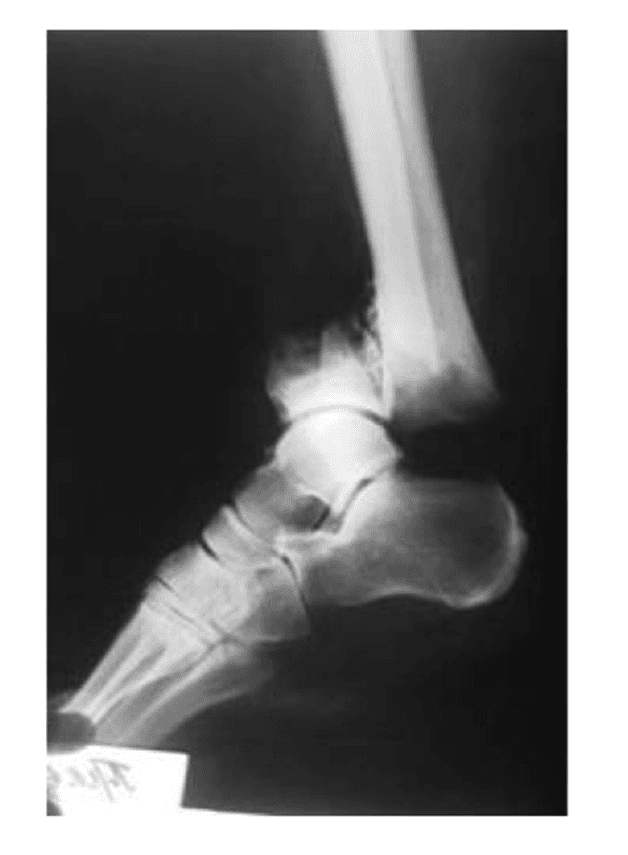
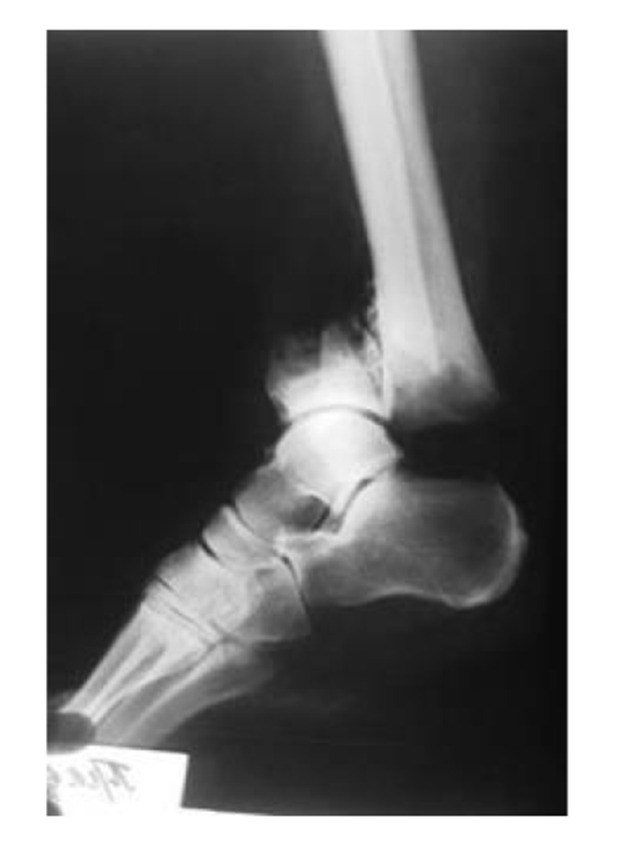
The image below shows a severe fracture-dislocation of the ankle with fibular and tibial fractures and posterior talar displacement — illustrating the end of the spectrum of Pott's-type injuries:
Management
Conservative (Non-operative)
Indicated for stable, undisplaced fractures:
- Below-knee plaster cast for 6–8 weeks
- Non-weight-bearing initially, then progressive weight-bearing
- Serial X-rays to confirm maintained reduction
Surgical (ORIF — Open Reduction Internal Fixation)
Indicated for:
- Displaced/unstable fractures
- Talar shift >2 mm
- Failed closed reduction
- Weber C fractures
Technique:
- Lateral malleolus fixed first (plate and screws, or intramedullary screw)
- Medial malleolus fixed second (cannulated screws or tension band wire)
- Syndesmotic screw if syndesmosis disrupted (removed at ~3 months)
Complications
| Complication | Details |
|---|---|
| Malunion / Non-union | Especially if undisplaced fracture treated with inadequate immobilization |
| Post-traumatic arthritis | Common if articular surface is disrupted |
| Wound infection | Post-surgical risk |
| DVT / PE | Prolonged immobilization |
| Stiffness | Ankle and subtalar joint |
| Compartment syndrome | In high-energy injuries |
Prognosis
- Stable, isolated fractures treated conservatively have good outcomes
- Bimalleolar and trimalleolar fractures have higher rates of post-traumatic osteoarthritis (~20–40%)
- Full recovery with return to activity typically takes 3–6 months
Note: The term "Pott's fracture" is sometimes used loosely to describe any ankle fracture involving both malleoli. In contemporary orthopedics, specific classification systems (Weber, Lauge-Hansen) are preferred for clinical and surgical decision-making.
This is a shared conversation. Sign in to Orris to start your own chat.