
Rmp gyton reference genrwl physiology
Reading File
The user is asking about Resting Membrane Potential (RMP) from Guyton's General Physiology. Let me search the library for this topic.
Finding Sources
Finding Sources
Guyton and Hall is in the library. Let me read both the RMP sections from Guyton.
Reading File
Reading File
Now let me fetch the key diagram images to show the user visually.
Loading Image
Loading Image
Here is a complete, textbook-accurate breakdown of Resting Membrane Potential (RMP) directly from Guyton and Hall Textbook of Medical Physiology (Chapter 5, pp. 78-79):
Resting Membrane Potential (RMP) - Guyton & Hall
Definition
The RMP of a large nerve fiber at rest (not transmitting signals) is approximately -70 mV (inside of the fiber is 70 mV more negative than the outside extracellular fluid).
Key Factors Responsible for RMP
1. The Na⁺-K⁺ (Sodium-Potassium) Pump
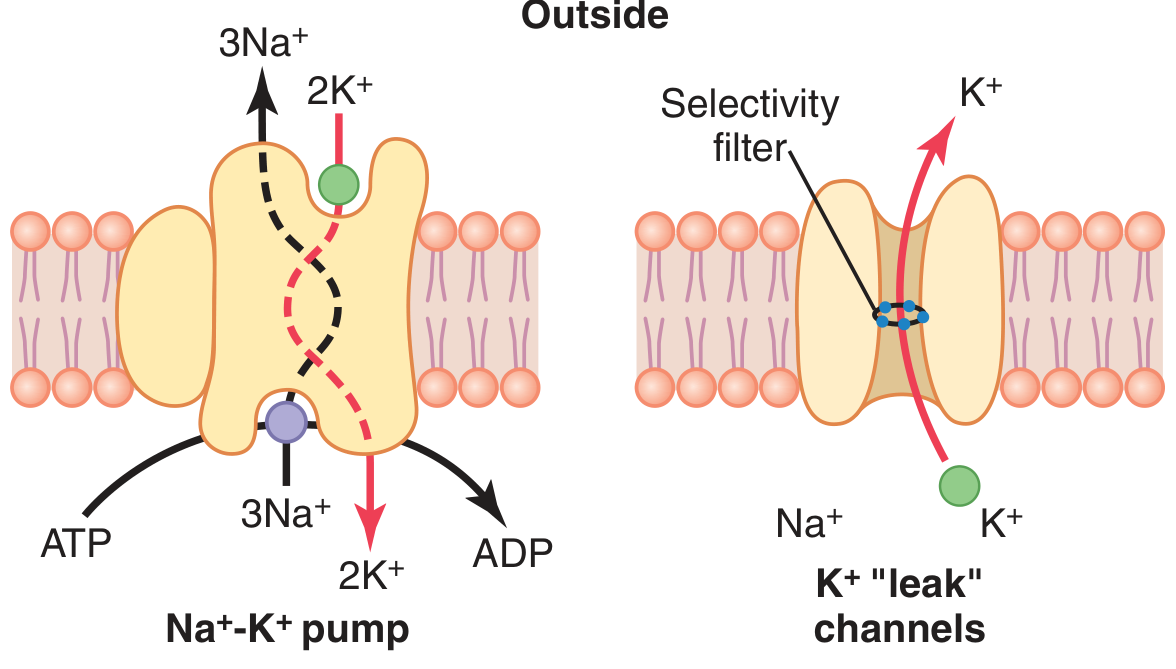
- Continuously pumps 3 Na⁺ out for every 2 K⁺ in (electrogenic pump)
- This creates a net loss of positive charges from inside the cell
- Maintains concentration gradients:
| Ion | Outside | Inside |
|---|---|---|
| Na⁺ | 142 mEq/L | 14 mEq/L |
| K⁺ | 4 mEq/L | 140 mEq/L |
- Na inside/outside ratio = 0.1
- K inside/outside ratio = 35.0
2. K⁺ "Leak" Channels (Tandem Pore Domain Channels)
- Always open at rest - allow K⁺ to leak out down its concentration gradient
- These channels are about 100 times more permeable to K⁺ than Na⁺
- K⁺ leaking out carries positive charge outside, making the inside more negative
Origin of the RMP - Three Contributions
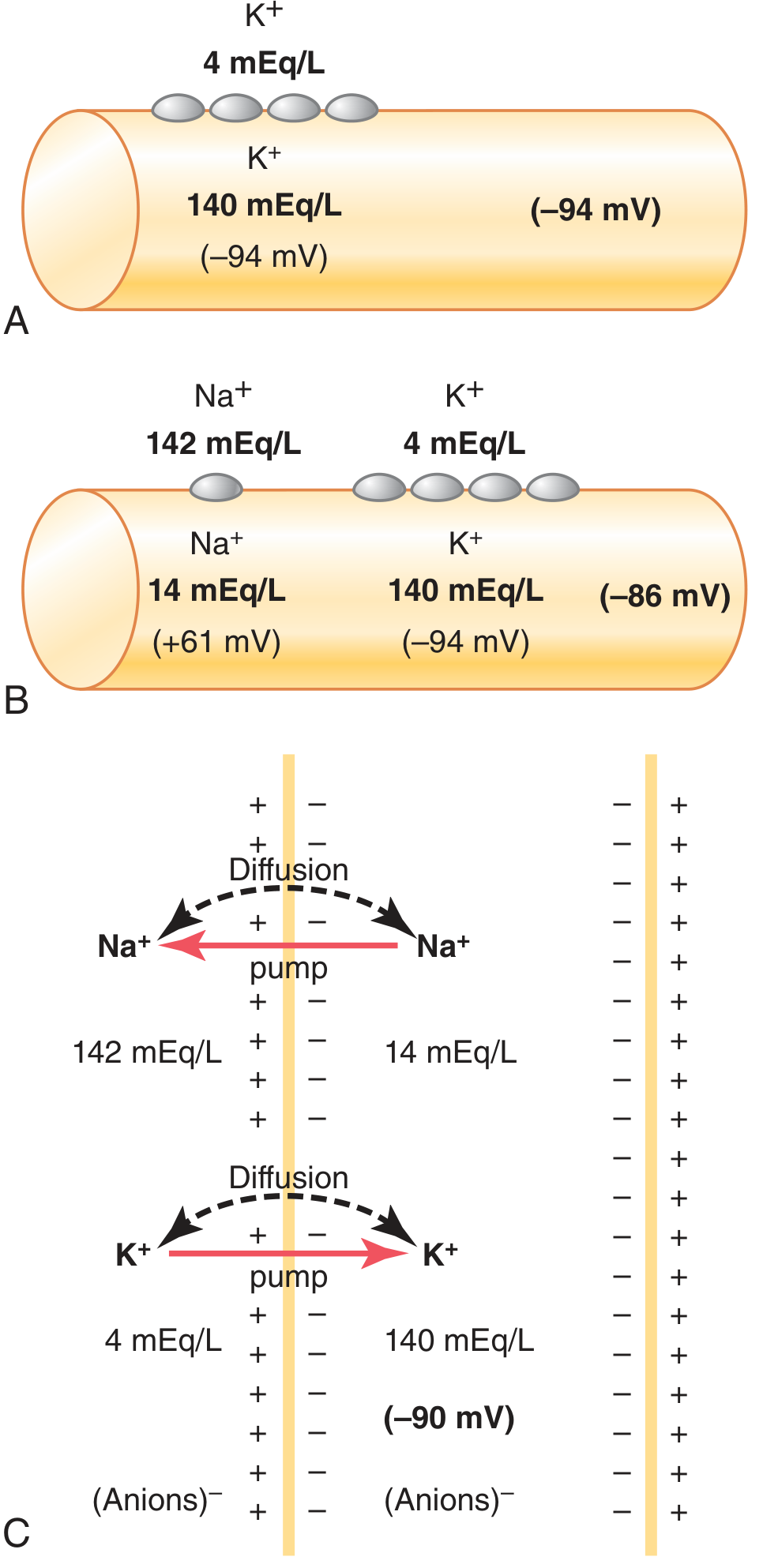
(A) K⁺ Diffusion Alone
- If only K⁺ moved, the Nernst potential = -94 mV
- (Log of 35 = 1.54; × -61 mV = -94 mV)
(B) Na⁺ + K⁺ Diffusion (Goldman Equation)
- Na⁺ Nernst potential = +61 mV (ratio 0.1 inside/outside)
- K⁺ Nernst potential = -94 mV
- Since membrane is 100x more permeable to K⁺ than Na⁺, K⁺ dominates
- Using Goldman equation: resultant potential = -86 mV
(C) Diffusion + Na⁺-K⁺ Pump (Full Picture)
- The electrogenic pump adds an additional -4 mV of negativity
- Final RMP = -90 mV (theoretical)
- Clinically quoted as -70 mV for a resting large nerve fiber
Summary of Contributions
| Factor | Contribution |
|---|---|
| K⁺ diffusion (mainly) | ~-86 mV |
| Electrogenic Na⁺-K⁺ pump | ~-4 mV additional |
| Net theoretical RMP | ~-90 mV |
| Quoted RMP (large nerve fiber) | ~-70 mV |
Key Points to Remember
- K⁺ is the main determinant of RMP because the membrane is far more permeable to K⁺ at rest
- The Na⁺-K⁺ pump is both concentrogenic (maintains ion gradients) and electrogenic (directly contributes ~4 mV)
- The Goldman-Hodgkin-Katz (GHK) equation accounts for multiple ions and their relative permeabilities to calculate the actual RMP
- Chloride ions must also be considered for a truly accurate calculation
Source: Guyton and Hall Textbook of Medical Physiology, Chapter 5 - Membrane Potentials and Action Potentials, pp. 78-79
This is a shared conversation. Sign in to Orris to start your own chat.