
Vitamin k biochemistry
Vitamin K - Biochemistry
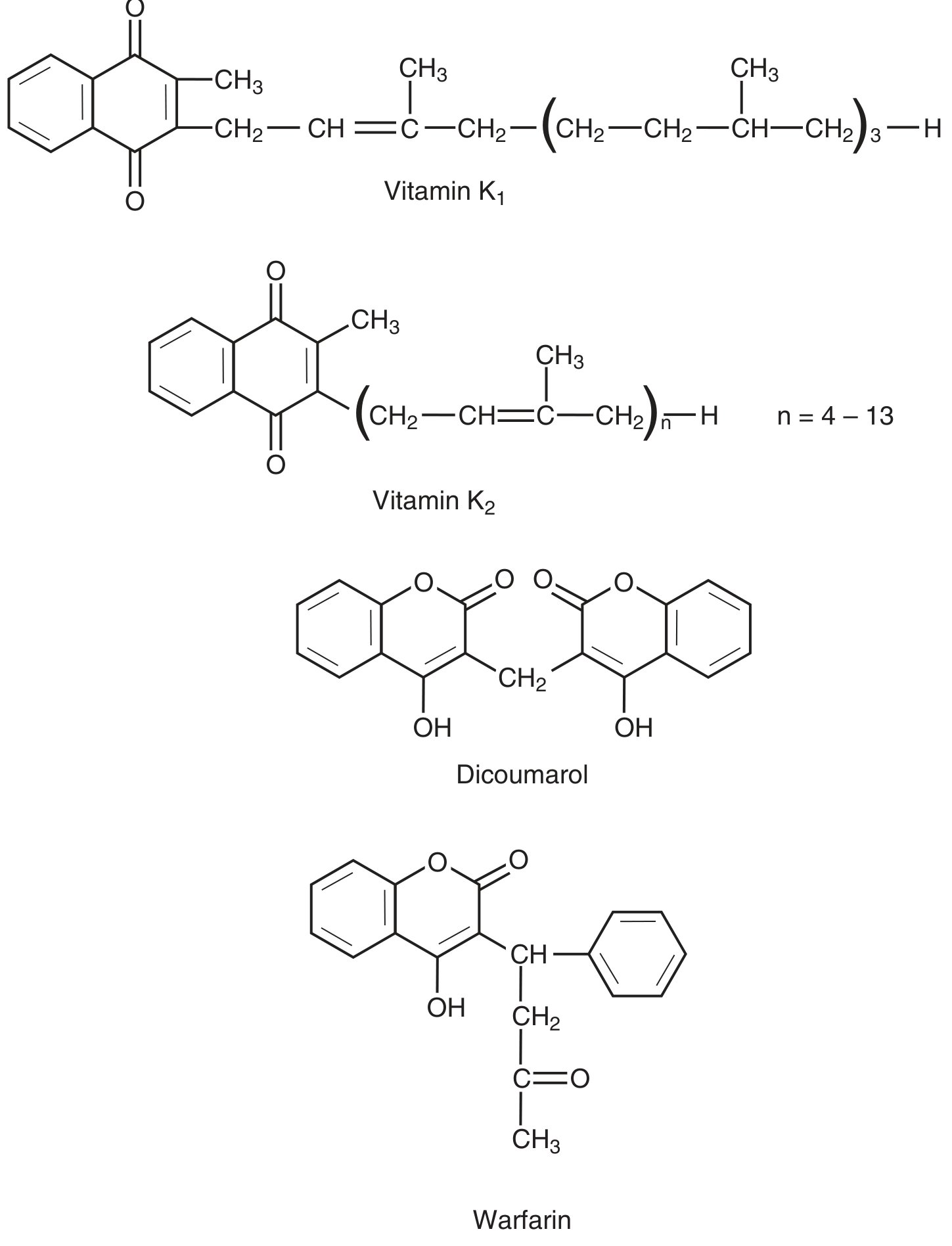
1. Structure and Forms
| Form | Name | Source |
|---|---|---|
| Vitamin K1 | Phylloquinone (phytomenadione) | Green leafy vegetables; role in photosynthesis |
| Vitamin K2 | Menaquinone (MK-4 to MK-13) | Synthesized by colonic bacteria; found in animal tissues |
| Vitamin K3 | Menadione | Synthetic; no longer used therapeutically due to toxicity |
2. The Core Biochemical Reaction: γ-Carboxylation
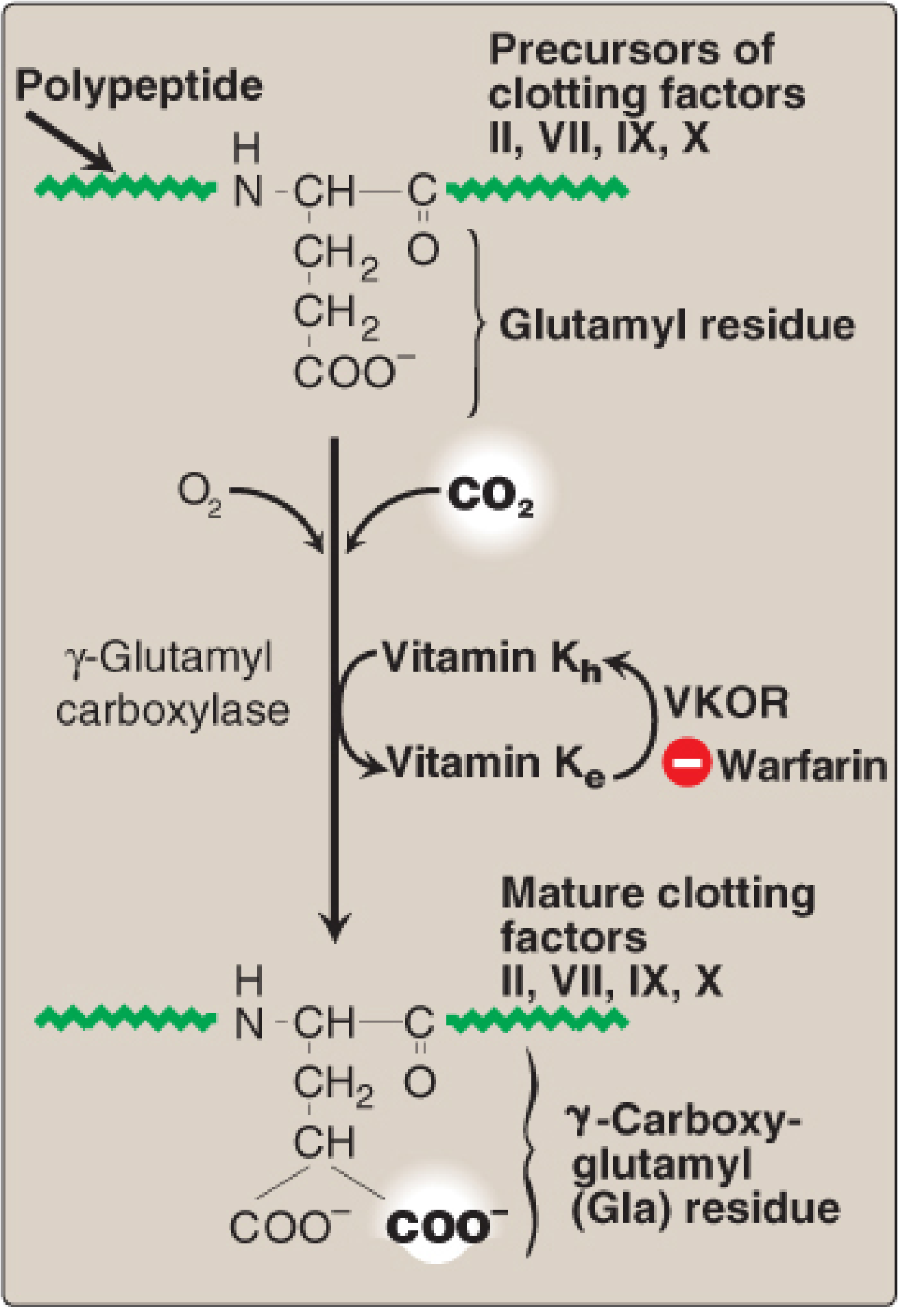
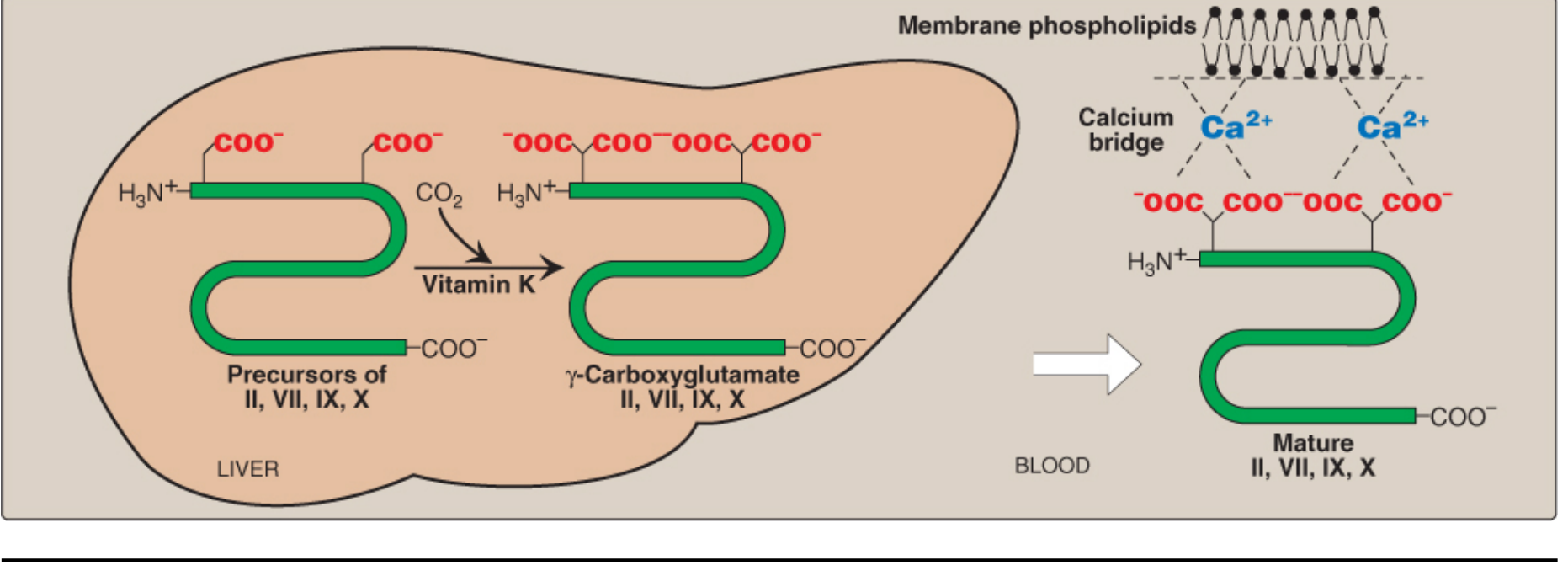
- The enzyme carboxylates glutamic acid (Glu) residues at the gamma-carbon position
- This converts Glu → γ-carboxyglutamic acid (Gla)
- Each Gla residue now has two adjacent carboxyl groups (-COO⁻)
- These bind Ca²⁺, which in turn allows the protein to anchor to phospholipid membrane surfaces
- KH₂ is oxidized → Vitamin K epoxide (KO)
- This is then recycled back to KH₂ by two sequential enzymes:
- Vitamin K epoxide reductase (VKOR) - converts KO → K (quinone)
- NADH-dependent quinone reductase - converts K → KH₂ (hydroquinone)
3. Vitamin K-Dependent Proteins (Gla Proteins)
- Factor II (Prothrombin)
- Factor VII
- Factor IX
- Factor X
- Protein C
- Protein S
- Protein Z
- Osteocalcin - most abundant Gla protein in the body; present in osteoblasts, role in bone mineralization
- Matrix Gla protein (MGP) - inhibits vascular calcification
- Periostin and Gla-rich protein - bone/extracellular matrix
4. Warfarin and VKOR Inhibition
- Warfarin inhibits VKOR (vitamin K epoxide reductase)
- This blocks the regeneration of active KH₂ from the epoxide form
- γ-Carboxylase is starved of its KH₂ cofactor
- New clotting factor precursors (II, VII, IX, X) are synthesized but remain undercarboxylated and cannot bind Ca²⁺ or phospholipid surfaces
- Coagulation cascade is effectively blocked
5. Dietary Sources and Requirements
| Source | Notes |
|---|---|
| Green leafy vegetables (kale, spinach, cabbage) | Primary source of K1 |
| Vegetable/canola/soybean/olive oil | Appreciable K1 content |
| Liver, egg yolk | Both K1 and K2 |
| Intestinal bacteria (gut microbiome) | Synthesize K2 (menaquinones) |
- Adult males: 120 μg/day
- Adult females: 90 μg/day
- Average American intake: ~100 μg/day
6. Deficiency
- Newborns (most susceptible): sterile intestines at birth → no bacterial K2 synthesis; poor placental transfer; breast milk contains only ~⅕ of daily requirement; immature liver; low fat stores
- Patients on broad-spectrum antibiotics (reduce gut flora)
- Fat malabsorption syndromes (celiac disease, Crohn's, biliary obstruction)
- Patients on prolonged parenteral nutrition without K supplementation
- Alcoholics (poor intake + liver disease)
- Patients on cephalosporins (e.g., cefamandole) - inhibit VKOR by a warfarin-like mechanism
- Patients taking orlistat (impairs fat-soluble vitamin absorption)
- Hemorrhage (ecchymoses, GI bleeding, intracranial bleeding)
- Prolonged PT/INR (factor VII has the shortest half-life, so PT is most sensitive early)
- Elevated APTT
- Normal platelet count (platelet function unaffected)
- Serum phylloquinone (K1) < 0.15 μg/L = deficiency
- PIVKA-II (undercarboxylated prothrombin) - sensitive marker of cellular K utilization
- PT/INR - useful in severe deficiency but non-specific
- Prophylaxis in newborns: 0.5-1 mg IM at birth
- Deficiency in adults: 10 mg IV (slow infusion over 15-30 min); onset of action within 2-4 hours
- Chronic malabsorption: 1-2 mg/day orally or 1-2 mg/week parenterally
7. Toxicity
- Natural forms (K1, K2): no upper tolerable limit set; no toxicity described
- Menadione (K3): high doses in infants → hemolytic anemia + jaundice (due to toxic effects on RBC membrane). This is why menadione is no longer used therapeutically
- High pharmacological doses of K1/K2 can blunt oral anticoagulant therapy
Summary Diagram (Vitamin K Cycle)
                   DIET (K1)
                      ↓
               Intestinal absorption (fat-soluble)
                      ↓
          Vitamin K quinone (inactive)
                      ↓ NADH-quinone reductase
          Vitamin K hydroquinone KH₂ (active)
                      ↓ γ-Glutamyl carboxylase + O₂ + CO₂
    Glu residues → Gla residues (in clotting factors, osteocalcin, etc.)
                      ↑                    ↓
          VKOR ←  Vitamin K epoxide (KO)  [Warfarin blocks VKOR here]
- Tietz Textbook of Laboratory Medicine, 7th ed. - Nature, Sources, and Function (p. 1685)
- Lippincott's Illustrated Biochemistry, 8th ed. - Ch. 28 (pp. 1095-1097)
- Harrison's Principles of Internal Medicine 22E - Ch. 344
- Basic Medical Biochemistry (6e) - Ch. 43 (p. 1560)
- Henry's Clinical Diagnosis and Management by Laboratory Methods - Vitamin K Deficiency section
Create a flowchart or summary document on vitamin K biochemistry
What format would you like?
ls /home/daytona/workspace/ 2>/dev/null && echo "---" && node --version
mkdir -p /home/daytona/workspace/vitaminK-pptx && node -e "require('pptxgenjs')" && echo "pptxgenjs OK"
~/vitaminK-pptx/build.js
const pptxgen = require("pptxgenjs");

const pres = new pptxgen();
pres.layout = "LAYOUT_16x9";
pres.title = "Vitamin K Biochemistry";
pres.author = "Orris Medical";

// ── Palette ──────────────────────────────────────────────
const C = {
  darkGreen:  "1A4731",   // dominant dark bg
  midGreen:   "2E7D52",   // section headers
  limeAccent: "A8D5B5",   // highlight accent
  lightGreen: "D6EFE1",   // light panel bg
  white:      "FFFFFF",
  offWhite:   "F4FAF7",
  amber:      "E8A020",   // warning / warfarin
  red:        "C0392B",   // deficiency
  blue:       "2471A3",   // calcium / coagulation
  charcoal:   "2C3E50",
  lightGray:  "ECF0F1",
};

// ── Helper: slide background ─────────────────────────────
function darkSlide(slide) {
  slide.background = { color: C.darkGreen };
}
function lightSlide(slide) {
  slide.background = { color: C.offWhite };
}

// ── Helper: section header bar ───────────────────────────
function addHeaderBar(slide, title, subtitle) {
  slide.addShape(pres.shapes.RECTANGLE, {
    x: 0, y: 0, w: 10, h: 1.0,
    fill: { color: C.midGreen }, line: { color: C.midGreen }
  });
  slide.addShape(pres.shapes.RECTANGLE, {
    x: 0, y: 1.0, w: 10, h: 0.07,
    fill: { color: C.limeAccent }, line: { color: C.limeAccent }
  });
  slide.addText(title, {
    x: 0.3, y: 0.05, w: 9.4, h: 0.9,
    fontSize: 24, bold: true, color: C.white, valign: "middle", margin: 0
  });
  if (subtitle) {
    slide.addText(subtitle, {
      x: 0.3, y: 0.62, w: 9.4, h: 0.35,
      fontSize: 12, color: C.limeAccent, italic: true, margin: 0
    });
  }
}

// ── Helper: small section pill ───────────────────────────
function pill(slide, label, x, y, w, h, fillColor, textColor) {
  slide.addShape(pres.shapes.ROUNDED_RECTANGLE, {
    x, y, w, h, rectRadius: 0.08,
    fill: { color: fillColor }, line: { color: fillColor }
  });
  slide.addText(label, {
    x, y, w, h,
    fontSize: 11, bold: true, color: textColor,
    align: "center", valign: "middle", margin: 0
  });
}

// ── Helper: info card ────────────────────────────────────
function card(slide, x, y, w, h, title, bullets, titleBg, titleFg, cardBg) {
  slide.addShape(pres.shapes.RECTANGLE, {
    x, y, w, h,
    fill: { color: cardBg || C.white },
    line: { color: titleBg, pt: 1.5 },
    shadow: { type: "outer", color: "000000", blur: 4, offset: 2, angle: 135, opacity: 0.1 }
  });
  slide.addShape(pres.shapes.RECTANGLE, {
    x, y, w, h: 0.38,
    fill: { color: titleBg }, line: { color: titleBg }
  });
  slide.addText(title, {
    x: x + 0.08, y: y, w: w - 0.16, h: 0.38,
    fontSize: 11, bold: true, color: titleFg || C.white,
    valign: "middle", margin: 0
  });
  const items = bullets.map((b, i) => ({
    text: b,
    options: { bullet: { code: "2022" }, fontSize: 10, color: C.charcoal, breakLine: i < bullets.length - 1 }
  }));
  slide.addText(items, {
    x: x + 0.1, y: y + 0.42, w: w - 0.2, h: h - 0.5,
    valign: "top"
  });
}

// ── Helper: arrow (right) ────────────────────────────────
function arrowRight(slide, x, y, w, h, color) {
  slide.addShape(pres.shapes.RIGHT_ARROW, {
    x, y, w, h,
    fill: { color: color || C.limeAccent },
    line: { color: color || C.limeAccent }
  });
}

// ── Helper: arrow (down) ─────────────────────────────────
function arrowDown(slide, x, y, w, h, color) {
  slide.addShape(pres.shapes.DOWN_ARROW, {
    x, y, w, h,
    fill: { color: color || C.limeAccent },
    line: { color: color || C.limeAccent }
  });
}

// ═══════════════════════════════════════════════════════
// SLIDE 1 — Title
// ═══════════════════════════════════════════════════════
{
  const s = pres.addSlide();
  darkSlide(s);

  // Big green accent block left
  s.addShape(pres.shapes.RECTANGLE, {
    x: 0, y: 0, w: 0.18, h: 5.625,
    fill: { color: C.limeAccent }, line: { color: C.limeAccent }
  });

  s.addText("VITAMIN K", {
    x: 0.5, y: 0.9, w: 9, h: 1.1,
    fontSize: 64, bold: true, color: C.white,
    charSpacing: 8, align: "left", margin: 0
  });

  s.addText("Biochemistry", {
    x: 0.5, y: 1.95, w: 7, h: 0.7,
    fontSize: 36, bold: false, color: C.limeAccent,
    italic: true, align: "left", margin: 0
  });

  // Horizontal divider
  s.addShape(pres.shapes.RECTANGLE, {
    x: 0.5, y: 2.75, w: 5.5, h: 0.06,
    fill: { color: C.midGreen }, line: { color: C.midGreen }
  });

  s.addText([
    { text: "Structure  •  ", options: { color: C.limeAccent } },
    { text: "γ-Carboxylation Cycle  •  ", options: { color: C.white } },
    { text: "Gla Proteins  •  ", options: { color: C.limeAccent } },
    { text: "Deficiency  •  ", options: { color: C.white } },
    { text: "Warfarin Pharmacology", options: { color: C.limeAccent } }
  ], {
    x: 0.5, y: 2.9, w: 9, h: 0.55,
    fontSize: 13, align: "left", margin: 0
  });

  s.addText("Sources: Tietz Lab Medicine 7e · Lippincott Biochemistry 8e · Harrison's 22e · Basic Medical Biochemistry 6e", {
    x: 0.5, y: 5.15, w: 9, h: 0.3,
    fontSize: 9, color: "7FB89A", italic: true, align: "left", margin: 0
  });
}

// ═══════════════════════════════════════════════════════
// SLIDE 2 — Overview: Forms & Sources
// ═══════════════════════════════════════════════════════
{
  const s = pres.addSlide();
  lightSlide(s);
  addHeaderBar(s, "Vitamin K — Forms, Sources & Properties", "Fat-soluble naphthoquinone vitamin");

  // Three form cards
  const forms = [
    {
      name: "Vitamin K₁",
      sub: "Phylloquinone\n(Phytomenadione)",
      color: C.midGreen,
      source: "Green leafy vegetables\n(kale, spinach, cabbage)",
      note: "Role in plant photosynthesis"
    },
    {
      name: "Vitamin K₂",
      sub: "Menaquinone\n(MK-4 to MK-13)",
      color: C.blue,
      source: "Gut bacteria synthesis\nHepatic tissue, fermented foods",
      note: "Major animal form; n = 4-13 isoprene units"
    },
    {
      name: "Vitamin K₃",
      sub: "Menadione\n(Synthetic)",
      color: C.amber,
      source: "No dietary source\n(synthetic only)",
      note: "No longer therapeutic — causes hemolytic anemia in neonates"
    }
  ];

  forms.forEach((f, i) => {
    const x = 0.25 + i * 3.22;
    const y = 1.35;
    const w = 3.0;
    const h = 3.7;
    s.addShape(pres.shapes.RECTANGLE, {
      x, y, w, h,
      fill: { color: C.white },
      line: { color: f.color, pt: 2 },
      shadow: { type: "outer", color: "000000", blur: 5, offset: 2, angle: 135, opacity: 0.12 }
    });
    // Color top band
    s.addShape(pres.shapes.RECTANGLE, {
      x, y, w, h: 0.75,
      fill: { color: f.color }, line: { color: f.color }
    });
    s.addText(f.name, {
      x: x + 0.1, y: y + 0.05, w: w - 0.2, h: 0.35,
      fontSize: 18, bold: true, color: C.white, align: "center", margin: 0
    });
    s.addText(f.sub, {
      x: x + 0.1, y: y + 0.38, w: w - 0.2, h: 0.38,
      fontSize: 10, color: C.limeAccent, align: "center", italic: true, margin: 0
    });
    // Source
    s.addText("Source", {
      x: x + 0.1, y: y + 0.85, w: w - 0.2, h: 0.28,
      fontSize: 10, bold: true, color: f.color, margin: 0
    });
    s.addText(f.source, {
      x: x + 0.1, y: y + 1.12, w: w - 0.2, h: 0.65,
      fontSize: 10, color: C.charcoal, margin: 0
    });
    // Note
    s.addShape(pres.shapes.RECTANGLE, {
      x: x + 0.1, y: y + 1.85, w: w - 0.2, h: 0.04,
      fill: { color: C.lightGray }, line: { color: C.lightGray }
    });
    s.addText("Key Note", {
      x: x + 0.1, y: y + 1.95, w: w - 0.2, h: 0.28,
      fontSize: 10, bold: true, color: f.color, margin: 0
    });
    s.addText(f.note, {
      x: x + 0.1, y: y + 2.22, w: w - 0.2, h: 1.0,
      fontSize: 10, color: C.charcoal, margin: 0
    });
  });

  // Bottom bar: requirements
  s.addShape(pres.shapes.RECTANGLE, {
    x: 0, y: 5.1, w: 10, h: 0.52,
    fill: { color: C.darkGreen }, line: { color: C.darkGreen }
  });
  s.addText([
    { text: "Dietary Requirements:  ", options: { bold: true, color: C.limeAccent } },
    { text: "Adult Males 120 μg/day  ", options: { color: C.white } },
    { text: "•  ", options: { color: C.limeAccent } },
    { text: "Adult Females 90 μg/day  ", options: { color: C.white } },
    { text: "•  ", options: { color: C.limeAccent } },
    { text: "K1 converts to K2 in some organs  ", options: { color: C.white } },
    { text: "•  ", options: { color: C.limeAccent } },
    { text: "Fat-soluble → needs bile salts for absorption", options: { color: C.white } }
  ], {
    x: 0.3, y: 5.1, w: 9.5, h: 0.52,
    fontSize: 11, valign: "middle", margin: 0
  });
}

// ═══════════════════════════════════════════════════════
// SLIDE 3 — Chemical Structure (naphthoquinone core)
// ═══════════════════════════════════════════════════════
{
  const s = pres.addSlide();
  lightSlide(s);
  addHeaderBar(s, "Chemical Structure — Naphthoquinone Core", "All forms share the 2-methyl-1,4-naphthoquinone ring system");

  // Central core box
  s.addShape(pres.shapes.RECTANGLE, {
    x: 3.2, y: 1.3, w: 3.6, h: 1.3,
    fill: { color: C.lightGreen }, line: { color: C.midGreen, pt: 2 },
    shadow: { type: "outer", color: "000000", blur: 5, offset: 2, angle: 135, opacity: 0.15 }
  });
  s.addText("2-Methyl-1,4-naphthoquinone", {
    x: 3.2, y: 1.3, w: 3.6, h: 0.45,
    fontSize: 13, bold: true, color: C.midGreen, align: "center", valign: "middle", margin: 0
  });
  s.addText("• Bicyclic aromatic ring (naphthalene)\n• Two ketone groups at C1 & C4\n• Methyl group at C2\n• Active nucleus common to ALL forms", {
    x: 3.3, y: 1.75, w: 3.4, h: 0.85,
    fontSize: 9.5, color: C.charcoal, margin: 0
  });

  // K1 side chain
  s.addShape(pres.shapes.RECTANGLE, {
    x: 0.2, y: 1.4, w: 2.6, h: 1.1,
    fill: { color: C.white }, line: { color: C.midGreen, pt: 1.5 }
  });
  s.addText("K₁ Side Chain", {
    x: 0.2, y: 1.4, w: 2.6, h: 0.35,
    fontSize: 11, bold: true, color: C.white,
    fill: { color: C.midGreen }, align: "center", valign: "middle", margin: 0
  });
  s.addShape(pres.shapes.RECTANGLE, {
    x: 0.2, y: 1.4, w: 2.6, h: 0.35,
    fill: { color: C.midGreen }, line: { color: C.midGreen }
  });
  s.addText("K₁ Side Chain", {
    x: 0.2, y: 1.4, w: 2.6, h: 0.35,
    fontSize: 11, bold: true, color: C.white, align: "center", valign: "middle", margin: 0
  });
  s.addText("Phytyl group\n(saturated except Δ2')\nC20 chain from C3 position", {
    x: 0.3, y: 1.78, w: 2.4, h: 0.75,
    fontSize: 9.5, color: C.charcoal, margin: 0
  });

  // Arrow K1 → core
  s.addShape(pres.shapes.RIGHT_ARROW, {
    x: 2.85, y: 1.7, w: 0.32, h: 0.35,
    fill: { color: C.midGreen }, line: { color: C.midGreen }
  });

  // K2 side chain
  s.addShape(pres.shapes.RECTANGLE, {
    x: 7.2, y: 1.4, w: 2.6, h: 1.1,
    fill: { color: C.white }, line: { color: C.blue, pt: 1.5 }
  });
  s.addShape(pres.shapes.RECTANGLE, {
    x: 7.2, y: 1.4, w: 2.6, h: 0.35,
    fill: { color: C.blue }, line: { color: C.blue }
  });
  s.addText("K₂ Side Chain", {
    x: 7.2, y: 1.4, w: 2.6, h: 0.35,
    fontSize: 11, bold: true, color: C.white, align: "center", valign: "middle", margin: 0
  });
  s.addText("Polyisoprenyl group\nn = 4–13 isoprene units\n(MK-4 to MK-13)", {
    x: 7.3, y: 1.78, w: 2.4, h: 0.75,
    fontSize: 9.5, color: C.charcoal, margin: 0
  });

  // Arrow core → K2
  s.addShape(pres.shapes.RIGHT_ARROW, {
    x: 6.82, y: 1.7, w: 0.35, h: 0.35,
    fill: { color: C.blue }, line: { color: C.blue }
  });

  // Warfarin / Dicoumarol structural analogy box
  s.addShape(pres.shapes.RECTANGLE, {
    x: 0.2, y: 3.0, w: 9.6, h: 2.3,
    fill: { color: C.white },
    line: { color: C.amber, pt: 2 },
    shadow: { type: "outer", color: "000000", blur: 5, offset: 2, angle: 135, opacity: 0.1 }
  });
  s.addShape(pres.shapes.RECTANGLE, {
    x: 0.2, y: 3.0, w: 9.6, h: 0.38,
    fill: { color: C.amber }, line: { color: C.amber }
  });
  s.addText("Vitamin K Antagonists — Structural Analogy", {
    x: 0.3, y: 3.0, w: 9.5, h: 0.38,
    fontSize: 13, bold: true, color: C.white, valign: "middle", margin: 0
  });

  // Two sub-boxes inside
  const analogs = [
    {
      name: "Warfarin",
      desc: "4-hydroxycoumarin derivative\nSingle coumarin ring + asymmetric carbon\nEnhanced oral bioavailability",
      mech: "Inhibits VKOR → blocks KO→KH₂ recycling"
    },
    {
      name: "Dicoumarol",
      desc: "Bis-coumarin (two coumarin rings linked by CH₂)\nFound in spoiled sweet clover\n(historical: caused cattle hemorrhage)",
      mech: "Same VKOR inhibition; parent compound of warfarin class"
    }
  ];
  analogs.forEach((a, i) => {
    const x = 0.4 + i * 4.8;
    s.addShape(pres.shapes.RECTANGLE, {
      x, y: 3.45, w: 4.6, h: 1.75,
      fill: { color: C.lightGreen }, line: { color: C.amber, pt: 1 }
    });
    s.addText(a.name, {
      x: x + 0.1, y: 3.47, w: 4.4, h: 0.3,
      fontSize: 12, bold: true, color: C.amber, margin: 0
    });
    s.addText(a.desc, {
      x: x + 0.1, y: 3.78, w: 4.4, h: 0.7,
      fontSize: 9.5, color: C.charcoal, margin: 0
    });
    s.addText("⚠ " + a.mech, {
      x: x + 0.1, y: 4.48, w: 4.4, h: 0.65,
      fontSize: 9.5, color: C.red, bold: true, margin: 0
    });
  });
}

// ═══════════════════════════════════════════════════════
// SLIDE 4 — The γ-Carboxylation Cycle (flowchart)
// ═══════════════════════════════════════════════════════
{
  const s = pres.addSlide();
  lightSlide(s);
  addHeaderBar(s, "The Vitamin K γ-Carboxylation Cycle", "Posttranslational modification of Glu residues → Gla residues in the ER");

  // ─────── Flow boxes ───────
  // Box 1: Dietary K1 / Bacterial K2
  s.addShape(pres.shapes.RECTANGLE, {
    x: 0.2, y: 1.25, w: 2.1, h: 1.0,
    fill: { color: C.lightGreen }, line: { color: C.midGreen, pt: 1.5 }
  });
  s.addText("Dietary K₁\nBacterial K₂", {
    x: 0.2, y: 1.25, w: 2.1, h: 1.0,
    fontSize: 11, bold: true, color: C.midGreen, align: "center", valign: "middle", margin: 0
  });

  arrowRight(s, 2.35, 1.6, 0.45, 0.3, C.midGreen);

  // Box 2: Vitamin K Quinone
  s.addShape(pres.shapes.RECTANGLE, {
    x: 2.82, y: 1.25, w: 1.9, h: 1.0,
    fill: { color: C.white }, line: { color: C.midGreen, pt: 1.5 }
  });
  s.addText("Vitamin K\nQuinone (K)", {
    x: 2.82, y: 1.25, w: 1.9, h: 1.0,
    fontSize: 10, bold: true, color: C.charcoal, align: "center", valign: "middle", margin: 0
  });

  // Arrow down from Quinone to KH2 (NADH reductase)
  arrowDown(s, 3.52, 2.28, 0.3, 0.4, C.midGreen);
  s.addText("NADH-quinone\nreductase", {
    x: 3.86, y: 2.3, w: 1.5, h: 0.4,
    fontSize: 8.5, color: C.midGreen, italic: true, margin: 0
  });

  // Box 3: KH2 (active hydroquinone)
  s.addShape(pres.shapes.RECTANGLE, {
    x: 2.82, y: 2.72, w: 1.9, h: 1.0,
    fill: { color: C.midGreen }, line: { color: C.midGreen }
  });
  s.addText("Vitamin KH₂\n(Hydroquinone)\nACTIVE FORM", {
    x: 2.82, y: 2.72, w: 1.9, h: 1.0,
    fontSize: 10, bold: true, color: C.white, align: "center", valign: "middle", margin: 0
  });

  arrowRight(s, 4.75, 3.07, 0.45, 0.3, C.midGreen);

  // Box 4: γ-Glutamyl Carboxylase reaction (centre)
  s.addShape(pres.shapes.RECTANGLE, {
    x: 5.22, y: 2.72, w: 2.5, h: 1.0,
    fill: { color: C.darkGreen }, line: { color: C.darkGreen }
  });
  s.addText([
    { text: "γ-Glutamyl Carboxylase\n", options: { bold: true, color: C.limeAccent } },
    { text: "Glu  →  Gla residues\n", options: { color: C.white } },
    { text: "+ CO₂ + O₂", options: { color: C.limeAccent } }
  ], {
    x: 5.22, y: 2.72, w: 2.5, h: 1.0,
    fontSize: 10, align: "center", valign: "middle", margin: 0
  });

  arrowRight(s, 7.75, 3.07, 0.45, 0.3, C.amber);

  // Box 5: K Epoxide
  s.addShape(pres.shapes.RECTANGLE, {
    x: 8.22, y: 2.72, w: 1.6, h: 1.0,
    fill: { color: C.white }, line: { color: C.amber, pt: 2 }
  });
  s.addText("Vitamin K\nEpoxide (KO)", {
    x: 8.22, y: 2.72, w: 1.6, h: 1.0,
    fontSize: 10, bold: true, color: C.amber, align: "center", valign: "middle", margin: 0
  });

  // Arrow up from KO back to Quinone (recycling arc - use two arrows)
  arrowDown(s, 8.72, 1.9, 0.3, 0.78, C.amber);   // down means toward K
  s.addShape(pres.shapes.RIGHT_ARROW, {
    x: 8.72, y: 1.25, w: 0.3, h: 0.65, // placeholder
    fill: { color: C.amber }, line: { color: C.amber }
  });

  // Recycling arrow from KO → K (up)
  s.addShape(pres.shapes.UP_ARROW, {
    x: 8.72, y: 1.25, w: 0.3, h: 1.43,
    fill: { color: C.amber }, line: { color: C.amber }
  });

  // VKOR label
  s.addShape(pres.shapes.RECTANGLE, {
    x: 8.35, y: 1.18, w: 1.4, h: 0.55,
    fill: { color: C.lightGreen }, line: { color: C.amber, pt: 1.5 }
  });
  s.addText("VKOR\n(Epoxide Reductase)", {
    x: 8.35, y: 1.18, w: 1.4, h: 0.55,
    fontSize: 8.5, bold: true, color: C.amber, align: "center", valign: "middle", margin: 0
  });

  // Warfarin inhibition marker
  s.addShape(pres.shapes.RECTANGLE, {
    x: 7.5, y: 1.22, w: 0.8, h: 0.48,
    fill: { color: C.red }, line: { color: C.red }
  });
  s.addText("⛔ Warfarin\nblocks VKOR", {
    x: 7.5, y: 1.22, w: 0.8, h: 0.48,
    fontSize: 8, bold: true, color: C.white, align: "center", valign: "middle", margin: 0
  });

  // KO → K arrow (horizontal left from KO to K position)
  s.addShape(pres.shapes.LEFT_ARROW, {
    x: 4.78, y: 1.58, w: 3.4, h: 0.28,
    fill: { color: C.amber }, line: { color: C.amber }
  });
  s.addText("VKOR", {
    x: 5.5, y: 1.28, w: 1.5, h: 0.3,
    fontSize: 8.5, italic: true, color: C.amber, align: "center", margin: 0
  });

  // Arrow from carboxylase product down to Gla proteins
  arrowDown(s, 6.12, 3.76, 0.3, 0.5, C.midGreen);
  s.addShape(pres.shapes.RECTANGLE, {
    x: 5.22, y: 4.3, w: 2.5, h: 0.8,
    fill: { color: C.blue }, line: { color: C.blue }
  });
  s.addText("Gla Proteins\n(Ca²⁺-binding active proteins)", {
    x: 5.22, y: 4.3, w: 2.5, h: 0.8,
    fontSize: 10, bold: true, color: C.white, align: "center", valign: "middle", margin: 0
  });

  // Note: reaction site
  s.addShape(pres.shapes.RECTANGLE, {
    x: 0.2, y: 4.3, w: 4.6, h: 1.0,
    fill: { color: C.lightGreen }, line: { color: C.midGreen, pt: 1 }
  });
  s.addText([
    { text: "Reaction Site: ", options: { bold: true, color: C.midGreen } },
    { text: "Rough ER membrane\n", options: { color: C.charcoal } },
    { text: "Substrates: ", options: { bold: true, color: C.midGreen } },
    { text: "O₂, CO₂, KH₂, Glu residues\n", options: { color: C.charcoal } },
    { text: "Product: ", options: { bold: true, color: C.midGreen } },
    { text: "γ-carboxyglutamate (Gla) + KO", options: { color: C.charcoal } }
  ], {
    x: 0.35, y: 4.32, w: 4.4, h: 0.95,
    fontSize: 10, valign: "middle", margin: 0
  });
}

// ═══════════════════════════════════════════════════════
// SLIDE 5 — Gla Proteins
// ═══════════════════════════════════════════════════════
{
  const s = pres.addSlide();
  lightSlide(s);
  addHeaderBar(s, "Vitamin K-Dependent Proteins (Gla Proteins)", "γ-Carboxyglutamate (Gla) residues enable Ca²⁺ binding and phospholipid membrane anchoring");

  // Mechanism box at top
  s.addShape(pres.shapes.RECTANGLE, {
    x: 0.2, y: 1.2, w: 9.6, h: 0.72,
    fill: { color: C.darkGreen }, line: { color: C.darkGreen }
  });
  s.addText([
    { text: "Glu residue  ", options: { color: C.limeAccent } },
    { text: "──[γ-carboxylase + Vitamin KH₂]──►  ", options: { color: C.white } },
    { text: "Gla residue  ", options: { color: C.limeAccent } },
    { text: "──[Ca²⁺]──►  ", options: { color: C.amber } },
    { text: "Binds phospholipid membrane  ", options: { color: C.white } },
    { text: "──►  ", options: { color: C.amber } },
    { text: "Active coagulation complex", options: { color: C.limeAccent } }
  ], {
    x: 0.3, y: 1.2, w: 9.4, h: 0.72,
    fontSize: 11, valign: "middle", align: "center", margin: 0
  });

  // Three category cards
  const cats = [
    {
      title: "Procoagulant Factors", color: C.blue,
      items: [
        "Factor II (Prothrombin) — 10+ Gla residues",
        "Factor VII — extrinsic pathway",
        "Factor IX — intrinsic/common pathway",
        "Factor X — final common pathway"
      ],
      note: "Without γ-carboxylation → cannot bind Ca²⁺ → cannot assemble on platelet phospholipid surface → coagulation fails"
    },
    {
      title: "Anticoagulant Proteins", color: C.midGreen,
      items: [
        "Protein C — inactivates Va & VIIIa",
        "Protein S — cofactor for Protein C",
        "Protein Z — cofactor for Z-dependent protease inhibitor"
      ],
      note: "Warfarin reduces BOTH procoagulant AND anticoagulant factors; net effect is anticoagulation (Protein C drops first — shortest half-life)"
    },
    {
      title: "Non-Hemostatic Gla Proteins", color: C.amber,
      items: [
        "Osteocalcin — most abundant Gla protein; osteoblasts; bone mineralization",
        "Matrix Gla Protein (MGP) — inhibits vascular calcification",
        "Periostin — extracellular matrix",
        "Gla-rich protein (GRP)"
      ],
      note: "Defective bone mineralization is NOT a feature of even severe Vit K deficiency; K supplementation for osteoporosis not routinely recommended"
    }
  ];

  cats.forEach((c, i) => {
    const x = 0.2 + i * 3.28;
    const y = 2.08;
    const w = 3.1;
    const h = 3.35;
    s.addShape(pres.shapes.RECTANGLE, {
      x, y, w, h,
      fill: { color: C.white },
      line: { color: c.color, pt: 2 },
      shadow: { type: "outer", color: "000000", blur: 4, offset: 2, angle: 135, opacity: 0.1 }
    });
    s.addShape(pres.shapes.RECTANGLE, {
      x, y, w, h: 0.38,
      fill: { color: c.color }, line: { color: c.color }
    });
    s.addText(c.title, {
      x: x + 0.08, y, w: w - 0.16, h: 0.38,
      fontSize: 11, bold: true, color: C.white, valign: "middle", margin: 0
    });

    const items = c.items.map((it, j) => ({
      text: it,
      options: { bullet: { code: "2022" }, fontSize: 9.5, color: C.charcoal, breakLine: true }
    }));
    s.addText(items, {
      x: x + 0.1, y: y + 0.42, w: w - 0.2, h: 1.85,
      valign: "top"
    });

    // Note area
    s.addShape(pres.shapes.RECTANGLE, {
      x: x + 0.05, y: y + 2.3, w: w - 0.1, h: 0.98,
      fill: { color: c.color + "22" }, line: { color: c.color, pt: 0.75 }
    });
    s.addText(c.note, {
      x: x + 0.12, y: y + 2.34, w: w - 0.25, h: 0.9,
      fontSize: 9, color: C.charcoal, italic: true, margin: 0
    });
  });
}

// ═══════════════════════════════════════════════════════
// SLIDE 6 — Warfarin Pharmacology
// ═══════════════════════════════════════════════════════
{
  const s = pres.addSlide();
  lightSlide(s);
  addHeaderBar(s, "Warfarin — Mechanism, VKOR, and Clinical Impact", "Competitive vitamin K antagonist acting on VKOR (VKORC1 gene product)");

  // Left: mechanism steps
  const steps = [
    { n: "1", text: "Warfarin (coumarin derivative) is structurally similar to vitamin K", color: C.amber },
    { n: "2", text: "Inhibits VKOR (vitamin K epoxide reductase, VKORC1)", color: C.amber },
    { n: "3", text: "KO (epoxide) cannot be recycled → KH₂ (active form) depleted", color: C.red },
    { n: "4", text: "γ-Glutamyl carboxylase starved of KH₂ cofactor", color: C.red },
    { n: "5", text: "New clotting factor precursors synthesized but under-carboxylated", color: C.red },
    { n: "6", text: "PIVKA proteins: can't bind Ca²⁺ → can't anchor to platelet membrane", color: C.charcoal },
    { n: "7", text: "Coagulation cascade blocked → therapeutic anticoagulation", color: C.midGreen }
  ];

  steps.forEach((st, i) => {
    const y = 1.2 + i * 0.56;
    s.addShape(pres.shapes.ELLIPSE, {
      x: 0.2, y: y, w: 0.38, h: 0.38,
      fill: { color: st.color }, line: { color: st.color }
    });
    s.addText(st.n, {
      x: 0.2, y: y, w: 0.38, h: 0.38,
      fontSize: 12, bold: true, color: C.white, align: "center", valign: "middle", margin: 0
    });
    s.addText(st.text, {
      x: 0.7, y: y + 0.02, w: 4.5, h: 0.36,
      fontSize: 10, color: C.charcoal, valign: "middle", margin: 0
    });
    if (i < steps.length - 1) {
      s.addShape(pres.shapes.LINE, {
        x: 0.38, y: y + 0.38, w: 0, h: 0.18,
        line: { color: st.color, pt: 1.5, dashType: "dash" }
      });
    }
  });

  // Right: affected factors table
  const tableData = [
    [
      { text: "Factor", options: { bold: true, color: C.white, fill: C.darkGreen } },
      { text: "Half-Life", options: { bold: true, color: C.white, fill: C.darkGreen } },
      { text: "Role", options: { bold: true, color: C.white, fill: C.darkGreen } }
    ],
    ["Protein C", "6–8 h", "Anticoagulant (drops first!)"],
    ["Factor VII", "4–6 h", "Extrinsic → PT prolonged first"],
    ["Protein S", "30 h", "Anticoagulant cofactor"],
    ["Factor IX", "18–24 h", "Intrinsic pathway"],
    ["Factor X", "24–48 h", "Common pathway"],
    ["Factor II", "50–80 h", "Prothrombin → drops last"]
  ];

  s.addTable(tableData, {
    x: 5.5, y: 1.2, w: 4.3, h: 3.5,
    colW: [1.3, 1.1, 1.9],
    rowH: 0.45,
    border: { type: "solid", color: C.midGreen, pt: 1 },
    fill: C.white,
    fontFace: "Arial",
    fontSize: 9.5,
    align: "center",
    valign: "middle",
    color: C.charcoal
  });

  s.addText("⚠ Transient hypercoagulable state at warfarin initiation", {
    x: 5.5, y: 4.78, w: 4.3, h: 0.38,
    fontSize: 9.5, bold: true, color: C.red,
    fill: { color: C.lightGreen },
    align: "center", valign: "middle", margin: 0
  });
  s.addShape(pres.shapes.RECTANGLE, {
    x: 5.5, y: 4.78, w: 4.3, h: 0.38,
    fill: { color: "FFF4E0" }, line: { color: C.amber, pt: 1.5 }
  });
  s.addText("⚠ Protein C drops before II/IX/X → transient hypercoagulable state at warfarin initiation", {
    x: 5.55, y: 4.8, w: 4.2, h: 0.36,
    fontSize: 9, bold: true, color: C.red, align: "center", valign: "middle", margin: 0
  });

  // Reversal
  s.addShape(pres.shapes.RECTANGLE, {
    x: 0.2, y: 5.1, w: 9.6, h: 0.45,
    fill: { color: C.midGreen }, line: { color: C.midGreen }
  });
  s.addText([
    { text: "Reversal: ", options: { bold: true, color: C.limeAccent } },
    { text: "Vitamin K1 (phytonadione) IV/PO  ", options: { color: C.white } },
    { text: "•  4-Factor PCC (urgent)  ", options: { color: C.white } },
    { text: "•  FFP  ", options: { color: C.white } },
    { text: "•  VKORC1 mutations → warfarin resistance", options: { color: C.limeAccent } }
  ], {
    x: 0.3, y: 5.1, w: 9.4, h: 0.45,
    fontSize: 10, valign: "middle", margin: 0
  });
}

// ═══════════════════════════════════════════════════════
// SLIDE 7 — Deficiency
// ═══════════════════════════════════════════════════════
{
  const s = pres.addSlide();
  lightSlide(s);
  addHeaderBar(s, "Vitamin K Deficiency", "Clinical causes, at-risk populations, diagnosis & treatment");

  // Causes (left)
  s.addShape(pres.shapes.RECTANGLE, {
    x: 0.2, y: 1.2, w: 3.1, h: 4.2,
    fill: { color: C.white }, line: { color: C.red, pt: 2 },
    shadow: { type: "outer", color: "000000", blur: 4, offset: 2, angle: 135, opacity: 0.1 }
  });
  s.addShape(pres.shapes.RECTANGLE, {
    x: 0.2, y: 1.2, w: 3.1, h: 0.38,
    fill: { color: C.red }, line: { color: C.red }
  });
  s.addText("Causes & Risk Groups", {
    x: 0.28, y: 1.2, w: 2.94, h: 0.38,
    fontSize: 11, bold: true, color: C.white, valign: "middle", margin: 0
  });
  const causes = [
    "Newborns — sterile gut, no K2 synthesis; poor placental transfer; low breast milk K",
    "Broad-spectrum antibiotics — reduce gut flora",
    "Fat malabsorption (celiac, Crohn's, biliary obstruction, bariatric surgery)",
    "Prolonged parenteral nutrition without K supplementation",
    "Warfarin / anticoagulant therapy",
    "Cephalosporins (e.g. cefamandole) — VKOR inhibition",
    "Orlistat — impairs fat-soluble vitamin absorption",
    "Alcoholism / severe liver disease",
    "Neonates of mothers on anticonvulsants (enzyme inducers → ↑K metabolism)"
  ];
  const causeItems = causes.map((c, i) => ({
    text: c,
    options: { bullet: { code: "25CF" }, fontSize: 9, color: C.charcoal, breakLine: i < causes.length - 1 }
  }));
  s.addText(causeItems, {
    x: 0.3, y: 1.62, w: 2.95, h: 3.7, valign: "top"
  });

  // Clinical features (centre)
  s.addShape(pres.shapes.RECTANGLE, {
    x: 3.55, y: 1.2, w: 2.9, h: 2.05,
    fill: { color: C.white }, line: { color: C.amber, pt: 2 },
    shadow: { type: "outer", color: "000000", blur: 4, offset: 2, angle: 135, opacity: 0.1 }
  });
  s.addShape(pres.shapes.RECTANGLE, {
    x: 3.55, y: 1.2, w: 2.9, h: 0.38,
    fill: { color: C.amber }, line: { color: C.amber }
  });
  s.addText("Clinical Features", {
    x: 3.63, y: 1.2, w: 2.74, h: 0.38,
    fontSize: 11, bold: true, color: C.white, valign: "middle", margin: 0
  });
  const feats = [
    "Ecchymoses, petechiae",
    "GI bleeding",
    "Intracranial hemorrhage (especially neonates)",
    "Prolonged PT/INR (VII drops first)",
    "Prolonged APTT",
    "Normal platelet count & function"
  ];
  const featItems = feats.map((f, i) => ({
    text: f,
    options: { bullet: { code: "2022" }, fontSize: 9.5, color: C.charcoal, breakLine: i < feats.length - 1 }
  }));
  s.addText(featItems, {
    x: 3.63, y: 1.62, w: 2.75, h: 1.55, valign: "top"
  });

  // Diagnosis
  s.addShape(pres.shapes.RECTANGLE, {
    x: 3.55, y: 3.32, w: 2.9, h: 2.08,
    fill: { color: C.white }, line: { color: C.blue, pt: 2 },
    shadow: { type: "outer", color: "000000", blur: 4, offset: 2, angle: 135, opacity: 0.1 }
  });
  s.addShape(pres.shapes.RECTANGLE, {
    x: 3.55, y: 3.32, w: 2.9, h: 0.38,
    fill: { color: C.blue }, line: { color: C.blue }
  });
  s.addText("Diagnosis / Assessment", {
    x: 3.63, y: 3.32, w: 2.74, h: 0.38,
    fontSize: 11, bold: true, color: C.white, valign: "middle", margin: 0
  });
  const diag = [
    "Serum phylloquinone (K1) < 0.15 μg/L",
    "PIVKA-II (undercarboxylated prothrombin) — most sensitive",
    "PT/INR — nonspecific but useful in severe deficiency",
    "APTT prolonged",
    "Clotting factor levels (II, VII, IX, X)"
  ];
  const diagItems = diag.map((d, i) => ({
    text: d,
    options: { bullet: { code: "2022" }, fontSize: 9.5, color: C.charcoal, breakLine: i < diag.length - 1 }
  }));
  s.addText(diagItems, {
    x: 3.63, y: 3.74, w: 2.75, h: 1.58, valign: "top"
  });

  // Treatment (right)
  s.addShape(pres.shapes.RECTANGLE, {
    x: 6.7, y: 1.2, w: 3.1, h: 4.2,
    fill: { color: C.white }, line: { color: C.midGreen, pt: 2 },
    shadow: { type: "outer", color: "000000", blur: 4, offset: 2, angle: 135, opacity: 0.1 }
  });
  s.addShape(pres.shapes.RECTANGLE, {
    x: 6.7, y: 1.2, w: 3.1, h: 0.38,
    fill: { color: C.midGreen }, line: { color: C.midGreen }
  });
  s.addText("Treatment / Prophylaxis", {
    x: 6.78, y: 1.2, w: 2.94, h: 0.38,
    fontSize: 11, bold: true, color: C.white, valign: "middle", margin: 0
  });
  const txItems = [
    { h: "Neonatal prophylaxis", b: "0.5–1 mg IM at birth (prevents VKDB)" },
    { h: "Acute adult deficiency", b: "10 mg IV in 25–50 mL NS over 15–30 min; onset 2–4 h" },
    { h: "Chronic malabsorption", b: "1–2 mg/day PO or 1–2 mg/week parenterally" },
    { h: "Warfarin reversal", b: "Oral K1 for non-urgent; IV K1 + 4-factor PCC for bleeding" },
    { h: "Diagnosis by therapy", b: "IV K normalizes PT within 2–4 h if deficiency is the cause; if PT unchanged → hepatocellular disease" }
  ];
  let ty = 1.65;
  txItems.forEach(it => {
    s.addText(it.h, {
      x: 6.82, y: ty, w: 2.88, h: 0.28,
      fontSize: 10, bold: true, color: C.midGreen, margin: 0
    });
    ty += 0.28;
    s.addText(it.b, {
      x: 6.9, y: ty, w: 2.78, h: 0.5,
      fontSize: 9.5, color: C.charcoal, margin: 0
    });
    ty += 0.54;
  });
}

// ═══════════════════════════════════════════════════════
// SLIDE 8 — Summary Flowchart (one-page overview)
// ═══════════════════════════════════════════════════════
{
  const s = pres.addSlide();
  darkSlide(s);

  s.addShape(pres.shapes.RECTANGLE, {
    x: 0, y: 0, w: 10, h: 0.75,
    fill: { color: C.midGreen }, line: { color: C.midGreen }
  });
  s.addText("Vitamin K Biochemistry — Summary Overview", {
    x: 0.3, y: 0, w: 9.4, h: 0.75,
    fontSize: 20, bold: true, color: C.white, valign: "middle", margin: 0
  });

  // Row 1: Sources
  const boxW = 1.75, boxH = 0.72;
  const row1y = 0.9, row2y = 2.0, row3y = 3.15, row4y = 4.32;

  // SOURCES
  [[C.midGreen, "K₁ (diet)", 0.15], [C.blue, "K₂ (bacteria)", 2.05], [C.amber, "K₃ (synthetic)", 4.0]].forEach(([col, label, x]) => {
    s.addShape(pres.shapes.ROUNDED_RECTANGLE, {
      x, y: row1y, w: boxW, h: boxH, rectRadius: 0.07,
      fill: { color: col }, line: { color: col }
    });
    s.addText(label, {
      x, y: row1y, w: boxW, h: boxH,
      fontSize: 12, bold: true, color: C.white, align: "center", valign: "middle", margin: 0
    });
  });

  s.addShape(pres.shapes.RIGHT_ARROW, {
    x: 5.9, y: row1y + 0.2, w: 0.7, h: 0.32,
    fill: { color: C.limeAccent }, line: { color: C.limeAccent }
  });

  // Absorption
  s.addShape(pres.shapes.ROUNDED_RECTANGLE, {
    x: 6.65, y: row1y, w: 3.2, h: boxH, rectRadius: 0.07,
    fill: { color: C.charcoal }, line: { color: C.limeAccent, pt: 1.5 }
  });
  s.addText("Intestinal Absorption\n(requires bile salts / dietary fat)", {
    x: 6.65, y: row1y, w: 3.2, h: boxH,
    fontSize: 10, color: C.limeAccent, align: "center", valign: "middle", margin: 0
  });

  // Row 2 arrows down + label
  arrowDown(s, 1.0, row1y + boxH, 0.28, 0.3, C.midGreen);
  arrowDown(s, 2.9, row1y + boxH, 0.28, 0.3, C.midGreen);
  arrowDown(s, 4.87, row1y + boxH, 0.28, 0.3, C.midGreen);
  arrowDown(s, 8.1, row1y + boxH, 0.28, 0.3, C.midGreen);

  // Vitamin K Cycle row
  [[C.charcoal, "Vitamin K\nQuinone (K)", 0.15],
   [C.midGreen, "KH₂ Active\n(Hydroquinone)", 2.05],
   [C.darkGreen + "00", "γ-Glutamyl\nCarboxylase", 3.95],
   [C.amber + "BB", "Vitamin K\nEpoxide (KO)", 5.85]].forEach(([col, label, x]) => {
    s.addShape(pres.shapes.ROUNDED_RECTANGLE, {
      x, y: row2y, w: boxW, h: boxH, rectRadius: 0.07,
      fill: { color: col === C.darkGreen + "00" ? "1E5C3A" : col },
      line: { color: C.limeAccent, pt: 1 }
    });
    s.addText(label, {
      x, y: row2y, w: boxW, h: boxH,
      fontSize: 10, bold: true, color: C.white, align: "center", valign: "middle", margin: 0
    });
  });

  // Arrows in cycle (right)
  [0.15 + boxW, 2.05 + boxW, 3.95 + boxW].forEach(x => {
    arrowRight(s, x, row2y + 0.22, 0.25, 0.28, C.limeAccent);
  });

  // VKOR arrow back (from KO to K - going left, upper arc)
  s.addShape(pres.shapes.LEFT_ARROW, {
    x: 0.15, y: row2y - 0.4, w: 5.9, h: 0.25,
    fill: { color: C.amber }, line: { color: C.amber }
  });
  s.addText("VKOR  ⛔Warfarin", {
    x: 2.4, y: row2y - 0.5, w: 2.5, h: 0.28,
    fontSize: 8.5, color: C.amber, bold: true, align: "center", margin: 0
  });

  // NADH reductase label
  s.addText("NADH\nreductase", {
    x: 0.15 + boxW - 0.2, y: row2y + boxH, w: 0.9, h: 0.35,
    fontSize: 7.5, color: C.limeAccent, italic: true, align: "center", margin: 0
  });

  // Row 3: Gla proteins
  arrowDown(s, 4.7, row2y + boxH, 0.28, 0.38, C.midGreen);
  s.addText("Gla residues\n+ Ca²⁺ + phospholipid", {
    x: 3.95, y: row2y + boxH + 0.04, w: 1.9, h: 0.4,
    fontSize: 8, color: C.limeAccent, italic: true, align: "center", margin: 0
  });

  const glaProts = [
    [C.blue, "Factors\nII·VII·IX·X", 0.15],
    [C.midGreen, "Protein C\nProtein S · Z", 2.05],
    [C.amber, "Osteocalcin\nMGP", 3.95],
    [C.charcoal, "Periostin\nGla-rich protein", 5.85]
  ];
  glaProts.forEach(([col, label, x]) => {
    s.addShape(pres.shapes.ROUNDED_RECTANGLE, {
      x, y: row3y, w: boxW, h: boxH, rectRadius: 0.07,
      fill: { color: col }, line: { color: col }
    });
    s.addText(label, {
      x, y: row3y, w: boxW, h: boxH,
      fontSize: 10, bold: true, color: C.white, align: "center", valign: "middle", margin: 0
    });
  });

  // Right side: PIVKA box
  s.addShape(pres.shapes.ROUNDED_RECTANGLE, {
    x: 7.7, y: row2y, w: 2.1, h: 1.85, rectRadius: 0.07,
    fill: { color: C.red + "22" }, line: { color: C.red, pt: 1.5 }
  });
  s.addShape(pres.shapes.RECTANGLE, {
    x: 7.7, y: row2y, w: 2.1, h: 0.32,
    fill: { color: C.red }, line: { color: C.red }
  });
  s.addText("Deficiency / PIVKA", {
    x: 7.72, y: row2y, w: 2.07, h: 0.32,
    fontSize: 9, bold: true, color: C.white, valign: "middle", margin: 0
  });
  s.addText("No KH₂ → No Gla →\nFactors inactive\n\nPIVKA-II: undercarboxylated prothrombin\n(sensitive biomarker)", {
    x: 7.78, y: row2y + 0.35, w: 1.96, h: 1.45,
    fontSize: 9, color: C.white, margin: 0
  });

  // Row 4: Deficiency effects / VKDB
  s.addShape(pres.shapes.RECTANGLE, {
    x: 0.15, y: row4y, w: 7.55, h: 0.9,
    fill: { color: C.charcoal }, line: { color: C.red, pt: 1.5 }
  });
  s.addText([
    { text: "DEFICIENCY:  ", options: { bold: true, color: C.red } },
    { text: "Bleeding · prolonged PT/INR  ", options: { color: C.white } },
    { text: "│  VKDB (newborns)  ", options: { color: C.amber } },
    { text: "│  Causes: antibiotics, malabsorption, warfarin, parenteral nutrition  ", options: { color: C.limeAccent } },
    { text: "│  Rx: 10 mg IV K1; neonates 0.5–1 mg IM", options: { color: C.white } }
  ], {
    x: 0.25, y: row4y, w: 7.35, h: 0.9,
    fontSize: 9.5, valign: "middle", margin: 0
  });

  s.addShape(pres.shapes.RECTANGLE, {
    x: 7.75, y: row4y, w: 2.1, h: 0.9,
    fill: { color: C.midGreen }, line: { color: C.midGreen }
  });
  s.addText("Toxicity: Natural\nforms — none\nK3 (menadione)\n— hemolytic anemia", {
    x: 7.8, y: row4y + 0.02, w: 2.0, h: 0.86,
    fontSize: 8.5, color: C.white, valign: "middle", margin: 0
  });
}

// ── Write file ───────────────────────────────────────────
pres.writeFile({ fileName: "/home/daytona/workspace/vitaminK-pptx/VitaminK_Biochemistry.pptx" })
  .then(() => console.log("DONE: VitaminK_Biochemistry.pptx"))
  .catch(e => { console.error(e); process.exit(1); });
cd /home/daytona/workspace/vitaminK-pptx && node build.js 2>&1
pres.shapes.LINE isn't valid. Let me check available shapes and fix:node -e "const p = require('pptxgenjs'); const pr = new p(); console.log(Object.keys(pr.shapes).filter(k => k.includes('ARROW') || k.includes('LINE')).join('\n'))"
LINE is actually valid per that list. The issue is addShape(pres.shapes.LINE, ...) uses addLine instead. Let me check line 655 and fix it:addShape(pres.shapes.LINE, ...) needs w and h to be non-zero - a vertical line with w:0 is invalid. I'll replace it with a thin rectangle:~/vitaminK-pptx/build.js
Successfully replaced 1 instance(s) of the string in '/home/daytona/workspace/vitaminK-pptx/build.js'
cd /home/daytona/workspace/vitaminK-pptx && node build.js 2>&1
ELLIPSE. Let me check what shapes are available:node -e "const p = require('pptxgenjs'); const pr = new p(); console.log(Object.keys(pr.shapes).join('\n'))" | grep -i "ellipse\|circle\|oval"
OVAL not ELLIPSE. Let me fix all such shape name issues at once:grep -n "pres\.shapes\." /home/daytona/workspace/vitaminK-pptx/build.js | grep -v "RECTANGLE\|ROUNDED_RECTANGLE\|RIGHT_ARROW\|LEFT_ARROW\|DOWN_ARROW\|UP_ARROW\|OVAL\|LEFT_RIGHT" | head -30
sed -i 's/pres\.shapes\.ELLIPSE/pres.shapes.OVAL/g' /home/daytona/workspace/vitaminK-pptx/build.js && cd /home/daytona/workspace/vitaminK-pptx && node build.js 2>&1
~/vitaminK-pptx/build.js
Successfully replaced 1 instance(s) of the string in '/home/daytona/workspace/vitaminK-pptx/build.js'
cd /home/daytona/workspace/vitaminK-pptx && node build.js 2>&1
VitaminK Biochemistry
Presentation · PPTX
| Slide | Content |
|---|---|
| 1 | Title slide with topic overview |
| 2 | Forms, Sources & Properties - K1 / K2 / K3 comparison cards |
| 3 | Chemical Structure - naphthoquinone core, side chain differences, warfarin/dicoumarol structural analogy |
| 4 | The γ-Carboxylation Cycle - full flowchart: KH₂ → carboxylase → KO → VKOR → K → KH₂, with warfarin block shown |
| 5 | Gla Proteins - procoagulant (II, VII, IX, X), anticoagulant (C, S, Z), and non-hemostatic (osteocalcin, MGP) |
| 6 | Warfarin Pharmacology - 7-step mechanism, half-life table of affected factors, transient hypercoagulable state warning |
| 7 | Deficiency - causes, clinical features, diagnosis (PIVKA-II), treatment doses |
| 8 | Summary overview flowchart - entire biochemistry pathway on one dark slide |