
breast ca in 38 yrs old women explain all usmle complex with prognisis short and seeet
"breast cancer" AND "young women" AND prognosis
Breast Cancer in a 38-Year-Old Woman - USMLE High-Yield Review
1. WHY A 38-YEAR-OLD IS HIGH RISK (Epidemiology)
-
Lifetime risk = 1 in 8 for US females (to age 90)
-
In young women (~40 years), TNBC and HER2-enriched subtypes are disproportionately common - they account for nearly half of breast cancers in young women but < 20% in older women
-
Incidence of luminal (ER+) cancer peaks later in life; TNBC/HER2 subtypes plateau around age 40
-
Young-onset breast cancer (≤40-45 yrs) strongly suggests hereditary etiology - up to ~10% of women with early-onset breast cancer carry a germline BRCA mutation
-
BRCA testing is indicated if diagnosed at ≤45 years of age
-
Robbins, Cotran & Kumar Pathologic Basis of Disease, p. 4384
-
Goldman-Cecil Medicine, p. 4151
2. GENETICS: BRCA1 AND BRCA2
| Feature | BRCA1 | BRCA2 |
|---|---|---|
| Chromosome | 17q | 13q |
| Gene type | Tumor suppressor (Knudson 2-hit) | Tumor suppressor (Knudson 2-hit) |
| Mechanism | DNA repair via homologous recombination | DNA repair via homologous recombination |
| Mutation type | Frameshift / nonsense → truncated protein | Same |
| Lifetime breast Ca risk | 72% (to age 80) | Lower but still elevated |
| Lifetime ovarian Ca risk | 44% | 17% |
| Other cancers (BRCA2) | Pancreatic (6.2x), prostate, melanoma, gastric, biliary | - |
| Breast Ca in males | Rare with BRCA1 | More common with BRCA2 |
| Hereditary breast Ca | BRCA1+2 account for ~20-25% of all hereditary cases | - |
- Sabiston Textbook of Surgery, p. 3010-3015
- Schwartz's Principles of Surgery
3. MOLECULAR SUBTYPES (Most USMLE-Tested)
| Subtype | ER | PR | HER2 | Ki-67 | Prognosis | Treatment |
|---|---|---|---|---|---|---|
| Luminal A | + | + | - | Low | Best | Endocrine therapy |
| Luminal B (HER2-) | + | Low/- | - | High | Intermediate | Endocrine ± chemo |
| Luminal B (HER2+) | + | Low/- | + | High | Intermediate | Endocrine + HER2-targeted + chemo |
| HER2-enriched | - | - | + | High | Poor (pre-trastuzumab) | HER2-targeted + chemo |
| Triple Negative (TNBC) | - | - | - | High | Worst | Chemo ± immunotherapy |
- ER+/PR+ → tamoxifen (premenopausal), aromatase inhibitor (postmenopausal)
- HER2+ → trastuzumab (Herceptin), pertuzumab
- TNBC → chemotherapy + pembrolizumab (PD-1 checkpoint inhibitor) - markedly improved outcomes in 2022 trial
- Fischer's Mastery of Surgery, p. 1297-1310
4. TNM STAGING (AJCC 8th Ed) - Anatomic
| Stage | Description |
|---|---|
| 0 (DCIS) | In situ, no basement membrane invasion |
| IA | Tumor ≤ 2 cm, no LN, no mets |
| IB | No tumor OR ≤2 cm + micro-LN mets (0.2-2 mm) |
| IIA | Tumor ≤2 cm + axillary LN mets; OR tumor 2-5 cm + no LN |
| IIB | Tumor 2-5 cm + 1-3 axillary LN; OR tumor >5 cm + no LN |
| IIIA | Tumor >5 cm + axillary/internal mammary LN; OR 4-9 axillary LN |
| IIIB | Chest wall/skin invasion (inflammatory breast Ca) |
| IIIC | ≥10 axillary LN; OR infraclavicular/supraclavicular LN |
| IV (Metastatic) | Bone (most common), lung, liver, brain |
- Goldman-Cecil Medicine, p. 4156-4187
5. PATHOLOGY: IN SITU vs. INVASIVE
DCIS (Ductal Carcinoma In Situ)
- No basement membrane invasion
- ~30% risk of progressing to invasive cancer in same breast
- Risk of metastasis is extremely small
- Treatment focuses on the breast, not axillary nodes typically
Invasive Ductal Carcinoma (IDC) - most common (~75%)
- Invades stroma
- Presents as a hard, irregular, fixed mass (stellate on imaging)
- Spreads via lymphatics to axillary LN → sentinel node biopsy
Invasive Lobular Carcinoma (ILC)
- E-cadherin negative (single-file "Indian file" pattern)
- Often ER+/PR+
- Bilateral in ~20%
Inflammatory Breast Cancer
- Skin edema (peau d'orange), erythema, warmth - NO discrete mass
- Due to dermal lymphatic invasion
- Stage IIIB by definition
- Worst prognosis among non-metastatic
6. RISK FACTORS (USMLE Mnemonic: DEARTH)
| Factor | Increased Risk |
|---|---|
| Density (mammographic) | Yes |
| Early menarche / late menopause | Yes |
| Age (older) + atypical hyperplasia | Yes |
| Radiation to chest | Yes (esp. prior mantle radiation) |
| Tumor history (prior breast Ca) | Yes |
| Hormones (exogenous HRT, OCP) | Modestly |
| Nulliparity / late first birth (>30) | Yes |
| BRCA1/2 | Major |
7. DIAGNOSIS AND WORKUP
- Triple assessment: Clinical exam + Imaging + Biopsy (core needle preferred)
- Imaging:
- Mammography: ~10% of palpable cancers are mammography-negative
- Ultrasound: helpful in dense breasts, young women
- MRI: best for BRCA carriers, implant evaluation, extent of disease
- Sentinel lymph node biopsy (SLNB): First step in axillary staging for clinically node-negative disease
- Biomarker testing: ER, PR, HER2, Ki-67, grade - all mandatory for invasive cancer
- Germline testing: BRCA1/2 panel - mandatory for this 38-year-old patient
- Staging imaging (Stage III/IV only): CT chest/abdomen/pelvis + bone scan or PET scan
8. TREATMENT OVERVIEW
Surgery
- Lumpectomy + radiation = mastectomy in survival (NSABP B-06 trial) for early-stage disease
- Modified radical mastectomy: breast + axillary LN dissection
- Prophylactic contralateral mastectomy: considered in BRCA carriers
Radiation
- After lumpectomy (standard)
- After mastectomy if T3/T4 or ≥4 positive LN
Systemic Therapy
- Endocrine therapy (ER+):
- Premenopausal (38 yo): Tamoxifen (SERM) ± ovarian suppression x 5-10 years
- Tamoxifen side effects: endometrial cancer, DVT/PE, hot flashes
- HER2-targeted:
- Trastuzumab (anti-HER2 antibody) + chemotherapy
- New: trastuzumab deruxtecan (T-DXd) - effective even in HER2-low disease
- Chemotherapy (AC-T or CMF):
- Anthracycline (doxorubicin) + cyclophosphamide → paclitaxel
- TNBC:
- Chemotherapy + pembrolizumab (checkpoint inhibitor) - major survival benefit (2022 clinical trial)
- PARP inhibitors (olaparib, talazoparib) if BRCA mutation present
Neoadjuvant Therapy
- Given before surgery to downstage tumor
- Pathologic complete response (pCR) = excellent prognosis marker
9. PROGNOSIS
| Factor | Better Prognosis | Worse Prognosis |
|---|---|---|
| Stage | I/II | III/IV |
| Subtype | Luminal A (ER+, Ki-67 low) | TNBC, HER2-enriched |
| Grade | Grade 1 (low) | Grade 3 (high) |
| Node status | Node negative | ≥4 positive nodes |
| Tumor size | < 2 cm | > 5 cm |
| Age | Older | Young (<40) |
| HER2 (pre-trastuzumab era) | Negative | Positive |
| BRCA mutation | - | Poorer in TNBC context |
- Young age is an independent adverse prognostic factor (recent meta-analysis, PMID: 41029018, 2025)
- Higher rate of TNBC and HER2-enriched subtypes in young women
- Higher risk of pregnancy-associated breast cancer complications (PMID: 41892835, 2026 systematic review)
- Fertility preservation counseling should be offered before chemotherapy
- Consider ovarian suppression to preserve fertility during treatment
5-Year Survival by Stage (approximate)
| Stage | 5-Year Survival |
|---|---|
| Stage I | ~99% |
| Stage II | ~85-90% |
| Stage III | ~70-75% |
| Stage IV | ~28% |
10. SPECIAL USMLE SCENARIOS
| Scenario | Key Point |
|---|---|
| Bloody nipple discharge | Think intraductal papilloma (#1) or DCIS |
| Peau d'orange + no mass | Inflammatory breast Ca - DO NOT biopsy skin alone; core needle biopsy |
| Bilateral breast Ca + family history | Think BRCA2 > BRCA1 |
| Male breast Ca | 81.5% ER+; staging same as female; BRCA2 association |
| Axillary LN+ with no breast mass | Occult primary breast Ca - MRI breast |
| Mass after breastfeeding cessation | Rule out lactational changes vs galactocele vs Ca |
| Bone pain + hypercalcemia | Stage IV with bone mets - PTHrP mediated |
| Prior mantle radiation (lymphoma) | High risk - annual MRI screening from age 25 or 8 years post-radiation |
| Tamoxifen complication | Endometrial cancer (agonist on uterus), DVT/PE |
| BRCA1 carrier | Prophylactic bilateral salpingo-oophorectomy reduces ovarian Ca risk and breast Ca risk |
Quick Memory Anchor for USMLE
- BRCA1 → Chromosome 17 → Higher ovarian risk (44%)
- BRCA2 → Chromosome 13 → Higher pancreatic/male breast risk
- Luminal A: best prognosis
- TNBC: worst prognosis BUT pembrolizumab now helps significantly
- Age 38 (premenopausal) → Tamoxifen
- Postmenopausal → Aromatase inhibitor (anastrozole, letrozole, exemestane)
Recent Evidence Update: A 2025 meta-analysis (PMID: 41029018) confirmed young age (< 40) is an independent poor prognostic factor for breast cancer survival, reinforcing the need for aggressive workup and counseling in this patient age group.
brain metastasis
"brain metastases" AND treatment
Brain Metastasis - USMLE High-Yield Review
MRI: Multiple Brain Metastases from Breast Carcinoma
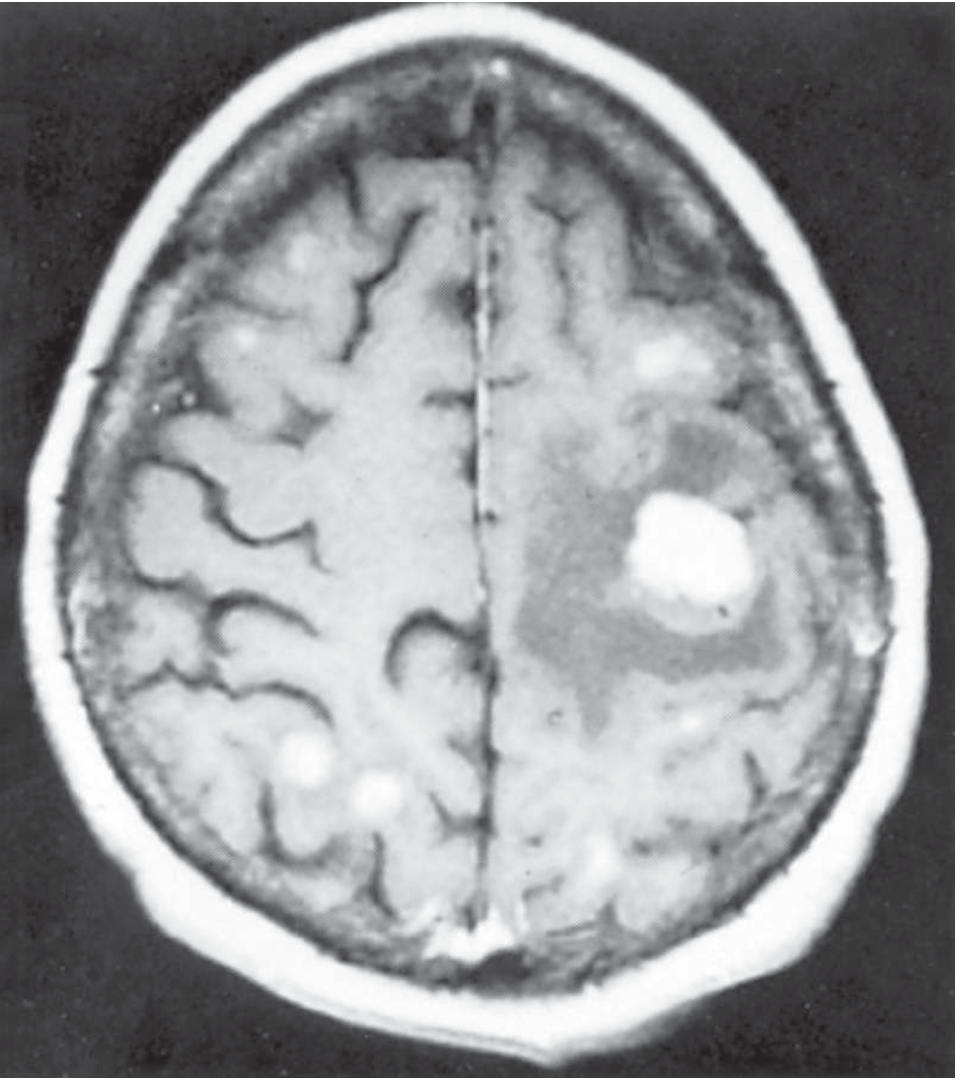
1. EPIDEMIOLOGY (Most Tested)
- Brain metastases are the most common intracranial tumors in adults - far more common than primary brain tumors
- ~25% of all cancer patients die with intracranial metastases
- About 3-8% of cancer patients develop leptomeningeal/neoplastic meningitis
Primary Cancers Ranked by Frequency of Brain Mets:
| Rank | Primary Cancer | Notes |
|---|---|---|
| #1 | Lung (most common overall) | Most common occult primary presenting as brain met |
| #2 | Breast | Lobular and TNBC subtypes highest risk for leptomeningeal mets |
| #3 | Melanoma | Highest propensity per tumor (most likely to go to brain) |
| #4 | Renal cell carcinoma | High hemorrhage risk |
| #5 | Colorectal |
- Goldman-Cecil Medicine, p. 4033
- Harrison's Principles, p. 401
2. PATHOPHYSIOLOGY & LOCATION
Why Grey-White Junction?
- Arterioles narrow abruptly at the cortical grey-white junction
- Tumor emboli get trapped at this junction → implant and grow
- Classic USMLE imaging clue: lesions at grey-white junction with surrounding edema
Mechanism of Symptoms:
- Vasogenic edema - tumor disrupts blood-brain barrier → protein-rich fluid leaks → surrounds lesion
- Mass effect - displaces brain tissue
- Hydrocephalus - CSF obstruction if near ventricles
- Herniation - uncal, central, tonsillar depending on location
- Seizures - cortical irritation
- Hemorrhage - especially melanoma, RCC, thyroid, choriocarcinoma
3. CLINICAL FEATURES
| Symptom | Mechanism |
|---|---|
| Headache (morning, worsening with valsalva) | Increased ICP |
| Nausea/vomiting | Increased ICP |
| Papilledema | Increased ICP → optic disc swelling |
| Focal neurologic deficits (hemiplegia, aphasia, visual field cuts) | Direct tissue invasion/edema |
| Seizures | Cortical irritation |
| Behavioral/cognitive changes | Frontal involvement or diffuse edema |
| Sudden stroke-like onset | Hemorrhage into metastasis (melanoma, RCC) |
| Neck stiffness + headache + CN palsies | Leptomeningeal spread |
Cushing Triad (late, ominous sign):
- Hypertension + Bradycardia + Irregular respirations = impending herniation
4. HEMORRHAGIC METASTASES (High-Yield)
- Melanoma (#1 propensity)
- Renal cell carcinoma
- Thyroid carcinoma
- Choriocarcinoma
- Lung (most common overall because it's so frequent)
5. DIAGNOSIS
Imaging Hierarchy:
| Test | Notes |
|---|---|
| MRI + gadolinium (BEST) | Most sensitive; shows ring-enhancing lesions; detects leptomeningeal involvement; superior for posterior fossa |
| CT + contrast | Faster; good for hemorrhage; misses small lesions and posterior fossa lesions |
| Non-contrast CT | Best for acute hemorrhage into met |
MRI Appearance:
- Ring-enhancing lesion(s) with surrounding low-density (dark) vasogenic edema
- Located at grey-white junction
- Often multiple (single in ~30-40%)
- Gadolinium enhancement = disrupted BBB
Ring-Enhancing Lesion DDx (USMLE):
| Diagnosis | Key Clue |
|---|---|
| Brain mets | Known primary cancer, multiple, grey-white junction |
| GBM (glioblastoma) | Single, crosses corpus callosum ("butterfly"), no known primary |
| Abscess (bacterial) | Fever, thin regular ring, restricted diffusion centrally (DWI bright) |
| Toxoplasma | HIV/AIDS, CD4 < 100, multiple, basal ganglia; responds to empiric Tx |
| Primary CNS lymphoma | HIV or immunosuppressed; periventricular; no ring on MRI (solid enhancement) |
6. TREATMENT
Step 1: Immediate Symptom Control
- Dexamethasone 8-12 mg/day - first-line for symptomatic brain mets
- Reduces vasogenic edema rapidly (hours)
- Do NOT use prophylactically in asymptomatic patients on immunotherapy (blunts antitumor response)
- Bevacizumab: for steroid-refractory edema or patients on immunotherapy who can't tolerate steroids
- Anticonvulsants: only if seizures occur - NOT prophylactic
Step 2: Definitive Treatment Based on Number of Mets
| # of Mets | Treatment |
|---|---|
| Single met, controlled systemic disease | Surgical resection + SRS (stereotactic radiosurgery) to cavity |
| 1-4 mets, stable systemic disease | SRS (Gamma Knife/CyberKnife) - preferred over WBRT to avoid cognitive dysfunction |
| Multiple mets (>4) | Whole Brain Radiation Therapy (WBRT) - but controversial; increasing use of SRS |
| WBRT failure / small number | SRS can be used as salvage |
| Hydrocephalus | VP shunt placement |
| Herniation unresponsive to steroids | Emergency craniotomy or ventriculostomy |
Step 3: Systemic Targeted Therapy - The Modern Era
| Primary Cancer | Molecular Target | Drug(s) | Notes |
|---|---|---|---|
| NSCLC with EGFR mutation | EGFR-TKI (osimertinib) | CNS-penetrant TKI preferred upfront; beats WBRT | |
| NSCLC with ALK/ROS1 | ALK inhibitors (alectinib, lorlatinib) | CNS-penetrant; preferred over radiation upfront | |
| HER2+ breast cancer | HER2 | Tucatinib + capecitabine + trastuzumab | For prior trastuzumab/pertuzumab/T-DM1 exposure |
| Melanoma (BRAF-mutant) | BRAF + MEK | Dabrafenib + trametinib | Intracranial responses seen |
| Melanoma (any) | PD-1/CTLA-4 | Nivolumab + ipilimumab | Active against asymptomatic mets |
| Testicular / SCLC | Chemo-sensitive | Platinum-based chemo | Good response |
7. LEPTOMENINGEAL / NEOPLASTIC MENINGITIS
Mechanism:
Most Common Primaries:
- Breast (especially lobular and TNBC)
- Lung (especially EGFR/ALK mutant)
- Melanoma
- Lymphoma / Leukemia
Clinical Features:
- Multifocal neurologic signs (key USMLE clue)
- Multiple cranial nerve palsies (diplopia, facial weakness, dysphagia)
- Radicular pain (from spinal nerve root involvement)
- Headache + raised ICP
- Communicating hydrocephalus
Diagnosis:
- LP with CSF cytology - gold standard (may need multiple LPs as sensitivity is ~50% on first tap)
- Gadolinium MRI spine: enhancing nodules on cauda equina / nerve roots (see spinal image below)
- Novel: circulating tumor cells in CSF or liquid biopsy
Treatment:
- Intrathecal chemotherapy (methotrexate or cytarabine via Ommaya reservoir)
- CNS-penetrant systemic agents if appropriate molecular target
- Prognosis: very poor - median survival ~6 weeks untreated, ~3-6 months with treatment
8. PROGNOSIS OF BRAIN METASTASES
| Factor | Better Prognosis | Worse Prognosis |
|---|---|---|
| # of lesions | Single | Multiple |
| Systemic disease | Controlled | Progressive |
| KPS (Karnofsky) | ≥70 | <70 |
| Primary tumor type | Breast, RCC | NSCLC, melanoma |
| Molecular target present | Yes (EGFR, HER2, BRAF) | None (TNBC, squamous) |
| Age | Younger | Older |
| Resectable | Yes | No |
9. USMLE CLASSIC QUESTION TRIGGERS
| Trigger | Answer |
|---|---|
| Most common intracranial tumor in adults | Brain metastasis (not primary tumor) |
| Most common PRIMARY causing brain mets | Lung cancer |
| Most likely to spread to brain (highest propensity) | Melanoma |
| Morning headache + papilledema + ring-enhancing lesion | Brain met → start dexamethasone |
| Sudden hemorrhagic stroke in cancer patient | Hemorrhagic met (melanoma/RCC) → non-contrast CT |
| Multiple cranial nerve palsies + radiculopathy in cancer patient | Leptomeningeal mets → LP + CSF cytology |
| Single brain met in HER2+ breast Ca patient | Surgical resection + SRS + tucatinib regimen |
| NSCLC + brain mets + EGFR mutation | Osimertinib (CNS-penetrant TKI) - not WBRT first |
| Prophylactic anticonvulsants in brain mets? | NO - only treat if seizures occur |
| Dexamethasone in immunotherapy patient? | Minimize - blunts antitumor response; use bevacizumab instead |
- Goldman-Cecil Medicine, p. 4030-4087
- Harrison's Principles of Internal Medicine 22E, p. 401-422
no brca mutation, mastectomy with implantation done radio and chemo ongoing now presented with multiple brain metastasis what is the prognosis and next plan
"breast cancer" AND "brain metastases" AND "multiple" AND prognosis
"breast cancer" AND "brain metastases" AND "tucatinib OR trastuzumab-deruxtecan OR SRS"
"breast cancer" AND "brain metastases" AND "survival" AND "GPA score"
PMID: 39271844
PMID: 38630386
Clinical Scenario: 38F, BRCA-Negative, Post-Mastectomy + Implant, On Chemo + Radiation → Now Multiple Brain Metastases
FIRST: The Critical Question Before Any Plan
PROGNOSIS
What this presentation means:
- This is now Stage IV (metastatic) disease - a life-changing progression
- Multiple brain mets = worse prognosis than single met
- Developing brain mets during active chemo + radiation signals treatment-resistant disease
- Age 38 is independently associated with poorer outcomes (meta-analysis, PMID: 41029018)
Median Survival by Subtype with Multiple Brain Mets:
| Molecular Subtype | Median OS (Brain Mets) | Notes |
|---|---|---|
| HER2+ (with modern therapy) | 12-26 months | T-DXd: 12-month PFS 61.6% (DESTINY-Breast12, PMID: 39271844) |
| HR+ / Luminal | 12-18 months | CDK4/6 inhibitors + endocrine Tx improving outcomes |
| TNBC (with SRS + pembrolizumab) | ~16-23 months | Previously < 6 months; improved with immunotherapy + SRS (PMID: 38630386) |
| TNBC (without immunotherapy) | ~6-9 months | Historically poor |
Prognostic Scoring: Breast-GPA (Graded Prognostic Assessment)
- KPS (Karnofsky Performance Status) - most important
- Number of brain mets (multiple = worse)
- Age (younger slightly better)
- ER/PR/HER2 status (HER2+ = better; TNBC = worst)
- Presence of extracranial mets
A Breast-GPA > 1 is associated with significantly improved survival after SRS (p < 0.001) - Goldman-Cecil Medicine, p. 4051; PMID: 38630386
IMMEDIATE MANAGEMENT PLAN
Step 1: Emergency Stabilization (Days 1-3)
| Action | Drug/Dose | Purpose |
|---|---|---|
| Dexamethasone | 8-12 mg/day IV/PO | Reduce vasogenic edema, relieve headache/deficits FAST |
| Anticonvulsants | Only if seizures present | NOT prophylactic |
| Bevacizumab | If on immunotherapy and can't use steroids | Steroid-sparing edema control |
| MRI brain with gadolinium | Full characterization | Number, size, location, hemorrhage, leptomeningeal enhancement |
| Gadolinium-MRI spine | If any CN palsies, radiculopathy, or back pain | Rule out concurrent leptomeningeal spread |
| CT chest/abdomen/pelvis | Systemic staging | Reassess extracranial disease burden |
| Repeat biopsy (if feasible) | Brain or systemic met | Confirm/re-evaluate ER/PR/HER2 status |
Step 2: Definitive CNS Treatment (by number of mets)
| Situation | Recommended Treatment |
|---|---|
| Multiple mets (>4) - current scenario | Whole Brain Radiation Therapy (WBRT): 30 Gy in 10 fractions (3 Gy/fraction) - standard for multiple mets |
| Concurrent hippocampal-avoidance WBRT + memantine | Reduces neurocognitive decline - PREFERRED if available |
| "Oligometastatic" (≤4 dominant lesions) within multiple | WBRT + stereotactic radiosurgery (SRS) boost to large/dominant lesions |
| Post-WBRT progression / new lesions | SRS (Gamma Knife / CyberKnife) as salvage - growing evidence for up to 10 lesions |
| Symptomatic hydrocephalus | VP shunt |
| Life-threatening single large met | Surgical debulking even in multiple-met setting |
Key: WBRT controls CNS disease but does NOT prolong overall survival - patients die of systemic disease. Hippocampal-avoidance WBRT + memantine preserves cognition (NCCTG N0179 trial). - Goldman-Cecil Medicine, p. 4061
Step 3: Systemic Therapy - Subtype-Driven (Most Important Step)
A. If HER2+ (Best prognosis, most options)
| Line | Regimen | Rationale |
|---|---|---|
| If not yet on pertuzumab + trastuzumab | Trastuzumab + pertuzumab + docetaxel | Standard 1st-line HER2+ mBC |
| Post trastuzumab/pertuzumab | T-DXd (trastuzumab deruxtecan) | Phase III DESTINY-Breast12: 12-month PFS 61.6% in brain met cohort; substantial intracranial activity |
| Post T-DXd / brain mets on chemo | Tucatinib + trastuzumab + capecitabine | HER2CLIMB trial: ~50% intracranial ORR; approved specifically for brain mets |
| Alternative HER2 TKIs | Lapatinib + capecitabine; Neratinib + capecitabine | CNS-active options |
T-DXd (DESTINY-Breast12, PMID: 39271844): Active in both stable and active (untreated/progressing) brain mets - 12-month CNS PFS 58.9%. This is the strongest intracranial data available. Watch for: Interstitial lung disease/pneumonitis (16% incidence) - monitor with regular chest CT.
B. If ER+/PR+ / HER2- (Luminal)
| Priority | Regimen |
|---|---|
| 1st | CDK4/6 inhibitor (palbociclib/ribociclib/abemaciclib) + fulvestrant or aromatase inhibitor + ovarian suppression (she is premenopausal) |
| Note | Visceral/brain involvement = more aggressive disease → may need chemotherapy first to gain rapid control, then transition to endocrine maintenance |
| Chemotherapy | Capecitabine, eribulin, gemcitabine, vinorelbine |
| PI3K inhibitor | Alpelisib if PIK3CA mutation present |
Key caveat from Katzung: "Patients with significant visceral involvement of the lung, liver, or brain or those with rapidly progressive disease rarely benefit from hormonal therapies. In this setting, systemic chemotherapy is usually indicated." - Katzung, p. 363
C. If TNBC (Worst prognosis, but improving)
| Priority | Drug | Notes |
|---|---|---|
| PD-L1 positive | Pembrolizumab + chemotherapy (nab-paclitaxel/gemcitabine/carboplatin) | Median OS ~23 months with SRS + immunotherapy (PMID: 38630386) |
| ADC | Sacituzumab govitecan (Trop-2 ADC) | Approved for ≥2 prior lines metastatic TNBC |
| PARP inhibitors | Olaparib / talazoparib | Only if BRCA mutation - not applicable here (BRCA-negative) |
| Capecitabine + bevacizumab | For chemo-refractory | Bevacizumab also helps CNS edema |
| Platinum agents | Carboplatin/cisplatin | If TNBC and no prior platinum |
Step 4: Watch for Leptomeningeal Spread
- LP for CSF cytology (repeat if first tap negative - up to 40% false-negative rate)
- MRI brain + full spine with gadolinium
- If confirmed: intrathecal methotrexate / cytarabine via Ommaya reservoir + focal radiation to bulky/symptomatic areas
Prognosis if leptomeningeal spread: median survival 10-12 weeks untreated; up to ~3-6 months with treatment. - Harrison's Principles, p. 433
Step 5: Supportive Care and Multidisciplinary Team
| Domain | Action |
|---|---|
| Pain/symptom management | Palliative care team - not "giving up," optimizes quality of life alongside treatment |
| Seizure management | Levetiracetam (drug of choice if seizures occur - no enzyme induction) |
| Neurocognitive preservation | Memantine with WBRT; neuropsychology follow-up |
| Fertility | Already post-mastectomy; discuss implications of ongoing chemo on ovarian function; oocyte cryopreservation if not already done |
| Psychological support | Formal oncopsychology referral - Stage IV diagnosis in a 38-year-old is devastating |
| Genetic re-counseling | Even BRCA-negative, consider expanded panel (PALB2, ATM, CHEK2, RAD51C/D) - may open PARP inhibitor trials |
| Clinical trials | Actively search - many trials now specifically enroll brain-met patients |
DECISION ALGORITHM SUMMARY
Multiple Brain Mets in 38F Breast Ca (BRCA-)
            │
            ▼
   URGENT: Dexamethasone 8-12 mg/day
            │
            ▼
   Biopsy → Confirm ER/PR/HER2
            │
     ┌──────┼──────┐
     ▼      ▼      ▼
   HER2+   HR+   TNBC
     │      │      │
 T-DXd   CDK4/6  Pembro
 Tucatinib Fulv   + SRS
 + WBRT  + WBRT  + WBRT
     │      │      │
     └──────┴──────┘
            │
     Monitor for leptomeningeal spread
     (LP if CN palsies / radiculopathy)
            │
     Palliative care integration
     Clinical trial enrollment
Key Numbers to Remember
| Metric | Value |
|---|---|
| WBRT standard dose | 30 Gy / 10 fractions |
| SRS indication | 1-4 mets (up to 10 with growing evidence) |
| T-DXd 12-month PFS in brain mets | 61.6% (DESTINY-Breast12) |
| TNBC brain mets median OS with SRS + pembro | ~23 months |
| TNBC brain mets median OS without immunotherapy | ~9-16 months |
| Leptomeningeal mets median survival untreated | 10-12 weeks |
| False-negative CSF cytology (1st LP) | ~40% |
- Goldman-Cecil Medicine, p. 4049-4087
- Katzung's Basic & Clinical Pharmacology 16e, p. 361-367
- Harrison's Principles of Internal Medicine 22E, p. 401-442

this is her findings
"HER2-low" OR "HER2 low" AND "brain metastases" AND "trastuzumab deruxtecan"
PMID: 39255534
PMID: 39572568
Case Analysis: This Specific Patient
RECONSTRUCTED CLINICAL TIMELINE
| Date | Event |
|---|---|
| Aug 2024 | USG-guided biopsy: Invasive Ductal Carcinoma, Grade 3, left breast |
| Sep 2024 | IHC: ER 1%, PR-, HER2 2+ / FISH negative, Ki-67 84% → Oncotype DX = 69 |
| Oct 2024 | PET-CT: T2 primary + internal mammary LN mets (N2b) → Stage IIIB |
| Oct–Dec 2024 | Neoadjuvant chemotherapy (NACT) given → partial response (51mm → 27-28mm on USG) |
| Feb 2025 | Left breast conserving surgery + sentinel node biopsy (05.02.2025) |
| HPE | pCR achieved: No residual tumor, sentinel nodes 0/5 free |
| Feb–Mar 2025 | Adjuvant radiotherapy to left breast |
| Nov 2025 | MRI Brain: Ring-enhancing lesion right frontal lobe + small lesions left frontal lobe (parasagittal + left basifrontal cortex) |
| Jul 2026 (now) | Planned radiation to brain lesions |
CRITICAL MOLECULAR INTERPRETATION
| Marker | Result | Interpretation |
|---|---|---|
| ER | 1% | Borderline - technically "ER-positive" by ASCO cutoff (≥1%) but functionally ER-negative / not truly hormone-driven |
| PR | Negative | |
| HER2 IHC | 2+ (equivocal) | |
| HER2 FISH | Negative (no amplification) | = HER2-negative by standard criteria |
| Ki-67 | 84% | Extremely high - highly proliferative, aggressive tumor |
| Oncotype DX | 69 | Extremely high-risk recurrence score (>31 = high risk; 69 is near maximum) |
What Subtype Is This?
ER 1% + PR- + HER2 2+/FISH- = HER2-LOW, Quasi-Triple Negative
- By standard IHC criteria: treated as Triple Negative (ER functionally negative, PR-, HER2-)
- BUT HER2 IHC 2+ / FISH- = "HER2-low" (IHC 1+ or 2+/FISH-) - a newly recognized category
- This is critical because it opens eligibility for T-DXd (trastuzumab deruxtecan), which is now approved for HER2-low metastatic breast cancer
WHY DID SHE DEVELOP BRAIN METS DESPITE pCR?
- pCR in breast = no residual tumor - excellent local response to NACT
- BUT: pCR does NOT guarantee systemic cure - micrometastases may have already seeded the brain BEFORE surgery (occult CNS disease)
- Her tumor profile - Ki-67 84% + Oncotype 69 + Grade 3 - represents one of the most biologically aggressive breast cancer phenotypes
- The CNS is a pharmacological sanctuary site - most chemotherapy agents do not penetrate the blood-brain barrier well
- Brain mets appeared ~9 months post-surgery - consistent with dormant micrometastases becoming clinically evident
- Family history (both grandmothers with breast Ca) suggests inherited/polygenic risk even though BRCA1/2 is negative
CURRENT STATUS ANALYSIS
Her brain lesions (MRI 27/11/2025):
- Ring-enhancing lesion, right frontal lobe (dominant)
- Small lesions, left frontal lobe parasagittal + left basifrontal cortex
- = Multiple bilateral brain metastases (at least 3 lesions identified)
- Frontal lobe location: risk of personality change, executive dysfunction, contralateral motor weakness
Performance Status:
- ECOG PS 1 - she is functional, good performance status
- This is a favorable prognostic factor for treatment eligibility and response
Restaging needed NOW:
- The PET-CT from Jan 2025 showed no systemic disease - this must be repeated to confirm there is no extracranial progression (bone, liver, lung)
PROGNOSIS - HONEST AND PRECISE
| Factor | Her Status | Impact |
|---|---|---|
| Age | 38 | Poor (independent adverse factor) |
| Subtype | HER2-low / quasi-TNBC | Intermediate-poor |
| Ki-67 | 84% | Very poor |
| Oncotype DX | 69 | Very high recurrence risk |
| Grade | 3 | Poor |
| Number of brain mets | Multiple (≥3, bilateral) | Poor |
| ECOG PS | 1 | Favorable |
| Extracranial disease | Likely minimal (pCR + prior clean PET) | Favorable |
| pCR achieved | Yes | Favorable (best systemic response achievable) |
| HER2-low status | Yes (IHC 2+/FISH-) | Opens T-DXd option |
Estimated Median OS (brain mets, this profile):
- Without aggressive CNS + systemic treatment: ~6-9 months
- With SRS/WBRT + T-DXd: Potentially 12-20+ months based on DEBBRAH trial data
- DEBBRAH trial (PMID: 39255534): T-DXd in HER2-low active brain mets → intracranial ORR 50% (untreated mets) and 33% (post-local therapy progression), median intracranial response duration 7.2 months
This is NOT a hopeless situation. The emergence of HER2-low as a targetable category means she may benefit from T-DXd - which would NOT have been available 3 years ago.
MANAGEMENT PLAN - STEP BY STEP
IMMEDIATE (This Week)
| Action | Details |
|---|---|
| 1. Dexamethasone | 8 mg BD (16 mg/day) → taper to 4 mg BD once symptoms controlled. She is planned for radiation - steroids reduce peritumoral edema |
| 2. PET-CT whole body repeat | Confirm no new systemic mets since Jan 2025 |
| 3. MRI Brain with contrast (full protocol) | Repeat if >4 weeks since Nov 2025 scan; assess number, size, mass effect accurately before radiation planning |
| 4. MRI spine with gadolinium | Rule out leptomeningeal spread - frontal lobe mets in quasi-TNBC carry risk |
| 5. Multidisciplinary tumor board | Radiation oncology (Dr Rohith) + Medical oncology + Neurosurgery |
CNS-DIRECTED TREATMENT (Primary Plan)
Preferred: SRS (Stereotactic Radiosurgery) for each identified lesion
- Rationale: ECOG 1, young, cognitive preservation critical, limited number of lesions
- SRS to right frontal lesion (dominant) + left frontal + left basifrontal = 3 lesion targets
- Growing evidence supports SRS for up to 10 lesions
- Concurrent T-DXd + SRS: 12-month local control 97%, symptomatic radiation necrosis only 2.1% per lesion (PMID: 39572568)
Alternative: Hippocampal-Avoidance WBRT + Memantine
- If SRS not available or lesion count grows on repeat MRI
- Standard: 30 Gy / 10 fractions (3 Gy/fraction)
- Add memantine to reduce cognitive decline
- BUT: avoid WBRT if planning immunotherapy - it may blunt antitumor response
SYSTEMIC THERAPY - THE GAME CHANGER FOR HER
She is HER2-low (IHC 2+/FISH-) → T-DXd (Trastuzumab Deruxtecan) eligible
| Drug | Mechanism | Relevance to her |
|---|---|---|
| T-DXd (trastuzumab deruxtecan) | Anti-HER2 ADC (antibody-drug conjugate) + topoisomerase I inhibitor payload | HER2-low category (IHC 2+/FISH-) = approved indication; DEBBRAH trial shows 50% intracranial ORR in active brain mets |
| Sacituzumab govitecan | Anti-Trop-2 ADC + SN-38 (irinotecan metabolite) | Approved for metastatic TNBC ≥2 prior lines; CNS activity emerging |
| Pembrolizumab | PD-1 checkpoint inhibitor | If PD-L1 positive (must test) → combined with chemo |
| Capecitabine | Oral fluoropyrimidine | CNS-penetrant, active in breast Ca brain mets |
| Carboplatin | If not used in NACT regimen | Active in TNBC |
Recommended Systemic Sequence:
First: Check PD-L1 status (CPS score on tumor/immune cells)
         │
    PD-L1+ (CPS ≥10)       PD-L1- (or not tested)
         │                          │
Pembrolizumab + chemo         T-DXd (5.4 mg/kg q21d)
+ T-DXd consideration          (HER2-low indication)
         │                          │
   Concurrent with SRS        Concurrent with SRS
         │                          │
    Monitor ILD                Monitor ILD
    (T-DXd risk 16-25%)        (CT chest q3 cycles)
Critical warning: T-DXd carries a 16-25% risk of interstitial lung disease (ILD)/pneumonitis. Must monitor with CT chest every 2-3 cycles. She previously received chest radiation (adjuvant RT to left breast) which may increase this risk. Manage proactively.
WATCH FOR LEPTOMENINGEAL SPREAD
- New cranial nerve palsy (diplopia, facial droop, dysphagia)
- New radicular back pain / leg weakness
- Progressive headache despite controlled brain lesions
- Hearing loss
SUPPORTIVE CARE
| Domain | Plan |
|---|---|
| Seizure prophylaxis | Only if seizures occur; levetiracetam preferred (no enzyme induction, no drug interactions) |
| Steroid taper | Taper dexamethasone as tolerated post-radiation; PPI cover (omeprazole 20 mg OD) while on steroids |
| Anticoagulation | Cancer patients on steroids are VTE-prone; assess DVT risk; LMWH if needed |
| Neuropsychology | Frontal lobe mets + planned radiation → cognitive monitoring critical for a 38-year-old |
| Fertility counseling | If any future fertility desired, urgent referral to reproductive endocrinology |
| Palliative care integration | Early palliative involvement improves QoL and even survival; not "giving up" |
| Genetic re-testing | Expand panel beyond BRCA1/2: PALB2, ATM, CHEK2, RAD51C/D - may open PARP inhibitor or clinical trial eligibility |
| Family counseling | Two grandmothers with breast Ca + BRCA-negative = possible moderate-penetrance gene; daughters/sisters should be counseled |
ONE-PAGE SUMMARY FOR WARD ROUNDS
38F | IDC Left Breast Grade 3 | Stage IIIB (T2N2b) at diagnosis
IHC: ER1% PR- HER2(2+/FISH-) = HER2-LOW | Ki-67 84% | Oncotype 69
NACT → pCR (0/5 LN) → BCS Feb 2025 → Adjuvant RT Feb-Mar 2025
→ MRI Brain Nov 2025: Multiple ring-enhancing lesions (R frontal + L frontal + L basifrontal)
→ Family Hx: Both grandmothers breast Ca | BRCA negative

PROGNOSIS: Guarded - median OS 12-20 months with aggressive Rx
KEY ADVANTAGE: HER2-low → T-DXd eligible (game-changer)

IMMEDIATE PLAN:
1. Dexamethasone 8 mg BD
2. Repeat MRI brain + PET-CT whole body + MRI spine
3. PD-L1 testing on archival or new biopsy
4. SRS to identified lesions (preferred over WBRT for cognitive preservation)
5. T-DXd 5.4 mg/kg q21d (HER2-low, brain mets)
   OR pembrolizumab + chemo if PD-L1+
6. Monitor: ILD (CT chest q3 cycles), seizures, leptomeningeal signs
7. Expand genetic panel (PALB2, ATM, CHEK2)
8. Multidisciplinary tumor board discussion
- Goldman-Cecil Medicine, p. 4049-4087
- Katzung's Basic & Clinical Pharmacology 16e, p. 361-367
- DEBBRAH Trial: T-DXd in HER2-low brain mets → intracranial ORR 50% (PMID: 39255534)
- T-DXd + SRS: 97% local control, low necrosis risk (PMID: 39572568)
- TNBC brain mets + SRS + pembrolizumab: median OS 23 months (PMID: 38630386)
continue
Which area would you like to continue with for this patient?
all next best possible steps
"brain metastases" AND "SRS" AND "breast cancer" AND "systemic therapy" AND outcomes
PMID: 41099786
"sacituzumab govitecan" AND "brain metastases" AND "breast cancer"
PMID: 39112464
PMID: 41026418
PMID: 40367401
"pembrolizumab" AND "triple negative breast cancer" AND "brain metastases"
PMID: 40546710
ALL NEXT BEST POSSIBLE STEPS - Complete Roadmap
Patient Profile Recap
PHASE 1: RIGHT NOW - THIS WEEK (Days 1-7)
A. Symptom Control - Start Immediately
| Drug | Dose | Route | Purpose |
|---|---|---|---|
| Dexamethasone | 8 mg BD (16 mg/day) | IV/PO | Reduce vasogenic edema, headache, neuro deficits |
| Omeprazole | 20 mg OD | PO | GI protection during steroid use |
| Levetiracetam | 500 mg BD → 1000 mg BD | PO | Only if seizures present - do NOT give prophylactically |
| LMWH (enoxaparin) | Prophylactic dose | SC | VTE prevention - cancer + steroids = very high DVT risk |
| Blood glucose monitoring | Fasting + post-meal | - | Steroid-induced hyperglycemia - common, must manage |
Begin steroid taper as soon as radiation planning starts - taper by 2 mg every 3-4 days once symptoms improve. Prolonged dexamethasone = Cushingoid features, myopathy, opportunistic infections.
B. Urgent Investigations to Order NOW
| Investigation | Why | Timeline |
|---|---|---|
| MRI Brain + gadolinium (full protocol) | Accurate baseline before radiation planning - characterize exact number, size, location, edema of all lesions | This week |
| MRI Spine full (with gadolinium) | Rule out leptomeningeal spread - frontal lobe + quasi-TNBC = high risk; critical to find before treating brain alone | This week |
| PET-CT whole body | Last scan was Jan 2025 - must reassess systemic disease burden before starting new systemic therapy | Within 1-2 weeks |
| PD-L1 testing (CPS score) | On archival tumor block or new biopsy - determines eligibility for pembrolizumab | URGENT - send to pathology today |
| HER2 IHC re-test on brain biopsy tissue (if feasible) | Up to 15-30% receptor discordance between primary and metastasis; HER2 status may have upgraded | If brain biopsy tissue available |
| LFTs, RFTs, CBC, LDH, CA 15-3, CEA | Baseline before systemic therapy; CA 15-3 leads recurrence detection by ~4 months | This week |
| Echocardiogram | Prior anthracycline-based NACT = cardiotoxicity risk; baseline before new agents | Before T-DXd |
| CT chest (HRCT) | Baseline before T-DXd (ILD monitoring) - especially important as she had chest RT | Before T-DXd |
PHASE 2: RADIATION PLANNING (Week 1-2)
Decision: SRS vs. WBRT
How many lesions on repeat MRI?
        │
   ≤10 lesions          >10 lesions
        │                    │
   SRS (preferred)      HA-WBRT + Memantine
   for each lesion      (if SRS not feasible)
        │
   Can ALL lesions
   be targeted by SRS?
        │
   YES → SRS alone     NO (deeply seated/
        │               brainstem) → SRS + WBRT
   Add systemic Tx
   concurrently
Option A: SRS (Strongly Preferred for Her)
| Parameter | Detail |
|---|---|
| Technique | Gamma Knife OR CyberKnife OR Linear accelerator-based SRS |
| Target | Each identified lesion + 1-2 mm margin (GTV = gross tumor volume) |
| Dose (single fraction) | - Lesion ≤2 cm: 24 Gy in 1 fraction - Lesion 2-3 cm: 18 Gy in 1 fraction - Lesion 3-4 cm: 15 Gy in 1 fraction |
| Fractionated SRS | 5-6 fractions of 5-6 Gy each - for larger lesions near eloquent cortex |
| Evidence | GKRS study (PMID: 41099786): Median OS 63-65 months in breast Ca brain mets; safe even with >10 and >20 lesions |
| Concurrent T-DXd + SRS | Safe: 12-month LC 97%, symptomatic radiation necrosis only 2.1%/lesion (PMID: 39572568) |
| Concurrent SG + SRS | Safe: LC at 12 months 94%, 24 months 84% - zero cases of symptomatic radiation necrosis (PMID: 41026418) |
Option B: HA-WBRT + Memantine (If SRS Not Feasible)
| Parameter | Detail |
|---|---|
| Standard dose | 30 Gy in 10 fractions (3 Gy/fraction) over 2 weeks |
| Hippocampal avoidance | Spare bilateral hippocampi using IMRT/VMAT - reduces memory loss |
| Memantine | Start 5 mg OD → 10 mg BD (dose escalation over 5 weeks) → maintained for 6 months post-WBRT - protects against delayed cognitive decline (NCCTG N0179 trial) |
| Why avoid in her? | Age 38 + frontal lobe lesions = significant neurocognitive risk; SRS spares more normal brain tissue |
| Caution with immunotherapy | If planning pembrolizumab concurrently, WBRT may blunt antitumor immune response - discuss with MDT |
Post-Radiation:
- Steroid taper begins immediately after completing radiation
- Monitor for radiation necrosis: MRI at 6-8 weeks post-SRS
- Radiation necrosis vs. recurrence: use MRI perfusion, MR spectroscopy, or FDG-PET
- If radiation necrosis confirmed: bevacizumab 7.5 mg/kg q3w × 4-6 cycles (reduces necrosis)
PHASE 3: SYSTEMIC THERAPY - THE CRITICAL DECISION (Start within 2-4 weeks)
Step 1: Check PD-L1 Result
If PD-L1 POSITIVE (CPS ≥10):
| Regimen | KEYNOTE-522 / 355 basis |
|---|---|
| Pembrolizumab 200 mg q3w | IV, day 1 |
| + Nab-paclitaxel 100 mg/m² | IV, days 1, 8, 15 |
| + Carboplatin AUC 2 | IV, days 1, 8 OR AUC 6 q3w |
| Duration | Until progression or intolerable toxicity |
| Brain met benefit | SRS + pembrolizumab → median OS 23 months vs. ~9 months without immunotherapy (PMID: 38630386) |
| Caution | Check PD-L1 on brain biopsy too if available - PD-L1 can be negative on primary but positive on BMs; always retest (PMID: 40546710) |
If PD-L1 NEGATIVE or Unknown:
| Parameter | Detail |
|---|---|
| Indication | HER2-low (IHC 2+/FISH-) = HER2-low metastatic breast cancer - FDA/EMA approved |
| Dose | 5.4 mg/kg IV q21d |
| Evidence | DEBBRAH trial: intracranial ORR 50% in untreated active brain mets (HER2-low) (PMID: 39255534); DESTINY-Breast04 showed OS benefit in HER2-low overall |
| T-DXd + SRS | Excellent combo: 97% LC at 12 months, minimal necrosis (PMID: 39572568) |
| Primary monitoring | ILD/pneumonitis (16% incidence; 3% grade ≥3) - especially important given prior chest RT |
T-DXd ILD Monitoring Protocol:
Before each cycle: symptom screen (new cough, dyspnea, fever)
Every 3 cycles (9 weeks): CT chest HRCT
At any new respiratory symptom: CT chest immediately

ILD Grade 1 (radiologic only):
→ Hold T-DXd, repeat CT in 3-4 weeks, resume if resolved

ILD Grade 2 (mild symptoms):
→ Hold T-DXd, start dexamethasone 0.5-1 mg/kg/day
→ Taper over ≥4 weeks, DO NOT re-challenge

ILD Grade 3-4 (severe/life-threatening):
→ PERMANENTLY DISCONTINUE T-DXd
→ High-dose IV methylprednisolone + pulmonology
PHASE 4: SEQUENTIAL THERAPY PLAN - LINE BY LINE
After NACT (anthracycline + taxane-based), adjuvant RT, now brain mets:
| Line | Regimen | Rationale | Key Toxicity to Watch |
|---|---|---|---|
| 1st line | T-DXd (if HER2-low confirmed) OR Pembrolizumab + Carbo/nab-Pac (if PD-L1+) | Most active CNS + systemic agent for her profile | ILD (T-DXd); immune adverse events (pembro) |
| 2nd line | Sacituzumab govitecan (SG) + SRS (for new/progressing brain lesions) | Trop-2 ADC; CNS-penetrant (SN-38 detected in brain tumor tissue); LC 94% at 12mo with SRS (PMID: 41026418); ORR 38% for BCBM (PMID: 39112464) | Neutropenia (28%), diarrhea, alopecia |
| 3rd line | Capecitabine ± bevacizumab | Oral, CNS-penetrant fluoropyrimidine; bevacizumab also reduces CNS edema | Hand-foot syndrome, HTN (bevacizumab) |
| 4th line | Eribulin | Shown to improve OS in heavily pretreated metastatic BC | Peripheral neuropathy, myelosuppression |
| 5th line / trial | Clinical trial (see Phase 5) | Novel agents, combinations | Variable |
| Any line | Repeat SRS for new/progressing brain lesions | GKRS safe for >20 lesions; targeted systemic therapy reduces brain metastasis velocity (BMV) from 11.4 to 7.9 new lesions/year (PMID: 41099786) | Radiation necrosis (~2-11%) |
PHASE 5: GENOMIC TESTING AND CLINICAL TRIALS
Expand Molecular Testing NOW
| Test | Why It Matters for Her |
|---|---|
| PALB2, ATM, CHEK2, RAD51C/D germline panel | BRCA-negative but family history strong - moderate-penetrance genes may open PARP inhibitor eligibility |
| PIK3CA somatic mutation | Targetable with alpelisib (though less relevant in TNBC) |
| PD-L1 (CPS) | Pembrolizumab eligibility - must test on brain biopsy too |
| Trop-2 expression | Sacituzumab govitecan activity predictor |
| Next-gen sequencing (NGS) panel | Foundation Medicine / Guardant360 - find any actionable mutation (AKT, NTRK, RET fusions, MSI-H etc.) |
| Liquid biopsy (ctDNA) | Monitor treatment response and emergence of resistance without repeat biopsy |
Clinical Trials to Actively Seek
| Trial Type | Target |
|---|---|
| T-DXd + immunotherapy combinations | HER2-low + CNS |
| SRS + novel ADC combinations | Brain-specific |
| PULSAR (personalized ultrafractionated SRS) + CNS-active drugs (PMID: 39557308) | Novel radiation-drug synergy |
| NTRK/AKT/PI3K inhibitor trials | If genomic testing positive |
PHASE 6: SURVEILLANCE AND RESPONSE ASSESSMENT
MRI Monitoring Schedule (Post-treatment)
| Timepoint | Test | Purpose |
|---|---|---|
| 6-8 weeks post-SRS | MRI brain + gadolinium | Assess early response; pseudoprogression vs. true response |
| Every 8-12 weeks on systemic therapy | MRI brain + gadolinium | Response assessment by RANO-BM criteria |
| Every 3-4 months | CT chest/abdomen/pelvis | Systemic disease surveillance |
| Every 3 cycles of T-DXd | HRCT chest | ILD screening |
| Every cycle | CBC, LFT, RFT, glucose | Drug toxicity monitoring |
| Every 3 months | CA 15-3, CEA | CA 15-3 leads recurrence by ~4 months |
Pseudoprogression vs. Radiation Necrosis vs. True Progression
| Finding | Clue | Action |
|---|---|---|
| Lesion enlarges at 6-8 weeks post-SRS | Pseudoprogression - don't panic | Continue treatment, repeat MRI in 4-6 weeks |
| New enhancing area adjacent to treated lesion | Radiation necrosis | MRI perfusion (low rCBV) + MR spectroscopy (low Cho/Cr) |
| Truly new/distant lesion on MRI | True progression | Consider: SRS to new lesion + switch systemic agent |
| Confirmed radiation necrosis | - | Bevacizumab 7.5 mg/kg q3w × 4-6 cycles |
PHASE 7: LEPTOMENINGEAL METASTASIS PREPAREDNESS
- New diplopia / facial weakness / hearing change (cranial nerve involvement)
- New radicular pain / limb weakness / urinary symptoms
- Worsening headache despite controlled brain lesions
- New cognitive decline disproportionate to known lesions
- MRI brain + full spine with gadolinium
- LP: CSF cytology + protein + glucose + opening pressure
- Repeat LP if 1st negative (40% false-negative rate on first tap)
- Consider CSF liquid biopsy (ctDNA in CSF) if available
- If confirmed leptomeningeal mets:
- Ommaya reservoir insertion by neurosurgery
- Intrathecal methotrexate 12 mg twice/week × 4 weeks → maintenance weekly
- Focal RT to bulky/symptomatic areas or obstructed CSF flow sites
- T-DXd has shown activity even in leptomeningeal disease (DEBBRAH trial leptomeningeal cohort, PMID: 39265579)
- Prognosis with LM: 10-12 weeks without Tx; 3-6 months with Tx + targeted agent
PHASE 8: HOLISTIC CARE - NON-NEGOTIABLE
| Domain | Specific Action |
|---|---|
| Palliative care referral | Not end-of-life care - concurrent palliative care improves QoL AND survival in Stage IV; do it NOW |
| Neuropsychology baseline | Frontal lobe mets + planned radiation = cognitive risk; document baseline, monitor every 3-6 months |
| Physiotherapy | Maintain function; prevent steroid myopathy (especially proximal muscle weakness) |
| Nutritional support | Steroids → hyperglycemia + weight gain; dietitian referral for calorie/protein optimization during treatment |
| Psychology / Psychiatry | Stage IV diagnosis at 38 = immense psychological burden; formal counseling, not just reassurance |
| Fertility / Endocrinology | Ongoing chemo → ovarian failure risk; discuss menopause management and long-term bone health (DXA scan, calcium, vitamin D) |
| Family counseling | Both grandmothers with breast Ca → family members need risk assessment and appropriate screening |
| Spiritual/social work support | Young woman, likely with dependents; social work assessment for family support, financial assistance, work leave |
COMPLETE DECISION FLOWCHART
TODAY
  │
  ├─ START Dexamethasone 16 mg/day + PPI + LMWH
  ├─ ORDER: MRI brain full + MRI spine + PET-CT + PD-L1 + CBC/LFT/RFT + Echo + HRCT chest
  │
WEEK 1-2: MDT TUMOR BOARD
  │
  ├─ Radiation decision:
  │     ≤10 lesions → SRS (preferred, Dr Rohith DNB-RT)
  │     >10 or SRS not feasible → HA-WBRT 30Gy/10f + Memantine
  │
  ├─ Systemic therapy (start with or soon after radiation):
  │     PD-L1+ (CPS≥10) → Pembrolizumab 200 mg + Carbo + nab-Pac
  │     PD-L1- → T-DXd 5.4 mg/kg q21d (HER2-low indication)
  │
WEEK 4 ONWARDS: MONITORING
  │
  ├─ MRI brain q8-12 weeks
  ├─ CT chest q3 cycles (T-DXd ILD)
  ├─ Watch for LM signs every visit
  │
PROGRESSION ON LINE 1:
  ├─ SRS to new brain lesions (safe even repeatedly)
  ├─ Switch to: SG + SRS → then Capecitabine ± Bev → then Eribulin
  ├─ Send NGS panel, enroll clinical trial
  │
LEPTOMENINGEAL PROGRESSION:
  └─ Ommaya + Intrathecal MTX + T-DXd systemic
SURVIVAL EXPECTATIONS - REALISTIC AND HONEST
| Scenario | Estimated Median OS |
|---|---|
| No active systemic treatment, WBRT only | ~6-9 months |
| WBRT + standard chemo | ~10-14 months |
| SRS + T-DXd (her best path - HER2-low) | ~16-24+ months |
| SRS + pembrolizumab (if PD-L1+) | ~23 months (PMID: 38630386) |
| Good breast-GPA score + ECOG 1 + minimal systemic disease | Toward upper range |
| Leptomeningeal progression | Reduces OS to ~3-6 months from that event |
She has several favorable factors: ECOG PS 1, pCR in breast, minimal systemic disease (clean PET Jan 2025), HER2-low eligibility for T-DXd, young immune system for immunotherapy. These are real reasons for cautious optimism with aggressive management.
- Goldman-Cecil Medicine, p. 4049-4087
- Katzung's Basic & Clinical Pharmacology 16e, p. 361-367
- DEBBRAH trial - T-DXd in HER2-low + brain mets: intracranial ORR 50% (PMID: 39255534)
- SG + SRS multi-institutional: zero radiation necrosis, 94% LC at 12mo (PMID: 41026418)
- SG CNS penetration confirmed in phase 0 trial: OS 35.2 months BCBM cohort (PMID: 39112464)
- Gamma Knife safe for >20 brain lesions, targeted therapy reduces BMV (PMID: 41099786)
- TNBC brain mets systemic treatment systematic review 2025 (PMID: 40546710)
continue
"metastatic breast cancer" AND "quality of life" AND "brain metastases" AND palliative
"datopotamab deruxtecan" AND "breast cancer" AND "brain metastases"
PMID: 39625633
CONTINUATION: Complete Management - Everything Left
PHASE 9: EMERGING AND PIPELINE THERAPIES FOR HER PROFILE
Datopotamab Deruxtecan (Dato-DXd)
- Anti-TROP-2 ADC using the same DXd payload as T-DXd
- Phase III TROPION-Breast01: significant PFS benefit in HR+/HER2-low metastatic BC
- CNS activity being investigated; listed in emerging therapy review (PMID: 39625633) as offering "new hope" for TNBC brain mets
- Relevance to her: If T-DXd fails → Dato-DXd may be next Trop-2-directed option (different from SG)
- Advantage over SG: Less diarrhea; different toxicity profile
AKT Inhibitors (Capivasertib, Ipatasertib)
- PIK3CA/AKT/PTEN pathway activated in ~30-40% of TNBC
- Capivasertib + fulvestrant: approved for HR+/HER2- with PIK3CA/AKT/PTEN alteration
- If her NGS panel shows PTEN loss or AKT activation → consider capivasertib
- CNS penetration data emerging
PARP Inhibitors (Even Without BRCA1/2)
- If expanded panel shows PALB2, RAD51C/D, or ATM mutation → olaparib or talazoparib eligible
- Talazoparib: active in TNBC brain mets in preliminary data (included in DEBBRAH protocol)
- Critical to check expanded germline panel - this is a potentially missed opportunity
Immunotherapy Combinations
- Nivolumab + ipilimumab (dual checkpoint): active in TNBC brain mets in trials
- Atezolizumab (anti-PD-L1): IMpassion130 showed benefit in PD-L1+ TNBC but note: different assay from pembrolizumab (SP142 vs. 22C3) - results not interchangeable
- Pembrolizumab remains preferred based on KEYNOTE-522 data
Blood-Brain Barrier Disruption Strategies (Emerging)
- Focused ultrasound (MRgFUS) to open BBB focally → allows systemic drugs to penetrate CNS better
- Mannitol IV transiently opens BBB - used before intrathecal therapy
- Not standard yet but being studied in clinical trials
PHASE 10: DRUG DOSING REFERENCE CARD (For Daily Clinical Use)
Dexamethasone Taper Protocol (Post-Radiation)
Starting dose: 8 mg BD (16 mg/day)
Week 1-2 (during radiation): Maintain 16 mg/day
Week 3: 8 mg morning + 4 mg evening (12 mg/day)
Week 4: 4 mg BD (8 mg/day)
Week 5: 4 mg morning + 2 mg evening (6 mg/day)
Week 6: 4 mg OD morning (4 mg/day)
Week 7: 2 mg OD morning (2 mg/day)
Week 8: 1 mg OD → then STOP

If symptoms return at any step: increase to previous dose, hold taper for 1 week
Always co-prescribe: Omeprazole 20 mg OD throughout steroid use
Consider Trimethoprim-sulfamethoxazole (TMP-SMX) prophylaxis if on steroids >4 weeks
T-DXd Protocol
Dose: 5.4 mg/kg IV over 90 min (first infusion) → 30 min if tolerated
Cycle: Every 21 days
Pre-medications: Antiemetics (ondansetron + dexamethasone 8 mg) 30 min before
Day 1: Infusion
Day 2-21: Monitor for ILD symptoms daily (patient to report any new cough/dyspnea/fever)

Dose reductions:
Level -1: 4.4 mg/kg
Level -2: 3.2 mg/kg
(Maximum 2 dose reductions; then discontinue if further reduction needed)

ILD monitoring:
- Baseline HRCT chest before cycle 1
- HRCT chest every 3 cycles (day 1 of cycles 4, 7, 10...)
- Immediate CT if ANY respiratory symptom
Sacituzumab Govitecan (SG) Protocol
Dose: 10 mg/kg IV days 1 and 8 of 21-day cycle
Pre-meds: Antiemetics + atropine (for cholinergic diarrhea with first dose)
Key toxicities to monitor:
- Neutropenia (Grade 3-4 in ~28%): CBC weekly for first 2 cycles, then day 1 and 8
- Diarrhea: Loperamide 4 mg at onset, then 2 mg after every loose stool; max 16 mg/day
- Alopecia: Expected and reversible
- UGT1A1*28 genotyping: If homozygous *28/*28 → higher SN-38 exposure → increased toxicity risk → consider dose reduction to 7.5 mg/kg
Pembrolizumab Protocol
Dose: 200 mg IV q21d (fixed dose) OR 400 mg q42d (maintenance)
Duration: Until progression, intolerable toxicity, or 2 years (whichever first)
Key immune-related adverse events (irAEs) to monitor:
- Pneumonitis: Dyspnea, new cough → CT chest → hold if G2, stop if G3-4
- Colitis: Diarrhea >4 stools/day → hold, steroids if G2+
- Hepatitis: LFT every cycle → hold if AST/ALT >3x ULN
- Endocrinopathy: Hypothyroidism (most common), adrenal insufficiency → TSH, cortisol q3 cycles
- Neurologic: Encephalitis, meningitis → VERY important in this patient with brain mets - any new confusion → brain MRI + LP

Note: Immunotherapy + WBRT → blunts immune response; use SRS preferentially with pembro
Memantine (with HA-WBRT)
Week 1: 5 mg OD
Week 2: 5 mg BD
Week 3: 5 mg AM + 10 mg PM
Week 4 onwards: 10 mg BD (target dose)
Duration: Continue for 6 months post-WBRT
Mechanism: NMDA receptor antagonist → prevents glutamate excitotoxicity from radiation
PHASE 11: TOXICITY MANAGEMENT - COMMON SCENARIOS
Scenario 1: Steroid Complications (Very Likely)
| Problem | Management |
|---|---|
| Hyperglycemia | Check fasting glucose every visit; metformin or insulin if >200 mg/dL consistently |
| Proximal muscle weakness (myopathy) | Reduce steroid dose as fast as tolerated; physiotherapy; avoid statins concurrently |
| Insomnia / mood disturbance | Give entire daily dose in morning (not evening); short course mirtazapine or melatonin if needed |
| Candidal oral thrush | Nystatin oral suspension or fluconazole; happens especially with long-term steroids |
| Pneumocystis pneumonia (PCP) | TMP-SMX 1 DS tablet 3x/week if on dexamethasone ≥4 weeks + lymphopenia |
| Osteoporosis | Ca 500 mg BD + Vit D 1000 IU daily + alendronate 70 mg weekly (if not on IV bisphosphonate) |
| Cushingoid appearance | Reassure patient - reversible on taper; important counselling |
Scenario 2: Radiation Toxicity Post-SRS
| Problem | Timing | Management |
|---|---|---|
| Acute edema / neuro worsening | 1-4 weeks post-SRS | Increase dexamethasone temporarily; usually self-limiting |
| Pseudoprogression | 1-3 months post-SRS | MRI shows enlargement but is treatment effect - do NOT change therapy; confirm with perfusion MRI |
| Radiation necrosis | 3-18 months post-SRS | Bevacizumab 7.5 mg/kg q3w × 4-6 cycles; surgical resection if mass effect |
| Alopecia | After WBRT | Reversible in 3-6 months |
| Fatigue | During and after WBRT | Rest, graded exercise; methylphenidate may help if severe |
| Cognitive decline | Months-years post-WBRT | Memantine; cognitive rehabilitation; donepezil (some evidence in WBRT-treated patients) |
Scenario 3: T-DXd Interstitial Lung Disease
Grade 1: Asymptomatic, radiologic only
→ Hold T-DXd
→ Repeat CT in 3-4 weeks
→ If resolved: resume at same dose (with caution)
→ If not resolved: treat as Grade 2

Grade 2: Mild/moderate symptoms, limiting ADLs
→ HOLD T-DXd PERMANENTLY
→ Prednisolone 1 mg/kg/day PO
→ Taper over minimum 4 weeks
→ Pulmonology referral
→ Do NOT rechallenge

Grade 3: Severe, requiring oxygen
→ Hospitalize
→ IV methylprednisolone 1-2 mg/kg/day
→ Taper over 6+ weeks
→ PERMANENTLY DISCONTINUE T-DXd
→ Consider IVIG/mycophenolate if steroid-refractory

Grade 4: Life-threatening
→ ICU
→ High-dose IV steroids
→ Intubation if needed
→ Fatal in ~1-2% of cases
Scenario 4: Worsening Brain Mets During Treatment
| Finding | Interpretation | Action |
|---|---|---|
| Enlarging lesion at 6-8 weeks post-SRS | Likely pseudoprogression or edema | Continue, repeat MRI in 4-6 weeks; increase dexamethasone temporarily |
| New lesion(s) at different site | New metastasis - true CNS progression | SRS to new lesion(s); assess systemic disease; consider switching systemic agent |
| All lesions growing at 3+ months | True progression | Switch systemic agent (line 2); discuss MDT; consider WBRT if SRS burden becomes unmanageable |
| Rapid neurologic deterioration | Herniation threat | Emergency dexamethasone IV bolus (10 mg) → consider surgical decompression |
PHASE 12: COMMUNICATION AND COUNSELLING GUIDE
How to Talk to This Patient
- "The cancer has spread to the brain - this is serious but not untreatable."
- "We have specific treatments that work in the brain - radiation directly to these spots, and new medicines that can cross into the brain."
- "Your profile - the way your cancer cells look - actually opens a newer drug called T-DXd that specifically targets your tumor type."
- "Our goal right now is to control this in your brain AND throughout your body, while keeping your quality of life as good as possible."
- "We will monitor you every 2-3 months with MRI and scans so we always know exactly what is happening."
- "There is nothing more we can do." - FALSE. There are multiple active lines of therapy.
- "You have X months to live." - Population statistics do NOT apply to individuals, especially with new agents.
- "This treatment will cure you." - Metastatic breast cancer is currently incurable, but long-term control is real and increasing.
Goals of Care Conversation (Must Happen Early)
| Question to Explore | Why Important |
|---|---|
| "What does a good day look like for you right now?" | Establishes what matters most - function, family time, pain-free living |
| "What are your biggest worries about treatment?" | Addresses fears before they become barriers to compliance |
| "Who is your support system at home?" | Identifies carer needs, family burden |
| "Have you thought about what you would want if you couldn't speak for yourself?" | Opens advance directive / healthcare proxy discussion without being abrupt |
| "Are there things - events, milestones - that you want to be well enough for?" | Helps time treatment cycles and plan for key life moments |
PHASE 13: BONE HEALTH AND SYSTEMIC COMPLICATION PREVENTION
| Intervention | Dose | Indication |
|---|---|---|
| Zoledronic acid (IV bisphosphonate) | 4 mg IV q4 weeks → q12 weeks after 1 year | If bone mets confirmed on PET-CT |
| Denosumab (anti-RANKL) | 120 mg SC q4 weeks | Alternative to zoledronic acid; preferred if renal impairment |
| Dental review BEFORE bisphosphonate | - | Osteonecrosis of jaw - must rule out active dental disease first |
| Calcium + Vitamin D | 500 mg Ca BD + 1000 IU D3 | All patients on steroids or bone-active agents |
| DXA scan (bone density) | Baseline | Chemotherapy + steroids + potential ovarian suppression = accelerated osteoporosis in a 38-year-old |
PHASE 14: ONCOLOGICAL EMERGENCIES TO ANTICIPATE AND PREVENT
| Emergency | Risk in Her | Early Warning Sign | Action |
|---|---|---|---|
| Herniation (transtentorial) | Multiple frontal mets + edema | Declining GCS, fixed dilated pupil, Cushing triad | IV mannitol 1 g/kg + emergency neurosurgery |
| Status epilepticus | Cortical mets | Prolonged seizure >5 min | IV lorazepam 0.1 mg/kg + levetiracetam loading; ICU |
| Hypercalcemia of malignancy | If bone mets develop | Nausea, confusion, polyuria, bone pain (elevated Ca²⁺) | IV fluids + zoledronic acid |
| Febrile neutropenia | On SG (neutropenia 28%) or chemo | Fever >38°C, ANC <500 | IV broad-spectrum antibiotics + G-CSF; hospitalize |
| SVCO (superior vena cava obstruction) | If mediastinal nodes progress | Facial swelling, arm swelling, headache bending forward | Dexamethasone + urgent CT + stenting vs. RT |
| Spinal cord compression | If bone/epidural mets | New back pain + leg weakness | Emergency MRI spine + dexamethasone 16 mg + RT/surgery |
| Immune-related encephalitis (on pembro) | If on pembrolizumab | Confusion, personality change | MRI brain + LP + high-dose steroids; differentiate from tumor progression |
PHASE 15: THE 3-MONTH ROADMAP - TIMELINE
WEEK 1-2
├─ Dexamethasone 16 mg/day + PPI + LMWH
├─ Repeat MRI brain (full protocol, gadolinium)
├─ MRI spine (gadolinium)
├─ PET-CT whole body
├─ PD-L1 testing (CPS on archival block)
├─ Baseline bloods: CBC, LFT, RFT, glucose, Ca²⁺, LDH, CA 15-3
├─ Echo + HRCT chest (baseline pre-T-DXd)
├─ Expanded germline gene panel (PALB2, ATM, CHEK2 etc.)
└─ MDT Tumor Board

WEEK 2-3
├─ RADIATION PLANNING SESSION
│   └─ SRS simulation CT + MRI fusion
│       → Treatment plan computed (1-3 days)
│       → SRS delivered (1-3 sessions for multiple targets)
└─ Start steroid taper plan post-RT

WEEK 3-4
├─ Systemic therapy STARTS
│   ├─ PD-L1+: Pembrolizumab + nab-Pac + Carboplatin
│   └─ PD-L1-: T-DXd 5.4 mg/kg IV (cycle 1, day 1)
└─ Patient education: ILD symptoms, neutropenia, when to call

WEEK 6-8
├─ MRI brain: First post-SRS response assessment
├─ Cycle 2/3 bloods: CBC, LFT, glucose
├─ CT chest HRCT (T-DXd ILD check)
├─ Dexamethasone at 4 mg OD by now (taper ongoing)
└─ Palliative care team formal introduction

WEEK 12 (3 MONTHS)
├─ MRI brain: Full response assessment
├─ PET-CT or CT CAP: Systemic disease reassessment
├─ MDT review: Continue current line? Switch? New trial?
├─ CA 15-3, CEA trends
├─ Bone density DXA (if not done)
├─ Neuropsychology assessment
└─ Goals of care review

ONGOING (every cycle)
├─ Symptom review + neuro exam
├─ Drug toxicity screen
├─ BMV (brain metastasis velocity) tracking
└─ Clinical trial eligibility re-assessment each line
COMPLETE DRUG TOXICITY MONITORING TABLE
| Drug | Frequency | What to Check | Action if Abnormal |
|---|---|---|---|
| Dexamethasone | Every visit | Glucose, BP, weight, muscle strength, mood | Taper faster, add insulin/anti-hypertensive |
| T-DXd | Each cycle (q21d) | CBC, LFT, creatinine, respiratory symptoms | Hold for ILD, dose reduce for G3 toxicity |
| T-DXd | Every 3 cycles | HRCT chest | Grade per ILD protocol above |
| Pembrolizumab | Each cycle | LFT, TSH, glucose (adrenal), creatinine, symptoms | Hold for G2+ irAE, steroids for G3-4 |
| Sacituzumab govitecan | Days 1 + 8 | CBC (neutropenia), stool frequency (diarrhea) | G-CSF for G3-4 neutropenia, dose hold/reduce |
| Levetiracetam (if seizures) | q3 months | CBC, LFT, mood/behavior | Rare hepatotoxicity; behavioral side effects |
| LMWH | Monthly | Platelets (HIT screening), renal function | Adjust dose if CrCl <30 mL/min |
| Zoledronic acid (if bone mets) | Before each dose | Creatinine, calcium, dental status | Hold if Cr raised; check for ONJ |
KEY NUMBERS SUMMARY FOR WARD ROUNDS
| Parameter | Value |
|---|---|
| Her Ki-67 | 84% - extremely high proliferative index |
| Her Oncotype DX score | 69 - near maximum risk score |
| ECOG PS | 1 - favorable for treatment |
| Breast GPA: age 38, ECOG 1, HER2-low, ≥3 brain mets | Intermediate - influences RT and systemic choice |
| T-DXd intracranial ORR (HER2-low, active BMs) | 50% (DEBBRAH trial) |
| SRS local control with T-DXd | 97% at 12 months |
| SRS local control with SG | 94% at 12 months |
| Symptomatic radiation necrosis (T-DXd + SRS) | 2.1% per lesion |
| TNBC + SRS + pembrolizumab median OS | ~23 months |
| ILD risk with T-DXd (prior chest RT patient) | >16-25% - heightened vigilance |
| UGT1A1 genotyping needed before SG | Yes - affects dosing |
FINAL SUMMARY: THE 5 MOST IMPORTANT DECISIONS FOR THIS PATIENT
1. SRS (not WBRT) → Protect cognition in a 38-year-old
   ↓
2. T-DXd (HER2-low indication) OR Pembrolizumab (if PD-L1+)
   → Game-changing systemic option; intracranial activity proven
   ↓
3. MONITOR FOR ILD AGGRESSIVELY
   → Prior chest RT + T-DXd = highest risk combination
   → CT chest every 3 cycles non-negotiable
   ↓
4. WATCH FOR LEPTOMENINGEAL SPREAD
   → Quasi-TNBC = highest risk subtype
   → Low threshold to do LP + spine MRI
   ↓
5. EARLY PALLIATIVE CARE + GOALS OF CARE
   → Not giving up - improves survival AND quality of life
   → Done alongside aggressive treatment
- Goldman-Cecil Medicine, p. 4049-4087
- Katzung's Basic & Clinical Pharmacology 16e, p. 361-367
- Emerging therapies review - SG, Dato-DXd, BBB strategies (PMID: 39625633)
- Optimal therapy sequencing in metastatic BC - ASCO 2025 (PMID: 40367401)
- TNBC brain mets systemic treatment systematic review (PMID: 40546710)
- GKRS safe and effective for >20 breast Ca brain lesions (PMID: 41099786)
Explain, uh, everything detailed with, uh, full treatment options available, best prognosis, and what are the next steps of the treatment plan.
"HER2-low" AND "breast cancer" AND "trastuzumab deruxtecan" AND "brain metastases" AND treatment
PMID: 40691796
COMPLETE CASE SUMMARY AND FULL TREATMENT PLAN
Carcinoma Left Breast with Brain Metastases - 38-Year-Old Female
SECTION 1: PATIENT PROFILE AT A GLANCE
| Parameter | Finding |
|---|---|
| Age / Sex | ~38 years, Female |
| Consultant | Dr. Rohith S, DNB (RT) - Radiation Therapy |
| Final Diagnosis | Carcinoma Left Breast with Brain Metastases |
| Performance Status | ECOG PS 1 (functional, good general condition) |
| Co-morbidities | Nil |
| Family History | Both grandmothers had carcinoma breast |
| BRCA Status | Negative (confirmed in prior discussion) |
SECTION 2: FULL DISEASE HISTORY - TIMELINE
2.1 Original Diagnosis (August-October 2024)
| Date | Finding |
|---|---|
| Aug 2024 | Bilateral MMG: BIRADS 5 lesion 3.5 × 2.4 × 2.8 cm left breast |
| Aug 14, 2024 | USG-guided left breast core biopsy: Invasive Ductal Carcinoma (IDC), Grade 3 |
| IHC Result | ER 1%, PR negative, HER2 2+, FISH negative, Ki-67 84% |
| Sep 2024 | Oncotype DX Recurrence Score: 69 (near maximum - extremely high risk) |
| Oct 7, 2024 | USG: Irregular hypoechoic lesion 51 × 40 mm, BIRADS 6, inner quadrant skin thickening |
| Oct 9, 2024 | PET-CT whole body: Left breast primary (T2), left internal mammary LN metastases (N2b), axillary LN likely reactive, paraortic LN indeterminate. No distant mets on systemic scan |
2.2 Neoadjuvant Chemotherapy (NACT) - Oct 2024 to Feb 2025
| Date | USG Monitoring | Residual Size |
|---|---|---|
| Dec 12, 2024 | Post 2-3 cycles | 27 × 14 mm (51mm → 27mm = significant response) |
| Jan 2, 2025 | Post further cycles | 28 × 13 mm (stable partial response) |
| Feb 1, 2025 | Post full NACT | 29 × 12 mm on HRUS - post-chemo changes |
| Jan 31, 2025 | PET-CT whole body | Non-FDG avid - NO metabolically active disease anywhere - complete metabolic response |
2.3 Surgery (February 2025)
| Parameter | Result |
|---|---|
| Operation | Left Breast Conserving Surgery (Wide Local Excision) + Sentinel Lymph Node Biopsy |
| Date | February 5, 2025 |
| HPE - Breast | No residual tumor identified - Chemotherapy related changes only = pCR (Pathologic Complete Response) |
| HPE - Sentinel LN | 5 lymph nodes identified - all free of tumor (0/5) = pN0 |
2.4 Adjuvant Radiotherapy (Feb-Mar 2025)
- Adjuvant RT to left breast / chest wall completed as per plan
- Consultant: Dr. Rohith S, DNB(RT)
2.5 Brain Metastases Discovered (November 2025)
| Finding | Details |
|---|---|
| MRI Brain - Nov 27, 2025 | Ring-enhancing lesion in right frontal lobe + similar small lesions in left frontal lobe parasagittal + superficial cortex of left basifrontal lobe |
| Pattern | Multiple bilateral ring-enhancing brain metastases |
| Time from surgery | ~9 months post-BCS, ~8 months post-RT |
SECTION 3: MOLECULAR BIOLOGY - DECODING HER TUMOR
3.1 IHC Interpretation
| Marker | Result | What It Means |
|---|---|---|
| ER (Estrogen Receptor) | 1% | Technically positive (ASCO cutoff ≥1%) but functionally behaves as ER-negative. Endocrine therapy will NOT meaningfully benefit her. |
| PR (Progesterone Receptor) | Negative | Confirms lack of hormone receptor drive |
| HER2 IHC | 2+ (equivocal) | Intermediate staining - cannot classify by IHC alone |
| HER2 FISH | Negative | No HER2 gene amplification → formally HER2-negative by standard criteria |
| Ki-67 | 84% | Extremely high proliferative index. Normal breast <5%; anything >30% is aggressive. 84% means this tumor divides very rapidly. |
| Grade | 3 (poorly differentiated) | Highest grade - worst morphology, fastest growing |
| Oncotype DX | 69 | Score ranges 0-100. >31 = high risk. Score of 69 = near-maximum recurrence risk and maximum chemotherapy benefit score |
3.2 What Subtype Is This?
ER 1% (functionally negative) + PR- + HER2 (2+/FISH-) =

Standard Classification: TRIPLE NEGATIVE BREAST CANCER (TNBC)
But critically: HER2 IHC 2+ / FISH- = "HER2-LOW" category
3.3 Why Did She Develop Brain Mets Despite pCR?
- pCR = no residual tumor in breast - excellent local response
- Brain = pharmacological sanctuary - most chemo does NOT cross the blood-brain barrier
- Micrometastatic seeding happened BEFORE surgery - cells were already in brain as dormant micrometastases
- Ki-67 84% + Grade 3 = extremely aggressive tumor with early systemic spread tendency
- The internal mammary lymph nodes (N2b) were involved at diagnosis - this drainage route leads directly toward the CNS vasculature
- Frontal lobe is particularly susceptible - large perfusion territory, grey-white junction traps tumor emboli
SECTION 4: WHAT IS HER PROGNOSIS?
4.1 Prognostic Factors Summary
| Factor | Her Status | Impact on Prognosis |
|---|---|---|
| Age | 38 years | Adverse (young age = independently worse) |
| Molecular subtype | HER2-low / quasi-TNBC | Intermediate-adverse |
| Ki-67 | 84% | Very adverse |
| Oncotype DX | 69 | Very adverse - maximal recurrence risk |
| Grade | 3 | Adverse |
| Primary treatment response | pCR | Favorable - best possible response to chemo |
| Nodal status post-NACT | 0/5 (ypN0) | Favorable |
| ECOG PS | 1 | Favorable - she is functional |
| Number of brain mets | Multiple (≥3) bilateral | Adverse |
| Extracranial disease | None documented (clean PET Jan 2025) | Favorable |
| HER2-low | Yes (IHC 2+/FISH-) | Opens T-DXd - significant advantage |
| BRCA | Negative | Neutral (no PARP inhibitor option) |
4.2 Breast-GPA Score (Graded Prognostic Assessment for Brain Mets)
| GPA Factor | Her Score |
|---|---|
| KPS equivalent to ECOG 1 = 80-90 | 1.5 points |
| Age 38 | 2 points |
| HER2-low (not true HER2+) | 1 point |
| Multiple brain mets | 0 points |
| Extracranial mets absent | 1 point |
| Total Breast-GPA | ~5.5 / 10 = Intermediate |
4.3 Realistic Survival Estimates
| Treatment Approach | Estimated Median OS |
|---|---|
| No active treatment / supportive care only | 3-4 months |
| WBRT alone (no systemic) | 6-9 months |
| WBRT + standard chemo | 10-14 months |
| SRS + T-DXd (HER2-low - her best path) | ~15-24+ months |
| SRS + pembrolizumab (if PD-L1 CPS ≥10) | ~18-23 months |
| Combination SRS + T-DXd + pembro | Being studied in trials |
Real-world T-DXd data (PMID: 40691796): In HER2-low active brain mets, intracranial ORR 66.7%, 12-month OS rate 85.7% - this is encouraging data published July 2025.
Important: These are population medians. Individual responses vary enormously. Patients with ECOG PS 1, limited extracranial disease, and targetable biology (like her) can substantially exceed median survival figures.
SECTION 5: ALL TREATMENT OPTIONS - COMPLETE
5.1 CNS-DIRECTED TREATMENT OPTIONS
Option A: Stereotactic Radiosurgery (SRS) - PREFERRED
| Parameter | Details |
|---|---|
| What it is | High-precision focused radiation to each individual brain lesion |
| Technique | Gamma Knife, CyberKnife, or LINAC-based SRS |
| Dose | 15-24 Gy in 1-5 fractions depending on lesion size and proximity to eloquent cortex |
| Eligibility | Up to 10 lesions (growing evidence for >10, even >20) |
| Advantage for her | Spares normal brain - preserves cognition critical for a 38-year-old |
| Combined with T-DXd | 97% local control at 12 months, symptomatic radiation necrosis only 2.1%/lesion (PMID: 39572568) |
| Combined with SG | 94% local control at 12 months, zero symptomatic radiation necrosis (PMID: 41026418) |
| Safe for repeat | Yes - GKRS shown safe even for >20 lesions; targeted therapy reduces new lesion velocity from 11.4 → 7.9 lesions/year (PMID: 41099786) |
Option B: Hippocampal-Avoidance WBRT + Memantine
| Parameter | Details |
|---|---|
| When used | If lesion count becomes unmanageable for SRS, or SRS not available |
| Dose | 30 Gy in 10 fractions (3 Gy/fraction over 2 weeks) |
| Hippocampal avoidance | IMRT/VMAT technique spares bilateral hippocampi - reduces memory loss |
| Memantine | Start 5 mg OD → escalate to 10 mg BD over 4 weeks; continue 6 months post-RT. NMDA antagonist - protects against radiation-induced cognitive decline |
| Disadvantage | Whole brain exposure - cognitive risk; blunts immunotherapy response |
| With steroid | Dexamethasone during treatment for edema control |
Option C: Surgery (Neurosurgical Resection)
| Indication | When to Consider |
|---|---|
| Single large dominant lesion with mass effect | Right frontal lesion if enlarging or causing herniation |
| To obtain tissue for biopsy | Confirm receptor status in metastatic lesion (receptor discordance occurs in 15-30%) |
| Hemorrhagic lesion | If acute bleed into met causes rapid deterioration |
| Not standard for multiple mets | Surgery alone does not address all lesions |
Option D: Laser Interstitial Thermal Therapy (LITT)
- Minimally invasive ablation via laser probe - for deep/eloquent lesions not amenable to SRS
- Growing evidence but not yet standard
5.2 SYSTEMIC THERAPY OPTIONS - ALL LINES
STEP 1: Critical Biomarker Results Needed Before Starting
| Test | Drug It Unlocks | Urgency |
|---|---|---|
| PD-L1 (CPS score) | Pembrolizumab eligibility | URGENT - send today |
| HER2 IHC on brain biopsy (if available) | Confirm HER2-low in met (receptor switch possible) | High priority |
| PALB2, ATM, CHEK2, RAD51C/D germline panel | PARP inhibitor eligibility | Within 2 weeks |
| Full NGS (Foundation/Guardant) | AKT inhibitors, PIK3CA, MSI-H, NTRK fusions | Within 2 weeks |
| Trop-2 expression | Sacituzumab govitecan predictive | If available |
| UGT1A1 genotyping | SG dose adjustment | Before SG |
LINE 1 OPTIONS (Choose based on PD-L1 result):
| Drug | Dose | Schedule |
|---|---|---|
| Pembrolizumab | 200 mg IV | Day 1, every 21 days |
| + Nab-paclitaxel | 100 mg/m² IV | Days 1, 8, 15 every 28 days |
| + Carboplatin | AUC 2 IV | Days 1, 8 every 28 days |
| Duration | Until progression or 2 years |
| Drug | Dose | Schedule |
|---|---|---|
| T-DXd (Trastuzumab Deruxtecan) | 5.4 mg/kg IV | Every 21 days |
| Duration | Until progression or intolerable toxicity |
Note: T-DXd + pembrolizumab combination is being studied in trials and may offer additive benefit - discuss at MDT.
LINE 2: After Line 1 Failure
| Drug | Mechanism | Dose | Evidence |
|---|---|---|---|
| Sacituzumab Govitecan (SG) | Anti-Trop-2 ADC + SN-38 payload | 10 mg/kg IV days 1 + 8 of 21-day cycle | CNS penetration confirmed; ORR 38% BCBM; OS 35.2 months with SRS (PMID: 39112464) |
| + SRS for new/progressing brain lesions | Radiation to each new lesion | 15-24 Gy | 94% LC at 12 months + zero radiation necrosis (PMID: 41026418) |
LINE 3: After Line 2 Failure
| Drug | Dose | Notes |
|---|---|---|
| Capecitabine | 1000-1250 mg/m² PO BD days 1-14 q21d | Oral, CNS-penetrant, well-tolerated; hand-foot syndrome is main side effect |
| ± Bevacizumab | 7.5-15 mg/kg IV q21d | Adds anti-angiogenic activity; also treats radiation necrosis |
LINE 4: After Line 3 Failure
| Drug | Dose | Notes |
|---|---|---|
| Eribulin | 1.4 mg/m² IV days 1, 8 q21d | Shown to improve OS in heavily pretreated metastatic BC; peripheral neuropathy main concern |
IF NGS PANEL SHOWS ACTIONABLE MUTATION:
| Mutation Found | Drug |
|---|---|
| PALB2 / RAD51C/D mutation | Olaparib 300 mg BD or talazoparib 1 mg OD (PARP inhibitors) |
| PIK3CA mutation | Alpelisib 300 mg OD (with fulvestrant) - though less relevant in ER1% tumors |
| AKT1/PTEN loss | Capivasertib + fulvestrant (CAPItello-291) |
| MSI-H / TMB-high | Pembrolizumab as monotherapy (regardless of PD-L1) |
| NTRK fusion | Larotrectinib or entrectinib |
EMERGING AGENTS (Clinical Trial / Near-Approval):
| Agent | Target | Status |
|---|---|---|
| Datopotamab deruxtecan (Dato-DXd) | Trop-2 ADC (different from SG, same DXd payload as T-DXd) | Phase III positive in HR+/HER2-low; CNS data emerging for TNBC |
| Nivolumab + ipilimumab | Dual PD-1/CTLA-4 blockade | Active in TNBC brain mets in trials |
| Capivasertib | AKT inhibitor | If AKT/PTEN alteration on NGS |
| PULSAR (personalized ultrafractionated SRS) | Novel radiation schedule with systemic agents | Phase I/II trial showing synergy with CNS-active drugs |
5.3 LEPTOMENINGEAL METASTASIS TREATMENT (if it develops)
| Treatment | Details |
|---|---|
| Ommaya reservoir insertion | By neurosurgery - allows direct CSF drug delivery |
| Intrathecal methotrexate | 12 mg twice weekly × 4 weeks → weekly maintenance |
| T-DXd (systemic) | DEBBRAH trial: active even in leptomeningeal disease (PMID: 39265579) |
| Focal RT | To obstructed CSF flow sites or bulky symptomatic areas |
| VP shunt | If communicating hydrocephalus develops |
SECTION 6: STEP-BY-STEP TREATMENT PLAN
Phase 1: THIS WEEK (Days 1-7)
┌─────────────────────────────────────────────────┐
│ IMMEDIATE ACTIONS                                │
├──────────────────────────┬──────────────────────┤
│ Dexamethasone            │ 8 mg BD (16 mg/day)  │
│ Omeprazole               │ 20 mg OD             │
│ LMWH (enoxaparin)        │ Prophylactic SC      │
│ Blood glucose monitoring │ Daily fasting + 2hr  │
│ Levetiracetam            │ ONLY if seizures      │
└──────────────────────────┴──────────────────────┘

INVESTIGATIONS TO ORDER:
✓ MRI Brain full protocol + gadolinium (updated baseline)
✓ MRI Full Spine + gadolinium (rule out leptomeningeal)
✓ PET-CT Whole Body (restage from Jan 2025)
✓ PD-L1 testing (CPS) on archival tumor block - URGENT
✓ Expanded germline panel (PALB2, ATM, CHEK2, RAD51C/D)
✓ Full NGS panel (Foundation Medicine / similar)
✓ Baseline: CBC, LFT, RFT, LDH, Ca²⁺, CA 15-3, CEA
✓ Echocardiogram (pre-T-DXd cardiac baseline)
✓ HRCT Chest (pre-T-DXd ILD baseline)
✓ UGT1A1 genotyping (pre-SG dosing)
Phase 2: MDT TUMOR BOARD (Week 2)
- SRS simulation and planning (if ≤10 lesions on repeat MRI)
- Systemic agent selection (T-DXd vs. pembrolizumab based on PD-L1)
- Timing of systemic therapy relative to radiation
- Need for neurosurgical biopsy of dominant lesion
Phase 3: RADIATION (Week 2-3)
PREFERRED: SRS to each identified lesion
├─ Right frontal lesion (dominant) → single/fractionated SRS
├─ Left frontal parasagittal lesion → SRS
└─ Left basifrontal cortex lesion → SRS

Doses:
├─ ≤2 cm: 24 Gy single fraction
├─ 2-3 cm: 18 Gy single fraction OR 25-27 Gy/5 fractions
└─ Near eloquent cortex: 25-30 Gy/5 fractions (fSRS)

IF >10 lesions on repeat MRI OR SRS not feasible:
└─ HA-WBRT 30 Gy/10 fractions + Memantine 10 mg BD × 6 months

Begin STEROID TAPER immediately after last radiation session
Phase 4: SYSTEMIC THERAPY (Week 3-4, concurrent or immediately after SRS)
PD-L1 CPS ≥10 → Pembrolizumab 200 mg q21d
                + Nab-paclitaxel 100 mg/m² days 1,8,15
                + Carboplatin AUC2 days 1,8

PD-L1 CPS <10 → T-DXd 5.4 mg/kg IV q21d
  (HER2-low indication - approved)

MONITORING ON T-DXd:
├─ Pre-infusion: CBC, LFT, RFT every cycle
├─ Symptom screen every cycle (cough, dyspnea, fever = STOP)
└─ HRCT Chest: Baseline, then every 3 cycles (cycles 4,7,10...)

MONITORING ON PEMBROLIZUMAB:
├─ TSH, LFT, glucose, creatinine every cycle
└─ Any new confusion/headache = differentiate from tumor vs. encephalitis
Phase 5: RESPONSE ASSESSMENT (Week 8-12)
Week 6-8 post-SRS:
├─ MRI Brain + gadolinium → First CNS response assessment
│  └─ Enlargement at this point = LIKELY PSEUDOPROGRESSION
│     → Do NOT change therapy; repeat MRI in 4-6 weeks
└─ CT CAP → Systemic disease assessment

Week 12 (3-month mark):
├─ MRI Brain (full response by RANO-BM criteria)
├─ PET-CT or CT CAP (systemic)
├─ CA 15-3 trend
└─ MDT review: Continue? Switch? New trial?

Every visit (ongoing):
├─ Neuro exam (frontal lobe function - cognition, personality, motor)
├─ Screen for leptomeningeal signs (CN palsies, radiculopathy)
└─ BMV (brain metastasis velocity) tracking
Phase 6: PROGRESSION MANAGEMENT
NEW brain lesions while on systemic therapy:
├─ SRS to new lesion(s) - safe repeatedly
└─ Reassess systemic therapy - switch if multiple new lesions

SYSTEMIC PROGRESSION:
└─ Move to next systemic line (SG → Cap/Bev → Eribulin → Trial)

RADIATION NECROSIS (confirmed by perfusion MRI):
└─ Bevacizumab 7.5 mg/kg q3w × 4-6 cycles

LEPTOMENINGEAL PROGRESSION (CN palsy / radiculopathy):
├─ LP for CSF cytology (repeat if 1st negative)
├─ MRI full spine
└─ Ommaya reservoir + intrathecal MTX + continue T-DXd
SECTION 7: COMPLETE DRUG MONITORING CARD
| Drug | Key Toxicity | Monitor | Action |
|---|---|---|---|
| Dexamethasone | Hyperglycemia, myopathy, infection, GI bleed | Glucose, BP, muscle strength | Taper ASAP; add insulin/PPI/TMP-SMX |
| T-DXd | ILD/pneumonitis (16-25%), nausea, fatigue | CBC, LFT, HRCT chest q3 cycles | Grade 2+ = STOP permanently |
| Pembrolizumab | Pneumonitis, colitis, hepatitis, hypothyroidism, encephalitis | LFT, TSH, Cr, symptoms | Hold G2, high-dose steroids G3-4 |
| Sacituzumab govitecan | Neutropenia (28%), diarrhea, alopecia | CBC days 1+8, stool frequency | G-CSF for G3-4 neutropenia; loperamide for diarrhea |
| Capecitabine | Hand-foot syndrome, diarrhea | Skin hands/feet, GI symptoms | Dose reduce, urea cream for HFS |
| Bevacizumab | Hypertension, proteinuria, wound healing | BP every visit, urine dipstick | Hold for severe HTN; stop for bowel perforation |
| Levetiracetam | Behavioral/mood changes, rarely hepatotoxicity | CBC, LFT, mood assessment | Behavioral SE: switch to lacosamide |
SECTION 8: EMERGENCY PROTOCOLS
| Emergency | Warning Signs | Immediate Action |
|---|---|---|
| Cerebral herniation | GCS drop, unequal pupils, Cushing triad | IV Mannitol 1 g/kg + emergency neurosurgery |
| Status epilepticus | Seizure >5 minutes | IV lorazepam 0.1 mg/kg → levetiracetam loading |
| Febrile neutropenia | Fever + ANC <500/µL | IV piperacillin-tazobactam + G-CSF; hospitalize |
| T-DXd ILD (G3-4) | Acute dyspnea + new CT infiltrates | Stop T-DXd; IV methylprednisolone 1-2 mg/kg; ICU |
| Immune encephalitis (on pembro) | Confusion, personality change on immunotherapy | MRI + LP; distinguish from progression; high-dose steroids |
| Spinal cord compression | New back pain + progressive leg weakness | Emergency MRI spine + dexamethasone 16 mg IV bolus + RT |
SECTION 9: HOLISTIC AND SUPPORTIVE CARE
Non-Negotiable Referrals
| Referral | Reason |
|---|---|
| Palliative Care | Early integration improves both QoL AND survival in Stage IV; not end-of-life - concurrent with active treatment |
| Neuropsychology | Frontal lobe mets + planned RT = cognitive risk; baseline assessment, follow every 3-6 months |
| Physiotherapy | Prevent steroid myopathy; maintain function; fall prevention (frontal mets = gait/balance risk) |
| Dietitian | Steroids → hyperglycemia + muscle loss; optimize protein intake 1.5 g/kg/day during treatment |
| Oncopsychologist / Psychiatrist | Stage IV at 38 = profound psychological burden; formal support mandatory |
| Endocrinology | Chemotherapy-induced ovarian failure; steroid-induced glucose dysregulation; bone health |
| Reproductive Endocrinology | If any future fertility desire; address ovarian reserve; menopause management |
| Dental | Before any bisphosphonate if bone mets confirmed; prevent osteonecrosis of jaw |
Bone Health (Proactive)
- DXA scan (baseline bone density) - she has had chemo + steroids + likely chemotherapy-induced menopause
- Calcium 500 mg BD + Vitamin D 1000 IU OD
- If bone mets confirmed on PET-CT: zoledronic acid 4 mg IV q4 weeks (after dental clearance)
Steroid Side Effect Prevention
GI protection: Omeprazole 20 mg OD throughout
Infection prevention: TMP-SMX 1 DS tab 3x/week if on steroids >4 weeks + lymphopenia
Bone protection: Ca + Vit D + weekly alendronate if on steroids >3 months
Glucose: Monitor fasting daily; consider metformin or insulin if >200 mg/dL
Mood/sleep: Give all steroids in morning; melatonin if insomnia
SECTION 10: GOALS OF CARE AND COMMUNICATION
- Her cancer has spread to the brain - serious but actively treatable
- Her tumor has a specific feature (HER2-low) that makes her eligible for a newer, targeted drug (T-DXd) that works directly in the brain
- The goal is to control the cancer in the brain and throughout the body while maintaining quality of life
- She will be monitored with MRI every 2-3 months
- There are multiple lines of treatment available - we are not at the end of options
- What matters most to her in daily life right now?
- What does she want to be able to do / be present for?
- Who is her healthcare decision-maker if she cannot speak for herself?
- Does she want advance directives documented?
SECTION 11: 3-MONTH MASTER TIMELINE
WEEK 1    ├── Dexamethasone + PPI + LMWH started
          ├── All investigations ordered (MRI, PET-CT, PD-L1, NGS, bloods)
          └── Palliative care + neuropsychology referrals made

WEEK 2    ├── MDT Tumor Board (all specialties)
          └── Radiation simulation CT + MRI fusion planning

WEEK 3    ├── SRS delivered to all identifiable lesions
          └── Steroid taper initiated

WEEK 4    ├── Systemic therapy starts:
          │     T-DXd 5.4 mg/kg q21d (HER2-low)
          │     OR Pembro + Carbo + nab-Pac (PD-L1+)
          └── Patient education: ILD symptoms, when to call emergency

WEEK 6-8  ├── MRI Brain: First post-SRS assessment
          ├── CT Chest HRCT (T-DXd cycle 3 ILD check)
          ├── Cycle bloods
          └── Dexamethasone at 4 mg OD or off by now

WEEK 12   ├── Full MRI Brain response (RANO-BM)
          ├── PET-CT whole body restaging
          ├── CA 15-3, CEA trend
          ├── Neuropsychology assessment
          └── MDT Review: Continue? Switch? Trial?

ONGOING   ├── MRI Brain every 8-12 weeks
          ├── CT CAP every 3-4 months
          ├── CT Chest every 3 cycles (T-DXd)
          └── Leptomeningeal surveillance every visit
SECTION 12: THE BOTTOM LINE
THIS PATIENT HAS:
✗ Stage IV disease (incurable in current medicine)
✓ ECOG PS 1 - she is functional and fit for aggressive treatment
✓ pCR achieved - her tumor responded beautifully to NACT
✓ Clean systemic staging (no liver/lung/bone mets documented)
✓ HER2-low status (IHC 2+/FISH-) = T-DXd eligible
✓ Multiple active systemic therapy lines available
✓ Young immune system = better immunotherapy response
✓ Frontal lobe mets = accessible to SRS
✓ Active clinical trials available for her profile

BEST POSSIBLE OUTCOME WITH AGGRESSIVE MANAGEMENT:
→ SRS achieves local CNS control (97% at 12 months)
→ T-DXd achieves intracranial + systemic response (ORR 50-67%)
→ 12-month OS rate: 85.7% in HER2-low brain mets cohort
→ Median OS: 15-24+ months (potentially longer with newer agents)

THE 5 MOST IMPORTANT DECISIONS:
1. SRS over WBRT → preserve cognition at age 38
2. T-DXd (HER2-low) over standard chemo → 50-67% intracranial ORR
3. Check PD-L1 → may open pembrolizumab with further benefit
4. Monitor aggressively for ILD (prior chest RT = higher risk)
5. Watch for leptomeningeal spread every single visit
- Goldman-Cecil Medicine, p. 4049-4087
- Schwartz's Principles of Surgery 11e, p. 1228-1230
- Katzung's Basic & Clinical Pharmacology 16e, p. 361-367
- Real-world T-DXd in HER2-low active brain mets: iORR 66.7%, 12-month OS 85.7% (PMID: 40691796)
- DEBBRAH trial - T-DXd in HER2-low brain mets: intracranial ORR 50% (PMID: 39255534)
- SRS + T-DXd: 97% LC, 2.1% necrosis (PMID: 39572568)
- SRS + SG: 94% LC, 0% necrosis (PMID: 41026418)
- TNBC brain mets + SRS + pembrolizumab: median OS 23 months (PMID: 38630386)