
Regulation of deglutition, GIT physiology. Concise.
Reading File
Finding Sources
Finding Sources
Reading File
Reading File
Reading File
Loading Image
I now have comprehensive material from Guyton & Hall and Costanzo. Let me compile the full answer.
Regulation of Deglutition (Swallowing) - GIT Physiology
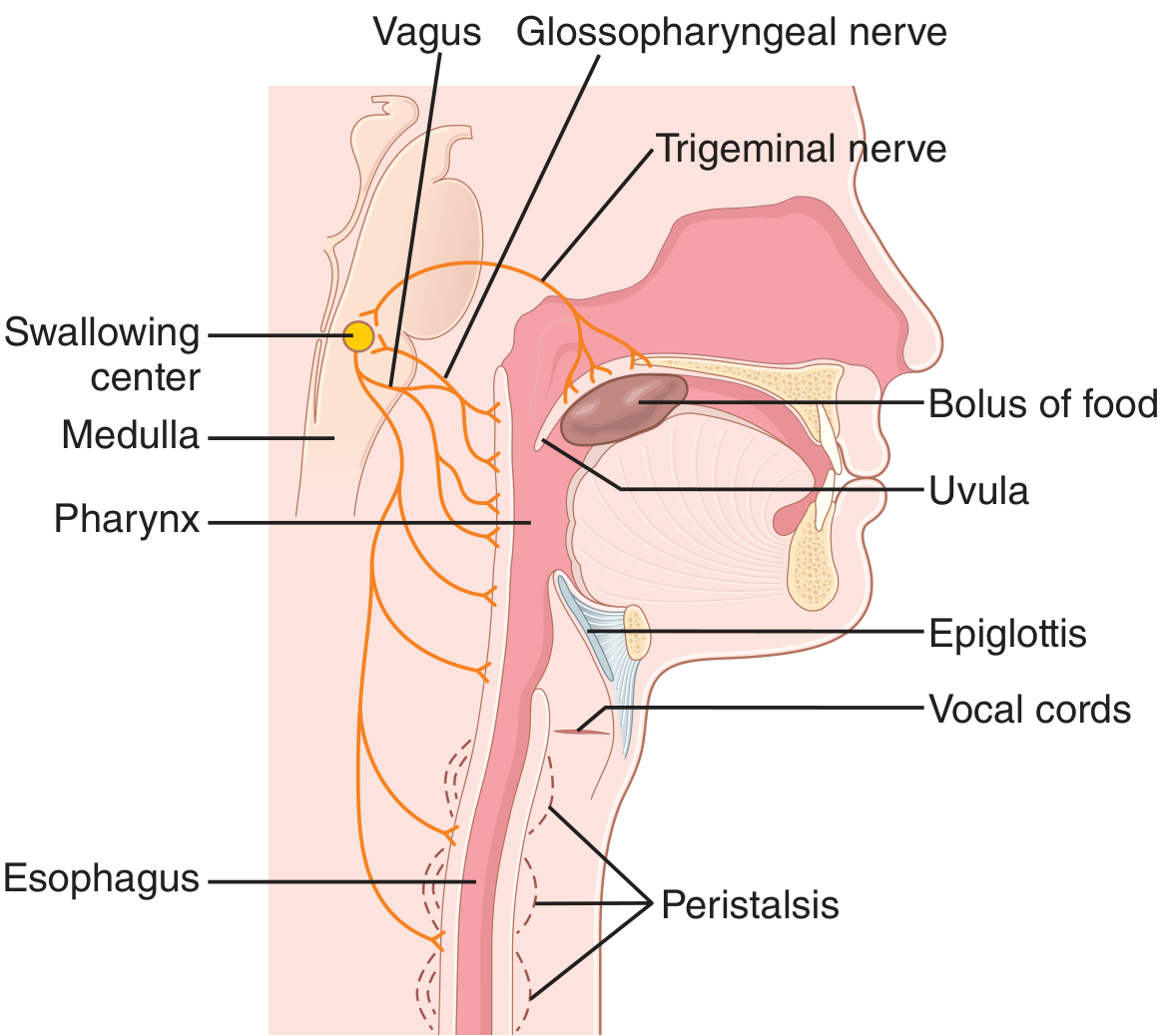
Fig. Swallowing mechanism - Guyton & Hall, p. 788
Overview
Swallowing is a complex coordinated act because the pharynx serves both respiration and deglutition. It is divided into 3 stages:
| Stage | Control | Location |
|---|---|---|
| 1. Oral (Voluntary) | Voluntary (cerebral cortex) | Mouth/tongue |
| 2. Pharyngeal | Involuntary reflex | Pharynx |
| 3. Esophageal | Involuntary reflex + enteric NS | Esophagus |
Stage 1: Oral (Voluntary) Phase
- The tongue squeezes/rolls the bolus posteriorly against the palate into the pharynx.
- Once the bolus enters the posterior mouth, swallowing becomes entirely automatic and cannot be stopped.
Stage 2: Pharyngeal Phase (Involuntary)
Trigger: Bolus stimulates epithelial swallowing receptor areas around the pharyngeal opening - maximal sensitivity at the tonsillar pillars.
Afferent pathway: Trigeminal (V) and glossopharyngeal (IX) nerves → tractus solitarius in medulla.
Swallowing center: Reticular formation of medulla oblongata + lower pons (deglutition center). Coordinates the entire sequence.
Efferent pathway: Cranial nerves V, IX, X, XII + superior cervical nerves → pharyngeal/esophageal muscles.
Sequential events (all in <2 seconds):
- Soft palate pulled upward → closes posterior nares → prevents nasal reflux
- Palatopharyngeal folds pulled medially → form a sagittal slit (size filter - only well-chewed food passes)
- Vocal cords strongly approximated + larynx pulled upward and anteriorly → epiglottis swings back over laryngeal opening → airway protection (most essential is vocal cord closure; epiglottis is secondary)
- Upper esophageal sphincter (UES) / pharyngoesophageal sphincter relaxes → food enters esophagus freely. Between swallows, UES remains strongly contracted (prevents air entry during breathing)
- Pharyngeal peristalsis - superior → inferior pharyngeal wall contraction propels bolus into esophagus
Respiratory inhibition: The swallowing center directly inhibits the respiratory center in medulla, halting breathing at any point in the cycle for <6 seconds during the pharyngeal phase.
Stage 3: Esophageal Phase
Two types of peristalsis:
| Type | Trigger | Nature |
|---|---|---|
| Primary peristalsis | Continuation of pharyngeal peristaltic wave | Vagally coordinated reflex; travels pharynx → stomach in 8-10 sec (5-8 sec with gravity) |
| Secondary peristalsis | Esophageal distension by retained food | Mediated by enteric nervous system (no external input needed); continues until stomach is reached |
Lower Esophageal Sphincter (LES):
- Normally contracted at ~30 mmHg above gastric pressure
- Relaxes ahead of the peristaltic wave (receptive relaxation) via VIP and nitric oxide (non-adrenergic, non-cholinergic neurons)
- After the bolus passes, LES closes (prevents gastric reflux)
- Tonic contraction is maintained by myogenic tone + excitatory vagal input
Esophageal muscle composition:
- Upper 1/3: striated muscle (voluntary nerve supply via somatic motor neurons)
- Lower 2/3: smooth muscle (controlled by enteric NS + vagus)
Neural Summary
SENSORY (afferent):
Pharyngeal receptors → CN V, CN IX → Tractus solitarius (medulla)
                                              ↓
                               SWALLOWING CENTER (medulla + lower pons)
                                              ↓
MOTOR (efferent):
CN V, IX, X, XII, cervical nerves → Pharynx, UES, Esophagus
Vagus (X) → Smooth muscle of lower esophagus + LES
Key Points for Exams
- Voluntary phase only: oral (tongue → palate)
- Most important airway protection: vocal cord closure (not epiglottis)
- UES: striated muscle, tonically contracted between swallows, relaxes during swallow
- LES relaxation mediators: VIP, nitric oxide (NANC neurons)
- Primary peristalsis = vagally coordinated; secondary peristalsis = enteric NS (local reflex)
- Swallowing center = medulla oblongata + lower pons (reticular formation)
- Entire pharyngeal phase: <2 seconds; esophageal transit: 8-10 seconds
Sources: Guyton & Hall Textbook of Medical Physiology, p. 788-790; Costanzo Physiology 7th Ed., p. 354-356
Mechanism of deglutition apnea. GIT physiology. Concise.
Finding Sources
Finding Sources
Reading File
Reading File
Reading File
Finding Sources
Now I have sufficient detail from both Guyton & Hall (previous session) and Cummings + Medical Physiology. Here is the concise answer:
Deglutition Apnea - Mechanism
Definition
Deglutition apnea is the brief cessation of breathing that occurs during the pharyngeal phase of swallowing. It lasts typically 0.6 - 3.8 seconds and is a mandatory, protective reflex.
Mechanism
1. Central Inhibition (Primary Mechanism)
The swallowing center (deglutition center) in the medullary reticular formation + caudal nucleus of the tractus solitarius (NTS) directly inhibits the respiratory center (also in the medulla) during swallowing.
- When sensory receptors in the oropharynx (tonsillar pillars, posterior pharyngeal wall) are stimulated by the bolus, afferents via CN IX (glossopharyngeal) and CN V (trigeminal) reach the NTS.
- The NTS acts as the gateway between the central pattern generator (CPG) for swallowing and the CPG for respiration.
- Activation of the swallowing CPG sends inhibitory signals to the respiratory CPG, suspending the respiratory rhythm at whatever point it is in the cycle.
2. Interaction Between Two CPGs
There are two proposed mechanisms for the CPG interaction:
| Pathway | Description |
|---|---|
| Oropharyngeal afferents → NTS → respiratory CPG | Sensory input from the pharynx directly modulates the respiratory rhythm generator (adapts to bolus size) |
| Swallowing CPG → Respiratory CPG | Direct cross-inhibition between the two central pattern generators in the medullary reticular formation |
3. Timing and Phase
- Swallows do not occur randomly throughout the respiratory cycle.
- The majority of swallows occur during expiration or late inspiration.
- After the swallow, the respiratory rhythm is reset - no compensatory modification occurs to make up for the lost breath.
Why Expiration Phase is Preferred
Swallowing preferentially during expiration has a mechanical advantage:
- Positive subglottic pressure during expiration helps keep the airway clear after glottic closure.
- Reduces risk of aspiration if airway protection is momentarily incomplete.
Structural Basis of Airway Protection During Apnea
While the respiratory center is inhibited centrally, three peripheral mechanisms also act simultaneously to prevent aspiration:
- Vocal cord approximation (most important) - closes the glottis
- Larynx elevated upward and anteriorly - epiglottis tilts over laryngeal inlet
- Cessation of diaphragm/respiratory muscle activity - no airflow during the swallow
Summary Diagram
Bolus → Oropharyngeal receptors (tonsillar pillars)
                ↓  (CN V, IX)
         NTS / Swallowing Center (medulla)
          ↙ (motor output)              ↘ (inhibition)
 Pharyngeal muscles contract       Respiratory CPG suppressed
 Glottis closes / larynx rises     → Breathing halts (apnea)
 UES relaxes → bolus enters               ↓
 esophagus                     Resumes after pharyngeal
                                phase (<6 sec); rhythm reset
Key Facts
- Duration: <6 seconds (usually 0.6-3.8 sec) - barely interrupts normal breathing
- Center: Medulla (swallowing center inhibits respiratory center directly)
- Phase preference: Expiratory phase of breathing cycle
- Post-swallow rhythm: Reset (no compensation for lost breath)
- The apneic period may increase with larger bolus volume in some individuals
- Mechanism is the same reason we cannot breathe and swallow simultaneously
Sources: Cummings Otolaryngology Head and Neck Surgery; Medical Physiology (Boron & Boulpaep); Guyton & Hall Textbook of Medical Physiology, p. 789
This is a shared conversation. Sign in to Orris to start your own chat.