
Dapagliflozin
dapagliflozin SGLT2 inhibitor
SGLT2 inhibitor dapagliflozin mechanism nephron kidney glucose reabsorption
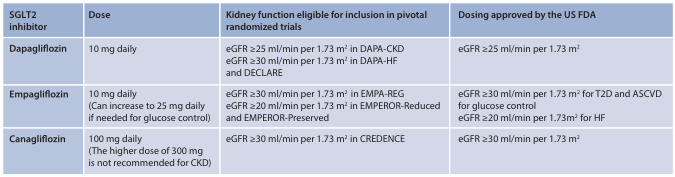
<table><thead><tr><th>SGLT2 inhibitor</th><th>Dose</th><th>Kidney function eligible for inclusion in pivotal randomized trials</th><th>Dosing approved by the US FDA</th></tr></thead><tbody><tr><td>Dapagliflozin</td><td>10 mg daily</td><td>eGFR ≥25 ml/min per 1.73 m<sup>2</sup> in DAPA-CKD<br>eGFR ≥30 ml/min per 1.73 m<sup>2</sup> in DAPA-HF<br>and DECLARE</td><td>eGFR ≥25 ml/min per 1.73 m<sup>2</sup></td></tr><tr><td>Empagliflozin</td><td>10 mg daily<br>(Can increase to 25 mg daily<br>if needed for glucose control)</td><td>eGFR ≥30 ml/min per 1.73 m<sup>2</sup> in EMPA-REG<br>eGFR ≥20 ml/min per 1.73 m<sup>2</sup> in EMPEROR-Reduced<br>and EMPEROR-Preserved</td><td>eGFR ≥30 ml/min per 1.73 m<sup>2</sup> for T2D and ASCVD<br>for glucose control<br>eGFR ≥20 ml/min per 1.73m<sup>2</sup> for HF</td></tr><tr><td>Canagliflozin</td><td>100 mg daily<br>(The higher dose of 300 mg<br>is not recommended for CKD)</td><td>eGFR ≥30 ml/min per 1.73 m<sup>2</sup> in CREDENCE</td><td>eGFR ≥30 ml/min per 1.73 m<sup>2</sup></td></tr></tbody></table>
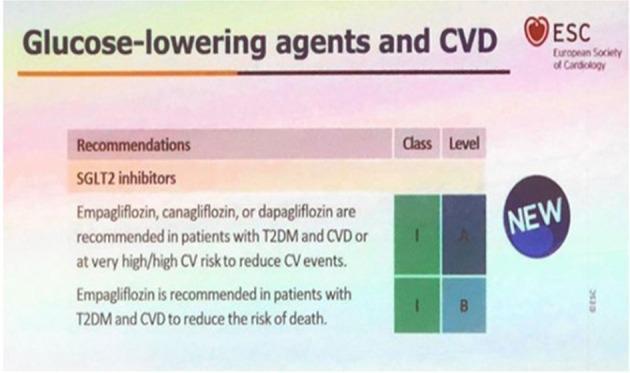
This Comparison Chart illustrates the European Society of Cardiology (ESC) guidelines regarding glucose-lowering agents and cardiovascular disease (CVD), specifically focusing on SGLT2 inhibitors. The chart displays two primary clinical recommendations with associated Class and Level of evidence ratings. First, the use of Empagliflozin, Canagliflozin, or Dapagliflozin for patients with Type 2 Diabetes Mellitus (T2DM) and existing CVD or high/very high cardiovascular risk to reduce CV events is designated as Class I, Level A. Second, the specific use of Empagliflozin in patients with T2DM and CVD to reduce the risk of mortality (death) is designated as Class I, Level B. The visual incorporates the ESC logo and a 'NEW' badge, indicating updated clinical standards. This resource is intended for medical education, guiding healthcare professionals on the evidence-based management of diabetic patients with cardiovascular comorbidities and emphasizing the therapeutic priority of the SGLT2 inhibitor class in modern cardiology.
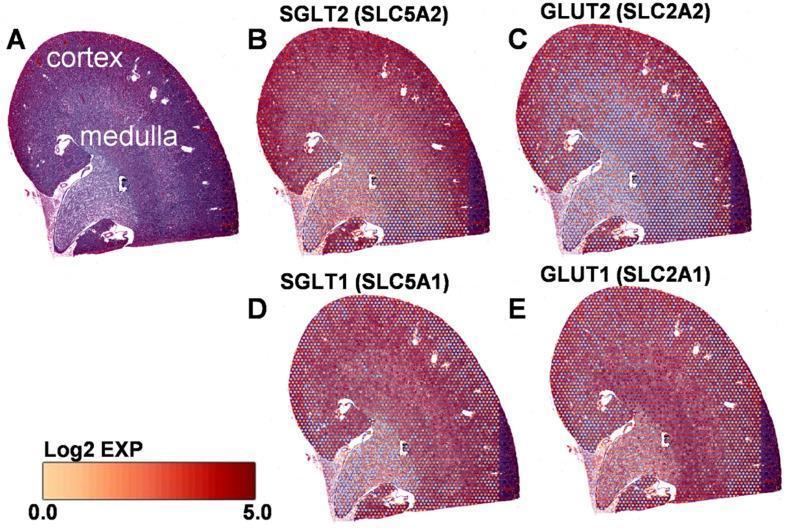
This composite diagnostic image showcases spatial transcriptomics data from a mouse kidney, illustrating the regional distribution of key glucose transporters. Panel A provides a histological reference snapshot, clearly labeling the outer cortex and inner medulla. Panels B through E display the spatial expression patterns for four transporters: SGLT2 (SLC5A2), GLUT2 (SLC2A2), SGLT1 (SLC5A1), and GLUT1 (SLC2A1). A Log2 expression color scale (0.0 to 5.0) at the bottom indicates that warmer red/orange tones represent higher transcript abundance, while cooler purple/blue tones indicate lower expression. The images demonstrate that SGLT2 (Panel B) and GLUT2 (Panel C) are most abundantly expressed within the renal cortex, corresponding to the S1 and S2 segments of the proximal tubules where the majority of glucose reabsorption occurs. Conversely, SGLT1 (Panel D) and GLUT1 (Panel E) show higher expression in the corticomedullary junction and medullary regions, correlating with the S3 segment of the proximal tubule. This visual comparison highlights the functional specialization of renal segments in glucose homeostasis.
Dapagliflozin (Farxiga)
Drug Class & Overview
Mechanism of Action
- Blocks renal glucose reabsorption → increases urinary glucose excretion (glucosuria)
- Lowers blood glucose independently of insulin (no risk of hypoglycemia as monotherapy)
- Causes osmotic diuresis and natriuresis → reduces preload and afterload
- Lowers systolic blood pressure modestly (not indicated for hypertension)
- Promotes weight loss (caloric loss via glucosuria ~70-100 kcal/day)
- Preferentially reduces interstitial volume over intravascular volume (less compensatory RAAS activation compared to loop diuretics)
Approved Indications
| Indication | Notes |
|---|---|
| Type 2 diabetes (T2DM) | Glycemic control (adjunct or monotherapy) |
| Heart failure with reduced EF (HFrEF) | With or without T2DM (post-DAPA-HF) |
| Chronic kidney disease (CKD) | Including non-diabetic CKD (post-DAPA-CKD); eGFR ≥25 mL/min |
| Heart failure with preserved EF (HFpEF) | Post-DELIVER trial |
- Lippincott Pharmacology, p. 819; Fuster & Hurst's The Heart, 15th Ed., p. 1543
Pharmacokinetics
| Parameter | Detail |
|---|---|
| Route | Oral, once daily (morning) |
| Bioavailability | ~60-80%; not affected by food |
| Protein binding | ~90% |
| Half-life | ~12 hours (suitable for once-daily dosing) |
| Metabolism | Glucuronidation to inactive metabolites |
| Elimination | Renal excretion of metabolites (virtually no parent drug in urine) |
| Doses | 5 mg (start) or 10 mg (maximum) once daily |
- Goodman & Gilman's, p. 1059
Key Clinical Trials
DAPA-HF (2019)
- 4,744 patients with HFrEF (EF ≤40%), NYHA class II-IV
- Dapagliflozin 10 mg vs. placebo, mean follow-up 18 months
- 26% reduction in composite of worsening HF or CV mortality vs. placebo
- Benefit seen regardless of T2DM status
- Led to FDA approval for HFrEF
DAPA-CKD (2020)
- Terminated early due to overwhelming efficacy
- Reduced composite of ≥50% eGFR decline, end-stage kidney disease, or death from CV/renal cause
- Included non-diabetic CKD patients (eGFR ≥25 mL/min)
DECLARE-TIMI 58
- CV outcomes in T2DM with ASCVD or multiple risk factors
- Reduced HF hospitalizations; non-inferior for MACE
DELIVER (2022)
- HFpEF (EF >40%)
- Dapagliflozin reduced CV death or worsening HF
DAPA ACT HF-TIMI 68 (2025) - NEW
- Fuster & Hurst's The Heart, 15th Ed., Table 48-14
Unique Properties Favoring Use in Heart Failure
- No dose titration required (once daily, fixed dose)
- Minimal drug-drug interactions
- Synergistic diuresis with loop diuretics but with less RAAS activation
- Kidney protection independent of glucose-lowering
- No effect on potassium (avoids hyperkalemia concerns that limit ACEi/ARB/MRA use)
- Minimal BP lowering at guideline-directed doses
Adverse Effects
| Effect | Notes |
|---|---|
| Genital mycotic infections | Most common; vulvovaginal candidiasis in women, balanitis in men (3-5%); rarely requires discontinuation |
| Urinary tract infections | ~2% increase; due to glucosuria |
| Urinary frequency/polyuria | Osmotic diuresis |
| Hypotension | Especially in elderly, volume-depleted, or patients on diuretics; check volume status before starting |
| Diabetic ketoacidosis (DKA) | Often "euglycemic DKA" (near-normal glucose); risk raised during illness, surgery, or fasting; hold perioperatively |
| Acute kidney injury | Transient, mild worsening of renal function early on; resolves with diuresis compensation |
| Fournier gangrene | Rare but serious necrotizing fasciitis of perineum |
| Bone fractures | Associated risk (mainly with canagliflozin; less clear for dapagliflozin) |
- Lippincott Pharmacology, p. 819; Goodman & Gilman's, p. 1059
Contraindications / Cautions
- eGFR <25 mL/min for CKD indication; avoid for glucose-lowering in severe CKD (loss of efficacy)
- Type 1 diabetes (risk of DKA; not approved)
- Recurrent genital infections (relative)
- Active UTI (hold until treated)
- Perioperative period (hold 3-4 days before major surgery due to DKA risk)
- Pregnancy / breastfeeding (avoid)
Drug Interactions
- Insulin / sulfonylureas: Does not cause hypoglycemia alone, but can potentiate hypoglycemia with these agents
- Diuretics: Additive volume depletion; monitor BP and renal function
- No significant CYP450 interactions (metabolized by glucuronidation)
Place in Therapy
- In T2DM + atherosclerotic CVD or HFrEF: add SGLT2i (or GLP-1 RA) regardless of A1C
- In T2DM + CKD (eGFR ≥25): dapagliflozin reduces progression to ESKD
- In HFrEF (any EF ≤40%, with or without T2DM): one of four pillars of GDMT alongside ACEi/ARB/ARNI, beta-blocker, and MRA
- In HFpEF (EF >40%): dapagliflozin now recommended (one of few evidence-based therapies in this group)
Recent Evidence (2024-2025)
- A network meta-analysis (2025) comparing SGLT2i class members in heart failure with T2DM found broadly consistent efficacy across agents, with class effects predominating.
- A network meta-analysis (2025) suggests SGLT2 inhibitors and GLP-1 RAs may have neuroprotective benefits, opening potential new indications in neurodegenerative diseases.
- The DAPA ACT HF-TIMI 68 trial and accompanying meta-analysis (Circulation 2025, PMID 40884036) provide evidence supporting early in-hospital initiation of dapagliflozin during acute HF admissions.
Teleact
Teleact telmisartan brand India uses dose
Teleact (Telmisartan)
Brand / Generic
| Brand Name | Generic |
|---|---|
| Teleact (India) | Telmisartan |
| Micardis (US/EU) |
Mechanism of Action
- Selectively blocks AT1 receptors (angiotensin II type 1 receptors) - blocking all Ang II effects regardless of which pathway produced it (ACE or chymase)
- Allows AT2 receptor activation (unlike ACEi) - since blocked AT1 causes compensatory rise in Ang II, which then stimulates AT2, potentially conferring vasodilatory and antiproliferative benefits
- Does NOT inhibit bradykinin breakdown (unlike ACEi) - hence no cough
- Additional unique property: inhibits sympathetic nervous system (SNS) activation through an antioxidant effect (distinguishes it from some other ARBs)
- Goodman & Gilman's, p. 1059; Brenner & Rector's The Kidney
Indications
| Indication | Evidence/Notes |
|---|---|
| Hypertension | First-line; once-daily dosing convenient |
| Cardiovascular risk reduction | ONTARGET trial: non-inferior to ramipril; less angioedema/cough |
| Diabetic nephropathy / proteinuria | Reduces proteinuria; nephroprotective in T2DM |
| Peripheral arterial disease (PAD) | Similar efficacy to ramipril with fewer side effects |
| Heart failure (as ARB class) | When ACEi-intolerant |
| Antipsychotic-related hypertension | Specific evidence supports valsartan and telmisartan |
| Polycystic Kidney Disease (ADPKD) | Used in HALT-PKD trial (lisinopril + telmisartan combination) |
Pharmacokinetics
| Parameter | Telmisartan (Teleact) |
|---|---|
| Route | Oral, once daily |
| Onset | ~3 hours |
| Peak plasma | 0.5-1 hour |
| Half-life | ~24 hours (longest among ARBs - ideal for once-daily dosing; effects may persist up to 7 days after stopping) |
| Protein binding | >90% |
| Metabolism | Minimal hepatic (<3%); glucuronidation to inactive compounds |
| Elimination | Primarily biliary/fecal (intact drug) - unlike most ARBs |
| Renal clearance | Virtually none - no dose adjustment needed in renal impairment |
| Hepatic clearance | Affected by hepatic insufficiency - use with caution in liver disease |
| Sex difference | Women achieve plasma levels 2-3x higher than men (no BP response difference) |
- Goodman & Gilman's, p. 1059; Brenner & Rector's The Kidney
Key distinguishing feature: Telmisartan has the longest half-life (~24 hours) among ARBs and is cleared almost entirely by biliary secretion (not kidneys), making it safe in CKD without dose adjustment.
Dosing
| Indication | Dose |
|---|---|
| Hypertension | Start: 40 mg once daily; Maintenance: 40-80 mg once daily |
| CV risk reduction | 80 mg once daily |
| Max dose | 80 mg/day |
- Can be taken with or without food
- No titration intervals required
Adverse Effects
| Effect | Notes |
|---|---|
| Hyperkalemia | ~3.3% incidence (similar to ACEi); monitor K+ and creatinine |
| Hypotension | Especially with volume depletion or diuretic co-use |
| Acute kidney injury | Especially in bilateral renal artery stenosis or volume depletion |
| Dizziness / headache | Common |
| No cough | Major advantage over ACEi (ARBs don't affect bradykinin) |
| No angioedema | Rare (much less than ACEi); seen in ONTARGET |
| Hypernatremia/hyponatremia | Neutral metabolic effect |
| Transaminase elevation | Occasionally; usually transient |
| Teratogenicity | Contraindicated in pregnancy (2nd and 3rd trimesters especially) - can cause fetal/neonatal death |
Contraindications
- Pregnancy (absolute) - stop at first missed period
- Bilateral renal artery stenosis (relative)
- Severe hepatic impairment (reduced clearance)
- Combination with ACEi - ONTARGET showed more adverse events (AKI, hyperkalemia, stroke) without added benefit; avoid dual RAAS blockade
- Combination with aliskiren in diabetics or CKD
Drug Interactions
| Drug | Interaction |
|---|---|
| ACEi / aliskiren | Increased hyperkalemia, AKI, hypotension - avoid combination |
| Potassium-sparing diuretics / MRAs | Additive hyperkalemia risk |
| Thiazide diuretics | Additive BP lowering (beneficial); response rates 70-80% with combination |
| NSAIDs | Reduce antihypertensive effect; increase AKI risk |
| Lithium | ARBs increase lithium levels (reduced renal clearance) |
| Digoxin | Telmisartan may increase digoxin levels - monitor |
Key Clinical Trial: ONTARGET (2008)
- ~25,000 high-risk cardiovascular patients
- Telmisartan vs. Ramipril vs. Combination
- Result: Telmisartan non-inferior to ramipril for MACE (MI, stroke, CV death) with less cough and angioedema
- Combination arm: more adverse events (AKI, hyperkalemia, hypotension) - no added benefit
- Established telmisartan as preferred alternative when ACEi not tolerated
ARB Class Comparison - Telmisartan's Unique Advantages
| Feature | Telmisartan | Other ARBs |
|---|---|---|
| Half-life | ~24 h (longest) | 6-15 h (most others) |
| Renal dose adjustment | Not needed | Required for several |
| Excretion route | Biliary (fecal) | Mixed renal/biliary |
| AT2 agonism (indirect) | Yes (class effect) | Yes |
| SNS inhibition | Yes (antioxidant mechanism) | Less evidence |
Available Formulations (India - Teleact)
- Teleact 20 mg, 40 mg, 80 mg tablets (telmisartan alone)
- Combination products common: Teleact-H (telmisartan + hydrochlorothiazide), Teleact-AM (telmisartan + amlodipine)