
What is your function
I'm Orris, a knowledgeable AI assistant built to help you with questions and tasks across a wide range of domains. Here's what I can do:
Research & Knowledge
- Answer questions on science, history, technology, law, finance, culture, and more
- Search the web for current information and news
- Look up peer-reviewed medical literature via PubMed
Medical & Clinical
- Consult an indexed library of medical textbooks for clinical questions
- Cover drugs, diagnoses, anatomy, physiology, pathology, pharmacology, procedures, and more
Document & File Creation
- Generate Word documents (.docx), PowerPoint presentations (.pptx), Excel spreadsheets (.xlsx), and PDFs
- Read, edit, and manipulate existing files you upload
Code & Computation
- Write and execute code (Python, JavaScript, shell, and more) in a sandbox environment
- Perform data analysis, build scripts, run calculations
Image Generation
- Create original images, diagrams, posters, flashcards, and other visuals from descriptions
General Tasks
- Summarize, rewrite, translate, or brainstorm content
- Break down complex multi-step projects and track progress
Ask me anything - I'll give you a direct, accurate answer and pull in sources when it helps.
Musculoskeletal system
Asking for Preferences
What about the musculoskeletal system would you like to explore?
The musculoskeletal system consists of bones, muscles, cartilage, tendons, ligaments, and joints - all working together to provide structure, movement, and protection. Let me pull a thorough overview from the medical library.
Searching sources...
Reading File
Finding Sources
Finding Sources
Finding Sources
Finding Sources
Finding Sources
Finding Sources
Finding Sources
Finding Sources
Reading File
Reading File
Reading File
Loading Image
Here is a thorough overview of the musculoskeletal system, drawn from the THIEME Atlas of Anatomy - General Anatomy and Musculoskeletal System.
The Musculoskeletal System - Overview & Anatomy
The musculoskeletal (locomotor) system is divided into two functional parts:
- Passive part - the skeleton and its connections (bones, cartilage, joints, ligaments)
- Active part - striated skeletal musculature (muscles, tendons)
1. The Skeleton
The adult human skeleton contains 206 bones organized into the axial skeleton (skull, vertebral column, thoracic cage) and the appendicular skeleton (upper and lower limbs, shoulder and pelvic girdles).
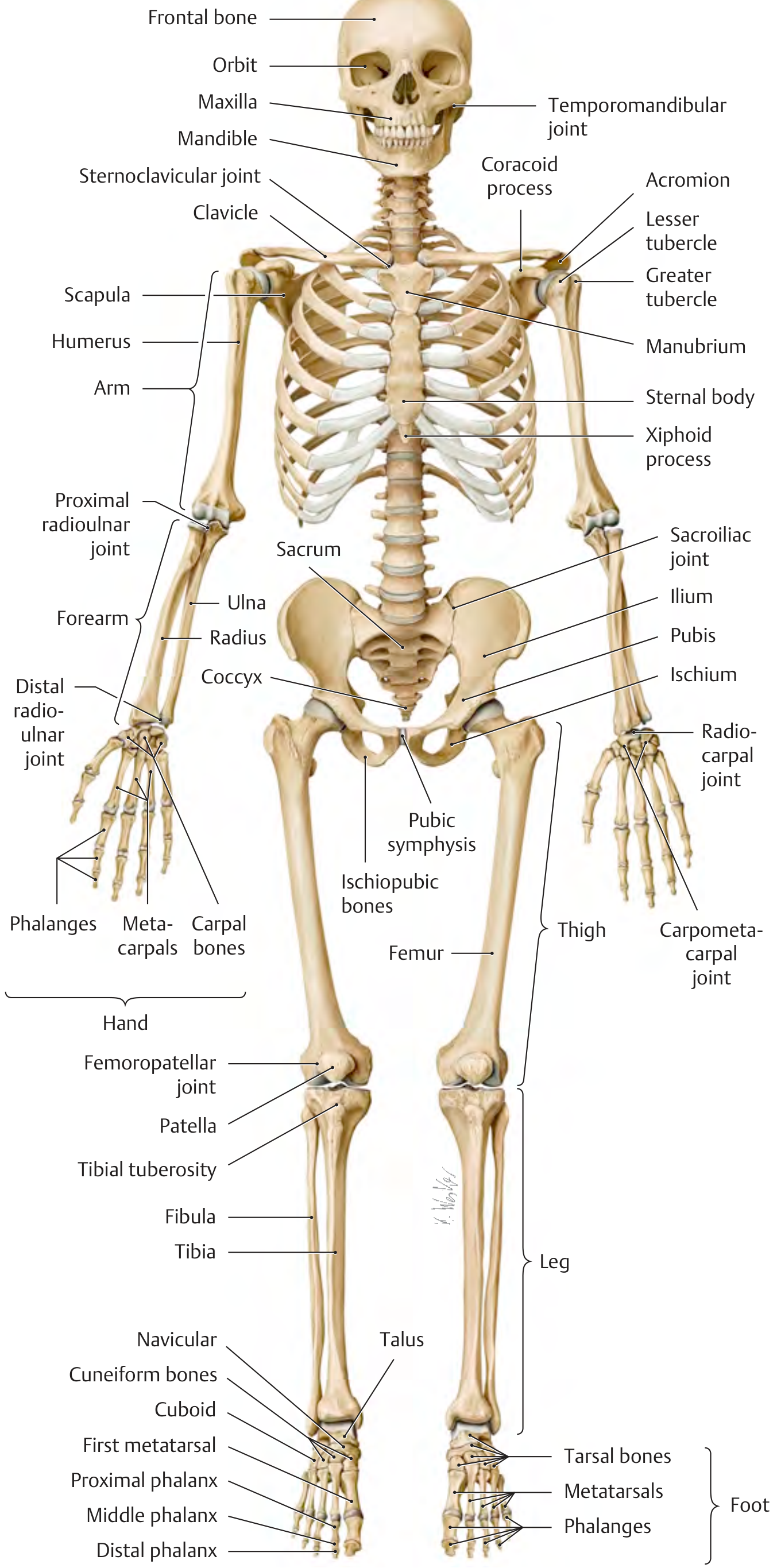
Types of Bone
| Type | Examples |
|---|---|
| Long bones (tubular) | Humerus, femur, tibia |
| Short bones | Carpal and tarsal bones |
| Flat bones | Scapula, ilium, calvaria |
| Irregular bones | Vertebrae |
| Pneumatic bones | Facial skeleton, paranasal sinuses |
| Sesamoid bones | Patella (embedded in tendons) |
| Accessory bones | Certain skull and foot bones (failure of ossification center fusion) |
Bone Microstructure
A long bone such as the femur has two layers:
- Compact (cortical) bone - the outer dense shell, made of structural units called osteons (~1 cm long, 250-350 µm in diameter). Each osteon has a central haversian canal carrying blood vessels, surrounded by 5-20 concentric lamellae of osteocytes. Osteons are interconnected by transverse Volkmann canals.
- Cancellous (trabecular/spongy) bone - the inner lattice of thin trabeculae (~200-300 µm thick), nourished by diffusion from the medullary cavity rather than direct vascular supply.
The periosteum covers the outer surface of compact bone and contributes to bone growth in thickness (appositional growth).
Bone Remodeling
Bone is not static. Approximately 10% of the entire adult skeleton is remodeled every year, meaning complete skeletal renewal over ~10 years. This process:
- Adapts bone to dominant stress patterns
- Prevents material fatigue
- Repairs microinjuries
- Provides a rapidly available calcium reservoir
2. Joints (Articular System)
Joints connect bones and allow varying degrees of movement.
Classification
False joints (Synarthroses) - bones are continuously connected; low to moderate mobility:
- Syndesmoses (fibrous joints) - e.g., newborn fontanelles, interosseous membranes
- Synchondroses (cartilaginous joints) - e.g., intervertebral discs; when fibrocartilaginous tissue predominates, called a symphysis (e.g., pubic symphysis)
- Synostoses (bony fusion) - e.g., sacral vertebrae fusing into the sacrum
True joints (Diarthroses) - separated by a joint space; mobility is variable:
- Diarthroses - classified by shape of articular surfaces (spheroidal, ellipsoidal, saddle), number of joint axes, and degrees of freedom
- Amphiarthroses - stiff true joints (e.g., sacroiliac joint)
Joint Development
Joints develop primarily by segmentation - cleavage of a continuous skeletal condensation (hip, shoulder, elbow). A minority form by appositional growth (two separate elements grow toward each other), as in the temporomandibular and sternoclavicular joints.
Joint development is complete by the 12th week of embryonic development, but the final structure is shaped by functional loads (muscle forces) throughout life.
3. Skeletal Musculature
Skeletal muscle is the active component of the musculoskeletal system. Key features:
- Attached to bone via tendons (dense regular connective tissue)
- Organized into functional groups (flexors, extensors, abductors, adductors, rotators)
- Contraction generates movement at joints, with the degree of movement depending on joint type and stabilizing ligaments
- Also stabilizes joints and maintains posture
4. Supporting Connective Tissues
| Structure | Composition | Function |
|---|---|---|
| Tendons | Dense collagen (type I) | Connect muscle to bone |
| Ligaments | Dense collagen (type I) | Connect bone to bone, stabilize joints |
| Cartilage | Chondrocytes + extracellular matrix | Articular surfaces, growth plates, shock absorption |
| Bursae / Synovial cavities | Synovial membrane + fluid | Reduce friction at joints and between tendons |
5. Key Clinical Terminology
| Term | Meaning |
|---|---|
| Ankylosis | Abnormal bony fixation of a true joint |
| Pseudarthrosis | False joint from abnormal fracture healing |
| Arthrodesis | Surgically induced joint ossification (to relieve pain/gain stability) |
| Arthroscopy | Endoscopic examination and treatment of a joint |
| Synovectomy | Removal of synovial membrane (e.g., in rheumatoid arthritis) |
| Arthroplasty | Joint replacement with total or partial endoprosthesis |
Summary
The musculoskeletal system provides the structural framework of the body, enables movement, protects internal organs, and maintains posture. Its passive (skeletal) and active (muscular) components work in close coordination, supported by cartilage, tendons, ligaments, and synovial structures.
Source: General Anatomy and Musculoskeletal System, THIEME Atlas of Anatomy (ISBN 9781626237186)
Would you like to go deeper into any specific area - such as the upper limb, lower limb, spine, joint biomechanics, or a specific muscle group?
This is a shared conversation. Sign in to Orris to start your own chat.