
Triangle of neck explain full anatomy ang with of 20 marks with all details and pictures refrence
Reading File
Now let me search the medical library for comprehensive content on the triangles of the neck:
Finding Sources
Finding Sources
Searching Images
triangles of the neck anatomy diagram
Excellent! Found Gray's Anatomy for Students. Now let me read the full content in parallel:
Reading File
Reading File
Searching Images
anterior triangle neck submental submandibular carotid muscular triangle anatomy
Now let me read more detailed content on posterior triangle, carotid triangle, and muscles:
Reading File
Reading File
Loading Image
Excellent content! Now let me get the posterior triangle image and more detail on vessels/nerves:
Loading Image
Reading File
Reading File
Let me fetch the carotid triangle image and the posterior triangle nerves section:
Loading Image
Reading File
I now have comprehensive content. Let me fetch one more key image (nerves of the posterior triangle) and also get the brachial plexus/cervical plexus content:
Loading Image
Reading File
I now have all the content needed for a comprehensive 20-mark answer. Let me compile the full detailed answer:
Triangles of the Neck — Full Anatomy (20 Marks)
Overview
The neck is divided into two major triangles — the Anterior Triangle and the Posterior Triangle — by the sternocleidomastoid (SCM) muscle. These triangles further subdivide into smaller triangles, each with distinct boundaries and clinically important contents.
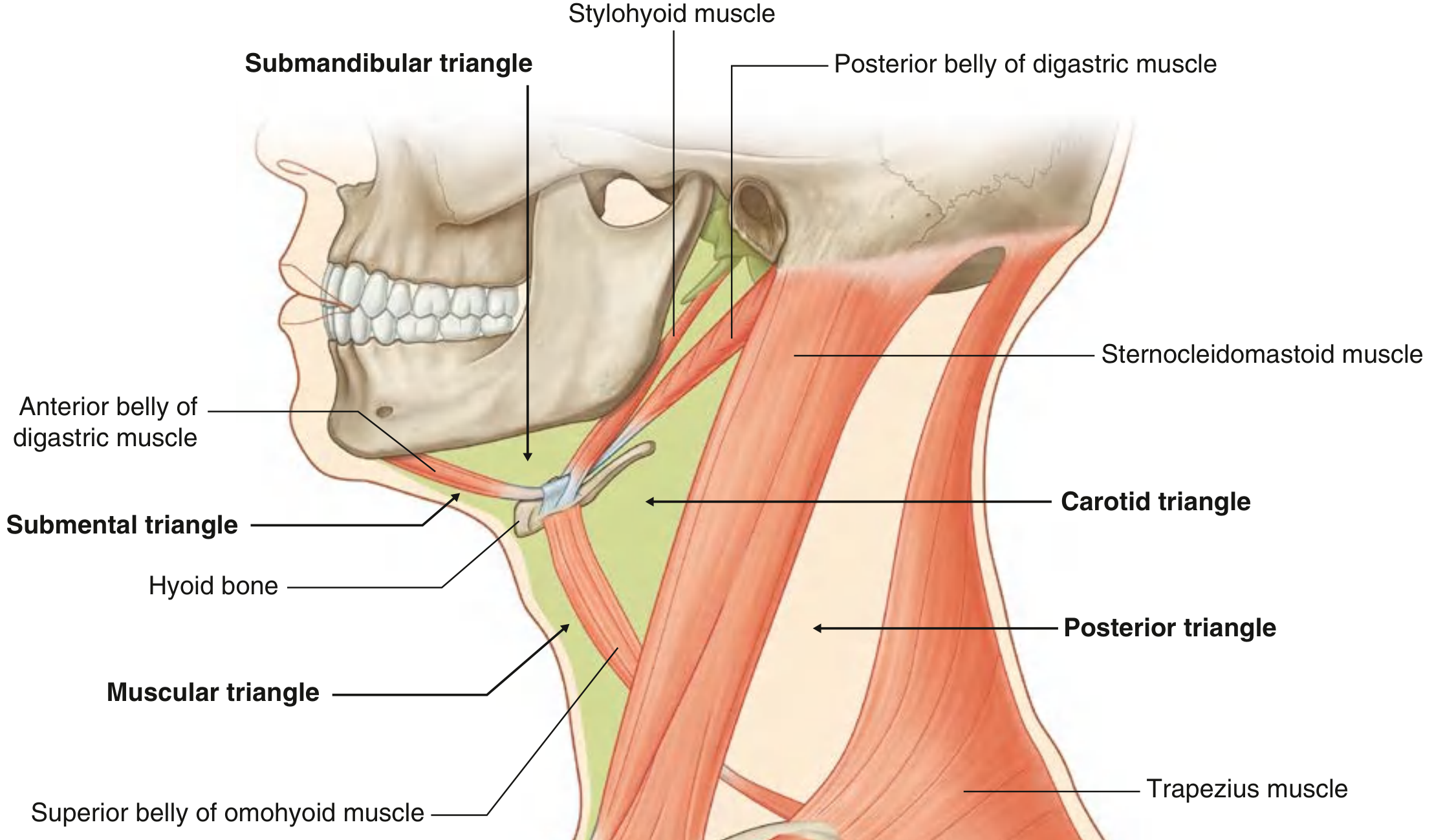
I. ANTERIOR TRIANGLE OF THE NECK
A. Boundaries
| Boundary | Structure |
|---|---|
| Lateral | Anterior border of SCM |
| Superior | Inferior border of mandible |
| Medial | Midline of neck |
| Apex | Chin (mental symphysis) |
The anterior triangle is further divided into four subdivisions:
B. Subdivisions of the Anterior Triangle
1. Submental Triangle (Unpaired)
- Boundaries: Mandibular symphysis superiorly; anterior belly of digastric on each side; body of hyoid bone inferiorly
- Contents:
- Submental lymph nodes
- Tributaries forming the anterior jugular vein
2. Submandibular Triangle (Digastric Triangle) — Paired
- Boundaries: Lower border of mandible superiorly; anterior belly of digastric anteriorly; posterior belly of digastric posteriorly
- Contents:
- Submandibular gland
- Submandibular lymph nodes
- Hypoglossal nerve [XII]
- Mylohyoid nerve
- Facial artery and vein
3. Carotid Triangle — Paired
- Boundaries: Posterior belly of digastric + stylohyoid superiorly; superior belly of omohyoid anteroinferiorly; anterior border of SCM posteriorly
- Contents (clinically most important):
- Common carotid artery (bifurcating into internal & external carotid)
- Carotid sinus & carotid body
- Internal jugular vein
- Superior thyroid, lingual, facial, occipital, and ascending pharyngeal arteries
- Vagus nerve [X], accessory nerve [XI], hypoglossal nerve [XII]
- Superior and inferior roots of ansa cervicalis
- Transverse cervical nerve
- Tributaries to common facial vein; cervical branch of facial nerve [VII]
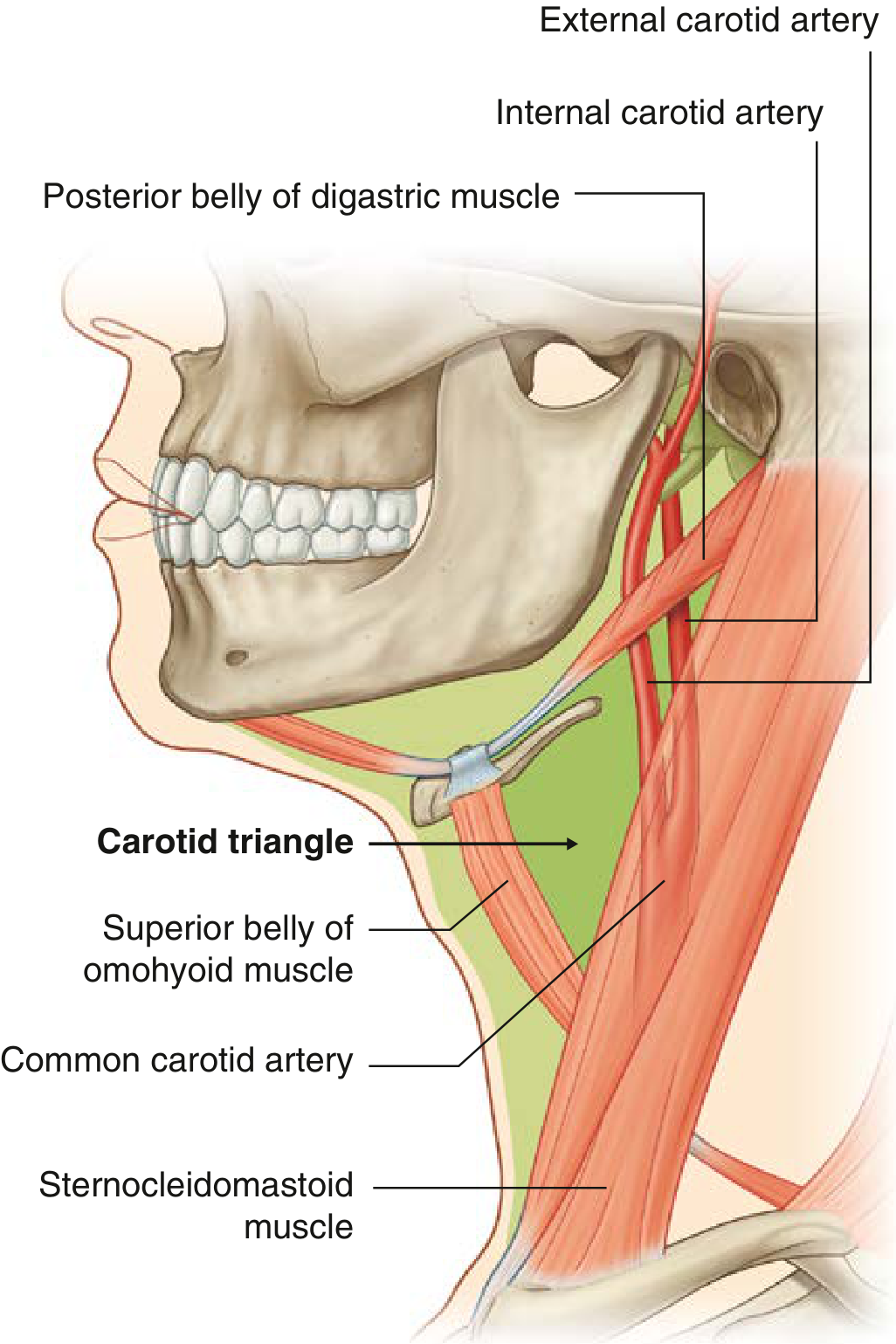
4. Muscular Triangle (Strap Triangle) — Paired
- Boundaries: Midline of neck medially; superior belly of omohyoid laterally; anterior border of SCM posterolaterally; hyoid bone superiorly
- Contents:
- Infrahyoid strap muscles: sternohyoid, omohyoid, sternothyroid, thyrohyoid
- Thyroid and parathyroid glands
- Larynx, trachea, pharynx, esophagus
C. Muscles of the Anterior Triangle
Suprahyoid Muscles (superior to hyoid bone)
| Muscle | Origin | Insertion | Innervation | Function |
|---|---|---|---|---|
| Stylohyoid | Base of styloid process | Lateral body of hyoid | Facial nerve [VII] | Pulls hyoid posterosuperiorly |
| Digastric (ant. belly) | Digastric fossa of mandible | Tendon to hyoid | Mylohyoid nerve (V₃) | Lowers mandible; raises hyoid |
| Digastric (post. belly) | Mastoid notch of temporal bone | Tendon to hyoid | Facial nerve [VII] | Pulls hyoid upward and back |
| Mylohyoid | Mylohyoid line of mandible | Body of hyoid + median raphe | Mylohyoid nerve (V₃) | Supports floor of mouth; elevates hyoid |
| Geniohyoid | Inferior mental spine (mandible) | Anterior surface of hyoid | C1 via hypoglossal nerve [XII] | Elevates hyoid forward or depresses mandible |
Infrahyoid Muscles (inferior to hyoid bone)
| Muscle | Origin | Insertion | Innervation | Function |
|---|---|---|---|---|
| Sternohyoid | Posterior sternoclavicular joint + manubrium | Body of hyoid | Ansa cervicalis (C1–C3) | Depresses hyoid after swallowing |
| Omohyoid | Superior border of scapula | Lower border of hyoid | Ansa cervicalis (C1–C3) | Depresses and fixes hyoid |
| Thyrohyoid | Oblique line of thyroid cartilage | Greater horn of hyoid | C1 via hypoglossal nerve [XII] | Depresses hyoid; raises larynx when fixed |
| Sternothyroid | Posterior manubrium | Oblique line of thyroid cartilage | Ansa cervicalis (C1–C3) | Draws larynx downward |
D. Vascular Contents of the Anterior Triangle
Common Carotid Artery (CCA):
- Right CCA: from brachiocephalic trunk, entirely in neck
- Left CCA: branches from arch of aorta, enters neck at left sternoclavicular joint
- Both ascend within the carotid sheath, lateral to trachea and esophagus
- Give no branches until bifurcation at the level of superior edge of thyroid cartilage (C3–C4)
Carotid Bifurcation (in the Carotid Triangle):
- Carotid sinus — dilatation at bifurcation; baroreceptors for blood pressure; innervated by glossopharyngeal nerve [IX]
- Carotid body — chemoreceptor for O₂ levels; innervated by glossopharyngeal [IX] and vagus [X] nerves
External Carotid Artery branches (8 total): Superior thyroid, Ascending pharyngeal, Lingual, Facial, Occipital, Posterior auricular, Maxillary, Superficial temporal
Internal Carotid Artery: Ascends without giving branches in the neck; enters carotid canal of temporal bone → supplies cerebral hemispheres, orbit, forehead.
II. POSTERIOR TRIANGLE OF THE NECK
A. Boundaries
| Boundary | Structure |
|---|---|
| Anterior | Posterior border of SCM |
| Posterior | Anterior border of trapezius |
| Base (inferior) | Middle one-third of clavicle |
| Apex | Occipital bone (behind mastoid process — where SCM & trapezius meet) |
| Roof | Investing layer of cervical fascia |
| Floor | Prevertebral fascia covering: splenius capitis, levator scapulae, posterior/middle/anterior scalene muscles |
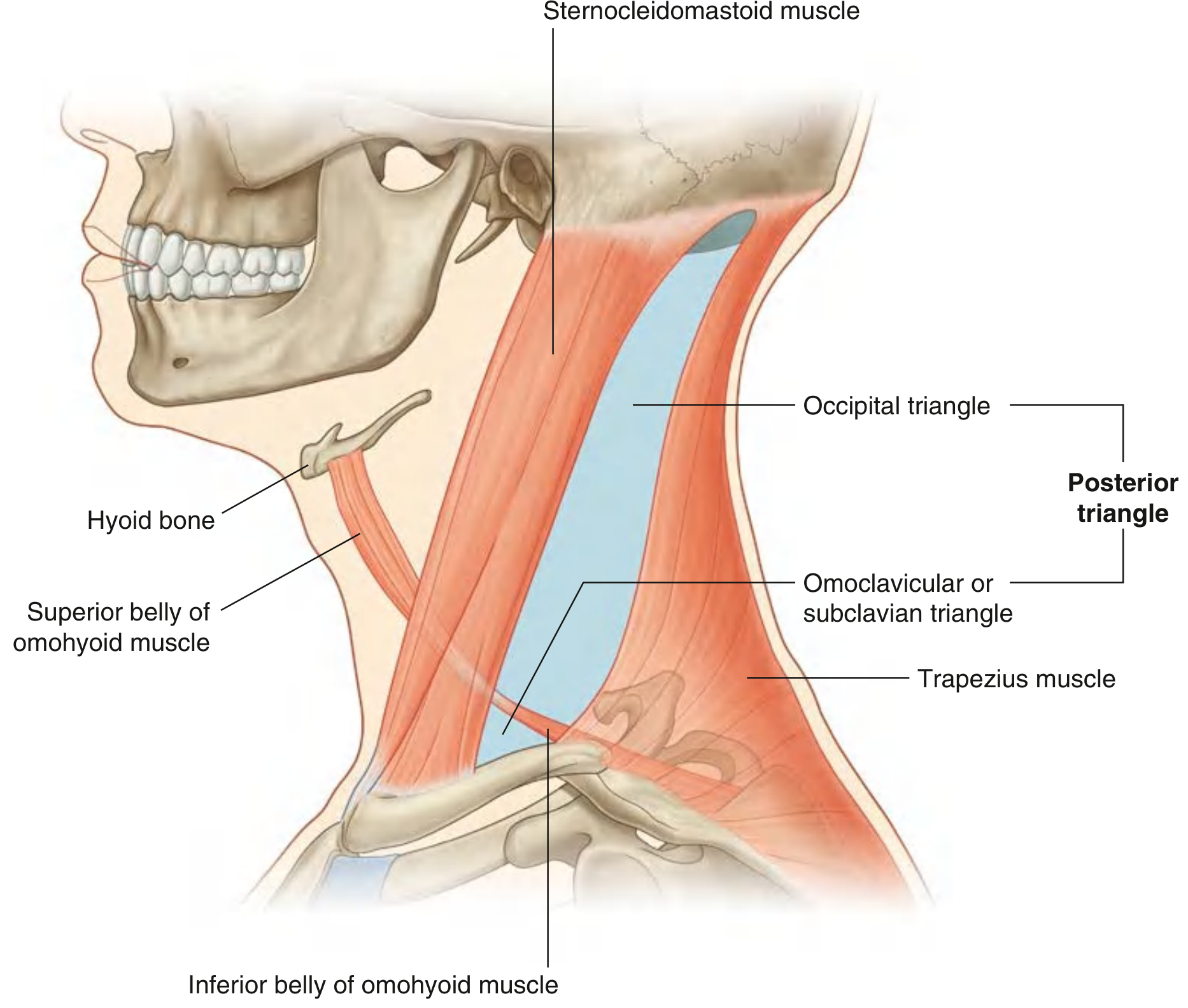
B. Subdivisions of the Posterior Triangle
The inferior belly of the omohyoid crosses the posterior triangle, dividing it into:
- Occipital Triangle (larger, superior): Contains accessory nerve [XI], cervical plexus branches, occipital artery, transverse cervical artery
- Omoclavicular (Subclavian) Triangle (smaller, inferior): Contains 3rd part of subclavian artery, subclavian vein, brachial plexus (lower trunks), suprascapular artery & vein
C. Muscles — Posterior Triangle
| Muscle | Origin | Insertion | Innervation | Function |
|---|---|---|---|---|
| SCM — sternal head | Anterior surface of manubrium | Lateral ½ superior nuchal line | Accessory [XI]; C2–C4 | Ipsilateral tilt; contralateral rotation of head |
| SCM — clavicular head | Medial ⅓ of clavicle | Mastoid process | " | " |
| Trapezius | Superior nuchal line, ext. occipital protuberance, ligamentum nuchae, C7–T12 spinous processes | Lateral ⅓ clavicle, acromion, spine of scapula | Motor: Accessory [XI]; Proprioception: C3, C4 | Rotates/elevates/retracts scapula |
| Splenius capitis | Lower ½ ligamentum nuchae; C7–T4 spinous processes | Mastoid process | Posterior rami middle cervical nerves | Extends and rotates head |
| Levator scapulae | Transverse processes C1–C4 | Upper medial border of scapula | C3, C4 + dorsal scapular nerve | Elevates scapula |
| Anterior scalene | Anterior tubercles C3–C6 transverse processes | Scalene tubercle, rib I | Anterior rami C4–C7 | Elevates rib I |
| Middle scalene | Transverse processes C3–C6 | Rib I (behind subclavian groove) | Anterior rami C3–C7 | Elevates rib I |
| Posterior scalene | Posterior tubercles C3–C6 | Rib II | Anterior rami C5–C7 | Elevates rib II |
| Omohyoid | Superior border of scapula | Inferior body of hyoid | Ansa cervicalis (C1–C3) | Depresses hyoid; divides posterior triangle |
D. Vessels of the Posterior Triangle
External jugular vein:
- Formed near angle of mandible (posterior retromandibular + posterior auricular veins)
- Crosses SCM superficially → enters posterior triangle → drains into subclavian vein
- Important landmark for estimating jugular venous pressure
Subclavian artery (3rd part):
- Found in the omoclavicular triangle
- Branches: transverse cervical artery (crosses base of posterior triangle to trapezius) and suprascapular artery (from thyrocervical trunk, crosses lowest part of posterior triangle)
Subclavian vein:
- Continuation of axillary vein from lateral border of rib I
- Passes anterior to anterior scalene muscle
- Receives external jugular vein; joins internal jugular vein → brachiocephalic vein
E. Nerves of the Posterior Triangle
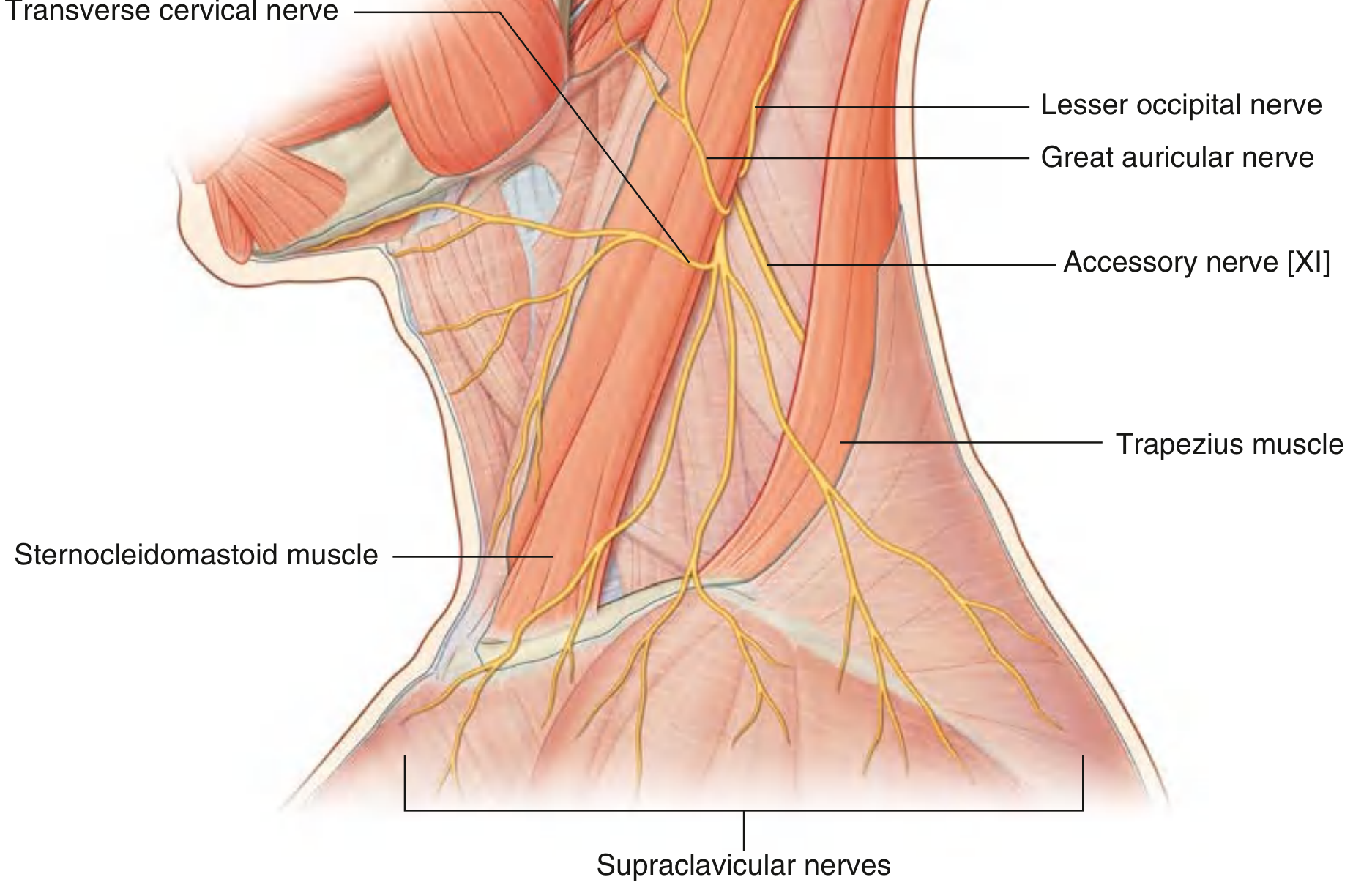
1. Accessory Nerve [XI]
- Exits cranial cavity via jugular foramen
- Descends posteriorly; innervates SCM then enters posterior triangle
- Crosses the posterior triangle in the investing cervical fascia
- Innervates the trapezius muscle
- Superficially placed → vulnerable to surgical injury (e.g., lymph node biopsy)
2. Cervical Plexus (C1–C4)
Forms within prevertebral fascia in the floor of the posterior triangle.
Cutaneous (superficial) branches — emerge at posterior border of SCM ("nerve point of the neck"):
- Lesser occipital nerve (C2): Skin of scalp posterior to ear
- Great auricular nerve (C2, C3): Skin of auricle and parotid region
- Transverse cervical nerve (C2, C3): Anterior skin of neck
- Supraclavicular nerves (C3, C4): Skin over clavicle and shoulder
Muscular (deep) branches:
- Phrenic nerve (C3, C4, C5) — Descends over anterior scalene → diaphragm (motor and sensory)
- Ansa cervicalis (C1–C3) — innervates infrahyoid muscles
- Branches to prevertebral muscles (rectus capitis, longus colli, longus capitis)
3. Brachial Plexus (C5–T1)
- Roots emerge between anterior and middle scalene muscles
- Trunks visible in the posterior triangle (lower part)
- Important for supraclavicular block in regional anaesthesia
III. CLINICAL SIGNIFICANCE
| Triangle | Clinical Relevance |
|---|---|
| Carotid triangle | Carotid endarterectomy; carotid pulse palpation; carotid bruit auscultation |
| Submandibular triangle | Submandibular gland excision; level I neck dissection |
| Submental triangle | Ludwig's angina (infection spreads here) |
| Muscular triangle | Thyroidectomy; tracheostomy access |
| Posterior triangle (occipital) | Accessory nerve [XI] injury during cervical lymph node biopsy → winging of scapula |
| Posterior triangle (omoclavicular) | Central venous catheter via subclavian vein; supraclavicular brachial plexus block |
| Posterior triangle (floor) | Scalene triangle: compression of brachial plexus / subclavian artery → Thoracic Outlet Syndrome |
Summary Diagram Reference
| Triangle | Key Boundaries | Key Contents |
|---|---|---|
| Submental | Digastric (ant. belly) × 2, hyoid, symphysis | Submental LN, ant. jugular tributaries |
| Submandibular | Mandible, ant. & post. belly digastric | Submandibular gland, CN XII, facial A&V |
| Carotid | Digastric (post.), omohyoid (sup. belly), SCM | CCA bifurcation, IJV, CN X/XI/XII, ansa cervicalis |
| Muscular | Midline, omohyoid (sup. belly), SCM | Strap muscles, thyroid, larynx/trachea |
| Occipital | SCM, trapezius, omohyoid (inf. belly) | CN XI, cervical plexus branches, occ. artery |
| Omoclavicular | SCM, clavicle, omohyoid (inf. belly) | Subclavian A&V, brachial plexus trunks |
Source: Gray's Anatomy for Students (ISBN 9780323934237), pp. 1145–1168 — Anterior and Posterior Triangles of the Neck
This is a shared conversation. Sign in to Orris to start your own chat.