
Explain me histology of nervous system in detail for first year student of mbbs
Reading File
Now let me search the library for histology of the nervous system content in parallel.
Finding Sources
Finding Sources
Finding Sources
Finding Sources
Finding Sources
Excellent! Found a dedicated histology textbook. Let me read the neuron section and search for more histology topics in parallel.
Reading File
Finding Sources
Finding Sources
Reading File
Finding Sources
Reading File
Finding Sources
Reading File
Reading File
I now have comprehensive content from the Histology textbook. Let me also fetch the key images to include in the response.
Loading Image
Loading Image
Searching Images
neuroglia astrocyte oligodendrocyte microglia histology
I now have comprehensive content from the Histology textbook (Histology: A Text and Atlas with Correlated Cell and Molecular Biology). Let me now compile the complete, detailed answer for a first-year MBBS student.
Histology of the Nervous System
Based on: Histology: A Text and Atlas with Correlated Cell and Molecular Biology, 9e & supplementary sources
Overview
The nervous system is divided into:
- Central Nervous System (CNS) — brain and spinal cord
- Peripheral Nervous System (PNS) — all nerves, ganglia, and sensory receptors outside the CNS
The two principal cell types are neurons (functional units) and neuroglia (supporting cells).
PART 1: THE NEURON
The neuron is the structural and functional unit of the nervous system. The human nervous system contains more than 10 billion neurons.
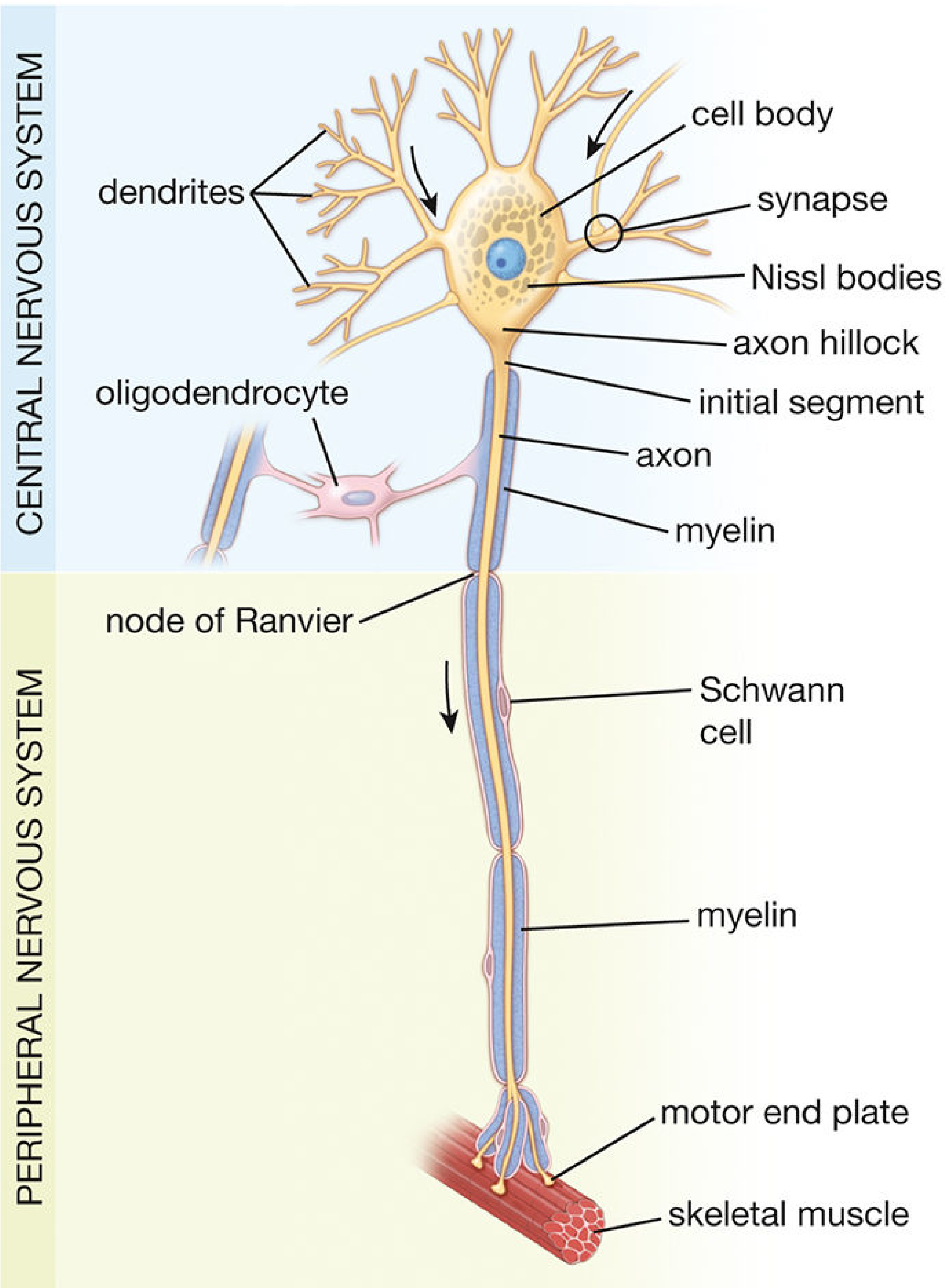
Figure 12.1 — Diagram of a motor neuron. In the CNS, myelin is produced by oligodendrocytes; in the PNS, it is produced by Schwann cells.
1.1 Classification of Neurons
By Function:
| Type | Function |
|---|---|
| Sensory (Afferent) | Convey impulses from receptors to the CNS. Somatic afferents carry pain, temperature, touch, pressure; visceral afferents carry pain from internal organs |
| Motor (Efferent) | Convey impulses from CNS/ganglia to effectors (muscle, glands). Somatic efferents go to skeletal muscle; visceral efferents go to smooth muscle, cardiac Purkinje fibers, glands |
| Interneurons | Form integrative networks between sensory and motor neurons. Comprise >99.9% of all neurons |
By Number of Processes:
| Type | Description | Example |
|---|---|---|
| Multipolar | One axon + two or more dendrites | Motor neurons, most CNS neurons |
| Bipolar | One axon + one dendrite | Retinal cells, cochlear neurons |
| Pseudounipolar | Single process that bifurcates | Dorsal root ganglion neurons (primary sensory) |
1.2 The Cell Body (Perikaryon/Soma)
The cell body contains the nucleus and all organelles necessary to maintain the cell.
Nucleus:
- Large, pale-staining (euchromatic) — reflects active gene transcription
- Prominent nucleolus — active ribosomal RNA synthesis
- Usually centrally placed (exception: dorsal root ganglion neurons have eccentric nuclei)
Cytoplasmic Organelles:
| Organelle | Histological Feature | Significance |
|---|---|---|
| Nissl bodies (Nissl substance) | Basophilic clumps — stain with basic dyes (thionin, cresyl violet), methylene blue | = Rough endoplasmic reticulum (rER) + free ribosomes; reflect high protein synthetic activity |
| Golgi apparatus | Not visible in H&E; requires silver impregnation | Packages and distributes proteins |
| Mitochondria | Scattered throughout | ATP production |
| Neurofilaments | Not visible in H&E; silver stains | Intermediate filaments unique to neurons; form cytoskeleton |
| Microtubules (neurotubules) | EM only | Transport organelles and vesicles |
| Lipofuscin granules | Yellow-brown pigment accumulates with age | Residual bodies from lysosomal digestion; not harmful |
| Melanin | Brown-black in substantia nigra neurons | Normal pigment (lost in Parkinson disease) |
Key exam point: Nissl bodies are absent in the axon hillock and in the axon itself, but are present in dendrites.
Axon Reaction (Chromatolysis):
When an axon is damaged, the cell body undergoes chromatolysis — Nissl bodies disperse, the nucleus moves to the periphery, and the cell swells. This indicates active protein synthesis for axon regeneration.
1.3 Dendrites
- Receptor processes that receive stimuli from other neurons or the environment and transmit them toward the cell body
- Usually short, tapered, extensively branched — form dendritic trees that greatly increase receptor surface area
- Unmyelinated
- Contain rER, free ribosomes, small Golgi outposts, microtubules
- Many CNS neurons have dendritic spines — small protrusions (actin-based) involved in synaptic plasticity, learning, and memory
- Mushroom-shaped spines = mature spines (~70–80% of total)
- Contain postsynaptic density
1.4 The Axon
- Usually a single, long process; transmits impulses away from the cell body to synaptic terminals
- Begins at the axon hillock — a cone-shaped elevation of the cell body where action potentials are initiated
- Lacks Nissl bodies and has sparse rER
- May be myelinated or unmyelinated
- Axolemma = plasma membrane of the axon
- Axoplasm = cytoplasm of the axon
Axon Terminals (Boutons/End Bulbs):
- Enlarged tips that form synapses
- Contain synaptic vesicles filled with neurotransmitter
- Contact points along the axon are called boutons en passant; terminal enlargements are boutons terminaux
Neuronal Transport:
| Type | Direction | Mechanism | Speed | What's Transported |
|---|---|---|---|---|
| Anterograde (fast) | Cell body → terminals | Kinesin motor protein | ~400 mm/day | Vesicles, mitochondria, membrane components |
| Anterograde (slow) | Cell body → terminals | Kinesin | 1–5 mm/day | Cytoskeletal proteins (neurofilaments, actin) |
| Retrograde | Terminals → cell body | Dynein motor protein | ~200 mm/day | Degraded organelles, trophic factors, viruses (rabies, herpes) |
1.5 Synapses
A synapse is a specialized junction where one neuron communicates with another neuron or effector cell.
Components:
- Presynaptic membrane — contains synaptic vesicles with neurotransmitter
- Synaptic cleft — ~20–30 nm wide
- Postsynaptic membrane — contains receptors; shows postsynaptic density (electron-dense thickening)
Types by location:
| Type | Between |
|---|---|
| Axodendritic | Axon terminal → dendrite (most common) |
| Axosomatic | Axon terminal → cell body |
| Axoaxonic | Axon terminal → another axon (modulatory) |
Synapses are not visible in routine H&E staining. They require silver precipitation (Golgi method) or electron microscopy.
Scanning electron micrograph of axosomatic synapses:
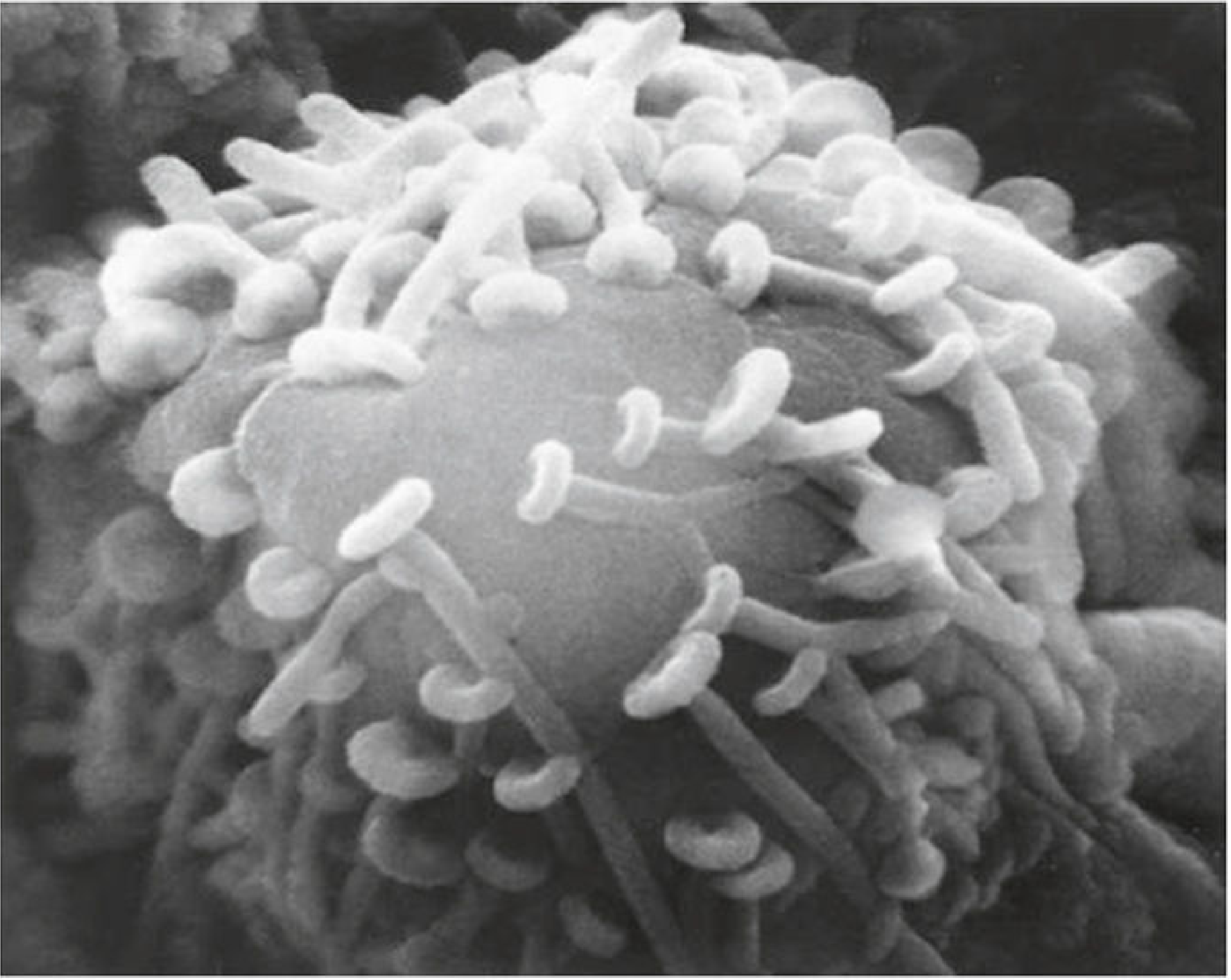
Figure 12.9 — SEM of neuron cell body covered by numerous presynaptic axon terminals forming axosomatic synapses. ×76,000.
Major Neurotransmitters (Summary Table):
| Neurotransmitter | Class | Action | Location |
|---|---|---|---|
| Acetylcholine (ACh) | Ester | Excitatory (nicotinic); Excitatory/Inhibitory (muscarinic) | Neuromuscular junction, ANS ganglia, CNS |
| Dopamine | Monoamine | Slow synaptic transmission | CNS (basal ganglia, limbic system) |
| Norepinephrine | Monoamine | Slow excitatory/inhibitory | CNS and smooth muscle |
| Serotonin | Monoamine | Excitatory and inhibitory | CNS and enteric system |
| Glutamate | Amino acid | Fast excitatory | CNS (major excitatory transmitter) |
| GABA | Amino acid | Fast and slow inhibitory | CNS (major inhibitory transmitter) |
| Glycine | Amino acid | Fast inhibitory | CNS (spinal cord) |
| Substance P | Peptide | Slow excitation | Pain pathways |
PART 2: NEUROGLIA (GLIAL CELLS)
Neuroglia are non-neuronal support cells of the nervous system. They outnumber neurons approximately 10:1. They do not generate action potentials but play critical roles in structural support, myelination, nutrition, and defense.
2.1 CNS Neuroglia
A. Astrocytes
- Largest glial cells in the CNS
- Two types:
- Protoplasmic astrocytes — found in grey matter; short, thick, branching processes
- Fibrous astrocytes — found in white matter; long, slender, unbranched processes containing GFAP (glial fibrillary acidic protein)
- Marker: GFAP (glial fibrillary acidic protein) — used for immunohistochemical identification
- Functions:
- Structural support (form glial limitans at CNS surface)
- Form perivascular end-feet around blood vessels → contribute to blood-brain barrier (BBB)
- Regulate extracellular K⁺ and glutamate concentrations
- Nutritional support for neurons
- Form glial scar (gliosis) after CNS injury
B. Oligodendrocytes
- Smaller than astrocytes; fewer, shorter processes
- Function: Produce and maintain myelin sheath in the CNS
- A single oligodendrocyte myelinates multiple axons (up to 50)
- Identified by small, round, dense nucleus; sparse cytoplasm
- Analogous to Schwann cells in the PNS
- Target in multiple sclerosis (demyelinating disease)
C. Microglia
- Smallest glial cells; elongated, dense, irregular nuclei with many short processes
- Derived from monocytes (bone marrow) — the only glial cells of non-neural origin
- Function: CNS's resident macrophages — phagocytose debris, dead cells, pathogens
- Become activated (ameboid) after CNS injury → transform into phagocytes
- Marker: CD68, Iba-1
D. Ependymal Cells
- Simple cuboidal to columnar epithelium lining the ventricular system (brain ventricles and central canal of spinal cord)
- Some bear cilia (beat CSF) and microvilli
- Specialized ependymal cells:
- Choroid plexus cells — modified ependymal cells that produce cerebrospinal fluid (CSF)
- Tanycytes — contact portal vessels; link CSF to hypothalamic neurons
2.2 PNS Supporting Cells
A. Schwann Cells (Neurilemma Cells)
- Analogous to oligodendrocytes but each Schwann cell myelinates only one axon segment
- Wrap concentrically around the axon to form the myelin sheath
- Myelinated fibers:
- Gaps in myelin at regular intervals = Nodes of Ranvier → allow saltatory conduction
- Oblique cytoplasmic channels in myelin = Schmidt-Lanterman clefts (incisures) — allow metabolite exchange; number correlates with axon diameter
- The outer collar of Schwann cell cytoplasm forms neurolemma (neurilemma) — important for PNS nerve regeneration
- Unmyelinated fibers (Remak Schwann cells):
- A single Schwann cell envelops multiple small-diameter axons in surface grooves
- Grooves may be open (mesaxon exposed) or closed (forming a mesaxon)
- Marker: S-100 protein
B. Satellite Cells
- Small, flat cells surrounding neuron cell bodies in ganglia
- Provide structural and metabolic support to ganglionic neurons
- Analogous to astrocytes in function
PART 3: NERVE FIBERS
3.1 Myelinated Nerve Fibers (PNS)
- Each internode = one Schwann cell wrapped around one axon segment
- Node of Ranvier = bare axon between two internodes (~1 µm wide)
- Myelin composition: ~70–80% lipid (cholesterol, phospholipids, sphingomyelin), ~20–30% protein (MBP, PLP)
- In cross-section (EM): myelin appears as concentric dark and light lamellae
- In light microscopy: myelin dissolves in routine processing (lipid solvents) → appears as empty space
3.2 Classification of Nerve Fibers
| Fiber Type | Myelination | Diameter | Conduction Velocity | Function |
|---|---|---|---|---|
| Aα | Heavy | 13–20 µm | 70–120 m/s | Proprioception, somatic motor |
| Aβ | Heavy | 6–12 µm | 30–70 m/s | Touch, pressure |
| Aδ | Light | 1–5 µm | 5–30 m/s | Pain (sharp), temperature |
| B | Light | <3 µm | 3–15 m/s | Preganglionic autonomic |
| C | Unmyelinated | 0.2–1.5 µm | 0.5–2 m/s | Pain (dull, burning), temperature |
PART 4: CONNECTIVE TISSUE SHEATHS OF PERIPHERAL NERVES
| Layer | Location | Composition |
|---|---|---|
| Endoneurium | Surrounds each individual nerve fiber | Reticular collagen fibers, fibroblasts |
| Perineurium | Surrounds each fascicle (bundle of fibers) | Concentric layers of perineurial cells (myoepithelial-like); forms blood-nerve barrier |
| Epineurium | Surrounds the entire nerve trunk | Dense irregular CT; fat cells, blood vessels (vasa nervorum) |
PART 5: GANGLIA
Ganglia are collections of neuron cell bodies outside the CNS, surrounded by satellite cells.
| Type | Location | Function |
|---|---|---|
| Dorsal root ganglia (Spinal ganglia) | Along dorsal roots of spinal nerves | Sensory; pseudounipolar neurons |
| Cranial nerve ganglia | Along sensory cranial nerves | Sensory |
| Autonomic ganglia | Sympathetic chain; walls of viscera | Motor to viscera; multipolar neurons |
PART 6: CNS TISSUE ORGANIZATION
Grey Matter vs. White Matter
| Feature | Grey Matter | White Matter |
|---|---|---|
| Location | Cortex (peripheral in brain), central in spinal cord | Deep in brain, peripheral in spinal cord |
| Composition | Neuron cell bodies, dendrites, synapses, glial cells, unmyelinated/lightly myelinated axons | Myelinated axons, oligodendrocytes; no neuron cell bodies |
| H&E appearance | Pinkish-grey; densely cellular | Pale pink; less cellular, lipid-rich |
| Neuropil | Present (dendrites + unmyelinated axons between cell bodies) | Absent |
Blood-Brain Barrier (BBB)
- Formed by: tight junctions between CNS endothelial cells + astrocyte perivascular end-feet + pericytes + basement membrane
- Restricts passage of large molecules, pathogens, and most drugs into brain
- Absent in circumventricular organs (area postrema, median eminence, neurohypophysis)
PART 7: KEY STAINING METHODS
| Stain | What it Shows |
|---|---|
| H&E | General morphology; Nissl substance weakly basophilic |
| Nissl stain (cresyl violet, thionin) | Nissl bodies (rER) in cell bodies and dendrites; identify neurons |
| Silver impregnation (Golgi, Bielschowsky) | Entire neuron shape, axons, dendrites, neurofibrils, synapses |
| Myelin stains (Luxol Fast Blue, Weigert) | Myelin sheaths blue; used to identify white matter and detect demyelination |
| Osmium tetroxide | Fixes and stains myelin black (EM and light microscopy) |
| GFAP immunostain | Labels astrocytes specifically |
| S-100 immunostain | Labels Schwann cells and some astrocytes |
| CD68/Iba-1 immunostain | Labels microglia |
PART 8: NEURAL REGENERATION
| Feature | CNS | PNS |
|---|---|---|
| Regeneration | Very limited | Occurs if cell body intact |
| Why limited in CNS? | Oligodendrocytes release inhibitory factors (MAG, Nogo); no neurolemma tube | — |
| Mechanism in PNS | — | Wallerian degeneration distally → Schwann cells form Bands of Büngner (guide tube) → axon sprouts grow at 1–3 mm/day |
| Neurolemma (neurilemma) | Absent | Present — critical for regeneration |
| Neural stem cells | Present in olfactory bulb and hippocampal dentate gyrus; express nestin (240 kDa IF) | — |
Quick Revision Summary
NEURONS:
  Cell body (perikaryon) → Nucleus + Nissl bodies (rER) + organelles
  Dendrites → receive signals → contain Nissl substance
  Axon → transmit signals away → NO Nissl bodies (absent from hillock onward)
  Synapse → axodendritic (most common), axosomatic, axoaxonic

NEUROGLIA (CNS):
  Astrocytes → BBB, support, GFAP+
  Oligodendrocytes → CNS myelin (one cell, many axons)
  Microglia → phagocytes (monocyte origin), CD68+
  Ependymal cells → line ventricles; choroid plexus → CSF

PNS SUPPORT:
  Schwann cells → PNS myelin (one cell, ONE axon segment) + S-100+
  Satellite cells → surround ganglionic neurons

NERVE SHEATHS: Endoneurium → Perineurium → Epineurium

GREY vs WHITE MATTER:
  Grey → cell bodies + neuropil
  White → myelinated axons only
Sources: Histology: A Text and Atlas with Correlated Cell and Molecular Biology (Ross & Pawlina), 9e, pp. 908–970; Junqueira's Basic Histology, 17e
This is a shared conversation. Sign in to Orris to start your own chat.