
Renal function tests
Reading File
Now let me search the medical library for renal function tests content.
Finding Sources
Finding Sources
Reading File
Reading File
Reading File
Reading File
Reading File
Reading File
Reading File
Finding Sources
Loading Image
Reading File
I now have comprehensive information from multiple textbooks. Here is a complete, well-organized answer:
Renal Function Tests
Renal function tests (RFTs) assess the ability of the kidneys to filter waste, maintain fluid/electrolyte balance, concentrate urine, and handle various solutes. They are categorized into glomerular function tests, tubular function tests, and additional blood/urine markers.
1. Glomerular Function Tests
Serum Creatinine
- End product of skeletal muscle creatine metabolism; excreted entirely by the kidneys.
- Normal: 0.8-1.2 mg/dL in adults; 0.4-0.8 mg/dL in young children; 0.5-1.0 mg/dL in pregnancy.
- Remains within normal range until approximately 50% of renal function is lost - this is the "creatinine blind spot."
- Unlike BUN, it is not significantly influenced by dietary intake.
- Measured classically by the Jaffe reaction (alkaline picrate + creatinine). False elevations occur with cephalosporins, ketones, glucose, ascorbic acid.
Glomerular Filtration Rate (GFR) and Its Estimation
Normal GFR is approximately 125 mL/min (or 90-110 mL/min on a 24h creatinine clearance).
The graph below illustrates the exponential rise of serum creatinine and BUN as GFR falls:
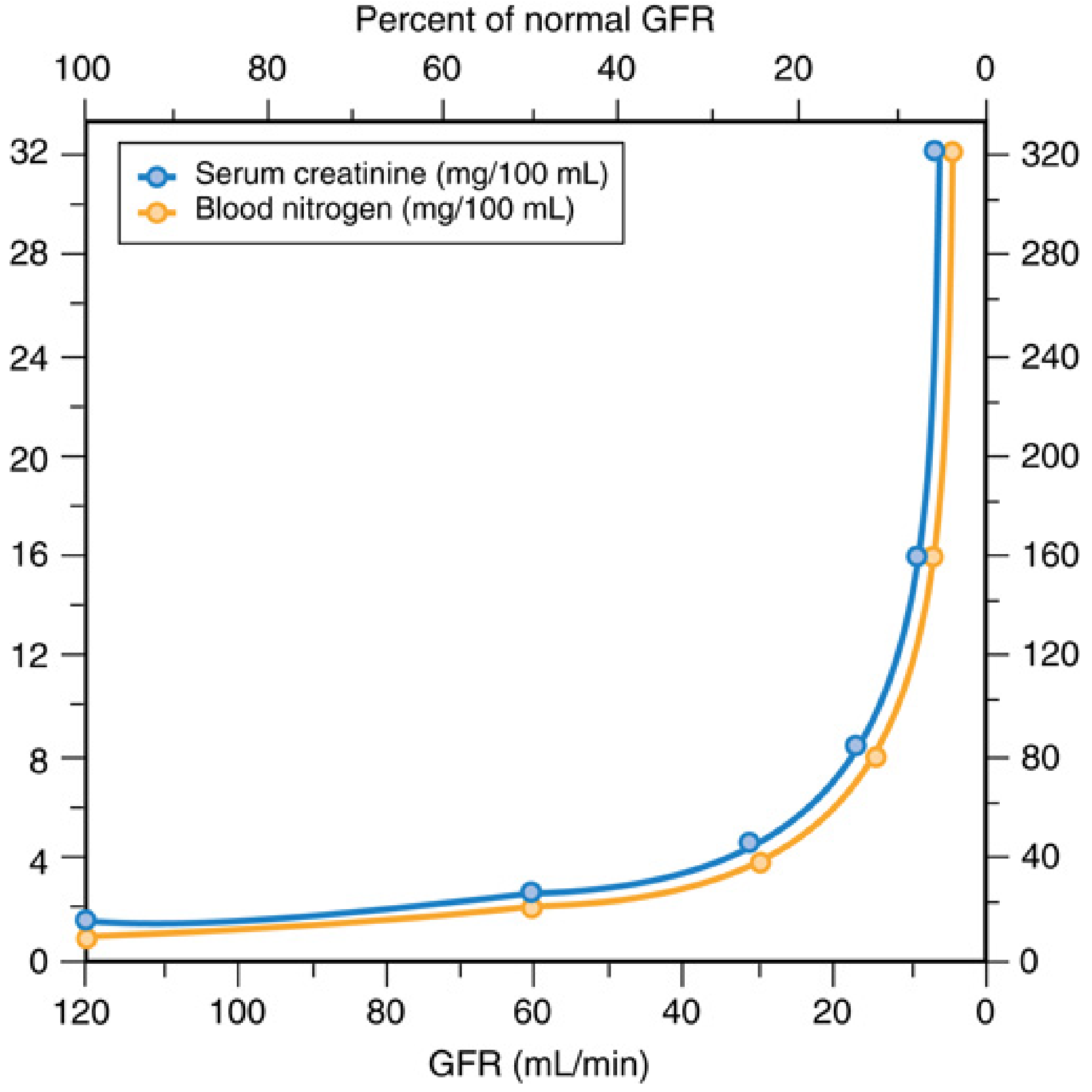
Note how both markers remain near-normal until GFR drops to ~50%, then rise steeply.
Three key GFR estimation formulas:
| Formula | Key Features | Limitations |
|---|---|---|
| Cockcroft-Gault | Uses age, weight, sex, serum Cr. Multiply by 0.85 for females. | Overestimates in obese patients |
| MDRD | Widely used; validated in CKD with GFR <60. Not reliable for GFR >60 mL/min/1.73 m² | Not validated in pregnancy, children, acutely ill |
| CKD-EPI | Uses creatinine, age, sex, race. More accurate at higher GFR values. Best predictor of ESRD risk and cardiovascular/all-cause mortality | Currently preferred formula |
Cockcroft-Gault formula:
Creatinine clearance (mL/min) = [(140 - age) × lean body weight (kg)] / [plasma Cr (mg/dL) × 72] Multiply by 0.85 for women.
Endogenous Creatinine Clearance (24-hour):
ClCr = (UCr × V) / (PCr × time in minutes)
- Normal: 90-110 mL/min (standardized: 70-140 mL/min)
- Requires a timed (usually 24-hour) urine collection plus a serum creatinine.
- Most accurate clinical measure without using exogenous markers.
Blood Urea Nitrogen (BUN)
- Urea = primary metabolite of protein catabolism; freely filtered and partially reabsorbed.
- Normal: 5-25 mg/dL.
- BUN is NOT elevated until ~75% of renal function is lost (less sensitive than creatinine).
- Non-renal factors affecting BUN:
| Elevated BUN | Decreased BUN |
|---|---|
| Reduced circulating volume (prerenal azotemia) | Liver disease |
| Catabolic states (GI bleeding, corticosteroids) | Malnutrition |
| High-protein diet | Sickle cell anemia |
| Tetracycline | SIADH |
BUN : Creatinine Ratio
- Normal: ~10:1
- Elevated (20:1 to 40:1): Dehydration, bilateral urinary obstruction, urinary extravasation (prerenal azotemia)
- Normal or low: Intrinsic renal disease, liver disease, overhydration
Cystatin C
- Produced by nearly all nucleated cells; freely filtered, completely reabsorbed by the proximal tubule.
- Less influenced by muscle mass, sex, or nutrition compared to creatinine.
- Superior to creatinine as a predictor of cardiovascular mortality.
- An early indicator of evolving chronic kidney disease.
- Increasingly used to calculate eGFR (CKD-EPI cystatin C equation available).
2. Tubular Function Tests
Urine Specific Gravity
- A direct index of the kidney's tubular concentrating ability.
- Normal range: 1.002-1.030.
- In diminished renal function, concentrating power progressively decreases until specific gravity becomes fixed at 1.006-1.010 (isosthenuria).
- Diluting ability (down to SG 1.002-1.004) is preserved much longer.
- Osmolality is a more precise measure: concentrated urine = ~1050 mOsm/kg (SG 1.030); fixed at plasma level = ~290 mOsm/kg (SG 1.010) = significant renal disease.
Urine Protein / Microalbuminuria
- Normal proteinuria: <150 mg/day (mainly Tamm-Horsfall protein).
- Dipstick: most sensitive to albumin; lower detection limit ~15 mg/dL.
- Microalbumin assay: detects as little as 0.3 mg/dL - sensitive marker of glomerular dysfunction.
- Urine beta-2-microglobulin and lysozyme: markers of tubular dysfunction.
Urine Glucose (Glycosuria)
- Glucose is freely filtered and reabsorbed entirely in the proximal tubule.
- Glycosuria occurs when tubular reabsorptive capacity is exceeded (diabetes mellitus) or tubular dysfunction lowers the reabsorption threshold (renal glycosuria).
3. Commonly Ordered Renal Panel (Reference Ranges)
| Test | Reference Range | Units |
|---|---|---|
| Blood urea nitrogen | 5-25 | mg/dL |
| Creatinine | 0.5-1.5 | mg/dL |
| Sodium | 133-147 | mmol/L |
| Potassium | 3.2-5.2 | mmol/L |
| Chloride | 94-110 | mmol/L |
| Bicarbonate (CO2) | 22-32 | mmol/L |
| Uric acid | 2.5-7.5 | mg/dL |
| Calcium | 8.5-10.5 | mg/dL |
| Phosphorus | 2.2-4.2 | mg/dL |
| Urine pH | 4.5-8.0 | - |
| Urine specific gravity | 1.002-1.030 | - |
| Urine RBC | 0-3 | /HPF |
| Urine WBC | 0-5 | /HPF |
| Urine casts | 0-2 | /LPF |
4. Novel Biomarkers
Beyond creatinine and cystatin C, several newer markers show promise for early/acute kidney injury (AKI) detection:
- KIM-1 (kidney injury molecule-1)
- NGAL (neutrophil gelatinase-associated lipocalin)
- IL-18 (interleukin-18)
- N-acetyl-beta-D-glucosaminidase (NAG)
- Uromodulin
- MicroRNA
These are especially relevant in perioperative settings where creatinine may take hours to days to reflect GFR changes.
5. GFR Staging and Clinical Significance
| % Normal GFR | Stage | Clinical Features |
|---|---|---|
| >50% | Mild insufficiency | Usually asymptomatic; BUN/Cr may be normal |
| ~30% | Moderate insufficiency | Biochemical changes; nocturia, anemia, Ca/P abnormalities |
| <30% | Severe insufficiency | Uremia: acidemia, volume overload, neurologic/cardiac/respiratory manifestations |
| 5-10% | End-stage renal disease (ESRD) | Renal replacement therapy required |
6. Screening for Chronic Kidney Disease (CKD)
The National Kidney Foundation recommends annual screening for high-risk groups (diabetes, hypertension, family history):
- eGFR - the primary test
- Microalbuminuria - sensitive early marker
CKD is defined as:
- GFR <60 mL/min/1.73 m², OR
- Albuminuria for ≥3 consecutive months
Sources: Smith and Tanagho's General Urology, 19th Ed. | Miller's Anesthesia, 10th Ed. | Quick Compendium of Clinical Pathology, 5th Ed.
Protein degradation protein folding protein mis folding
Finding Sources
Finding Sources
Finding Sources
Finding Sources
Finding Sources
Reading File
Reading File
Reading File
Reading File
Reading File
Reading File
Your credits are exhausted. You can purchase a top-up or subscribe to a plan to continue using Orris. If you're already subscribed, your daily credits will reset tomorrow.
This is a shared conversation. Sign in to Orris to start your own chat.