
maps OG8.1 ENUMERATE, DESCRIBE AND DISCUSS THE OBJECTIVES OF ANTENATAL CARE, ASSESSMENT OF PERIOD OF GESTATION; SCREENING FOR HIGH-RISK FACTORS. THE OBJECTIVES OF ANTENATAL CARE
Reading File
Finding Sources
Finding Sources
Finding Sources
Finding Sources
Finding Sources
Finding Sources
Park's Textbook of Preventive and Social Medicine has a dedicated section. Let me read it along with sections on period of gestation and high-risk screening.
Reading File
Finding Sources
Finding Sources
I have rich content from Park's Textbook. Now let me read the detailed sections on period of gestation assessment and high-risk factors from the Park's block.
Reading File
Reading File
I now have all the key content needed. Let me read the section specifically on assessment of period of gestation and the high-risk factors section.
Reading File
Reading File
I now have comprehensive content. Let me also fetch the uterine fundal height diagram.
Loading Image
Reading File
I now have all the content needed to give a thorough, structured answer. Here is the complete response:
OG8.1 - Antenatal Care: Objectives, Assessment of Period of Gestation, and Screening for High-Risk Factors
(Source: Park's Textbook of Preventive and Social Medicine)
DEFINITION OF ANTENATAL CARE
Antenatal care (ANC) is defined as the care provided by skilled health-care professionals to pregnant women and adolescent girls in order to ensure the best health conditions for both mother and baby during pregnancy. Its components include:
- Risk identification
- Prevention and management of pregnancy-related or concurrent diseases
- Health education and health promotion
ANC reduces maternal and perinatal morbidity and mortality both directly (through detection) and indirectly (by identifying women at increased risk of complications during labour/delivery and ensuring referral to an appropriate level of care).
I. OBJECTIVES OF ANTENATAL CARE
The objectives of ANC are:
| # | Objective |
|---|---|
| 1 | Promote, protect and maintain health of the mother during pregnancy |
| 2 | Detect "high-risk" cases and give them special attention |
| 3 | Foresee complications and prevent them |
| 4 | Remove anxiety and dread associated with delivery |
| 5 | Reduce maternal and infant mortality and morbidity |
| 6 | Teach the mother elements of child care, nutrition, personal hygiene, and environmental sanitation |
| 7 | Sensitize the mother to the need for family planning, including advice to cases seeking medical termination of pregnancy |
| 8 | Attend to under-fives accompanying the mother |
II. ANTENATAL VISITS - SCHEDULE
These objectives are achieved through a programme of health care services. The ideal schedule:
- Months 1-7: Once a month
- Month 8: Twice a month
- Month 9 onward: Once a week (if everything is normal)
Minimum 4 visits (as per Government of India guidelines):
| Visit | When |
|---|---|
| 1st | Within 12 weeks (as soon as pregnancy is suspected) |
| 2nd | Between 14 and 26 weeks |
| 3rd | Between 28 and 34 weeks (medical officer check at PHC advised) |
| 4th | Between 36 weeks and term |
III. ASSESSMENT OF PERIOD OF GESTATION
A. History-Taking (I. component of antenatal check-up)
- Record the date of 1st day of last menstrual period (LMP)
- Calculate Expected Date of Delivery (EDD) by adding 9 months and 7 days to the 1st day of LMP (Naegele's rule)
- Record symptoms indicating complications (fever, bleeding, absent foetal movements, etc.)
B. Physical Examination - Abdominal Palpation (III. component)
Key findings used to assess gestational age clinically:
- Fundal height - The level of the uterine fundus correlates with weeks of gestation (see figure below)
- Foetal heart sounds - Heard with a stethoscope/Doppler
- Foetal movements - Noted from around 20 weeks
- Foetal parts - Can be distinguished from the 28th week onward
- Multiple pregnancy - Suspected if uterus is larger than estimated gestational age, or palpation of multiple foetal parts
- Foetal lie and presentation - Relevant only after 32 weeks
- Abdominal scars - Inspection for any relevant abdominal findings
C. Uterine Fundal Height - Key Clinical Landmarks
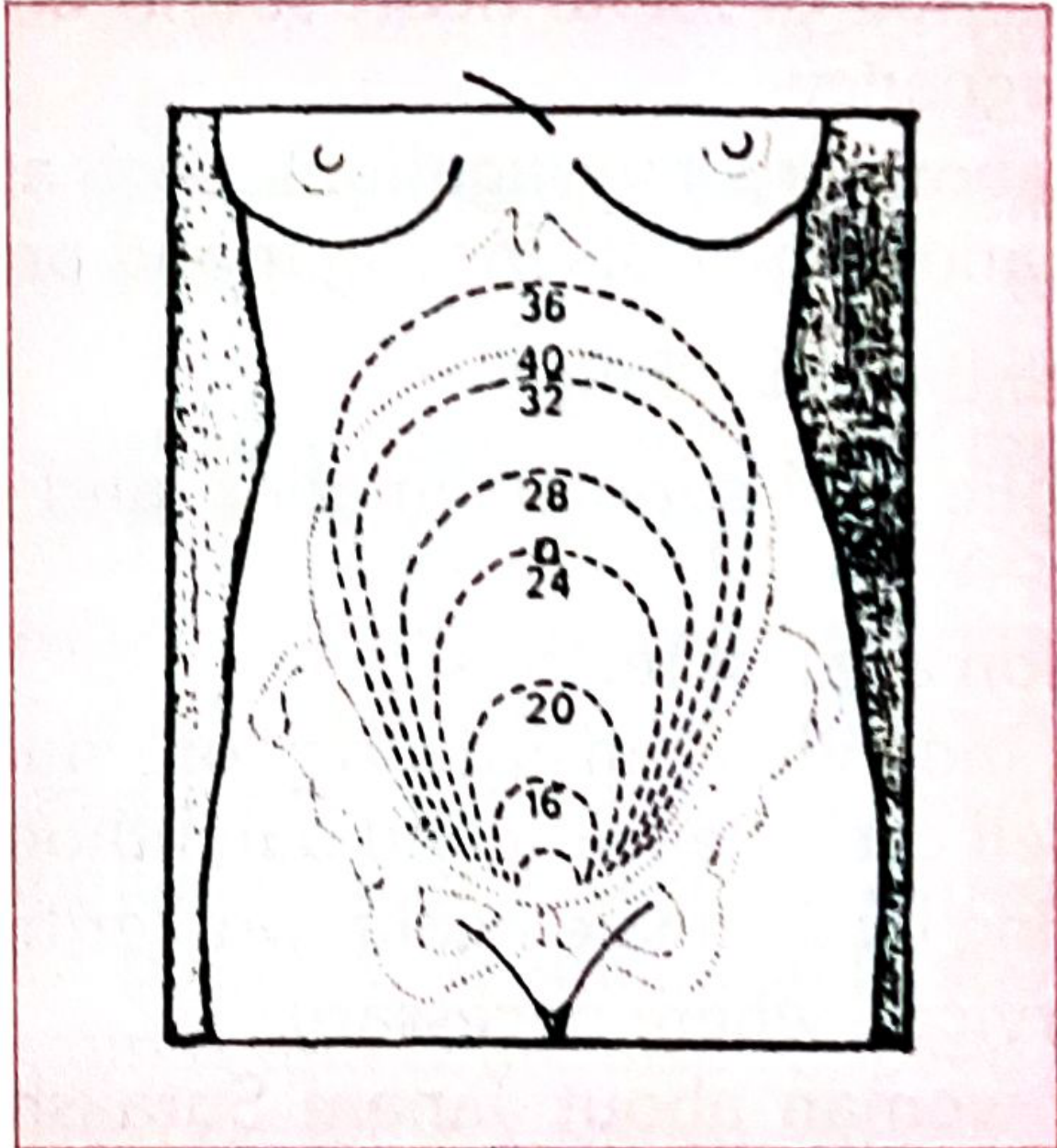
Fig. 1 - Uterine fundal height at various stages of pregnancy. Numbers indicate weeks of gestation (16, 20, 24, 28, 32, 36, 40).
D. Assessment of Gestational Age (IV. component)
| Method | Details |
|---|---|
| LMP-based | Previously most widespread; remains the only available method in many low-income settings |
| Ultrasound (gold standard) | Routine early ultrasound + foetal measurements, ideally in the first trimester |
| "Best obstetric estimate" | Combines ultrasound and LMP - now used by many countries |
| Alternative methods (low-resource settings) | Fundal height, clinical assessment of newborn after birth, or birth weight as a surrogate |
Ultrasound requires skilled technicians, equipment, and first-trimester ANC attendance - not always feasible in low-income settings where the majority of preterm births occur.
IV. LABORATORY INVESTIGATIONS
At Sub-centre level:
- Pregnancy detection test
- Haemoglobin estimation
- Urine test for albumin and sugar
- Rapid malaria test
At PHC/CHC/FRU level:
- Blood group including Rh factor
- VDRL/RPR (syphilis)
- HIV testing
- Blood sugar
- Thyroid function (where indicated)
- Ultrasound
V. SCREENING FOR HIGH-RISK FACTORS - THE RISK APPROACH
"The central purpose of antenatal care is to identify 'high risk' cases (as early as possible) from a large group of antenatal mothers and arrange for them skilled care, while continuing to provide appropriate care for all mothers."
- Park's Textbook of Preventive and Social Medicine
High-Risk Factors (to be screened for):
| Category | High-Risk Factors |
|---|---|
| Age/Parity | Elderly primi (≥30 years); Elderly grandmultiparas |
| Anthropometric | Short-statured primi (≤140 cm) |
| Obstetric - Current | Malpresentations (breech, transverse lie); Antepartum haemorrhage / threatened abortion; Pre-eclampsia and eclampsia; Twins, hydramnios; Prolonged pregnancy (>14 days after EDD) |
| Obstetric - Past | Previous stillbirth, intrauterine death, manual removal of placenta; Previous abortion; Previous caesarean or instrumental delivery; Three or more spontaneous consecutive abortions |
| Medical | Cardiovascular disease, kidney disease, diabetes, tuberculosis, liver disease, malaria, convulsions, asthma, HIV, RTI, STI |
| Reproductive | Treatment for infertility |
| Haematological | Anaemia |
The Risk Approach - Purpose and Philosophy
The "risk approach" is a managerial tool for improved MCH care. Its purpose is to provide better services for all, but with special attention to those who need them most. Key principles:
- Maximum utilization of all resources - including non-conventional human resources (traditional birth attendants, community health workers, women's groups)
- Far-reaching effects on the whole organization of MCH/FP services
- Improvements in both coverage and quality of health care at all levels, particularly at the primary health care level
VI. INTERVENTIONS AND COUNSELLING AT EACH VISIT
- Iron and folic acid (IFA) supplementation
- Immunization against tetanus (TT injection)
- Group or individual instruction on nutrition, family planning, self-care, delivery, and parenthood
- Home visiting by a female health worker/trained dai
- Referral services where necessary
- Inform the woman about Janani Suraksha Yojana (JSY) and other government incentives
SUMMARY TABLE
| Component | Key Points |
|---|---|
| ANC Definition | Care by skilled professionals during pregnancy to ensure best health for mother and baby |
| Objectives | 8 objectives - from maternal health promotion to family planning sensitization |
| Visit Schedule | Minimum 4 visits; ideally monthly in 1st 7 months |
| Gestational Age | LMP (Naegele's rule), fundal height clinically, ultrasound is gold standard |
| High-Risk Screening | 14 categories screened at every ANC visit |
| Risk Approach | Managerial tool - special attention to high-risk while covering all mothers |
- Park's Textbook of Preventive and Social Medicine, pp. 611-616
This is a shared conversation. Sign in to Orris to start your own chat.