
Carcinoma tongue in detail
Reading File
Now I'll run parallel searches across the medical library for comprehensive coverage of carcinoma of the tongue.
Finding Sources
Finding Sources
Searching PubMed
"tongue neoplasms"[MeSH Terms] AND "squamous cell carcinoma"[MeSH Terms]
Excellent — found dedicated sections. Now reading them all in parallel.
Reading File
Reading File
Finding Sources
Finding Sources
Great content found. Now reading more from Cummings (the definitive otolaryngology text) and the staging/neck management sections:
Reading File
Reading File
Reading File
Excellent data. Now let me get the base of tongue section, T staging table, and fetch the key clinical images in parallel:
Reading File
Finding Sources
Loading Image
Loading Image
Now let me get the T-staging details and the Cummings staging section for completeness:
Reading File
Reading File
I now have comprehensive material. Let me compile the full detailed answer on Carcinoma of the Tongue.
Carcinoma of the Tongue
Overview & Anatomy
The tongue is divided into two distinct anatomical and oncological regions:
- Oral tongue (anterior 2/3) — from the tip to the circumvallate papillae; part of the oral cavity
- Base of tongue (posterior 1/3) — from the circumvallate papillae to the vallecula; part of the oropharynx
The oral tongue is a muscular structure covered by non-keratinizing squamous epithelium. Subsites include the lateral tongue, anterior tip, ventral tongue, and dorsal surface. Carcinomas arise in the epithelium and invade the deeper musculature.
Epidemiology
- Oral tongue is the second most common site of oral cancer (30% of all oral cancers)
- Most lesions (≈75%) occur on the posterolateral aspect of the oral tongue; 20% on the anterolateral ventral surface; 3–5% on the dorsal surface
- Typical patient: male, 6th–7th decade, with history of tobacco and/or alcohol use
- Increasing incidence in young patients (18 years old in 1993, up from 4% in 1971) — no clear risk factors identified; increased genetic susceptibility postulated
- At diagnosis, majority (75%) are staged T2 or smaller
Histology
- Squamous cell carcinoma (SCC) accounts for the vast majority
- Dorsal tongue differential: amyloidosis, median rhomboid glossitis, granular cell myoblastoma, erosive lichen planus
- Submucosal tongue tumors: leiomyoma, leiomyosarcoma, rhabdomyosarcoma, neurofibroma (mesenchymal origin)
- Tonsil tissue at base of tongue → may also give rise to lymphoma
Risk Factors
| Factor | Details |
|---|---|
| Tobacco | Smoking and smokeless tobacco — major risk |
| Alcohol | Synergistic with tobacco |
| HPV | Especially HPV-16/18 for base of tongue (oropharyngeal SCC) |
| Immunosuppression | Post-transplant, HIV |
| Poor oral hygiene | Possible contributing factor |
| Genetic susceptibility | Young-onset cases without traditional risk factors |
| Reverse smoking | Associated with hard palate and tongue dorsum lesions in certain populations |
Clinical Presentation
Early
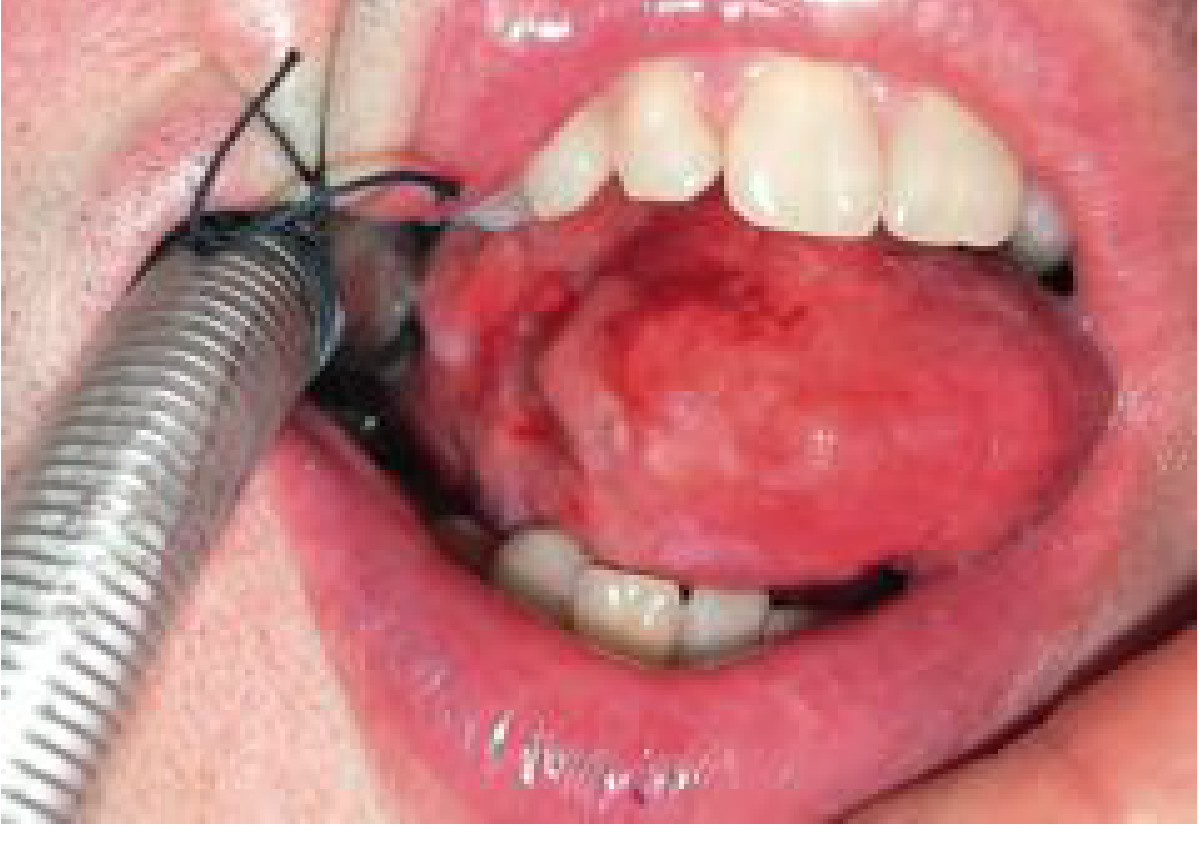
- Erythroplakia (red, inflammatory lesion) — most common presentation of early SCC
- Leukoplakia (white patch) — premalignant lesion
- Painless ulcer or exophytic mass
Late / Advanced
- Painful ulcerated or exophytic mass (see clinical photo below)
- Tongue fixation (invasion of intrinsic/extrinsic muscles)
- Decreased tongue sensation (lingual nerve invasion)
- Deviation on tongue protrusion, fasciculations, atrophy (hypoglossal nerve invasion)
- Alteration in speech and swallowing
- Referred otalgia (via lingual nerve → auriculotemporal nerve)
- Cervical lymphadenopathy
Base of Tongue (BOT) Specific
- Most common: referred otalgia and odynophagia
- Visualization is difficult → early detection is rare
- HPV+ BOT cancer: frequently presents with cervical lymphadenopathy with small primary (occult primary)
Local Invasion Patterns
- Anterolateral tongue → spreads medially across central raphe to contralateral side, posteriorly to tongue base, inferiorly into suprahyoid muscles
- Inferolateral spread → involves floor of mouth (common)
- Lingual nerve invasion → loss of dorsal tongue sensation
- Hypoglossal nerve invasion → deviation, atrophy, fasciculations
- Extreme lateral extension → direct invasion of mandible → requires composite resection
- BOT tumors → invade larynx, tonsil, soft palate, hypopharynx
Staging (AJCC 8th Edition)
T-Staging (Oral Cavity — incorporates Depth of Invasion)
| T | Criteria |
|---|---|
| Tis | Carcinoma in situ |
| T1 | ≤2 cm and DOI ≤5 mm |
| T2 | ≤2 cm with DOI >5 mm & ≤10 mm; OR >2 cm and ≤4 cm with DOI ≤10 mm |
| T3 | >4 cm in size; OR any tumor with DOI >10 mm |
| T4a | Invades cortical bone, deep tongue/extrinsic muscles, maxillary sinus, skin of face |
| T4b | Invades masticator space, pterygoid plates, skull base, or encases internal carotid artery |
Key update (AJCC 8th ed.): Depth of Invasion (DOI) was added to T-staging. Thin tumors (<2 mm DOI) have minimal regional metastatic potential; thick tumors (>8–9 mm) have significantly higher risk. - Mulholland & Greenfield's Surgery, p. 1997
N-Staging (Oral Cavity / HPV-negative)
| N | Criteria |
|---|---|
| N0 | No regional lymph node metastasis |
| N1 | Single ipsilateral node ≤3 cm, ENE(–) |
| N2a | Single ipsilateral node >3 cm and ≤6 cm, ENE(–) |
| N2b | Multiple ipsilateral nodes ≤6 cm, ENE(–) |
| N2c | Bilateral or contralateral nodes ≤6 cm, ENE(–) |
| N3a | Any node >6 cm, ENE(–) |
| N3b | Any node with clinically overt ENE(+) |
ENE = Extranodal Extension
Overall Stage Grouping
| Stage | T | N | M |
|---|---|---|---|
| I | T1 | N0 | M0 |
| II | T2 | N0 | M0 |
| III | T3 | N0 | M0; or T1–T3 N1 M0 |
| IVA | T4a N0–N1 M0; or T1–T4a N2 M0 | ||
| IVB | T4b any N M0; or any T N3 M0 | ||
| IVC | Any T, Any N, M1 |
Lymphatic Drainage & Regional Metastasis
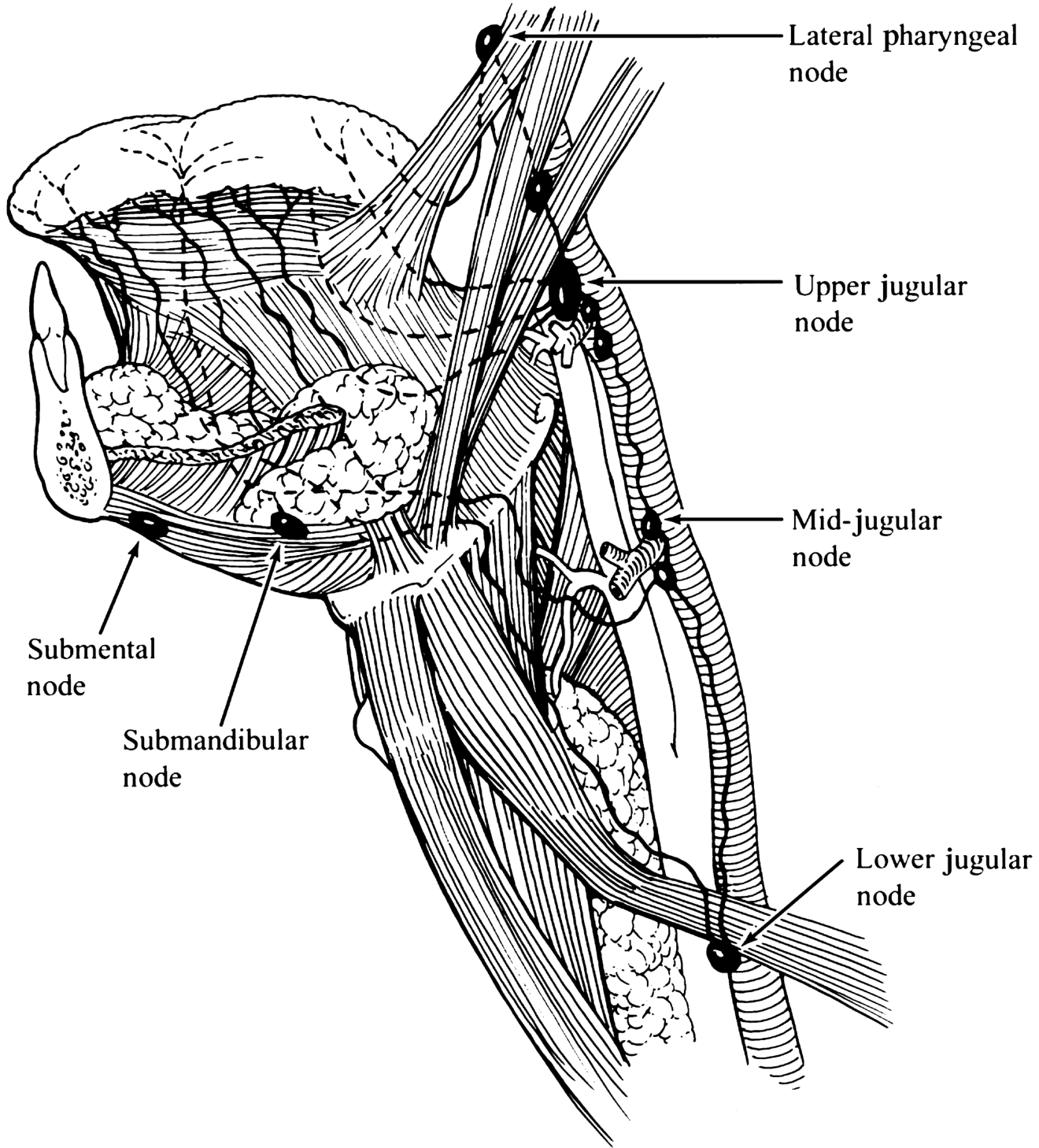
Primary drainage (oral tongue) → Levels I–III:
- Upper jugular nodes (73%)
- Submandibular nodes (18%)
- Middle jugular nodes (18%)
- Submental nodes (9%)
Key facts:
- 25–33% of lymph node metastases are clinically detectable; 20–25% are occult
- Incidence depends on tumor size and depth of invasion
- Midline dorsum or ventral tongue → bilateral cervical metastasis risk
- Base of tongue → levels II–IV; >60% have detectable nodes at presentation, 20% bilateral
- Distant metastasis in oropharyngeal cancer: ~15–20% (screen with chest CT or PET/CT)
Prognostic Factors
| Factor | Impact |
|---|---|
| Depth of invasion >2–4 mm | Higher regional metastasis, recurrence, mortality |
| Positive surgical margin | Major independent predictor of recurrence |
| Perineural invasion | Worse prognosis |
| Extracapsular spread (ECS/ENE) | Markedly worse survival |
| Nodal metastasis | Fivefold increased risk of dying of disease (occult mets) |
| Tumor differentiation | Poorly differentiated → higher occult nodal rate |
ECS and survival impact (from MSKCC data):
- pN–: 5-year DSS 88%, OS 75%
- pN+/ECS–: 5-year DSS 65%, OS 50%
- pN+/ECS+: 5-year DSS 48%, OS 30%
Diagnosis & Workup
- History & physical examination — thorough oral examination, bimanual palpation
- Biopsy — most lesions amenable to office biopsy; frozen sections intraoperatively
- Imaging:
- CT neck with contrast — assess primary extent, bone involvement, nodal disease
- MRI — superior for soft tissue invasion, perineural spread
- PET/CT — for advanced disease, detect distant metastasis
- Intraoral ultrasound — assess depth of invasion (hypoechoic irregular tumor)
- Panendoscopy — to rule out synchronous primaries
- Cranial nerve examination — CN V, VII, X, XII
Treatment
Oral Tongue
Surgery — Primary Modality
| Extent | Procedure |
|---|---|
| T1/T2 small | Transoral wide local excision (partial glossectomy) |
| Primary closure | For resection of ~1/4 to 1/3 of tongue |
| With floor of mouth | Skin graft or dermal graft to prevent tethering |
| ~1/2 tongue resection | Radial forearm or anterolateral thigh free flap |
| Near mandible | Pull-through or mandibulotomy approach |
| Cortical bone erosion | Marginal mandibulectomy (periosteum as deep margin) |
| Medullary bone invasion | Segmental mandibulectomy |
| Extensive local disease | Near-total or total glossectomy ± laryngectomy |
Reconstruction: Palatal augmentation prosthesis, fasciocutaneous free flaps (radial forearm, ALT), pectoralis major (pedicled) for bulk.
Radiation
- For patients unsuitable for surgery: external beam ± brachytherapy
- Postoperative chemoradiation: positive margins, ENE, multiple positive nodes
Chemotherapy
- T4 tumors: chemoradiation considered; bone involvement usually requires surgery
- Concurrent cisplatin-based chemoradiation is standard for unresectable/adjuvant settings
Management of the Neck
| Clinical Scenario | Recommendation |
|---|---|
| DOI ≥4 mm | Elective neck treatment (surgery or radiation) |
| DOI 2–4 mm, N0 | Elective neck dissection preferred over observation |
| DOI <2 mm, carcinoma in situ | Observation may be considered |
| T1/T2, N0 (any DOI) | Sentinel lymph node biopsy — feasible and accurate |
| Selective neck dissection | At least levels I–III (supraomohyoid neck dissection) |
| Midline/ventral tongue | Bilateral neck dissections |
| N+ neck | Selective/modified radical neck dissection + adjuvant RT |
Base of Tongue Treatment
| Stage | Treatment |
|---|---|
| T1/T2 | Transoral robotic surgery (TORS) or laser ± adjuvant; or (chemo)radiation |
| T3/T4 (resectable) | Mandibular swing, composite resection, or median mandibuloglossotomy |
| Smaller lesions at base | Suprahyoid pharyngotomy |
| Advanced | Total glossectomy ± laryngectomy + free flap reconstruction |
| HPV+ | Generally favorable response to chemoradiation |
Outcomes / Prognosis
Oral Tongue (5-year survival)
| Stage | Survival |
|---|---|
| Stage I–II | 60–75% |
| Stage III–IV | 25–40% |
| After salvage for regional recurrence | 35–40% |
Locoregional control at 5 years: 91% (early-stage surgical series)
Base of Tongue (5-year survival)
| Stage | Locoregional control | Overall survival |
|---|---|---|
| Stage I–II | 75–90% | Higher |
| Stage III | 50% | Moderate |
| Stage IV | 20% | Poor |
Key Surgical Margins
- Margin of ≥2.2 mm is the threshold below which local recurrence risk substantially increases (Zanoni et al., 381 patients — adjusted HR 2.25 for margin 0.01–2.2 mm vs. HR 1.17 for 2.3–5.0 mm)
- Tumor bed sampling for frozen section has sensitivity of only 24% for detecting positive margins in early-stage tongue SCC
Complications of Treatment
| Complication | Context |
|---|---|
| Aspiration / airway compromise | Post-glossectomy; may require laryngectomy |
| Dysphagia / altered swallowing | Post-partial or total glossectomy |
| Speech impairment | Loss of tongue bulk/mobility |
| Osteoradionecrosis | Post-radiation, especially after mandibulectomy |
| Xerostomia | Post-radiation |
| Fistula | Post-surgical reconstruction |
| Hypothyroidism | Post-neck dissection + radiation |
Summary of Key Points
- Most common histology: SCC; most frequent subsite = posterolateral oral tongue
- Risk factors: tobacco + alcohol (synergistic); HPV-16 for base of tongue
- Early sign: erythroplakia; late signs: fixation, otalgia, dysphagia, lymphadenopathy
- AJCC 8th ed. incorporates DOI into T-staging — critical prognostic variable
- Primary treatment: surgery (partial glossectomy) for oral tongue; (chemo)radiation or TORS for base of tongue
- Elective neck dissection: recommended for DOI ≥4 mm even if clinically N0
- ECS dramatically worsens prognosis; drives adjuvant chemoradiation decision
- Free flap reconstruction is the standard for defects involving >1/2 tongue or floor of mouth
Sources:
- Cummings Otolaryngology Head and Neck Surgery, Chapter 91
- KJ Lee's Essential Otolaryngology, Chapter 45
- Mulholland & Greenfield's Surgery, Chapter 41
- Harrison's Principles of Internal Medicine, 22nd ed.
This is a shared conversation. Sign in to Orris to start your own chat.