I now have all the content needed for a comprehensive 10-mark answer. Here it is:
Balanced Diet - 10 Marks Answer
B.Sc. Nursing 2nd Semester | Nutrition & Dietetics
Definition
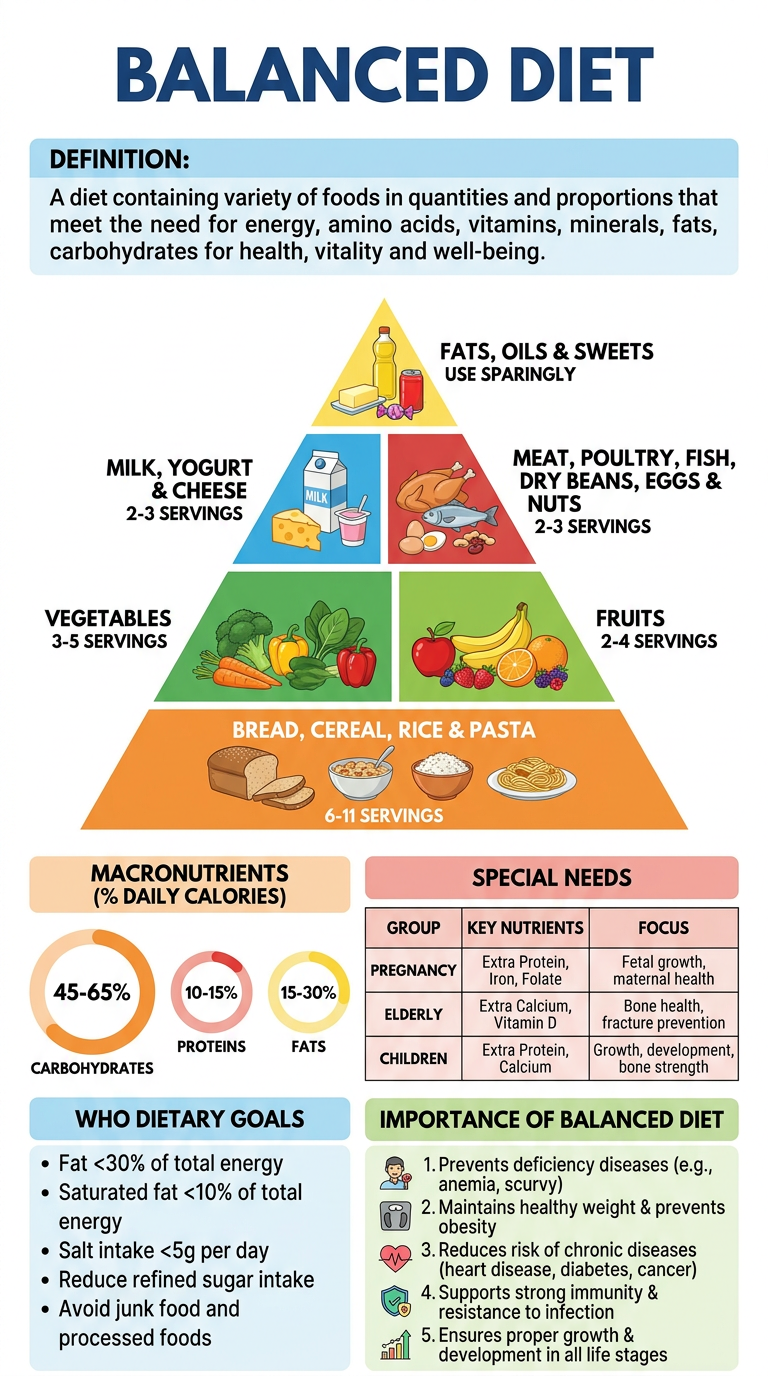
A diet is defined as the kinds of food on which a person or group lives. A balanced diet is defined as one which contains a variety of foods in such quantities and proportions that the need for energy, amino acids, vitamins, minerals, fats, carbohydrates, and other nutrients is adequately met for maintaining health, vitality, and general well-being, and also makes a small provision for extra nutrients to withstand short duration of leanness.
A balanced diet has become an accepted means to safeguard a population from nutritional deficiencies.
- Park's Textbook of Preventive and Social Medicine
Nutrients in a Balanced Diet
For good health, the following nutrients are required:
| Nutrient | Function | % of Daily Intake |
|---|
| Carbohydrates | Primary energy source | 45-65% of total calories |
| Proteins | Growth, repair, immunity | 10-15% of total energy |
| Fats | Energy, fat-soluble vitamins | 15-30% of total energy |
| Vitamins | Metabolic regulation | As per RDA |
| Minerals | Structural + enzymatic roles | As per RDA |
| Water | Constitutes 1/2 to 4/5 of body weight | 2-3 litres/day |
| Dietary Fibre | Bowel regularity, reduces chronic disease risk | 25-32 g/day |
The Food Guide Pyramid
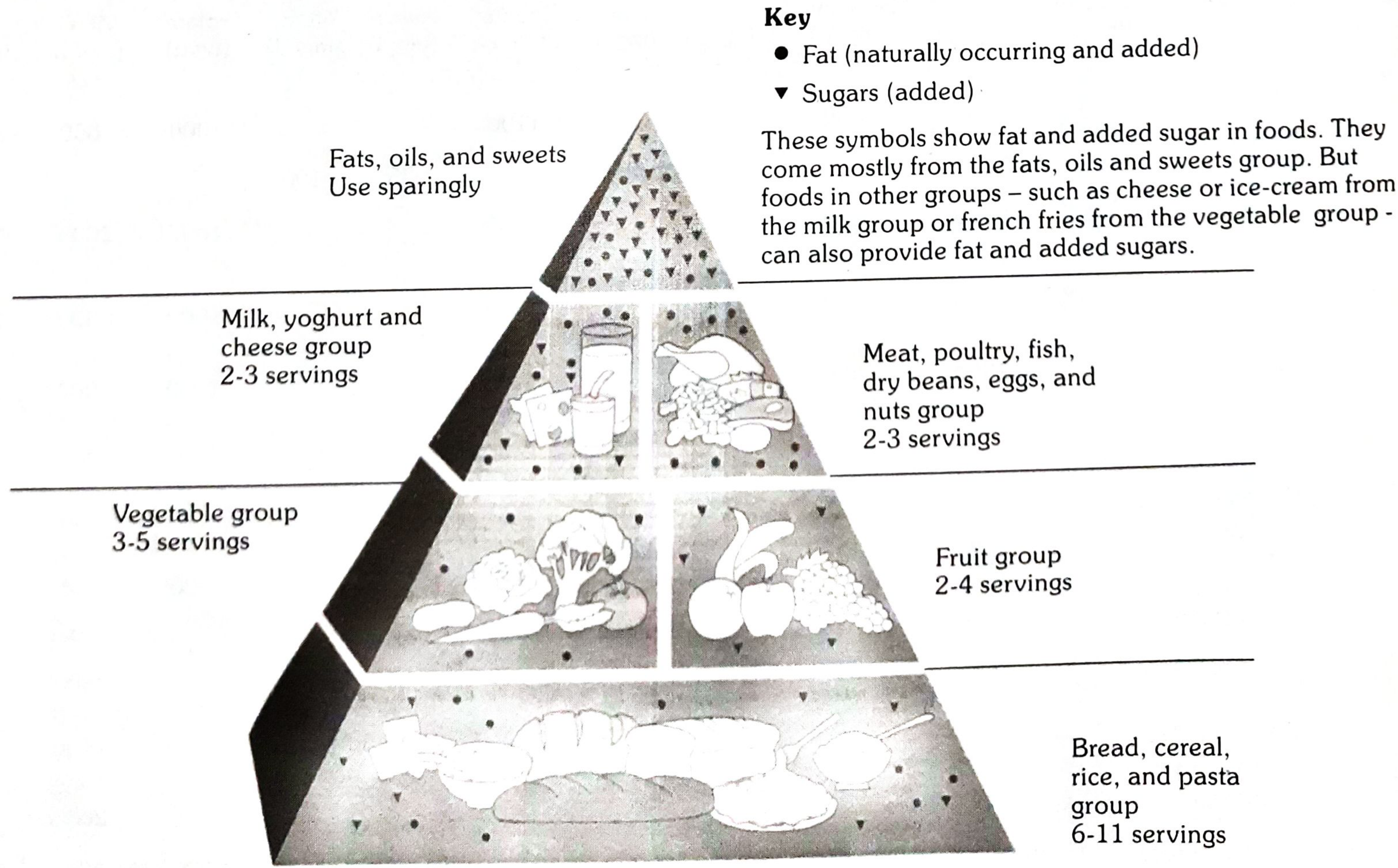
The Food Guide Pyramid illustrates the five major food groups and their recommended daily servings:
| Food Group | Daily Servings |
|---|
| Bread, cereal, rice, pasta | 6-11 servings |
| Vegetable group | 3-5 servings |
| Fruit group | 2-4 servings |
| Milk, yoghurt, cheese | 2-3 servings |
| Meat, poultry, fish, beans, eggs, nuts | 2-3 servings |
| Fats, oils, sweets | Use sparingly |
No single food group is more important than another - all are needed for good health.
Principles of Constructing a Balanced Diet
According to Park's Textbook of Preventive and Social Medicine, the following principles should be kept in mind:
- Protein requirement - must be met first; amounts to 10-15% of daily energy intake
- Fat requirement - limited to 15-30% of daily energy intake; unsaturated fats preferred
- Carbohydrates - rich in natural fibre; should constitute the remaining food energy
- Micronutrients - requirements for vitamins and minerals must be met as per RDA
WHO Dietary Goals ("Prudent Diet")
The WHO Expert Committee recommends the following dietary goals:
- (a) Dietary fat: limited to 15-30% of total daily intake
- (b) Saturated fats: no more than 10% of total energy intake; unsaturated vegetable oils should be substituted
- (c) Refined carbohydrates: excessive consumption should be avoided; fibre-rich carbohydrates preferred
- (d) Energy-dense foods (fats, alcohol): should be restricted
- (e) Salt intake: reduced to not more than 5 g per day (Indian average is ~15 g/day - far too high)
- (f) Protein: approximately 10-15% of daily intake
- (g) Junk foods (colas, ketchups, "empty calorie" foods): should be reduced
Macronutrient Guidelines (Detailed)
Carbohydrates
- Should provide 45-65% of total calories
- Choose a variety of vegetables, whole fruits, and whole grains
- At least half of grains consumed should be whole grains
- Added sugars should be limited to <10% of total calories (they provide no nutrition and promote tooth decay)
- Vegetables, fruits, and grains supply vitamins, minerals, phytochemicals (carotenoids, flavonoids, lycopene), and fibre
Proteins
- Recommended intake: 0.8 g/kg body weight/day for adults (Indian RDA for moderately active adult man: 54 g/day; woman: 46 g/day)
- High-quality protein from sources low in saturated fat: fish, poultry, beans, lentils, low-fat dairy, soy products
- Vegans should eat a mixture of plant proteins to ensure all essential amino acids are covered
Fats
- 20-35% of total calories from fat
- Saturated fatty acids: <10% of total calories
- Fats from fish, nuts, and vegetables (polyunsaturated and monounsaturated) are preferred
- Trans-fatty acids (partially hydrogenated vegetable oils in stick margarine, baked goods, fried foods) should be avoided
- Saturated and trans fats raise LDL cholesterol and contribute to atherosclerosis
RDA for Indians - 2020 (Key Values)
| Category | Protein (g/d) | Calcium (mg/d) | Iron (mg/d) | Vit C (mg/d) | Vit D (IU/d) |
|---|
| Adult Man (Moderate work) | 54.0 | 1000 | 19 | 80 | 600 |
| Adult Woman (Moderate work) | 46.0 | 1000 | 29 | 65 | 600 |
| Pregnant Woman (3rd trimester) | +22.0 | 1000 | 27 | - | 600 |
(Source: ICMR RDA 2020, as cited in Park's Textbook)
Special Dietary Needs
The balanced diet must be adapted for special physiological and pathological conditions:
| Condition | Adjustment |
|---|
| Growth (children) | Increased protein, calcium, iron, Vit D |
| Pregnancy | Extra protein (+22 g/day in 3rd trimester), iron, folate, calcium |
| Lactation | Increased energy, protein, calcium, Vit D |
| Elderly | Higher calcium (1200 mg/day), Vit D, adequate protein |
| Heavy physical activity | Increased total energy and protein intake |
| Medical disorders (e.g., diabetes) | Restrict refined sugars; increase fibre |
Factors Affecting Dietary Pattern
The dietary pattern varies widely across different populations and is influenced by:
- Climatic conditions and food production
- Economic capacity
- Regional customs, religion, and taboos
- Tastes and food habits of the people
Importance of a Balanced Diet
- Prevents nutritional deficiency diseases (e.g., scurvy, rickets, beriberi, anaemia)
- Maintains healthy body weight and prevents obesity
- Reduces risk of chronic diseases: hypertension, atherosclerosis, stroke, diabetes, and certain cancers
- Supports immune function and wound healing
- Ensures proper growth and development in children
- Maintains energy levels and physical performance
- Supports bone health (adequate calcium and Vit D)
- Reduces risk of osteoporosis and fractures in old age
Conclusion
A balanced diet provides all macronutrients and micronutrients in the right proportions to maintain optimal health throughout the life cycle. As a nurse, it is important to assess patients' dietary habits, educate them on food groups and portion sizes, and tailor dietary advice to their specific physiological needs (pregnancy, illness, old age, etc.). The Food Guide Pyramid and national RDA guidelines are useful tools for planning and counselling.
Sources: