
Why acidic drug toxicity make urin basic
When acidic drugs (like aspirin/salicylates, phenobarbital) cause toxicity, the treatment involves alkalinizing the urine - making it basic (high pH) - not the other way around. Let me clarify what's happening and why.
Searching sources...
Reading File
Finding Sources
Finding Sources
Finding Sources
Finding Sources
Finding Sources
Finding Sources
Finding Sources
Finding Sources
Reading File
Reading File
I now have all the information needed for a thorough answer. Let me also fetch that ion-trapping diagram.
Loading Image
Here is the full explanation:
Why Is Urine Alkalinized in Acidic Drug Toxicity?
First, a critical clarification: the question is likely asking why we make the urine basic (alkaline) as a treatment when someone is poisoned by an acidic drug. This is a deliberate therapeutic maneuver, not a spontaneous event. Here is the full mechanism.
1. The Core Principle: Ion Trapping
All drugs that are weak acids or weak bases exist in two forms in solution:
- Ionized (charged) form - water-soluble, cannot cross lipid membranes
- Non-ionized (uncharged) form - lipid-soluble, can freely cross membranes
The ratio of ionized to non-ionized form depends on the pH of the environment and the drug's pKa, governed by the Henderson-Hasselbalch equation:
log [Ionized] / [Non-ionized] = pKa - pH
For a weak acid (like aspirin, salicylate, phenobarbital):
- In acidic environment (low pH) → the drug is mostly non-ionized (neutral, lipid-soluble)
- In alkaline environment (high pH) → the drug is mostly ionized (charged, water-soluble)
2. How This Applies to Renal Excretion
The kidney filters almost all drugs at the glomerulus. As the filtered drug travels down the renal tubule, what happens next depends on its ionization state:
- Non-ionized drug = lipid-soluble = passively reabsorbed back into the bloodstream through tubular cells
- Ionized drug = water-soluble = cannot cross the tubular membrane = stays in urine and gets excreted
As [Katzung's Basic and Clinical Pharmacology](Katzung's Basic and Clinical Pharmacology, 16th Ed.) explains:
"If the goal is to accelerate excretion of the drug (eg, in a case of drug overdose), it is important to prevent its reabsorption from the tubule. This can often be accomplished by adjusting urine pH to make certain that most of the drug is in the ionized state... Thus, weak acids are usually excreted faster in alkaline urine."
3. Alkaline Urine "Traps" the Acidic Drug
When you give IV sodium bicarbonate (NaHCO₃):
- It raises urine pH (makes it alkaline/basic, e.g., pH 7.5-8.5)
- In this alkaline urine, the weak acid drug loses its proton (H⁺) and becomes negatively charged (ionized)
- The ionized form cannot diffuse back through the lipid tubular membrane
- The drug is "trapped" in the urine and excreted in large amounts
This is called urinary alkalinization or ion trapping.
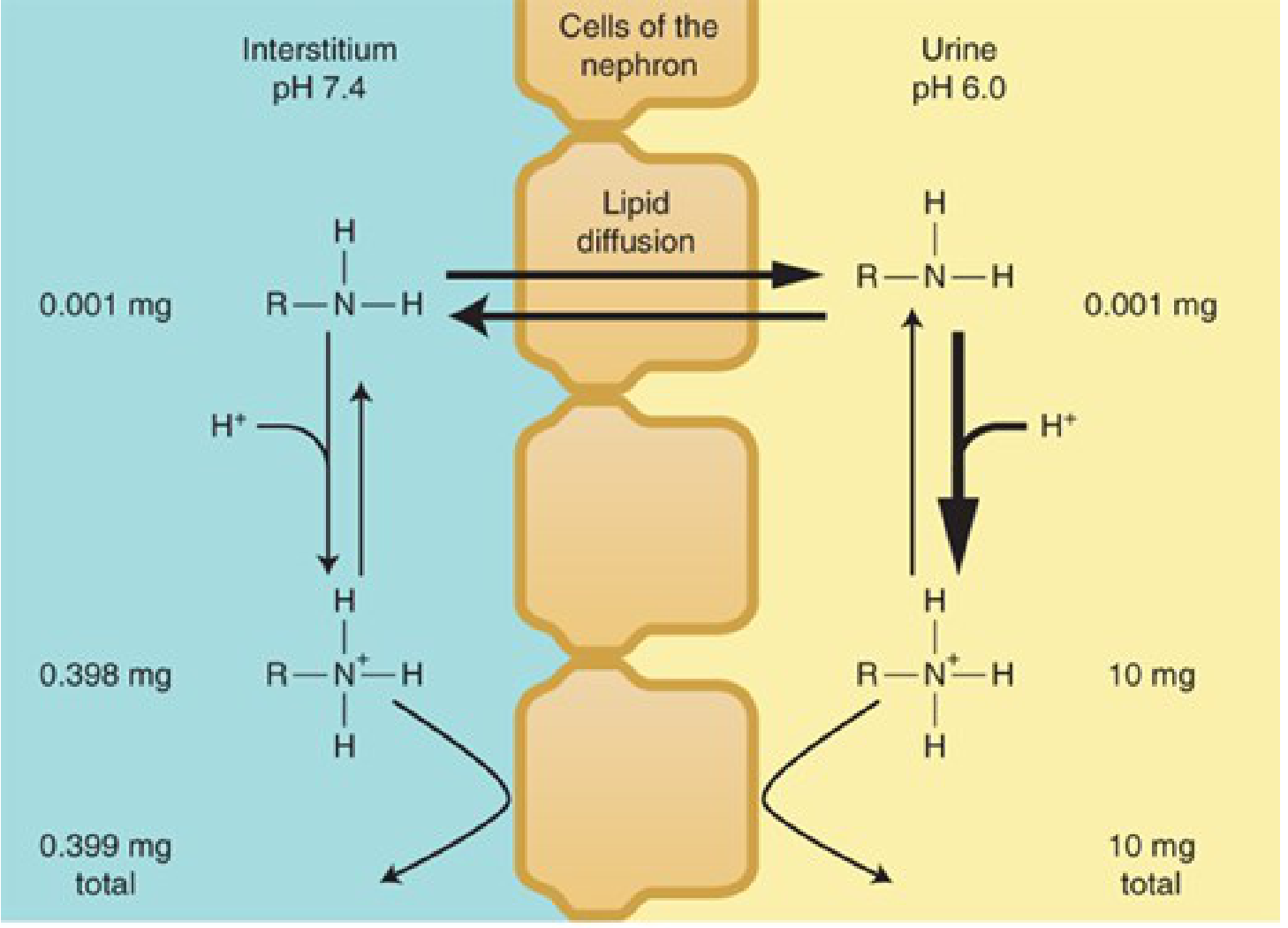
(The diagram above shows ion trapping of a weak base in acidic urine - the same principle works in reverse for weak acids trapped in alkaline urine)
4. Clinical Example: Aspirin (Salicylate) Poisoning
Aspirin is a classic weak acid (pKa ~3.5). As stated in [The Essentials of Forensic Medicine and Toxicology, 36th Edition](The Essentials of Forensic Medicine and Toxicology):
"Aspirin is a weak acid; it becomes ionized in alkaline urine. Ionized form is not reabsorbed in renal tubules, leading to enhanced excretion."
Treatment protocol:
- IV sodium bicarbonate to alkalinize urine to pH 7.5-8.5
- This dramatically increases salicylate excretion
- Urine output is maintained at ~1-2 mL/kg/hr to keep flushing the drug out
- Hemodialysis if serum salicylate >100 mg/dL or patient deteriorates
5. Summary Table
| Drug type | Treatment urine pH | Reason |
|---|---|---|
| Weak acid (aspirin, phenobarbital, methotrexate) | Make alkaline (basic) | Ionizes drug → traps it in urine → excreted |
| Weak base (amphetamines, PCP) | Make acidic | Ionizes drug → traps it in urine → excreted |
The Bottom Line
The urine is not made basic because of the drug toxicity - it is made basic as a treatment. When we alkalinize urine with sodium bicarbonate in acidic drug overdose, the acidic drug becomes ionized (charged) in the alkaline urine, cannot be reabsorbed by the tubular cells, and is eliminated rapidly in urine. This is the ion-trapping principle.
This is a shared conversation. Sign in to Orris to start your own chat.