
Ischemic stroke history
Reading File
Now I'll search the library for ischemic stroke history content in parallel.
Finding Sources
Finding Sources
Searching PubMed
"ischemic stroke"[MeSH Terms] AND "history"
Good. Now I'll read the most comprehensive sources in parallel - Bradley & Daroff (the gold standard neurology text) and Rosen's Emergency Medicine for the ischemic stroke sections.
Reading File
Reading File
Finding Sources
I have strong content from Rosen's and Bradley. Now let me read the deeper sections on pathophysiology, clinical presentation, and management from the key textbooks, plus the Adams & Victor entry on prior ischemic stroke history.
Reading File
Reading File
Reading File
I now have rich content from multiple authoritative sources. Let me read the Rosen's section on acute management and clinical presentation more fully, and also fetch one of the imaging figures.
Reading File
Loading Image
I now have comprehensive, well-sourced content from multiple major textbooks. Here is a full, organized account of ischemic stroke.
Ischemic Stroke - A Complete Overview
Definition and Epidemiology
Ischemic stroke accounts for approximately 87% of all strokes. About 600,000 "first-ever" ischemic strokes occur each year in the United States. Strokes of all subtypes are more common in Black and Hispanic populations versus non-Hispanic whites. Although stroke risk increases with age, approximately 3-4% of all strokes occur in patients aged 15-45, and the average age of first stroke has been trending younger. - Rosen's Emergency Medicine, p. 2746
Pathophysiology and Subtypes
1. Large-Vessel Thrombotic (~33% of cases)
Caused by in situ thrombosis at areas of turbulent blood flow - particularly at vessel bifurcations where atherosclerotic plaques form and ulcerate. The internal carotid artery (ICA) distribution is most commonly affected. A stenosis occluding >90% of the vessel diameter causes marked reduction in flow; further ulceration leads to platelet adhesion and clot formation that either embolizes or occludes the artery. - Rosen's, p. 2748
2. Lacunar (Small-Vessel) Strokes (~33%)
Involve small terminal sections of vasculature. Most common in patients with diabetes and hypertension (80-90% of lacunar stroke patients have hypertension). Sites: basal ganglia, thalamus, pons, internal capsule. Size: a few mm to 2 cm. Mechanism: either small emboli or lipohyalinosis (hypertensive cerebral vasculopathy). - Rosen's, p. 2750
3. Cardioembolic (~25%)
Most commonly caused by embolization of mural thrombus in atrial fibrillation - patients with AF have approximately a 5-fold increased risk of stroke. Other sources: aortic atheromas, diseased extracranial arteries (artery-to-artery embolism). A classic example is amaurosis fugax - a carotid plaque embolus to the ophthalmic artery causing transient monocular blindness. - Rosen's, p. 2752
4. Cryptogenic (~33%)
In more than one-third of first-ever strokes, no clear cause is identified. - Rosen's, p. 2746
Causes in Younger Patients (15-45 years)
-
Oral contraceptive use, pregnancy
-
Antiphospholipid antibodies (lupus anticoagulant, anticardiolipin antibodies)
-
Protein S and C deficiencies
-
Sickle cell disease, polycythemia
-
Carotid/vertebral dissection - the leading determined cause in young patients; often follows minor trauma (sneezing, yoga, spinal manipulation, coughing). Associated with fibromuscular dysplasia and connective tissue disorders
-
Fibromuscular dysplasia
-
Migraine with prolonged vasoconstriction (rare)
-
Cocaine and amphetamines (potent vasoconstrictors)
-
Infectious vasculopathies (varicella, fungal meningitis)
-
Rosen's, p. 2754-2758
Clinical Presentation by Territory
Anterior Circulation (ICA, MCA, ACA)
- Contralateral hemiplegia, hemisensory loss
- Aphasia (dominant hemisphere)
- Contralateral gaze deviation
- Contralateral visual field defect
- Deficits limited to one side of the body
Posterior Circulation (Vertebrobasilar)
The most challenging to diagnose - widest variety of symptoms reflecting cranial nerve deficits, cerebellar involvement, and long tract deficits:
-
Loss of consciousness (reticular activating system involvement)
-
Nausea, vomiting (chemoreceptor trigger zone)
-
Vertigo, diplopia, nystagmus, dysarthria, dysphagia
-
Crossed deficits: motor deficit on one side + sensory loss on the other
-
Visual agnosia, alexia, homonymous hemianopsia
-
CN III palsy (tentorial herniation sign)
-
Visual neglect (patient unaware of visual deficit)
-
Ataxia, spasticity
-
Rosen's, p. 2846
Examination
A focused neurological exam should assess:
- Level of consciousness - using GCS (Eye + Verbal + Motor)
- Speech - aphasia vs. dysarthria
- Cranial nerves - pupillary size/reactivity, extraocular movements (CNs III-VI), CN VII (central vs. peripheral: central spares forehead wrinkling), gag reflex
- Motor/sensory - pronator drift (sensitive for motor weakness), double simultaneous extinction (sensory neglect), graphesthesia
- Cerebellar - finger-to-nose, heel-to-shin, gait
- Reflexes - Babinski sign, deep tendon reflexes
Prehospital tools: Cincinnati Prehospital Stroke Scale, Los Angeles Prehospital Stroke Screen. - Rosen's, p. 2848-2856
Imaging
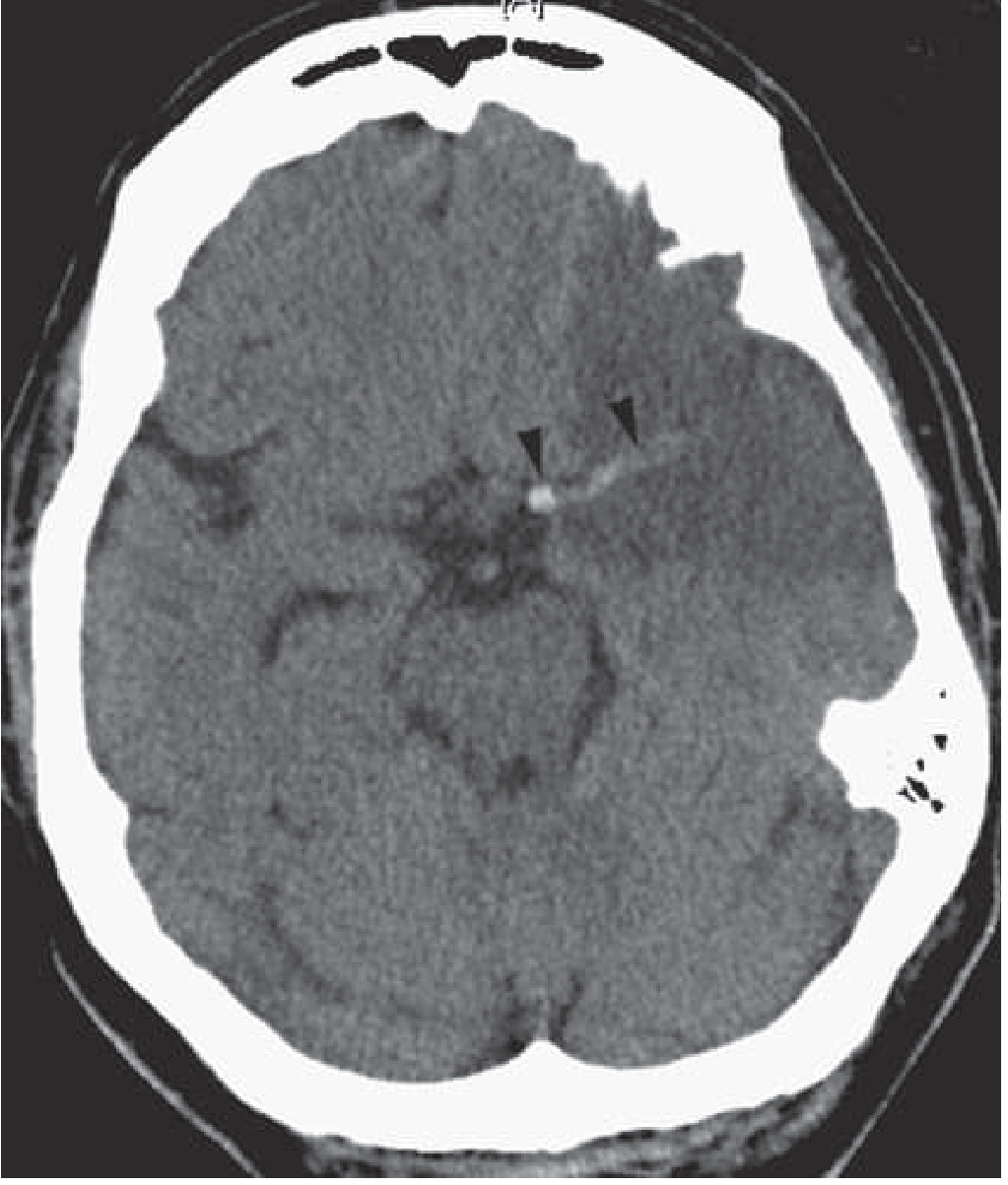
CT (Non-contrast)
- First-line: fast, widely available
- Excellent at excluding hemorrhage (hyperdense lesion)
- Early ischemic signs: gray/white junction blurring, sulcal effacement, deep gray matter blurring
- Hyperdense MCA sign (or "hyperdense dot sign"): focal hyperdensity from intraluminal clot
- Limited in posterior fossa (streak artifacts from skull base)
- May be entirely normal in early ischemic stroke
MRI / DWI
-
DWI with ADC mapping is the most sensitive method for acute ischemia - hyperintense signal detectable within minutes of onset
-
Caution: in the first 5-7 days, DWI signal reflects decreased water diffusivity (ischemic cell swelling), then increasingly reflects T2 shine-through from infarcted tissue. Reliable age estimation of a lesion is not possible on DWI alone
-
CT and MR perfusion imaging help identify the ischemic penumbra (at-risk tissue)
-
Bradley & Daroff's, p. 470-474
Differential Diagnosis (Stroke Mimics)
| Mimic | Key Distinguishing Feature |
|---|---|
| Hypoglycemia | Focal deficits that can persist days; check glucose first |
| Wernicke encephalopathy | Ophthalmoplegia + ataxia + confusion; thiamine deficiency |
| Todd's paralysis | Postictal; history of seizure |
| Complex migraine | Focal deficits with/without headache; younger patient |
| Bell's palsy | Peripheral CN VII - forehead wrinkling absent |
| Brain tumor/abscess | Subacute course, fever, systemic signs |
| Ménière disease | Vertigo + tinnitus + hearing loss; no motor/speech deficits |
| Air embolism | History of pressure changes, procedures |
| Giant cell arteritis | Elderly, severe headache, elevated ESR/CRP |
- Rosen's, p. 2920-2939
Acute Management
IV tPA (Alteplase)
- Window: within 4.5 hours of symptom onset (or last known well)
- Also applicable if perfusion-diffusion MRI mismatch is demonstrated
- Prior history of ischemic stroke is a relative contraindication if recent (<3 months)
Mechanical Thrombectomy
- Large vessel occlusion; window extending to 24 hours in selected patients with salvageable penumbra
- Requires CT/MR angiography to confirm occlusion
Blood Pressure
- In fluctuating deficits suggesting large vessel occlusion: avoid aggressive BP lowering, ensure adequate hydration, hold usual antihypertensives to maintain cerebral perfusion
Anticoagulation (when thrombolysis not available)
-
Heparin or LMWH to prevent thrombus propagation, followed by warfarin
-
Adams & Victor's, p. 1166
Secondary Prevention in Patients With Prior Ischemic Stroke / TIA
This is the core clinical challenge when a patient presents with a history of ischemic stroke. - Adams & Victor's, p. 1159-1161
Risk Stratification After TIA
-
~10% stroke risk within 90 days of TIA; nearly half within 2 days
-
Higher risk with: age >60, diabetes, speech/weakness deficits, symptoms >10 min, ischemic MRI lesion
-
After the acute period: ~20% stroke risk over 10 years after a TIA
-
Goldman-Cecil Medicine, p. 2828
Antiplatelets and Anticoagulation
- Atrial fibrillation-related stroke: direct oral anticoagulant (DOAC) or warfarin; recurrence risk 6-10% per year
- Non-cardioembolic stroke: antiplatelet therapy (aspirin, clopidogrel, aspirin/dipyridamole)
- Acute MI-related stroke, valvular disease: warfarin
Statin Therapy
- All patients with prior stroke/TIA + atherosclerotic disease, diabetes, or hyperlipidemia: high-potency statin (atorvastatin 40-80 mg or rosuvastatin 20-40 mg daily) or PCSK9 inhibitor
- Target LDL <70 mg/dL reduces recurrent major cardiovascular events and all-cause recurrent strokes by ~20%
- Stopping a statin acutely in ischemic stroke increases morbidity and mortality
Carotid Revascularization
| Stenosis | Recommendation |
|---|---|
| 70-99% symptomatic extracranial carotid stenosis (within 6 months) | Carotid endarterectomy (CEA) or stenting; reduces recurrence by ~50% |
| 50-69% symptomatic stenosis | Benefit present but smaller (~16% relative reduction) |
| <50% stenosis | No benefit from revascularization |
- Carotid stenting = similar efficacy to CEA overall, but higher stroke risk; patients >70 years do better with CEA, younger patients better with stenting
- Extracranial-intracranial bypass: no benefit, possibly harmful
- Intracranial artery stenting: no benefit vs. medical therapy
Blood Pressure and Metabolic Control
-
Control of hypertension
-
High LDL treatment (above)
-
Pioglitazone (45 mg/day) showed reduced subsequent stroke/MI in patients with prior ischemic stroke/TIA + insulin resistance without overt diabetes in one RCT - awaits wider guideline adoption
-
Goldman-Cecil Medicine, p. 2814-2824
Workup After Established Prior Stroke
Key investigations to identify the etiology and guide prevention:
- Carotid duplex ultrasonography or MRA - to assess ICA patency; if >70% stenosis or severely ulcerated plaque, revascularization indicated
- ECG - detect atrial fibrillation
- Transesophageal echocardiogram - source of embolism
- Cardiac monitoring - prolonged monitoring for paroxysmal AF
- CT/MRI brain - characterize lesion
- Fasting lipids, HbA1c, glucose
The critical mistake is to ignore the potential significance of a prior small stroke or TIA. - Adams & Victor's Principles of Neurology, p. 1161
Sources
- Rosen's Emergency Medicine: Concepts and Clinical Practice, Chapter 87 (Ischemic Stroke), pp. 2746-3053
- Bradley and Daroff's Neurology in Clinical Practice, Chapter 40 & 65 (Ischemic Stroke, Imaging)
- Adams and Victor's Principles of Neurology, 12th Edition, p. 1159-1166
- Goldman-Cecil Medicine, Chapter 376 (Secondary Prevention after Stroke/TIA), pp. 2813-2829
This is a shared conversation. Sign in to Orris to start your own chat.