
What is reservoir and source and what's the difference between them
In epidemiology and infectious disease, these two terms are often used interchangeably but they have distinct meanings:
Reservoir refers to the natural habitat where a pathogen lives, grows, and multiplies - it's where the agent normally resides long-term. This can be a human, animal, arthropod, plant, soil, water, or other environmental substance. The reservoir doesn't necessarily get sick from the pathogen.
Source is the person, animal, object, or substance from which the infectious agent is actually transmitted to a host - the immediate origin of infection. It's the point of departure for transmission.
The key difference: the reservoir is where the pathogen persists, while the source is from where it spreads to a new host. They can be the same (e.g., a typhoid carrier is both reservoir and source) or different (e.g., for Legionella, the reservoir is water, but the source is an air conditioning cooling tower that aerosolizes it).
Searching sources...
Reading File
Searching the Web
reservoir vs source infectious disease epidemiology difference
Finding Sources
Reading File
Here is a thorough breakdown, drawn from Park's Textbook of Preventive and Social Medicine (a leading epidemiology reference):
Reservoir vs. Source of Infection
Definitions
Reservoir
"Any person, animal, arthropod, plant, soil or substance (or combination of these) in which an infectious agent lives and multiplies, on which it depends primarily for survival, and where it reproduces itself in such a manner that it can be transmitted to a susceptible host."
In short: the reservoir is the natural habitat where the pathogen metabolizes and replicates over the long term.
Source of Infection
"The person, animal, object or substance from which an infectious agent passes or is disseminated to the host."
In short: the source is the immediate point of departure - where the host actually picks up the infection.
The Key Difference
The two terms are not always synonymous, even though they are often used interchangeably. The "source" refers to the immediate origin of transmission, and it may or may not be part of the reservoir.
| Feature | Reservoir | Source |
|---|---|---|
| Role | Long-term survival & multiplication of pathogen | Immediate origin of transmission to the host |
| Duration | Persists indefinitely | The point of actual transmission |
| Can be the same? | Yes, sometimes | Yes, sometimes |
| Examples | Human, animal, soil, water | Feces, urine, contaminated food/water, soil, aerosols |
Illustrative Examples
-
Hookworm infection
- Reservoir: Man (the pathogen lives in the human intestine)
- Source: Soil contaminated with infective larvae (where humans pick it up)
- Here, reservoir ≠ source
-
Tetanus
- Reservoir: Soil (Clostridium tetani spores persist there)
- Source: Soil (directly contaminates wounds)
- Here, reservoir = source
-
Typhoid fever
- Reservoir: A case or carrier (a person harboring Salmonella typhi)
- Source: Feces or urine of the patient, or contaminated food, milk, or water
- Here, the reservoir is the person, but the source is the excreta or contaminated vehicle
-
Cholera (Vibrio cholerae)
- Uses the concept of a homologous reservoir - man is the principal reservoir (same species is the victim)
-
Salmonella (from animals/birds)
- Uses the concept of a heterologous reservoir - infection derived from a species other than man
Types of Reservoirs
Reservoirs fall into three categories:
- Human reservoir - The most important. A person can be a case (symptomatic) or a carrier (asymptomatic but infectious)
- Animal reservoir - Infections passed from animals to humans are called zoonoses (e.g., rabies, brucellosis, plague)
- Reservoir in non-living things - Soil (tetanus, histoplasmosis), water (Legionella), etc.
Chain of Infection (Visual)

The three essential links in disease transmission are: Reservoir/Source → Mode of Transmission → Susceptible Host. Breaking any one link interrupts transmission and controls the disease.
Summary: Every reservoir can potentially become a source, but not every source is the reservoir. The reservoir is where the pathogen lives and persists; the source is from where it actually reaches the new host.
- Park's Textbook of Preventive and Social Medicine, p. 107
What is amplifying and maintaience reservoir of Japenese Encephalitis
For Japanese Encephalitis (JE), the classic teaching is:
- Amplifying host: Pigs and wading birds (herons/egrets) - they develop high-level viremia so mosquitoes feeding on them pick up large viral loads
- Maintenance reservoir: Wading birds (Ardeid birds) - they sustain the virus long-term in nature
- Vector: Culex tritaeniorhynchus mosquito
Searching sources...
Finding Sources
Searching the Web
Japanese Encephalitis amplifying host maintenance reservoir pigs birds
Finding Sources
Finding Sources
Reading File
Reading File
Reading File
Reading File
Reading File
Reading File
Now I have everything needed from the textbooks. Let me also fetch the transmission cycle diagram:
Loading Image
Here is a complete answer drawn directly from Park's Textbook of Preventive and Social Medicine and Goldman-Cecil Medicine:
Japanese Encephalitis - Amplifying and Maintenance Reservoirs
The Two Basic Transmission Cycles
JE virus infects several extra-human hosts. The two primary cycles established in nature are:
(a) Pig → Mosquito → Pig
(b) Ardeid bird → Mosquito → Ardeid bird
Man is only an incidental "dead-end" host - man-to-man transmission does not occur.
Amplifying Host - PIGS
Pigs are the major amplifying hosts of JE virus.
- In some areas, up to 100% of pigs may be sero-positive for JE virus
- Infected pigs do not show any overt signs of illness
- However, they develop a high-level viremia - the virus circulates freely in their blood
- When Culex mosquitoes feed on these viremic pigs, they pick up large amounts of virus and become highly infectious
- Pigs therefore amplify the viral population exponentially - they multiply the amount of virus available for mosquitoes to pick up and pass on to humans
This is why JE outbreaks are closely tied to pig-rearing areas near rice fields, where the Culex vector also breeds.
Maintenance (Reservoir) Host - ARDEID BIRDS (Herons and Egrets)
Ardeid birds (family Ardeidae - herons, egrets, bitterns) are the maintenance/natural reservoir hosts of JE virus.
- They sustain the virus in nature long-term, even between epidemic seasons
- They also develop viremia but do not die from infection
- They serve as the enzootic cycle hosts - keeping the virus circulating quietly in the environment year-round
- Migratory birds in this family may also spread the virus to new geographic areas
Why the Distinction Matters
| Feature | Amplifying Host (Pig) | Maintenance Host (Ardeid Bird) |
|---|---|---|
| Role | Boosts viral numbers explosively | Keeps virus alive in nature long-term |
| Viremia level | Very high - infects many mosquitoes | Sustained but moderate |
| Disease in host | None (asymptomatic) | None (asymptomatic) |
| Epidemiological importance | Drives human outbreaks | Maintains enzootic cycle between seasons |
| Term used | Amplifier | Reservoir / maintenance host |
Transmission Cycle Diagram
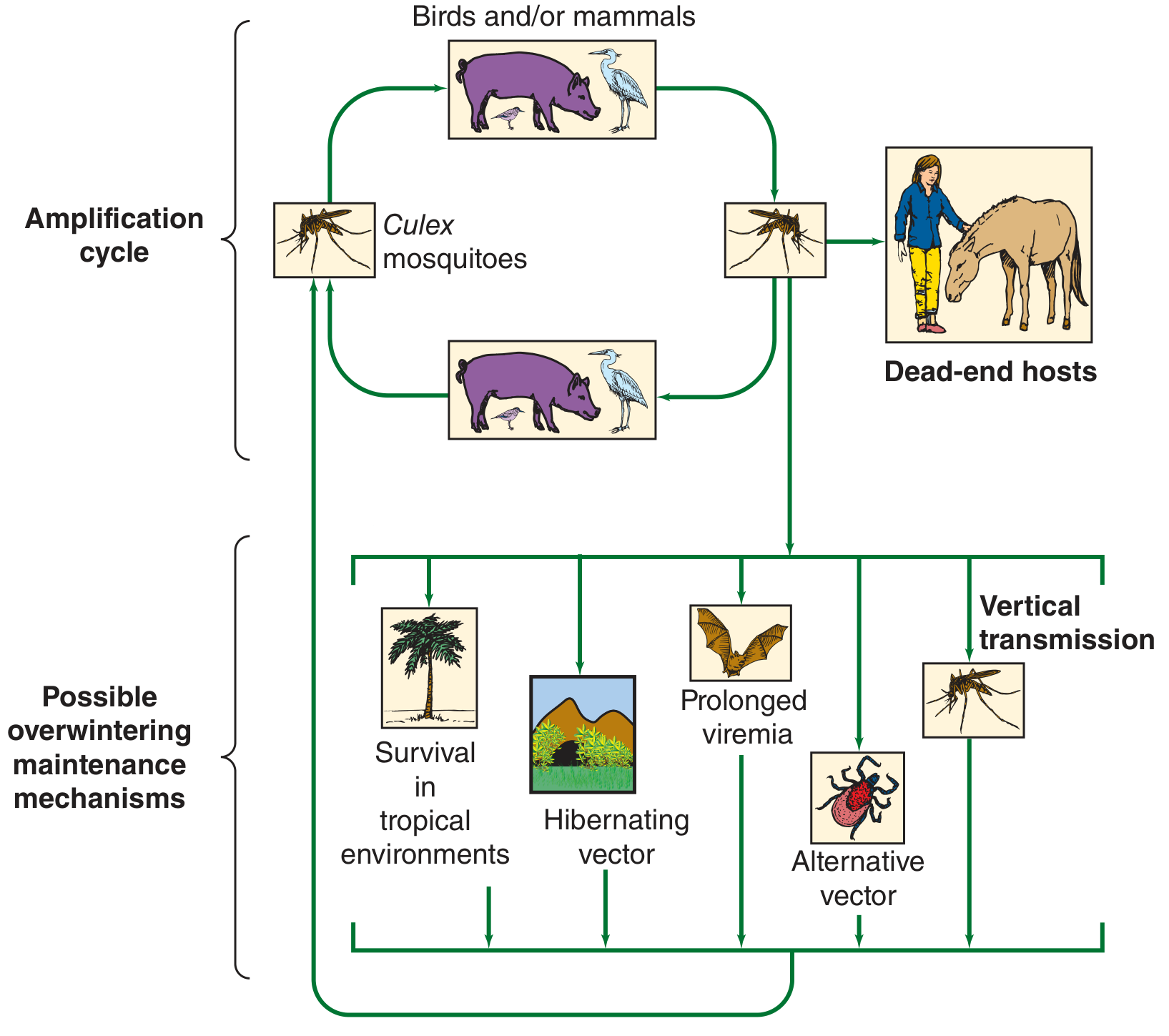
Generalized transmission cycle of mosquito-borne flaviviruses. Humans and horses are dead-end hosts. Pigs play the amplifying role for JE specifically. Possible overwintering maintenance mechanisms include hibernating vectors, prolonged viremia in bats/birds, alternative vectors, and vertical (transovarial) transmission in mosquitoes.
Vectors
The primary mosquito vectors are:
- Culex tritaeniorhynchus - the most important vector
- Culex vishnui and Culex gelidus - also implicated
- These mosquitoes breed in irrigated rice fields, shallow ditches, and pools - explaining the rural, agricultural epidemiology of JE
After feeding on a viremic host, the mosquito requires a 9-12 day extrinsic incubation period before it can transmit the virus.
Quick memory aid: Pigs Amplify (A for Animal that's a pig) - Birds Maintain (M for Maintenance - birds keep it going). The vector is Culex (C for Culex tritaeniorhynchus). Man is a dead-end host.
- Park's Textbook of Preventive and Social Medicine, p. 331-332
- Goldman-Cecil Medicine, p. 3664
- Jawetz, Melnick & Adelberg's Medical Microbiology, 28th Ed., p. 572
How does pig amplify the virus
Pigs amplify JE virus because they develop extremely high-level viremia (high concentration of virus in the blood) without getting sick. When a Culex mosquito bites an infected pig, it ingests a large viral load, becomes infectious, and can then transmit the virus to many other hosts. Pigs also reproduce rapidly and live in large numbers near rice fields, so many mosquitoes feed on them repeatedly.
Searching sources...
Finding Sources
Searching the Web
how pigs amplify Japanese encephalitis virus viremia mechanism
Finding Sources
Reading Web Page
https://pmc.ncbi.nlm.nih.gov/articles/PMC9146973
Reading File
Here is the complete explanation of how pigs amplify JE virus:
How Pigs Amplify Japanese Encephalitis Virus
Amplification is a step-by-step process. Think of it as the virus using the pig as a multiplier before it reaches humans.
Step-by-Step Mechanism
Step 1 - Mosquito bites an infected pig
A Culex mosquito feeds on a pig that already has JEV in its bloodstream. The mosquito ingests the virus along with the blood meal.
Step 2 - Extrinsic incubation in the mosquito
The virus replicates inside the mosquito for 9-12 days (the extrinsic incubation period). After this, the mosquito's salivary glands are loaded with virus and it becomes capable of transmission.
Step 3 - Why the pig is special: HIGH-LEVEL VIREMIA
This is the core of amplification. When JEV infects a pig:
- The virus replicates to extremely high titers in the pig's bloodstream
- This is called a high-level viremia - the concentration of virus in pig blood is far higher than in most other hosts (including birds and certainly humans)
- The pig shows no illness - it remains healthy, active, and continues to be bitten by many mosquitoes
- Because pigs are large animals that attract many mosquitoes, and their blood contains enormous amounts of virus, every mosquito that bites them gets a high infectious dose
Step 4 - Infected mosquito bites another pig (or human)
The now-infectious mosquito passes the virus on. If it bites another pig, that pig also develops high viremia and the cycle repeats - exponentially increasing the number of infected mosquitoes in the environment. Eventually some infected mosquitoes bite humans, causing disease.
Why Humans Can't Amplify
Humans (and horses) are dead-end hosts because:
- They develop only low-level viremia - not enough virus in the blood for a mosquito to pick up and transmit
- So the cycle stops at the human - humans cannot pass it on to mosquitoes
This is the fundamental contrast:
| Host | Viremia level | Can infect mosquito? | Role |
|---|---|---|---|
| Pig | Very high | Yes - effectively | Amplifier |
| Ardeid bird | Moderate-high | Yes - effectively | Maintenance reservoir |
| Human | Very low | No | Dead-end host |
| Horse | Very low | No | Dead-end host |
Additional Features That Make Pigs Efficient Amplifiers
- Asymptomatic infection - pigs don't get sick, so they remain out in the open and continue to attract mosquitoes (sick animals hide or die)
- High population density - pigs are raised in large numbers near rice fields, right next to the Culex mosquito breeding sites
- Rapid reproduction - piglets are born susceptible, constantly providing new non-immune animals for the virus to infect and amplify through
- Up to 100% seroprevalence in endemic areas - showing how efficiently the virus circulates through pig populations
- Cattle and buffaloes in the same settings act as "mosquito attractants" - they draw more mosquitoes to the area, increasing the chance of pigs being bitten
Simple Analogy
Think of the pig as a viral factory. The mosquito delivers a small order (a few virus particles), the pig's body mass-produces them (high viremia), and the next mosquito that comes along picks up a huge consignment (large infectious dose) and delivers it to the next host - possibly a human.
- Park's Textbook of Preventive and Social Medicine, p. 331-332
This is a shared conversation. Sign in to Orris to start your own chat.