
Azithromycin vs amoxy clav
Quick answer: Azithromycin and amoxicillin-clavulanate (Augmentin) are both broad-spectrum antibiotics but differ significantly in spectrum, mechanism, pharmacokinetics, and clinical indications.
- Azithromycin is a macrolide - bacteriostatic, covers atypicals (Mycoplasma, Chlamydia, Legionella), short course (3-5 days), once daily
- Amoxicillin-clavulanate is a beta-lactam + beta-lactamase inhibitor - bactericidal, covers beta-lactamase producing organisms, better for dental/skin/bite wound infections
- Key choice driver: atypical coverage needed? -> azithromycin. Beta-lactamase producers (H. influenzae, S. aureus, anaerobes)? -> amoxy-clav
Searching sources...
Reading File
Now I'll search the medical library and PubMed in parallel for detailed content on both drugs.
Finding Sources
Finding Sources
Searching PubMed
azithromycin AND "amoxicillin-clavulanate" AND respiratory infection
Good results. Now let me read the key textbook sections on azithromycin mechanism/PK and amoxicillin-clavulanate, plus look at the cardiovascular safety paper.
Reading File
Reading File
Reading File
Reading Article
PMID: 35560969
Excellent data gathered. Let me now fetch the macrolide spectrum diagram and get the amoxy-clav section on clinical uses and adverse effects.
Reading File
Reading File
Loading Image
I now have comprehensive data from multiple authoritative textbooks and a recent PubMed study. Here is the full comparison:
Azithromycin vs Amoxicillin-Clavulanate (Augmentin): A Full Comparison
1. Drug Class & Mechanism of Action
| Feature | Azithromycin | Amoxicillin-Clavulanate |
|---|---|---|
| Class | Macrolide (15-atom lactone ring) | Aminopenicillin + beta-lactamase inhibitor |
| Mechanism | Binds irreversibly to the 50S ribosomal subunit -> inhibits translocation in bacterial protein synthesis | Amoxicillin: inhibits cell wall synthesis (binds PBPs, disrupts peptidoglycan cross-linking). Clavulanate: irreversibly inhibits beta-lactamases, protecting amoxicillin from enzymatic destruction |
| Bactericidal/static | Generally bacteriostatic (may be bactericidal at higher concentrations) | Bactericidal |
- Lippincott Illustrated Reviews Pharmacology, p. 998
- Goodman & Gilman's Pharmacological Basis of Therapeutics, p. 747-748
2. Antimicrobial Spectrum
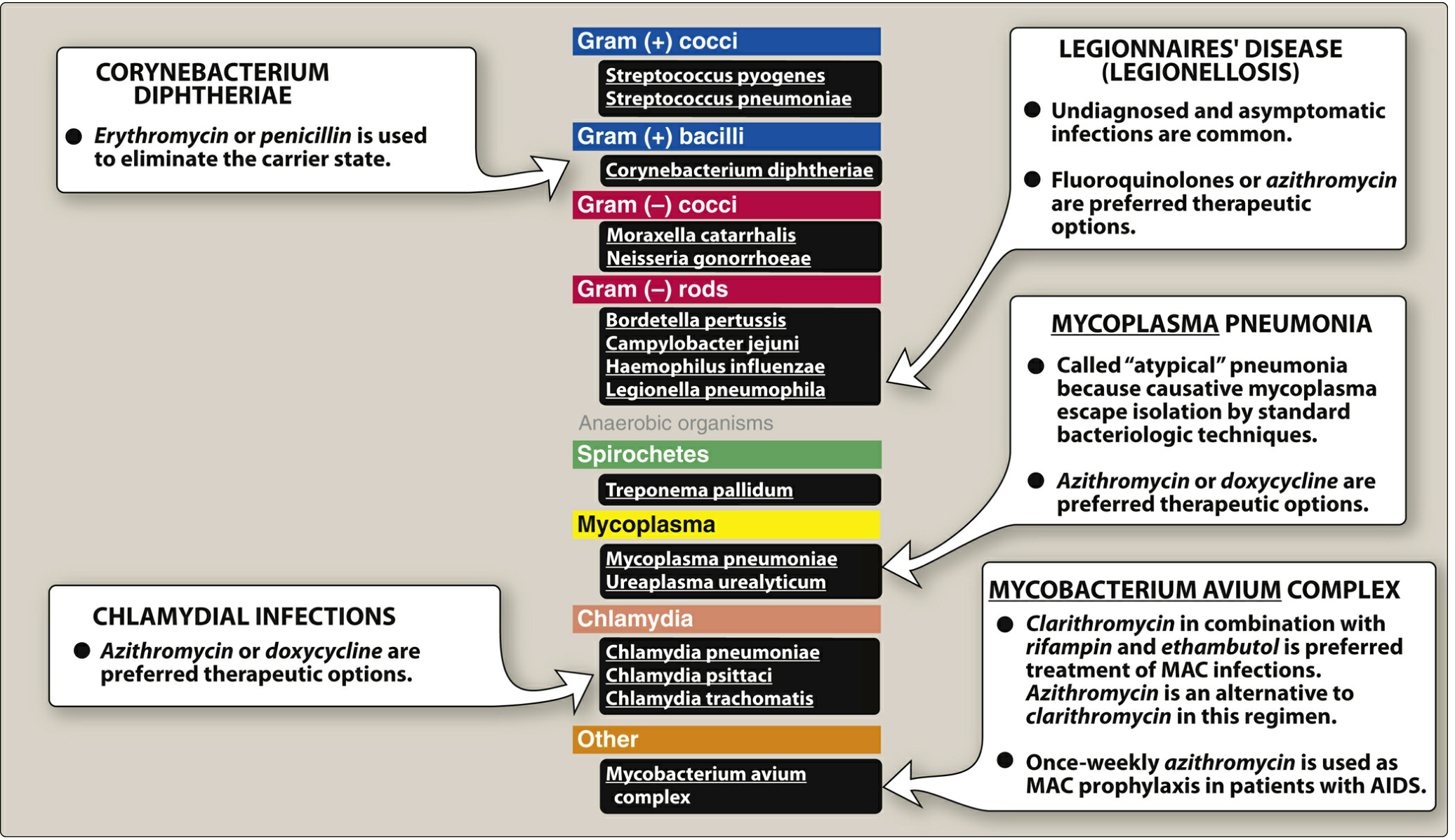
| Organism | Azithromycin | Amoxicillin-Clavulanate |
|---|---|---|
| Streptococcus pneumoniae | Moderate (growing resistance) | Good |
| Streptococcus pyogenes | Moderate (less than erythromycin) | Good |
| S. aureus (MSSA, beta-lactamase +) | Moderate | Yes (clavulanate protects) |
| H. influenzae | Good | Good (covers beta-lactamase producers) |
| Moraxella catarrhalis | Good | Good |
| Mycoplasma pneumoniae | Excellent | No cell wall = no coverage |
| Chlamydia sp | Excellent | No coverage |
| Legionella pneumophila | Good | No coverage |
| Anaerobes (e.g. B. fragilis) | Poor | Good (with clavulanate) |
| MRSA | No | No |
| Pseudomonas | No | No |
| Neisseria gonorrhoeae | Moderate | Limited |
| M. avium complex | Good (part of MAC regimen) | No |
- Katzung's Basic & Clinical Pharmacology 16th ed., p. 1273-1274
- Goodman & Gilman's, p. 753
3. Pharmacokinetics
| Parameter | Azithromycin | Amoxicillin-Clavulanate |
|---|---|---|
| Oral bioavailability | Well absorbed; food reduces absorption | Well absorbed; food does NOT reduce absorption (take with food to reduce GI upset) |
| Serum concentrations | Low (~0.4 mcg/mL after 500 mg) | Good (peaks 2-2.5x higher than ampicillin) |
| Tissue penetration | Exceptional - 10 to 100x serum levels; concentrates in phagocytes | Moderate tissue penetration |
| Half-life | ~3 days (tissue t1/2 = 2-4 days) | ~80 min (amoxicillin); requires TID or BID dosing |
| Dosing frequency | Once daily | BID (875/125 mg) or TID (500/125 mg) |
| Duration | Usually 3-5 days (Z-pack = 5 days) | Usually 5-10 days |
| Renal adjustment | Not typically required | Required if CrCl <30 mL/min |
| CSF penetration | Poor | Poor |
The exceptional tissue half-life of azithromycin means antibiotic activity persists at tissue sites for days after the last dose - this is why a 5-day course produces ~10 days of therapeutic tissue levels. - Katzung's, p. 1273
4. Drug Interactions & CYP450
| Azithromycin | Amoxicillin-Clavulanate | |
|---|---|---|
| CYP450 | Does NOT inhibit CYP enzymes (15-member ring - key advantage over erythromycin/clarithromycin) | No significant CYP interactions |
| QT prolongation | Yes - prolongs QT interval (potassium channel effect) -> risk of torsades de pointes. Avoid with other QT-prolonging drugs | No QT effect |
| Warfarin | Minimal (unlike erythromycin) | May enhance warfarin effect slightly (alter gut flora) |
| Antacids | Al/Mg antacids delay absorption (reduce peak) | No significant interaction |
5. Adverse Effects
| Azithromycin | Amoxicillin-Clavulanate | |
|---|---|---|
| GI side effects | Mild nausea, diarrhea | More significant diarrhea (especially with clavulanate - due to gut flora disruption); take with food |
| Allergy/rash | Rare | Hypersensitivity reactions (rash, urticaria, anaphylaxis ~0.004-0.04%); contraindicated in penicillin allergy |
| Cardiac | QT prolongation risk; historically debated cardiac death risk | No cardiac risk |
| Hepatotoxicity | Rare | Rare (clavulanate-associated cholestatic jaundice more common than with amoxicillin alone) |
| C. difficile | Risk (any antibiotic) | Risk (any antibiotic) |
| Ototoxicity | High-dose/prolonged use | None |
Cardiovascular safety note: A 2022 meta-analysis in US Veterans comparing azithromycin vs amoxicillin-clavulanate (n = 629,345 vs 168,429 courses) found no significant difference in cardiovascular mortality between the two drugs (HR 1.12 [95% CI: 0.63-2.00]). This is reassuring given earlier concerns about azithromycin and cardiac death (PMID: 35560969).
6. Resistance
| Azithromycin | Amoxicillin-Clavulanate | |
|---|---|---|
| Mechanisms | (1) Efflux pumps, (2) 23S rRNA methylation (erm genes) in gram-positives, (3) Esterases in gram-negatives | Clavulanate overcomes most beta-lactamases; but AmpC, ESBL, and KPC-type enzymes can confer resistance |
| S. pneumoniae | Growing macrolide resistance - a significant clinical problem | Better coverage of resistant pneumococci |
| Cross-resistance | Shares resistance with erythromycin and clarithromycin | No cross-resistance with macrolides |
- Lippincott, p. 999; Katzung's, p. 1274
7. Key Clinical Indications
| Indication | Preferred Agent | Notes |
|---|---|---|
| Community-acquired pneumonia (outpatient, no comorbidities) | Azithromycin | Covers typical + atypical pathogens. Or amoxy-clav + azithromycin if high resistance area |
| CAP with comorbidities / beta-lactam-resistant concerns | Amoxicillin-clavulanate + azithromycin | Combination for broader coverage |
| Atypical pneumonia (Mycoplasma, Chlamydia, Legionella) | Azithromycin | Amoxy-clav has no atypical coverage |
| Acute otitis media (AOM) | Amoxicillin-clavulanate | First-line for treatment failures or high-risk patients (covers H. influenzae beta-lactamase producers) |
| Sinusitis (bacterial) | Amoxicillin-clavulanate | Better anaerobic and H. influenzae coverage |
| Skin/soft tissue infection | Amoxicillin-clavulanate | Better MSSA and anaerobic coverage |
| Animal bite wounds | Amoxicillin-clavulanate | Covers Pasteurella, anaerobes |
| Dental infections | Amoxicillin-clavulanate | Anaerobic + streptococcal coverage |
| Chlamydial infections (STI) | Azithromycin (1 g single dose) | Amoxy-clav has no activity |
| Pertussis (whooping cough) | Azithromycin | First-line for Bordetella pertussis |
| COPD exacerbation | Either (amoxy-clav preferred if purulent) | Azithromycin used for long-term prophylaxis in COPD |
| MAC prophylaxis (HIV/AIDS) | Azithromycin (weekly) | Amoxy-clav not indicated |
8. Dosing Summary
Azithromycin:
- Adults: 500 mg on day 1, then 250 mg days 2-5 (or 500 mg once daily x 3 days for Z-pack)
- Single dose 1 g for chlamydial STI
- IV formulation available for severe CAP
Amoxicillin-clavulanate:
- Standard adult: 875/125 mg BID or 500/125 mg TID
- High-dose: 2 g/125 mg BID (for resistant S. pneumoniae, sinusitis)
- Augmentin ES-600 (pediatric sinusitis): 90 mg/kg/day of amoxicillin component
- IV formulation: co-amoxiclav (Augmentin IV) available
9. When to Choose Which: Quick Decision Guide
Choose Azithromycin when:
- Atypical pathogens are suspected (Mycoplasma, Chlamydia, Legionella)
- Outpatient CAP in a healthy adult with no recent antibiotics
- Penicillin allergy
- Compliance is a concern (once daily, short course)
- STI treatment (single 1 g dose for Chlamydia)
- Pertussis exposure/prophylaxis
- Long-term MAC prophylaxis in HIV
Choose Amoxicillin-Clavulanate when:
- Beta-lactamase producing organisms expected (H. influenzae, S. aureus, Klebsiella)
- Animal/human bite wounds
- Dental or orofacial infections (anaerobic coverage needed)
- Sinusitis, otitis media
- Skin/soft tissue infections
- Patient at risk for QT prolongation (avoid azithromycin)
- Prior azithromycin failure or macrolide-resistant area
Use Both Together when:
- Hospitalized CAP (beta-lactam + macrolide combination is standard - covers both typical and atypical pathogens)
Sources: Katzung's Basic & Clinical Pharmacology 16th Ed.; Lippincott Illustrated Reviews Pharmacology; Goodman & Gilman's Pharmacological Basis of Therapeutics; The Harriet Lane Handbook 23rd Ed.; Murray & Nadel's Respiratory Medicine; DerSarkissian et al. Pharmacoepidemiol Drug Saf 2022 [PMID: 35560969]
This is a shared conversation. Sign in to Orris to start your own chat.