
Child With Rash (Measles] al Diagnosis b] Epidemiological determinants. Complications & Vit A Zole d] Prevention. 10 marks
Reading File
Now let me search the medical library in parallel for all four components of this question.
Finding Sources
Finding Sources
Good. Now let me read the most comprehensive measles sections - the Red Book (pediatric infectious disease) and Tintinalli's Emergency Medicine, plus search for complications and Vitamin A:
Reading File
Finding Sources
Finding Sources
Excellent - Park's Textbook and Fitzpatrick's are ideal sources. Let me now read the key measles sections from Red Book, Park's (for epidemiology/prevention), and Fitzpatrick's (for clinical features/complications/Vitamin A):
Reading File
Reading File
Reading File
Excellent data. Now let me read the rest of the Fitzpatrick's section (clinical features, complications, management) and the Park's section (complications, treatment with Vitamin A, prevention):
Reading File
Reading File
I have the Vitamin A treatment section but it was cut off. Let me get the rest of the Park's section (Vitamin A doses, prevention) and the Fitzpatrick's management/complications sections:
Reading File
Reading File
Let me get the Fitzpatrick's complications/management section and Park's epidemiology/prevention continuation:
Reading File
Reading File
I need to get the Vitamin A dosing continuation from Fitzpatrick's and Park's epidemiological determinants section. Let me also get the Park's epidemiology section:
Reading File
Reading File
Excellent! I found the epidemiological determinants section. Let me read the full epidemiology section:
Reading File
I now have comprehensive information from Park's Textbook (the gold standard for community medicine/public health examinations) and Fitzpatrick's for clinical features. Let me also get the Fitzpatrick's Vitamin A dosing section which was cut off, and fetch the measles rash image:
Loading Image
Loading Image
I now have everything needed for a comprehensive 10-mark answer. Let me compose the full response.
Measles (Rubeola) in a Child - Comprehensive Answer (10 Marks)
a) Diagnosis
Clinical Diagnosis
Measles diagnosis is primarily clinical, based on three stages:
Stage 1 - Prodromal Stage (Day 10-14 post-exposure, lasts ~4 days):
- High fever (up to 40.5°C / 104.9°F)
- The "3 Cs": Cough (brassy/barking), Coryza (nasal discharge, sneezing), Conjunctivitis (redness, lacrimation, photophobia)
- Koplik's spots - the pathognomonic enanthema: tiny bluish-white specks on a bright red base ("grains of sand" or "table salt crystals"), found on the buccal mucosa opposite the 1st and 2nd lower molars, appearing 1-2 days before the rash and lasting only 12-72 hours
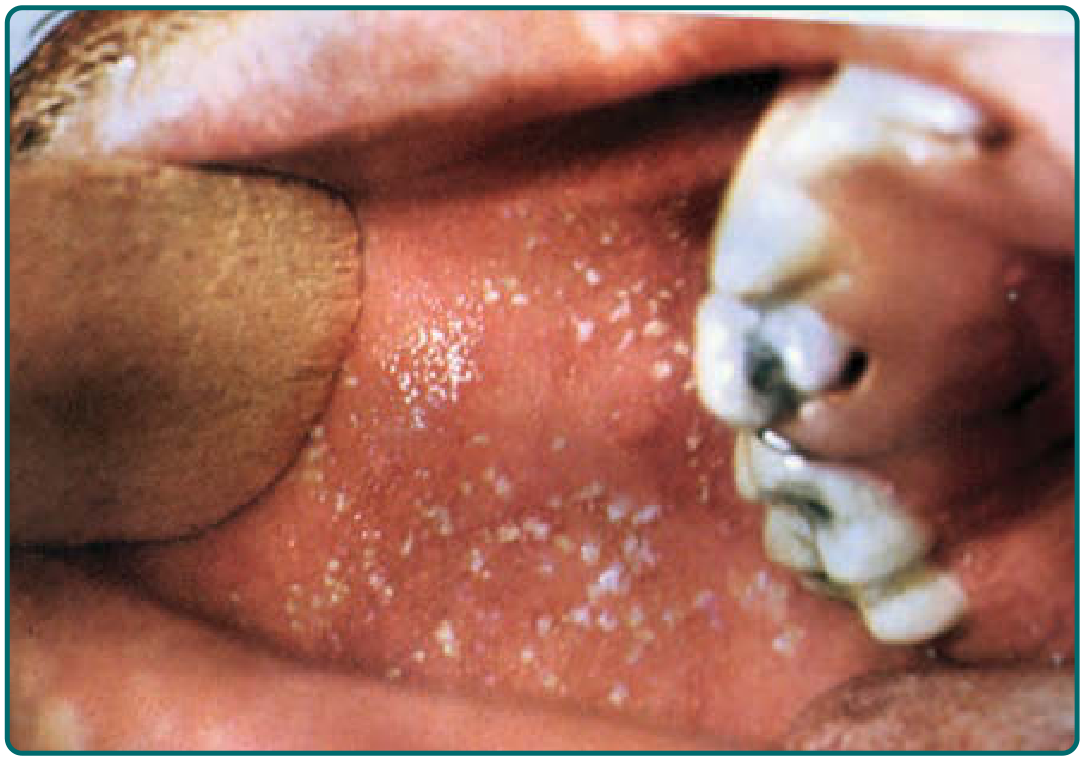
Stage 2 - Eruptive/Exanthematous Stage (begins Day 14):
- Dusky-red, nonpruritic maculopapular rash starting behind the ears and on the forehead, spreading cephalocaudally (face → neck → trunk → extremities) over 2-3 days
- Lesions may coalesce, especially on the face
- Rash peaks at ~3 days, then fades in order of appearance, leaving brownish hyperpigmentation
- Virus is present in tears, nasal/throat secretions, urine, and blood during prodrome and first 2-5 days of rash
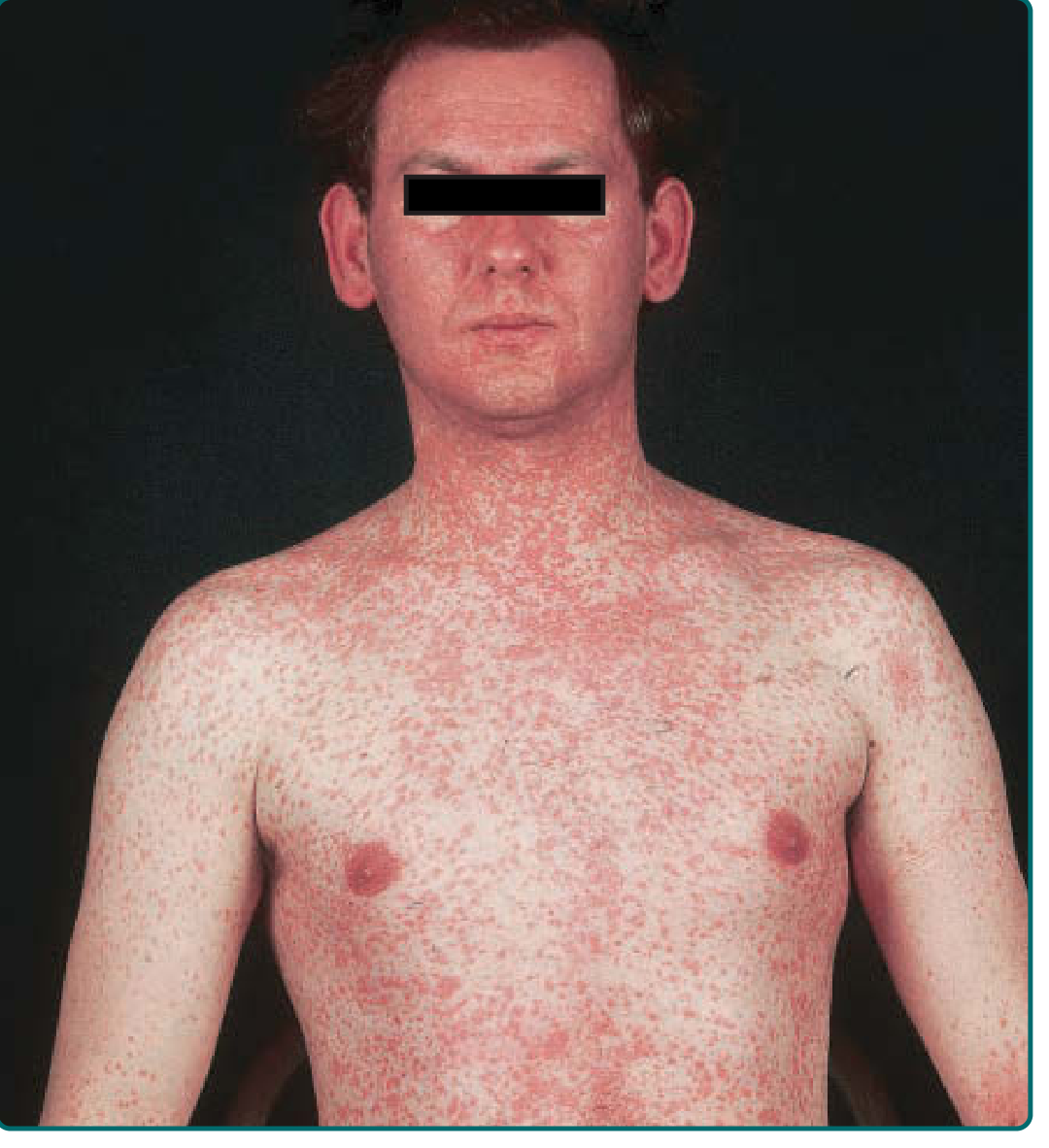
Stage 3 - Post-measles Stage:
- Weight loss, weakness, susceptibility to secondary infections
- Risk of malnutrition, diarrhea, growth retardation
Diagnostic Rule: Measles would normally be incorrect in any febrile exanthem where red eyes and cough are both absent.
Laboratory Diagnosis
| Test | Detail |
|---|---|
| Serum IgM ELISA | Positive from Day 1 of rash; stays positive ≥30 days. May be falsely negative within first 72 h |
| RT-PCR | Detects measles RNA from throat swabs, nasopharyngeal mucus, urine; best within 3 days of rash onset |
| Serum IgG (paired) | 4-fold rise in titers between acute and convalescent samples (2-4 weeks apart) |
| Viral isolation | From nasopharyngeal aspirates, blood |
Source: Fitzpatrick's Dermatology, Vol. 1-2; Park's Textbook of Preventive and Social Medicine
b) Epidemiological Determinants
Agent Factors
(a) Agent: RNA paramyxovirus (genus Morbillivirus, family Paramyxoviridae). Single serotype - one antigenic type only. Cannot survive outside the human body for long, but retains infectivity at sub-zero temperatures.
(b) Source of infection: Only a case of measles. Carriers do not occur. Subclinical measles may occur more than previously thought.
(c) Infective material: Secretions of the nose, throat, and respiratory tract during the prodromal period and early stages of the rash. Infectious droplets can remain airborne for up to 2 hours.
(d) Communicability: Highly infectious during prodrome and at the time of eruption. Period of communicability = 4 days before to 4 days after rash onset. Isolation for 1 week from rash onset covers communicability. Attack rate in susceptible close contacts = 90% - one of the most contagious infectious diseases.
(e) Second attack rate: Only one antigenic type. Infection confers lifelong immunity. So-called second attacks usually represent diagnostic errors.
Host Factors
(a) Age: Affects virtually everyone in infancy/childhood. In developing countries: 6 months to 3 years; in developed countries: over 5 years. Infants protected by maternal antibodies up to 6 months (occasionally beyond 9 months).
(b) Sex: Equal incidence in males and females.
(c) Immunity: No age is immune without prior exposure. One attack = lifelong immunity. Vaccine immunity is solid and long-lasting.
(d) Nutrition: Measles is very severe in malnourished children, with mortality up to 400 times higher than in well-nourished children. Related to poor cell-mediated immunity secondary to malnutrition. Malnourished children also excrete virus for longer periods, increasing spread risk.
Environmental Factors
- Virus can spread in any season
- In tropical zones (e.g., India): most cases during dry season; epidemics in India occur January to April (winter/early spring)
- In temperate climates: winter disease (indoor crowding)
- Population density and movement affect epidemicity
- Poorer socioeconomic conditions = lower average age at infection
Source: Park's Textbook of Preventive and Social Medicine, 26th Edition
c) Complications & Role of Vitamin A
Complications
Complications occur in approximately 30-40% of reported cases.
| System | Complication | Notes |
|---|---|---|
| Respiratory | Pneumonia (viral or secondary bacterial) | 1-6% of cases; most common cause of death |
| Ear | Otitis media | 7-9% in developed countries |
| GI | Diarrhea | ~8%; protein-losing enteropathy in infants in developing countries |
| Respiratory | Laryngotracheobronchitis (croup) | |
| Neurological | Post-infectious measles encephalitis | 1-4 per 1,000-2,000 cases; often causes permanent brain damage |
| Neurological | Subacute Sclerosing Panencephalitis (SSPE) | Rare, 1 per 10,000-100,000 cases; occurs 7-11 years after wild-type infection; rates as high as 1:1,000 in recent studies, especially if infected before age 2 |
| Neurological | Measles Inclusion Body Encephalitis (MIBE) | In immunocompromised; within 1 year of infection |
| Eye | Keratomalacia, corneal scarring, blindness | Due to Vitamin A deficiency |
| Immune | Transient immunosuppression | Lymphopenia, decreased CMI; increases susceptibility to other infections |
| Rare | Giant cell pneumonia | In immunocompromised |
High-risk groups for severe/fatal measles:
- Children <5 years (especially <1 year)
- Malnourished children (especially with Vitamin A deficiency)
- Immunocompromised (HIV: case-fatality up to 50%)
- Pregnant women (associated with spontaneous abortion, premature delivery)
- Adults >30 years
Case-fatality rates:
- Developed countries: 0.01-0.1%
- Developing countries: 3-6% (can reach 30% in displaced/isolated populations)
Vitamin A and Measles
Why it matters: Vitamin A deficiency depresses cell-mediated immunity, increasing disease severity, complications, and risk of blindness (keratomalacia from corneal scarring). Many children with measles develop acute Vitamin A deficiency during illness.
WHO Recommendation: Vitamin A should be administered to all children with measles regardless of country of residence.
Vitamin A Dosing (WHO/Park's):
| Age Group | Dose | Route | Duration |
|---|---|---|---|
| Infants <6 months | 50,000 IU | Oral | Day 1 + Day 2 |
| Infants 6-11 months | 100,000 IU | Oral | Day 1 + Day 2 |
| Children ≥12 months | 200,000 IU | Oral | Day 1 + Day 2 |
| If signs of Vitamin A deficiency (e.g., Bitot's spots) | Same dose | Oral | + 3rd dose at 4-6 weeks |
A 2005 Cochrane review found Vitamin A supplementation (200,000 IU/day) significantly reduces measles mortality and complications.
An additional dose can be given 2-6 weeks later to patients with ophthalmic findings of Vitamin A deficiency.
Source: Park's Textbook of Preventive and Social Medicine; Fitzpatrick's Dermatology; Goldman-Cecil Medicine
d) Prevention
1. Active Immunization (Primary Prevention)
Vaccine: Live attenuated virus; available as:
- Monovalent (measles only)
- MR (measles-rubella)
- MMR (measles-mumps-rubella) - most common
- MMRV (measles-mumps-rubella-varicella)
Key properties of vaccine:
- Freeze-dried; reconstituted before use; each dose = 0.5 mL with ≥1,000 viral infective units
- Sensitive to heat and sunlight; stored at 2-8°C in coloured glass vials
- Reconstituted vaccine must be used within 4 hours
- Does not contain thiomersal; may contain neomycin, gelatin, sorbitol
Schedule (WHO/India UIP):
| Country Context | MCV1 | MCV2 |
|---|---|---|
| High-transmission countries | 9 months | 15-18 months |
| Low-transmission/near-elimination countries | 12 months | 15-18 months or at school entry |
| USA (AAP) | 12-15 months | 4-6 years (school entry) |
- Minimum interval between MCV1 and MCV2: 4 weeks
- Two doses of MMR after 12 months produces antibodies in 99% of individuals conferring lifelong immunity
- Herd immunity threshold: ≥95% population immunity needed to stop transmission
Supplementary Immunization Activities (SIAs): Conduct mass campaigns to close immunity gaps, especially in children under 15 years.
2. Post-Exposure Prophylaxis
Within 72 hours of exposure (healthy individuals):
- MMR vaccine - boosts immunity and may prevent disease
Within 6 days of exposure (high-risk groups: infants <1 year, pregnant women, immunocompromised, unvaccinated):
- IM immunoglobulin: 0.5 mL/kg (max 15 mL)
- IV immunoglobulin: 400 mg/kg
3. Other Control Measures
- Patient isolation for 1 week from rash onset (airborne precautions; 4 days post-rash in immunocompetent; entire illness duration in immunocompromised)
- Nutritional support and breastfeeding
- Surveillance: case-based measles-rubella surveillance with laboratory support
- Oral rehydration to prevent dehydration from diarrhea
4. Contraindications to Vaccine
- Moderate-to-severe acute illness
- Pregnancy
- Immunosuppression (severe HIV, immunosuppressive therapy)
- Prior anaphylaxis to measles vaccine components (gelatin, neomycin, egg cross-reactive proteins)
5. Global Targets (WHO)
- Achieve ≥90% national MCV1 coverage; ≥80% in every district
- Maintain measles incidence <5 cases per million population
- Reduce measles mortality by ≥95% from 2000 levels
Source: Park's Textbook of Preventive and Social Medicine; Red Book 2021 (AAP Committee on Infectious Diseases); Fitzpatrick's Dermatology
Summary for 10-Mark Exam:
| Part | Key Points |
|---|---|
| a) Diagnosis | 3 stages; 3 Cs; Koplik's spots (pathognomonic); cephalocaudal rash; IgM ELISA + RT-PCR |
| b) Epidemiology | RNA paramyxovirus; 1 serotype; no carriers; 4 days before/after rash communicable; 90% attack rate; malnutrition = 400x mortality |
| c) Complications | Pneumonia, otitis media, encephalitis, SSPE, keratomalacia; Vitamin A: age-specific doses (50K/100K/200K IU x 2 days) |
| d) Prevention | 2-dose live attenuated MMR; 95% herd immunity needed; PEP with immunoglobulin within 6 days; isolation; SIAs |
This is a shared conversation. Sign in to Orris to start your own chat.