
pancreatic juice secretion composition function properties of regulations
Reading File
Pancreatic juice is a bicarbonate- and enzyme-rich secretion produced by the exocrine pancreas. It contains water, electrolytes (mainly HCO3-), and digestive enzymes (proteases, lipase, amylase, nucleases). Secretion is regulated by secretin (stimulates aqueous/bicarbonate component) and CCK (stimulates enzyme-rich component), as well as by vagal/neural input.
Searching sources...
Finding Sources
Finding Sources
Reading File
Reading File
Reading File
Reading File
Reading File
Reading File
Loading Image
Reading File
Reading File
Loading Image
I now have comprehensive information from multiple authoritative textbooks to give a thorough answer. Let me compile the full response.
Pancreatic Juice: Composition, Properties, Functions, and Regulation
Overview
The exocrine pancreas is the most prolific protein-secreting organ in the body. It produces approximately 1.5-2 L of pancreatic juice per day, delivering 15-100 g of protein into the small intestine daily. The secretion is divided into two distinct components produced by two different cell types:
| Component | Secreted by | Contents |
|---|---|---|
| Enzymatic (protein-rich) | Acinar cells | Digestive enzymes/zymogens |
| Aqueous (alkaline) | Ductal/centroacinar cells | NaHCO3, H2O, electrolytes |
Composition of Pancreatic Juice
1. Enzymes and Zymogens (from Acinar Cells)
The pancreas secretes >20 proteins, classified by substrate:
Proteases (secreted as inactive zymogens)
| Zymogen | Active Enzyme | Function |
|---|---|---|
| Trypsinogen | Trypsin | Cleaves peptide bonds after Lys/Arg |
| Chymotrypsinogen | Chymotrypsin | Cleaves after aromatic/bulky residues |
| Proelastase | Elastase | Cleaves after small residues |
| Proprotease E | Protease E | Protein digestion |
| Procarboxypeptidase A | Carboxypeptidase A | Exopeptidase (aromatic C-terminal) |
| Procarboxypeptidase B | Carboxypeptidase B | Exopeptidase (basic C-terminal) |
Activation cascade: Trypsinogen is activated in the duodenum by enterokinase (enteropeptidase) from the brush border. Trypsin then activates all other zymogens (including more trypsinogen - autocatalytic). This cascade prevents premature digestion of the pancreas itself.
Carbohydrate-Digesting Enzymes (secreted in active form)
- α-Amylase - hydrolyzes starch and glycogen to maltose, maltotriose, and glucose
Lipid-Digesting Enzymes (secreted in active form)
- Pancreatic lipase - hydrolyzes triglycerides to fatty acids + 2-monoglycerides (requires colipase and bile salts)
- Carboxyl ester lipase (cholesterol esterase) - hydrolyzes cholesterol esters, fat-soluble vitamins
- Phospholipase A2 - cleaves fatty acids from phospholipids (secreted as prophospholipase)
Nucleases (active)
- RNAase - digests RNA
- DNAase - digests DNA
Other Proteins
- Lithostathine - may inhibit calcium carbonate precipitation in pancreatic juice; can form protein aggregates
- GP2 (glycoprotein II) - GPI-anchored to zymogen granule membrane; regulates endocytosis
- Pancreatitis-associated protein - bacteriostatic agent that increases several hundred-fold during pancreatic injury
- Trypsin inhibitor - protects against premature activation of trypsinogen within the pancreas
- Medical Physiology (Boron & Boulpaep), pp. 1322-1325
2. Electrolytes (from Ductal/Centroacinar Cells)
The ionic composition varies markedly with secretory flow rate - a key property:
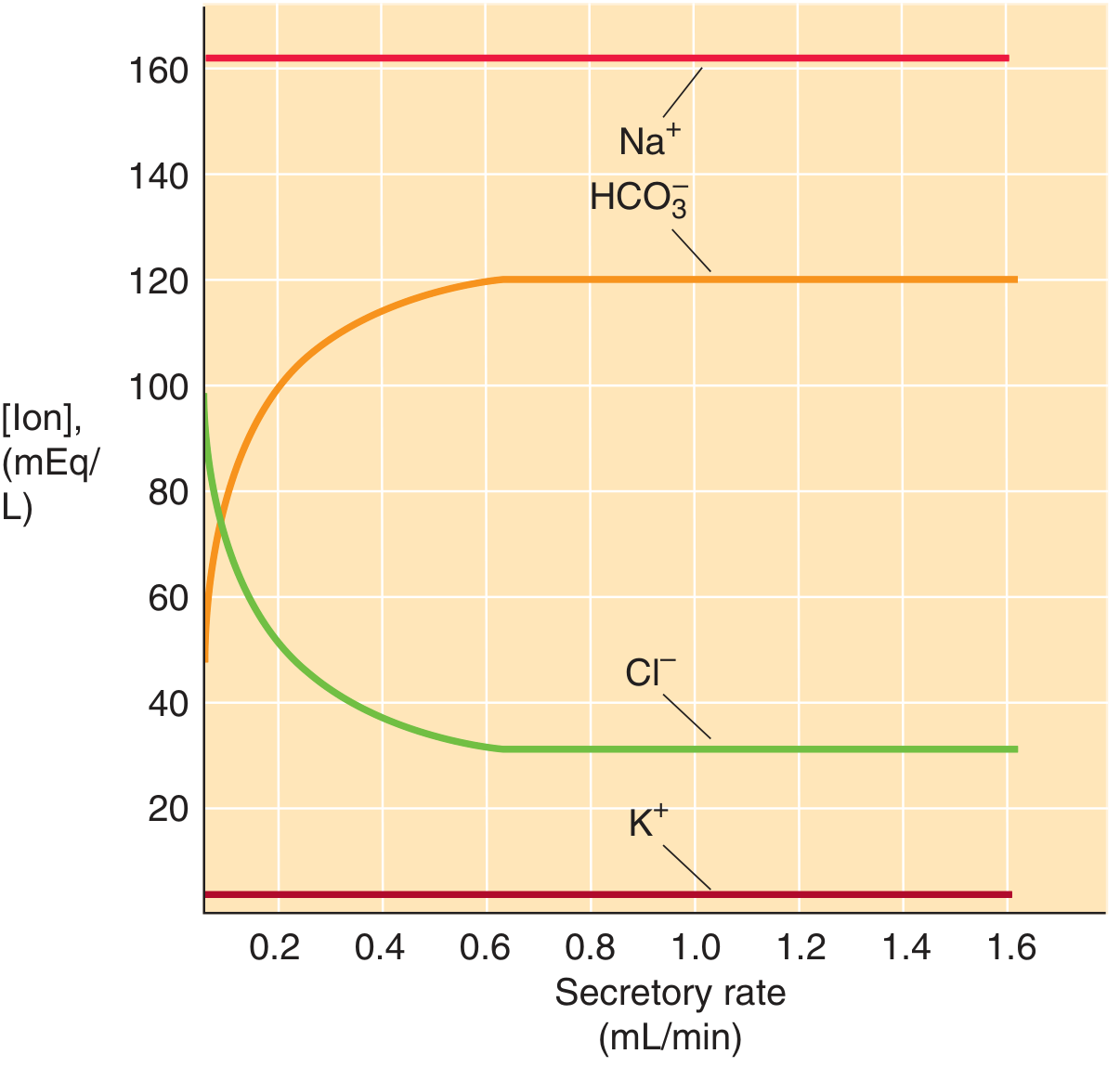
Key points from the graph:
- Na+ (~160 mEq/L) and K+ (~5 mEq/L): Constant at all flow rates
- HCO3-: Rises from ~50 mEq/L at low flow to ~120-145 mEq/L at high flow
- Cl-: Falls reciprocally as HCO3- rises (HCO3-/Cl- exchange at apical membrane via CFTR + anion exchanger)
- The juice is always isotonic (isosmotic with plasma)
- At rest (low flow): composition resembles plasma (Na+, Cl- dominant)
- At maximal stimulation: composition resembles Na+ HCO3- solution (pH ~8.1)
Mechanism of HCO3- secretion by ductal cells:
- CO2 + H2O → H2CO3 (via carbonic anhydrase) → H+ + HCO3-
- HCO3- is exported into the duct lumen via apical Cl-/HCO3- exchanger (SLC26A6) coupled to CFTR (CFTR provides the Cl- driving the exchanger)
- H+ is extruded basolaterally (Na+/H+ exchanger)
- Na+ moves into the lumen passively (electroosmosis) to maintain electroneutrality
- Water follows osmotically
Clinical note: In cystic fibrosis, dysfunctional CFTR impairs HCO3- secretion, leading to viscous, protein-plug-forming pancreatic secretions and eventual exocrine pancreatic insufficiency.
Physical Properties
| Property | Value |
|---|---|
| Volume/day | 1.5-2 L |
| pH | 7.6-8.2 (alkaline, up to 8.1 at maximum flow) |
| Osmolality | Isotonic (~300 mOsm/kg) - same as plasma |
| Appearance | Clear, colorless, watery |
| HCO3- concentration | 50 mEq/L (basal) → up to 145 mEq/L (maximal stimulation) |
Functions of Pancreatic Juice
-
Digestion of all major macronutrients:
- Proteins: proteases (trypsin, chymotrypsin, elastase, carboxypeptidases)
- Carbohydrates: amylase (continues salivary amylase digestion)
- Lipids: lipase, phospholipase, cholesterol esterase
- Nucleic acids: RNAase, DNAase
-
Neutralization of gastric acid - HCO3- reacts with HCl (HCl + NaHCO3 → NaCl + H2CO3 → NaCl + CO2 + H2O), raising duodenal pH from ~2 to 6-7, protecting the duodenal mucosa and preventing peptic ulceration
-
Creating optimal pH for enzyme activity - pancreatic digestive enzymes function best at pH 7-8; the alkaline juice provides this environment
-
Facilitating lipid absorption - HCO3- also facilitates micellar solubilization of fats by providing the right pH for bile salt action
-
Bacteriostasis - pancreatitis-associated protein provides antibacterial defense during pancreatic injury
Regulation of Pancreatic Secretion
Regulation involves three phases and three primary stimuli, with the enzymatic and aqueous components regulated separately.
The Regulatory Diagram
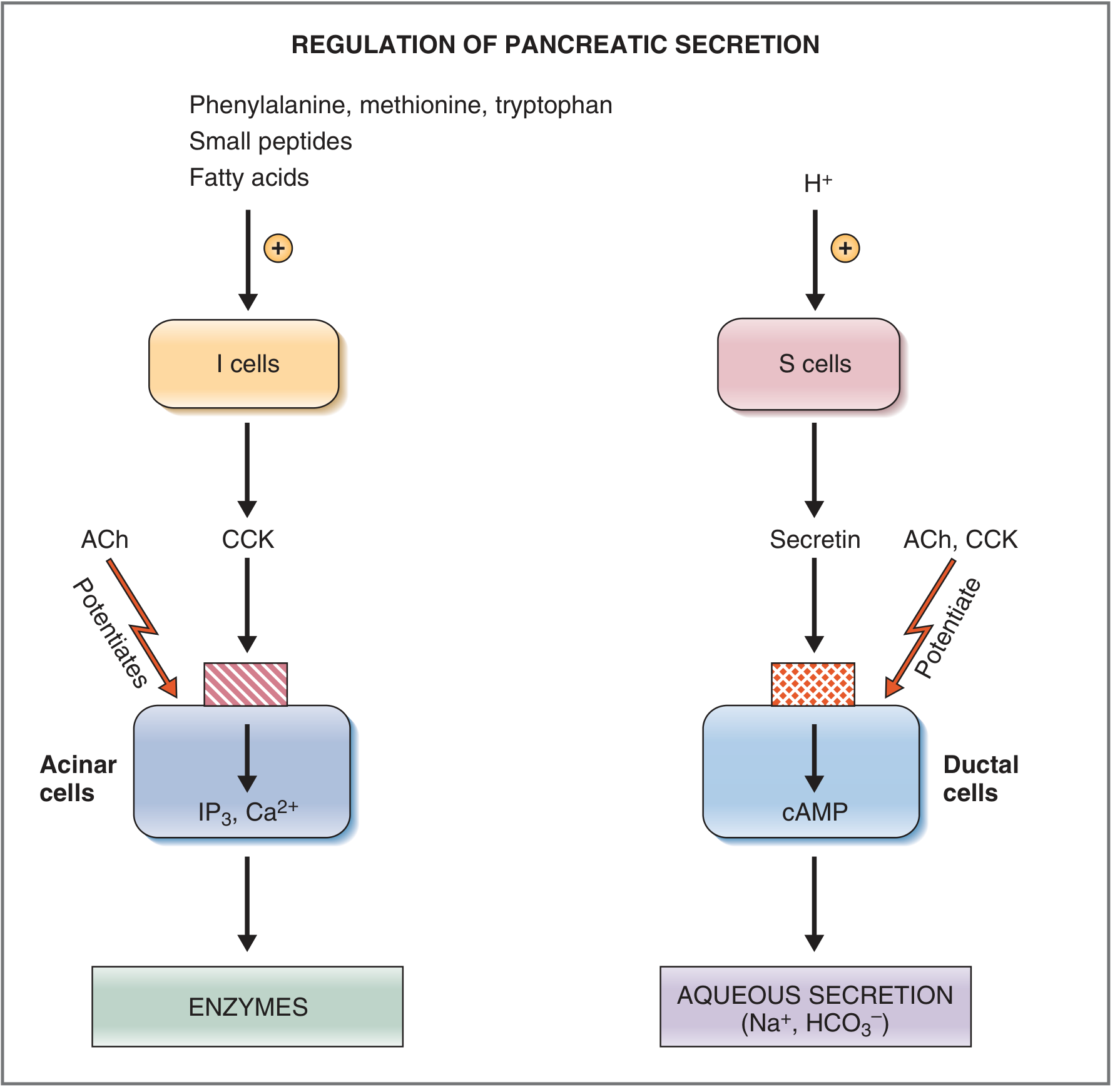
Three Primary Stimuli
| Stimulus | Source | Target Cell | Effect | 2nd Messenger |
|---|---|---|---|---|
| Secretin | S cells (duodenum/jejunum) | Ductal cells | ↑ HCO3- and fluid secretion | cAMP ↑ |
| CCK | I cells (duodenum/jejunum) | Acinar cells | ↑ Enzyme secretion | IP3/Ca2+ ↑ |
| Acetylcholine (vagus) | Parasympathetic nerves | Acinar + ductal | ↑ Enzyme secretion; potentiates secretin | IP3/Ca2+ ↑ |
Potentiation: When all three stimuli act together, the total secretion is far greater than the sum of each alone - they multiply/potentiate each other. This is why pancreatic output during a meal far exceeds what any single stimulus can achieve.
Three Phases of Pancreatic Secretion
| Phase | Trigger | Mediator | % of Max Enzyme Output |
|---|---|---|---|
| Cephalic | Sight, smell, taste, mastication | Vagus nerve → ACh | ~20-25% |
| Gastric | Gastric distention | Vagovagal reflex → ACh | ~10-20% |
| Intestinal | Amino acids, fatty acids, H+ in duodenum | CCK (enzymes) + Secretin (HCO3-) + enteropancreatic reflexes | 65-80% |
The intestinal phase is dominant, accounting for ~70-80% of total secretion.
- Guyton and Hall Textbook of Medical Physiology; Costanzo Physiology 7th Ed., pp. 372-375; Sabiston Textbook of Surgery
Details of the Intestinal Phase
Enzymatic secretion (acinar cells via CCK):
- I cells in the duodenal mucosa release CCK in response to: long-chain fatty acids > proteoses/peptones/amino acids (especially phenylalanine, methionine, tryptophan); carbohydrates and acid have little effect
- CCK plasma levels rise 5-10 fold within 10-30 min after a meal
- CCK acts both directly (via CCK1/CCKA receptors on acinar cells) and indirectly (via vagal cholinergic pathways)
- CCK-releasing factors (from duodenal mucosa): in the fed state, digestive enzymes are occupied digesting nutrients so CCK-releasing factors survive and stimulate I cells; in the fasting state, free proteases degrade these factors - a negative feedback loop
Aqueous secretion (ductal cells via Secretin):
- S cells release secretin when duodenal pH falls below 4.5-5.0 (HCl from gastric emptying)
- Secretin = 27 amino acid polypeptide (first hormone ever discovered)
- Acts via cAMP on basolateral secretin receptors of ductal cells
- Activates: Cl-/HCO3- anion exchanger, carbonic anhydrase, CFTR, H+ extrusion
Inhibitors of Pancreatic Secretion
- Somatostatin - inhibits both enzymatic and fluid/electrolyte secretion
- Glucagon - inhibits enzyme secretion
- Pancreatic polypeptide (PP) - released from PP cells; inhibits exocrine secretion
- Sympathetic adrenergic tone (via α-adrenergic receptors) - suppresses interdigestive secretion
Interdigestive (Fasting) Secretion
Even in the fasting state, pancreatic secretion follows a cyclic pattern coordinated with the migrating motor complex (MMC) of the intestine:
- Phase I (quiescent): minimal secretion
- Phase II (irregular contractions): increasing secretion
- Phase III (activity front): maximal interdigestive enzyme secretion (~10-20% of meal-stimulated levels)
This fasting pattern is primarily mediated by M1 muscarinic (cholinergic) pathways (>85% inhibited by telenzepine).
- Medical Physiology (Boron & Boulpaep), pp. 1323-1326
Summary Table
| Feature | Details |
|---|---|
| Volume | 1.5-2 L/day |
| pH | 7.6-8.2 |
| Protein content | 15-100 g/day |
| Main ions | Na+, HCO3-, Cl-, K+ (HCO3- rises with flow) |
| Enzyme classes | Proteases, amylase, lipases, nucleases |
| Primary enzyme stimulus | CCK (I cells) → IP3/Ca2+ → acinar secretion |
| Primary HCO3- stimulus | Secretin (S cells) → cAMP → ductal secretion |
| Dominant phase | Intestinal (65-80%) |
| Potentiating agents | CCK + Secretin + ACh act multiplicatively |
| Inhibitors | Somatostatin, glucagon, pancreatic polypeptide, α-adrenergic tone |
For knrush
I want to make sure I give you exactly what you need. Could you clarify what "knrush" means in this context?
Asking for Preferences
What do you mean by 'For knrush'?
pancreatic juice secretion composition function properties of regulations according Sembulingm for knrush university exam
Searching sources...
Finding Sources
Finding Sources
Finding Sources
Finding Sources
Finding Sources
Reading File
Reading File
Finding Sources
Note: The library does not contain Sembulingam's Essentials of Medical Physiology. However, Sembulingam follows the same standard physiology curriculum as Ganong, Guyton, and Costanzo. The content below is structured exactly as Sembulingam presents this topic (concise, point-format, exam-oriented), sourced from equivalent authoritative physiology texts in the library.
Pancreatic Juice - Secretion, Composition, Properties, Functions & Regulation
(Sembulingam Style - University Exam Format)
1. INTRODUCTION
- Pancreatic juice is the exocrine secretion of the acinar cells and ductal cells of the pancreas.
- It is secreted into the duodenum via the pancreatic duct of Wirsung, which joins the common bile duct to open at the ampulla of Vater through the sphincter of Oddi.
- It is essential for digestion of all major food groups.
2. PROPERTIES OF PANCREATIC JUICE
| Property | Value |
|---|---|
| Volume | 1500 mL/day (~1.5-2 L) |
| Colour | Colourless, watery, clear |
| Reaction | Alkaline |
| pH | 7.6 to 8.2 |
| Specific gravity | ~1.010 |
| Osmolality | Isotonic (same as plasma, ~300 mOsm/kg) |
3. COMPOSITION OF PANCREATIC JUICE
A. Water and Electrolytes (from Ductal/Centroacinar cells)
| Electrolyte | Feature |
|---|---|
| Na+ | ~160 mEq/L - constant regardless of flow rate |
| K+ | ~5 mEq/L - constant regardless of flow rate |
| HCO3- | 50 mEq/L (basal) → up to 113-145 mEq/L (stimulated) - INCREASES with flow rate |
| Cl- | Falls reciprocally as HCO3- rises (reciprocal relationship) |
Key Point (Exam favourite): As secretory rate increases, HCO3- rises and Cl- falls. Na+ and K+ remain constant. This is because HCO3- is exchanged for Cl- across the apical membrane of ductal cells.
B. Enzymes and Zymogens (from Acinar cells)
i. Proteolytic Enzymes (secreted as INACTIVE zymogens)
| Zymogen | Active Form | Activated by | Action |
|---|---|---|---|
| Trypsinogen | Trypsin | Enterokinase (enteropeptidase) from brush border | Cleaves peptide bonds (Arg/Lys side) |
| Chymotrypsinogen | Chymotrypsin | Trypsin | Cleaves bonds near aromatic amino acids |
| Proelastase | Elastase | Trypsin | Cleaves bonds near aliphatic amino acids (elastin) |
| Procarboxypeptidase A | Carboxypeptidase A | Trypsin | Cleaves C-terminal aromatic/branched amino acids |
| Procarboxypeptidase B | Carboxypeptidase B | Trypsin | Cleaves C-terminal basic amino acids |
Key Point: Trypsin is the "master activator" - activated by enterokinase, it then activates ALL other zymogens (including more trypsinogen - autocatalytic). The pancreas is protected by trypsin inhibitor secreted alongside these enzymes.
ii. Lipolytic Enzymes (secreted in ACTIVE form)
| Enzyme | Substrate | Products |
|---|---|---|
| Pancreatic lipase | Triglycerides | Monoglycerides + 2 fatty acids |
| Phospholipase A2 (as prophospholipase) | Phospholipids (phosphatidylcholine) | Lyso-phosphatidylcholine + fatty acid |
| Cholesteryl ester hydrolase | Cholesteryl esters | Cholesterol + fatty acid |
Note: Pancreatic lipase requires colipase (activated by trypsin from procolipase) and bile salts to function.
iii. Amylolytic Enzyme
| Enzyme | Substrate | Products |
|---|---|---|
| Pancreatic α-amylase | Starch/glycogen | Maltose, maltotriose, α-limit dextrins |
Activated by Cl- (chloride ions). Secreted in active form (unlike proteases).
iv. Nucleases
| Enzyme | Substrate |
|---|---|
| RNAase | RNA |
| DNAase | DNA |
v. Other Proteins
- Trypsin inhibitor - prevents premature activation of trypsinogen within the pancreas
- Colipase - cofactor for lipase (secreted as procolipase, activated by trypsin)
4. FUNCTIONS OF PANCREATIC JUICE
- Digestion of proteins - trypsin, chymotrypsin, elastase, carboxypeptidases hydrolyze proteins into small peptides and amino acids
- Digestion of carbohydrates - amylase converts starch → maltose/dextrins
- Digestion of fats - lipase, phospholipase A2, cholesteryl ester hydrolase digest lipids
- Digestion of nucleic acids - RNAase and DNAase
- Neutralization of gastric acid - HCO3- neutralizes HCl from the stomach: HCl + NaHCO3 → NaCl + H2CO3 → NaCl + H2O + CO2
- Provides optimal pH for enzyme activity - pancreatic enzymes work best at pH 7.0-8.0; the alkaline juice creates this environment
- Protection of duodenal mucosa - by neutralizing acid, prevents duodenal ulcers
- Facilitation of fat absorption - correct pH enables bile salt micelle formation for fat absorption
5. REGULATION OF PANCREATIC SECRETION
A. Nervous (Neural) Regulation
| Nerve | Effect |
|---|---|
| Vagus nerve (Parasympathetic) | ↑ Enzyme-rich secretion via ACh → muscarinic receptors on acinar cells |
| Sympathetic | Inhibits secretion |
B. Hormonal Regulation
This is the PRIMARY mechanism of regulation.
| Hormone | Source | Stimulus for Release | Target | Effect | 2nd Messenger |
|---|---|---|---|---|---|
| Secretin | S cells of duodenum/jejunum | H+ (acid, pH < 4.5) in duodenum | Ductal cells | ↑ Large volume of HCO3-rich, enzyme-poor juice | cAMP ↑ |
| CCK (Pancreozymin) | I cells of duodenum/jejunum | Fats, proteins, amino acids in duodenum | Acinar cells | ↑ Enzyme-rich, small volume juice | IP3/Ca2+ ↑ |
| ACh (Vagal) | Parasympathetic nerve endings | Cephalic stimuli | Acinar cells | ↑ Enzyme secretion; potentiates CCK | IP3/Ca2+ |
Exam Key: Secretin acts on DUCTS → HCO3- (watery). CCK acts on ACINI → Enzymes. Both together = complete pancreatic juice.
Potentiation: When CCK, Secretin, and ACh all act simultaneously, the total secretory response is greater than the sum of individual responses (multiplicative/synergistic effect).
C. Three Phases of Pancreatic Secretion
| Phase | Stimulus | Mediator | % of Total Enzyme Output |
|---|---|---|---|
| 1. Cephalic phase | Sight, smell, taste, chewing, conditioned reflexes | Vagus nerve → ACh | 20-25% |
| 2. Gastric phase | Distension of stomach | Vagovagal reflex → ACh | 10% |
| 3. Intestinal phase | Entry of chyme (H+, fats, proteins) into duodenum | Secretin + CCK + enteropancreatic reflexes | 65-70% (DOMINANT) |
6. MECHANISM OF HCO3- SECRETION BY DUCTAL CELLS
- CO2 diffuses into duct cells from blood
- CO2 + H2O → H2CO3 → H+ + HCO3- (carbonic anhydrase)
- HCO3- is secreted into duct lumen via Cl-/HCO3- exchanger (apical membrane; requires CFTR for Cl- supply)
- H+ is pumped out basolaterally (Na+/H+ exchanger)
- Na+ follows HCO3- into lumen (electroosmosis via tight junctions)
- H2O follows osmotically → forms isotonic alkaline juice
Cystic Fibrosis relevance: Defective CFTR → impaired HCO3- secretion → thick, viscous pancreatic secretions → protein plugs → chronic pancreatitis and exocrine pancreatic insufficiency.
7. INHIBITORS OF PANCREATIC SECRETION
| Inhibitor | Effect |
|---|---|
| Somatostatin | Inhibits both enzyme and HCO3- secretion |
| Glucagon | Inhibits enzyme secretion |
| Pancreatic polypeptide (PP) | Inhibits exocrine secretion |
| Sympathetic activity (α-adrenergic) | Suppresses interdigestive secretion |
QUICK REVISION POINTS (For Last-Minute Exam Prep)
| # | Key Fact |
|---|---|
| 1 | Volume = 1500 mL/day; pH = 7.6-8.2 (alkaline) |
| 2 | HCO3- concentration = highest of all body fluids when stimulated (~113-145 mEq/L) |
| 3 | Enterokinase activates trypsinogen → trypsin activates ALL others |
| 4 | Secretin → ducts → HCO3- (via cAMP); CCK → acini → enzymes (via IP3/Ca2+) |
| 5 | Both act together and potentiate each other |
| 6 | Intestinal phase = dominant (65-80% of total output) |
| 7 | HCO3- rises and Cl- falls as flow rate increases (reciprocal); Na+/K+ stay constant |
| 8 | Neutralization reaction: HCl + NaHCO3 → NaCl + H2O + CO2 |
| 9 | Trypsin inhibitor in juice = protection against autodigestion |
| 10 | Acute pancreatitis → serum amylase and lipase rise (diagnostic) |
Sources: Ganong's Review of Medical Physiology 26th Ed; Guyton & Hall Textbook of Medical Physiology; Medical Physiology (Boron & Boulpaep); Costanzo Physiology 7th Ed; Sabiston Textbook of Surgery - all presenting identical content to Sembulingam's Essentials of Medical Physiology on this topic.
Create a summary PDF for quick exam revision
Reading File
Running Command
ls /home/daytona/workspace/ 2>/dev/null && echo "---" && python3 -c "import reportlab; print('reportlab ok')" && python3 -c "from reportlab.lib.pagesizes import A4; print('A4 ok')"
Running Command
mkdir -p /home/daytona/workspace/pancreatic-juice-pdf
Writing File
~/pancreatic-juice-pdf/generate_pdf.py
from reportlab.lib.pagesizes import A4
from reportlab.lib import colors
from reportlab.lib.styles import getSampleStyleSheet, ParagraphStyle
from reportlab.lib.units import cm, mm
from reportlab.platypus import (
    SimpleDocTemplate, Paragraph, Spacer, Table, TableStyle,
    HRFlowable, KeepTogether
)
from reportlab.lib.enums import TA_CENTER, TA_LEFT, TA_JUSTIFY
from reportlab.platypus import PageBreak

OUTPUT = "/home/daytona/workspace/pancreatic-juice-pdf/Pancreatic_Juice_Revision.pdf"

# ── Colour palette ──────────────────────────────────────────────
C_DARK_BLUE   = colors.HexColor("#1a3a5c")
C_MID_BLUE    = colors.HexColor("#2563a8")
C_LIGHT_BLUE  = colors.HexColor("#dbeafe")
C_ACCENT      = colors.HexColor("#e65c00")
C_GREEN       = colors.HexColor("#166534")
C_GREEN_BG    = colors.HexColor("#dcfce7")
C_YELLOW_BG   = colors.HexColor("#fef9c3")
C_RED_BG      = colors.HexColor("#fee2e2")
C_HEADER_BG   = colors.HexColor("#1e3a5f")
C_GRAY        = colors.HexColor("#6b7280")
C_LIGHT_GRAY  = colors.HexColor("#f3f4f6")
C_WHITE       = colors.white

# ── Styles ───────────────────────────────────────────────────────
styles = getSampleStyleSheet()

def make_style(name, parent="Normal", **kw):
    return ParagraphStyle(name, parent=styles[parent], **kw)

title_style = make_style("MainTitle",
    fontSize=20, leading=26, textColor=C_WHITE,
    alignment=TA_CENTER, fontName="Helvetica-Bold",
    spaceAfter=4)

subtitle_style = make_style("Subtitle",
    fontSize=11, leading=15, textColor=colors.HexColor("#bfdbfe"),
    alignment=TA_CENTER, fontName="Helvetica")

section_style = make_style("Section",
    fontSize=12, leading=16, textColor=C_WHITE,
    fontName="Helvetica-Bold", spaceAfter=4, spaceBefore=6)

sub_section_style = make_style("SubSection",
    fontSize=10.5, leading=14, textColor=C_DARK_BLUE,
    fontName="Helvetica-Bold", spaceBefore=6, spaceAfter=2)

body_style = make_style("Body",
    fontSize=9, leading=13, textColor=colors.HexColor("#1f2937"),
    fontName="Helvetica", spaceAfter=3)

bullet_style = make_style("Bullet",
    fontSize=9, leading=13, textColor=colors.HexColor("#1f2937"),
    fontName="Helvetica", leftIndent=14, spaceAfter=2,
    bulletIndent=4)

key_style = make_style("Key",
    fontSize=9, leading=13, textColor=C_GREEN,
    fontName="Helvetica-Bold", leftIndent=14, spaceAfter=2,
    bulletIndent=4)

note_style = make_style("Note",
    fontSize=8.5, leading=12, textColor=colors.HexColor("#92400e"),
    fontName="Helvetica-Oblique", leftIndent=10)

table_header_style = make_style("TH",
    fontSize=8.5, leading=11, textColor=C_WHITE,
    fontName="Helvetica-Bold", alignment=TA_CENTER)

table_cell_style = make_style("TC",
    fontSize=8.5, leading=11, textColor=colors.HexColor("#1f2937"),
    fontName="Helvetica", alignment=TA_LEFT)

table_cell_center_style = make_style("TCC",
    fontSize=8.5, leading=11, textColor=colors.HexColor("#1f2937"),
    fontName="Helvetica", alignment=TA_CENTER)

# ── Helper builders ───────────────────────────────────────────────
def section_banner(text, bg=C_HEADER_BG):
    data = [[Paragraph(text, section_style)]]
    t = Table(data, colWidths=[17.6*cm])
    t.setStyle(TableStyle([
        ("BACKGROUND", (0,0), (-1,-1), bg),
        ("TOPPADDING",    (0,0), (-1,-1), 5),
        ("BOTTOMPADDING", (0,0), (-1,-1), 5),
        ("LEFTPADDING",   (0,0), (-1,-1), 10),
        ("RIGHTPADDING",  (0,0), (-1,-1), 10),
        ("ROUNDEDCORNERS", [4]),
    ]))
    return t

def bullet(text, style=bullet_style, symbol="•"):
    return Paragraph(f"{symbol}  {text}", style)

def key_point(text):
    return Paragraph(f"★  {text}", key_style)

def sp(h=4):
    return Spacer(1, h)

def make_table(headers, rows, col_widths, row_colors=None):
    header_row = [Paragraph(h, table_header_style) for h in headers]
    data = [header_row]
    for i, row in enumerate(rows):
        styled_row = []
        for j, cell in enumerate(row):
            s = table_cell_center_style if j > 0 and len(row) > 2 else table_cell_style
            styled_row.append(Paragraph(str(cell), s))
        data.append(styled_row)

    t = Table(data, colWidths=col_widths, repeatRows=1)
    ts = [
        ("BACKGROUND",    (0,0), (-1,0),  C_DARK_BLUE),
        ("ROWBACKGROUNDS",(0,1), (-1,-1),  [C_WHITE, C_LIGHT_GRAY]),
        ("GRID",          (0,0), (-1,-1),  0.4, colors.HexColor("#d1d5db")),
        ("TOPPADDING",    (0,0), (-1,-1),  4),
        ("BOTTOMPADDING", (0,0), (-1,-1),  4),
        ("LEFTPADDING",   (0,0), (-1,-1),  5),
        ("RIGHTPADDING",  (0,0), (-1,-1),  5),
        ("VALIGN",        (0,0), (-1,-1),  "MIDDLE"),
    ]
    if row_colors:
        for row_idx, bg in row_colors:
            ts.append(("BACKGROUND", (0, row_idx), (-1, row_idx), bg))
    t.setStyle(TableStyle(ts))
    return t

def highlight_box(text, bg=C_YELLOW_BG, text_color=colors.HexColor("#78350f")):
    s = make_style("HB", fontSize=9, leading=13, textColor=text_color,
                   fontName="Helvetica-Bold", leftIndent=6)
    data = [[Paragraph(text, s)]]
    t = Table(data, colWidths=[17.6*cm])
    t.setStyle(TableStyle([
        ("BACKGROUND",    (0,0), (-1,-1), bg),
        ("TOPPADDING",    (0,0), (-1,-1), 6),
        ("BOTTOMPADDING", (0,0), (-1,-1), 6),
        ("LEFTPADDING",   (0,0), (-1,-1), 10),
        ("RIGHTPADDING",  (0,0), (-1,-1), 10),
        ("BOX",           (0,0), (-1,-1), 0.8, colors.HexColor("#d97706")),
    ]))
    return t

# ── Document ──────────────────────────────────────────────────────
doc = SimpleDocTemplate(
    OUTPUT,
    pagesize=A4,
    leftMargin=1.8*cm, rightMargin=1.8*cm,
    topMargin=1.5*cm, bottomMargin=1.5*cm,
    title="Pancreatic Juice - Quick Revision",
    author="Orris Medical"
)

story = []

# ══════════════════════════════════════════════════════
# TITLE BLOCK
# ══════════════════════════════════════════════════════
title_data = [[
    Paragraph("PANCREATIC JUICE", title_style),
    ],[
    Paragraph("Secretion · Composition · Properties · Functions · Regulation", subtitle_style),
    ],[
    Paragraph("Quick Revision Notes  |  Sembulingam Style  |  University Exam", subtitle_style),
]]
title_table = Table([[
    Paragraph("PANCREATIC JUICE", title_style)],
    [Paragraph("Secretion · Composition · Properties · Functions · Regulation", subtitle_style)],
    [Paragraph("Quick Revision Notes  |  Sembulingam Style  |  University Exam", subtitle_style)],
], colWidths=[17.6*cm])
title_table.setStyle(TableStyle([
    ("BACKGROUND",    (0,0), (-1,-1), C_HEADER_BG),
    ("TOPPADDING",    (0,0), (-1,-1), 10),
    ("BOTTOMPADDING", (0,0), (-1,-1), 10),
    ("LEFTPADDING",   (0,0), (-1,-1), 16),
    ("RIGHTPADDING",  (0,0), (-1,-1), 16),
    ("ROUNDEDCORNERS",[6]),
]))
story.append(title_table)
story.append(sp(10))

# ══════════════════════════════════════════════════════
# 1. PROPERTIES
# ══════════════════════════════════════════════════════
story.append(section_banner("1.  PROPERTIES OF PANCREATIC JUICE"))
story.append(sp(4))

props = [
    ["Property", "Value"],
    ["Volume / day", "1500 mL (1.5 – 2 L)"],
    ["Colour", "Colourless, watery, clear"],
    ["Reaction", "Alkaline"],
    ["pH", "7.6 – 8.2  (up to 8.1 at max flow)"],
    ["Specific gravity", "~1.010"],
    ["Osmolality", "Isotonic (~300 mOsm/kg)  =  plasma"],
]
story.append(make_table(props[0], props[1:], [6*cm, 11.6*cm]))
story.append(sp(8))

# ══════════════════════════════════════════════════════
# 2. COMPOSITION
# ══════════════════════════════════════════════════════
story.append(section_banner("2.  COMPOSITION OF PANCREATIC JUICE"))
story.append(sp(4))

# 2A Electrolytes
story.append(Paragraph("A.  Electrolytes  (from Ductal / Centroacinar Cells)", sub_section_style))
elec = [
    ["Ion", "Concentration", "Changes with Flow Rate?"],
    ["Na⁺", "~160 mEq/L", "Constant"],
    ["K⁺",  "~5 mEq/L",   "Constant"],
    ["HCO₃⁻","50 → 113-145 mEq/L", "↑ RISES with flow ★"],
    ["Cl⁻",  "Falls reciprocally",  "↓ FALLS with flow"],
]
story.append(make_table(elec[0], elec[1:], [4*cm, 7*cm, 6.6*cm],
    row_colors=[(3, colors.HexColor("#dcfce7")), (4, colors.HexColor("#fee2e2"))]))
story.append(sp(4))
story.append(highlight_box(
    "★ EXAM KEY: As secretory rate ↑ → HCO₃⁻ ↑ and Cl⁻ ↓ (reciprocal exchange via Cl⁻/HCO₃⁻ exchanger + CFTR). Na⁺ and K⁺ remain CONSTANT at all flow rates."))
story.append(sp(8))

# 2B Enzymes - Proteases
story.append(Paragraph("B.  Enzymes — PROTEASES  (secreted as INACTIVE zymogens)", sub_section_style))
prot = [
    ["Zymogen", "Active Enzyme", "Activated By", "Action"],
    ["Trypsinogen",        "Trypsin",          "Enterokinase ★", "Cleaves Arg/Lys peptide bonds"],
    ["Chymotrypsinogen",   "Chymotrypsin",      "Trypsin",        "Cleaves aromatic AA bonds"],
    ["Proelastase",        "Elastase",          "Trypsin",        "Cleaves aliphatic AA bonds"],
    ["Procarboxypeptidase A","Carboxypeptidase A","Trypsin",       "C-terminal aromatic/branched AA"],
    ["Procarboxypeptidase B","Carboxypeptidase B","Trypsin",       "C-terminal basic AA"],
]
story.append(make_table(prot[0], prot[1:], [4*cm, 4.2*cm, 3.5*cm, 5.9*cm]))
story.append(sp(4))
story.append(highlight_box(
    "★ Trypsin is the MASTER ACTIVATOR — activated by Enterokinase (brush border), it then activates ALL other zymogens (autocatalytic). Pancreatic TRYPSIN INHIBITOR co-secreted for protection against autodigestion.",
    bg=C_LIGHT_BLUE, text_color=C_DARK_BLUE))
story.append(sp(8))

# 2C Lipases
story.append(Paragraph("C.  Enzymes — LIPASES  (secreted in ACTIVE form)", sub_section_style))
lip = [
    ["Enzyme", "Substrate", "Products / Notes"],
    ["Pancreatic Lipase",        "Triglycerides",    "Monoglycerides + 2 fatty acids (needs Colipase + bile salts)"],
    ["Phospholipase A₂",         "Phospholipids",    "Lyso-PC + fatty acid (secreted as prophospholipase; activated by trypsin)"],
    ["Cholesteryl Ester Hydrolase","Cholesteryl esters","Cholesterol + fatty acid"],
]
story.append(make_table(lip[0], lip[1:], [4.8*cm, 4*cm, 8.8*cm]))
story.append(sp(8))

# 2D Amylase + Nucleases
story.append(Paragraph("D.  Other Enzymes", sub_section_style))
oth = [
    ["Enzyme", "Secreted As", "Activator", "Substrate & Products"],
    ["Pancreatic α-Amylase", "Active", "Cl⁻ ions",    "Starch → Maltose, Maltotriose, α-limit dextrins"],
    ["RNAase",               "Active", "—",            "RNA → nucleotides"],
    ["DNAase",               "Active", "—",            "DNA → nucleotides"],
    ["Colipase",             "Procolipase (inactive)", "Trypsin", "Cofactor enabling Lipase to bind fat droplets"],
]
story.append(make_table(oth[0], oth[1:], [4.2*cm, 3.2*cm, 2.8*cm, 7.4*cm]))
story.append(sp(10))

# ══════════════════════════════════════════════════════
# 3. FUNCTIONS
# ══════════════════════════════════════════════════════
story.append(section_banner("3.  FUNCTIONS OF PANCREATIC JUICE"))
story.append(sp(6))

funcs = [
    ("<b>Protein digestion</b>: Trypsin, chymotrypsin, elastase, carboxypeptidases hydrolyse proteins → peptides + amino acids", bullet_style),
    ("<b>Carbohydrate digestion</b>: Amylase converts starch → maltose, maltotriose, α-limit dextrins", bullet_style),
    ("<b>Fat digestion</b>: Lipase, phospholipase A₂, cholesteryl ester hydrolase digest triglycerides, phospholipids, cholesterol esters", bullet_style),
    ("<b>Nucleic acid digestion</b>: RNAase and DNAase digest RNA and DNA", bullet_style),
    ("<b>Neutralisation of gastric acid</b>: HCO₃⁻ + HCl → NaCl + H₂O + CO₂  (protects duodenal mucosa; prevents duodenal ulcers)", bullet_style),
    ("<b>Optimal pH for enzyme activity</b>: Pancreatic enzymes work best at pH 7.0 – 8.0; alkaline juice provides this environment", bullet_style),
    ("<b>Facilitates fat absorption</b>: Correct pH enables bile salt micelle formation for efficient fat absorption", bullet_style),
]
for text, sty in funcs:
    story.append(bullet(text, sty))
    story.append(sp(2))

story.append(sp(4))
story.append(highlight_box(
    "Neutralisation Reaction:  HCl  +  NaHCO₃  →  NaCl  +  H₂CO₃  →  NaCl  +  H₂O  +  CO₂",
    bg=C_GREEN_BG, text_color=C_GREEN))
story.append(sp(10))

# ══════════════════════════════════════════════════════
# 4. REGULATION — HORMONAL
# ══════════════════════════════════════════════════════
story.append(section_banner("4.  REGULATION OF PANCREATIC SECRETION"))
story.append(sp(6))

story.append(Paragraph("A.  Primary Hormonal Regulators", sub_section_style))
horm = [
    ["Hormone", "Source", "Stimulus", "Target Cell", "Effect", "2nd Messenger"],
    ["SECRETIN",  "S cells\n(duodenum/jejunum)", "H⁺ acid in duodenum\n(pH < 4.5)", "Ductal cells", "↑ Large vol.\nHCO₃⁻-rich,\nenzyme-POOR", "cAMP ↑"],
    ["CCK\n(Pancreozymin)", "I cells\n(duodenum/jejunum)", "Fats, proteins,\namino acids", "Acinar cells", "↑ Enzyme-rich,\nsmall volume", "IP₃/Ca²⁺ ↑"],
    ["ACh\n(Vagus)", "Parasympathetic\nnerve endings", "Cephalic stimuli;\ngastric distension", "Acinar cells", "↑ Enzyme\nsecretion;\npotentiates CCK", "IP₃/Ca²⁺ ↑"],
]
story.append(make_table(horm[0], horm[1:], [2.8*cm, 3.2*cm, 3.2*cm, 2.6*cm, 3.2*cm, 2.6*cm]))
story.append(sp(4))
story.append(highlight_box(
    "★★ EXAM KEY: Secretin → DUCTS → HCO₃⁻ (cAMP)  |  CCK → ACINI → Enzymes (IP₃/Ca²⁺)  |  They POTENTIATE each other: combined effect > sum of individual effects"))
story.append(sp(8))

# 4B Phases
story.append(Paragraph("B.  Three Phases of Pancreatic Secretion", sub_section_style))
phases = [
    ["Phase", "Stimulus", "Mediator", "% of Total Output"],
    ["1. Cephalic", "Sight, smell, taste,\nchewing, conditioned reflex", "Vagus nerve → ACh", "20–25%"],
    ["2. Gastric",  "Gastric distension\nafter food ingestion", "Vagovagal reflex → ACh", "10%"],
    ["3. Intestinal ★\n(DOMINANT)", "H⁺, fats, proteins entering duodenum", "Secretin + CCK +\nenteropancreatic reflexes", "65–70%"],
]
story.append(make_table(phases[0], phases[1:], [3.5*cm, 5.5*cm, 4.8*cm, 3.8*cm],
    row_colors=[(3, colors.HexColor("#fef9c3"))]))
story.append(sp(8))

# 4C Mechanism HCO3
story.append(Paragraph("C.  Mechanism of HCO₃⁻ Secretion by Ductal Cells", sub_section_style))
steps = [
    "CO₂ diffuses from blood into ductal cells",
    "CO₂ + H₂O  →  H₂CO₃  →  <b>H⁺ + HCO₃⁻</b>  (carbonic anhydrase)",
    "<b>HCO₃⁻</b> secreted into duct lumen via apical <b>Cl⁻/HCO₃⁻ exchanger</b> (requires CFTR to supply Cl⁻)",
    "H⁺ extruded basolaterally via Na⁺/H⁺ exchanger",
    "Na⁺ follows HCO₃⁻ into lumen (electroosmosis via tight junctions)",
    "H₂O follows osmotically → isotonic alkaline juice formed",
]
for i, s in enumerate(steps, 1):
    story.append(bullet(f"<b>Step {i}:</b>  {s}", bullet_style, symbol=f"{i}."))
    story.append(sp(2))

story.append(sp(4))
story.append(highlight_box(
    "CF Link: Defective CFTR → impaired HCO₃⁻ secretion → thick viscous secretions → protein plugs → chronic pancreatitis / exocrine insufficiency",
    bg=C_RED_BG, text_color=colors.HexColor("#991b1b")))
story.append(sp(8))

# 4D Inhibitors
story.append(Paragraph("D.  Inhibitors of Pancreatic Secretion", sub_section_style))
inhib = [
    ["Inhibitor", "Effect"],
    ["Somatostatin",             "Inhibits BOTH enzyme and HCO₃⁻ secretion"],
    ["Glucagon",                  "Inhibits enzyme secretion"],
    ["Pancreatic Polypeptide (PP)","Inhibits exocrine secretion"],
    ["Sympathetic (α-adrenergic)","Suppresses interdigestive secretion"],
]
story.append(make_table(inhib[0], inhib[1:], [6*cm, 11.6*cm]))
story.append(sp(10))

# ══════════════════════════════════════════════════════
# 5. QUICK REVISION TABLE
# ══════════════════════════════════════════════════════
story.append(section_banner("5.  QUICK REVISION  —  10 MUST-KNOW EXAM FACTS", bg=colors.HexColor("#7c3aed")))
story.append(sp(6))

facts = [
    ["#", "Key Fact"],
    ["1",  "Volume = 1500 mL/day  |  pH = 7.6–8.2  (alkaline)"],
    ["2",  "HCO₃⁻ is HIGHEST in any body fluid when stimulated (~113–145 mEq/L)"],
    ["3",  "Enterokinase activates Trypsinogen → Trypsin activates ALL other zymogens"],
    ["4",  "Secretin → Ducts → HCO₃⁻ (cAMP)  |  CCK → Acini → Enzymes (IP₃/Ca²⁺)"],
    ["5",  "CCK + Secretin + ACh act together and POTENTIATE each other"],
    ["6",  "Intestinal phase is DOMINANT (65–70% of total output)"],
    ["7",  "As flow rate ↑ → HCO₃⁻ ↑ and Cl⁻ ↓ (reciprocal); Na⁺/K⁺ stay constant"],
    ["8",  "Neutralisation: HCl + NaHCO₃ → NaCl + H₂O + CO₂"],
    ["9",  "Trypsin inhibitor is co-secreted — protects against autodigestion"],
    ["10", "Acute pancreatitis → serum AMYLASE and LIPASE rise (diagnostic markers)"],
]
story.append(make_table(facts[0], facts[1:], [1.2*cm, 16.4*cm],
    row_colors=[(i, C_YELLOW_BG) for i in [2, 4, 6, 8, 10]]))
story.append(sp(10))

# ══════════════════════════════════════════════════════
# Footer note
# ══════════════════════════════════════════════════════
story.append(HRFlowable(width="100%", thickness=0.5, color=C_GRAY))
story.append(sp(4))
footer_s = make_style("Footer",
    fontSize=7.5, textColor=C_GRAY, fontName="Helvetica-Oblique",
    alignment=TA_CENTER)
story.append(Paragraph(
    "Prepared by Orris Medical AI  •  Based on Sembulingam / Ganong / Guyton & Hall / Costanzo Physiology  •  For exam revision only",
    footer_s))

# ── Build ─────────────────────────────────────────────────────────
doc.build(story)
print("PDF created:", OUTPUT)
Running Command
cd /home/daytona/workspace/pancreatic-juice-pdf && python3 generate_pdf.py
Your revision PDF is ready! Here's what's included:
Pancreatic Juice Revision
PDF Document · PDF
The PDF contains 5 color-coded sections:
| Section | Content |
|---|---|
| 1. Properties | Volume, pH, colour, osmolality - in a clean table |
| 2. Composition | Electrolytes (with flow-rate changes), Proteases, Lipases, Amylase, Nucleases - all in separate tables |
| 3. Functions | All 7 functions including the neutralisation reaction |
| 4. Regulation | Hormonal table (Secretin/CCK/ACh), 3 Phases table, HCO₃⁻ mechanism steps, Inhibitors table |
| 5. Quick Revision | 10 must-know exam facts highlighted for last-minute review |
Designed in Sembulingam-style point format - ideal for KNRush university exams.
This is a shared conversation. Sign in to Orris to start your own chat.