
Isotype switching
Reading File
Isotype switching (also called class switching or class switch recombination, CSR) is the process by which a B cell changes the antibody isotype it produces - from IgM to IgG, IgA, or IgE - while keeping the same antigen-binding specificity. It is driven by cytokine signals and requires AID (activation-induced cytidine deaminase).
Searching sources...
Finding Sources
Searching PubMed
"class switch recombination" AND "AID"
Finding Sources
Good - I have multiple rich sources. Let me read the most dedicated sections in parallel.
Reading File
Reading File
Reading File
I have excellent content. Let me fetch the key diagram images to include in the answer.
Loading Image
Reading File
I now have very comprehensive content from multiple textbooks. Let me compile the full answer.
Isotype Switching (Class Switch Recombination)
Definition
Isotype switching - formally called class switch recombination (CSR) - is the process by which an antigen-stimulated B cell changes the class (isotype) of antibody it produces, shifting from the default IgM to IgG, IgA, or IgE, while retaining the same antigen-binding specificity. Only the heavy chain constant (C) region changes; the variable (V) domain, and therefore antigen recognition, remains unchanged.
- Cellular and Molecular Immunology, p. 783
Where It Occurs
CSR is initiated in extrafollicular pre-germinal center Tfh cells (outside the follicle) and continues inside germinal centers, driven by follicular helper T (Tfh) cells in the light zone. B cells entering the germinal center are IgM- and IgD-expressing; their progeny switch to express downstream heavy chain genes.
- Cellular and Molecular Immunology, p. 783
- Roitt's Essential Immunology, p. 114
Molecular Mechanism
1. Heavy Chain Locus Architecture
The immunoglobulin heavy chain (IgH) locus is arranged in a linear order downstream of the assembled VDJ exon:
V-D-J | Sµ | Cµ | Cδ | Sγ3 | Cγ3 | Sγ1 | Cγ1 | ... | Sε | Cε | Sα | Cα
- Constant region genes for IgD, IgG, IgE, and IgA lie downstream of Cµ.
- Switch (S) regions - repetitive, G-rich sequences 1-10 kb long - flank the 5' end of each CH gene (except Cδ).
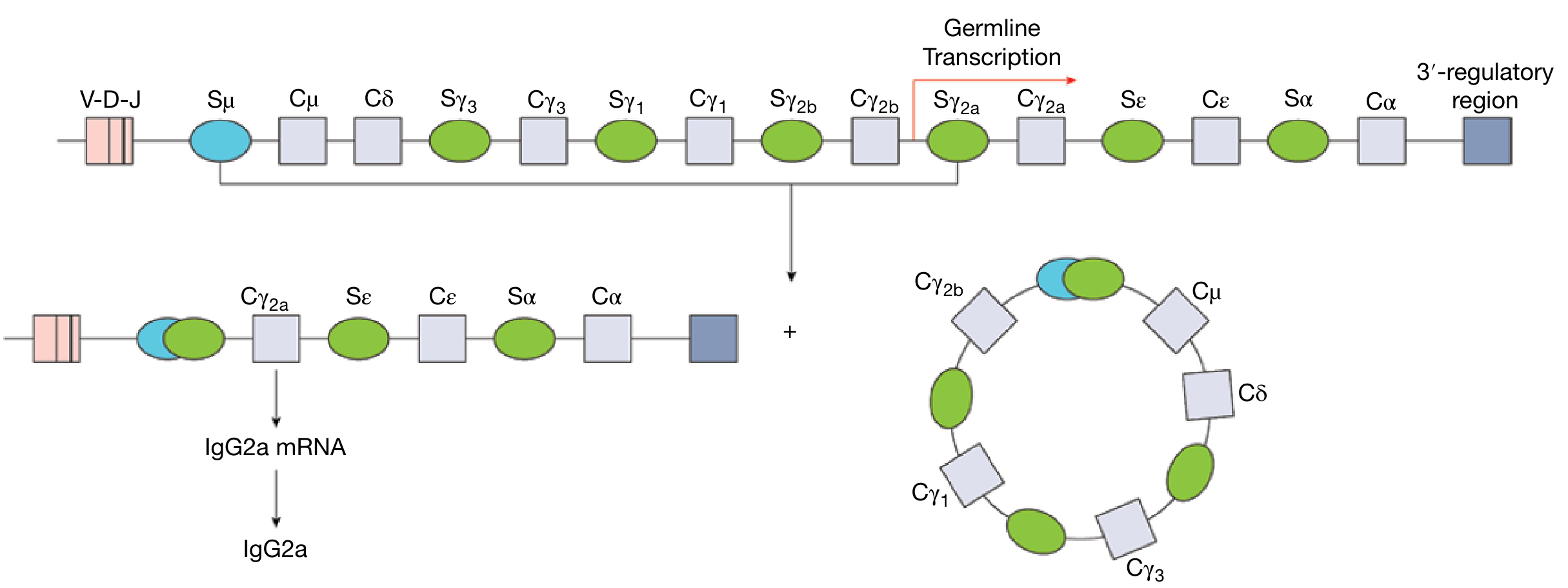
Figure: CSR illustrated for an IgM to IgG2a switch. Breaks are introduced in Sµ and Sγ2a; the intervening DNA is excised as an episomal circle, and the VDJ exon is joined to Cγ2a, leading to IgG2a mRNA and protein.
2. Germline (Sterile) Transcription
Before recombination, cytokine signals induce germline transcription from an intronic promoter (I-region promoter) upstream of the target switch region. These transcripts (I exon → S region → CH exon) do not code for protein but are required to open chromatin and make the switch region accessible to AID.
- Cellular and Molecular Immunology, p. 787
- Roitt's Essential Immunology, p. 114
3. Role of AID (Activation-Induced Cytidine Deaminase)
AID is the key enzymatic mediator of CSR. It is induced by CD40 signaling and deaminates cytosines in the S regions, converting C→U. This leads to:
- Uracil-DNA glycosylase removal of uracils
- DNA double-strand breaks (DSBs) in the S regions
- Non-homologous end joining (NHEJ) and other DNA repair pathways fuse the two broken S regions
The result: the VDJ exon is joined to a new downstream CH gene; the intervening DNA is excised as an episomal circle. Alternative splicing of the primary RNA then determines whether the antibody is membrane-bound or secreted.
- Roitt's Essential Immunology, p. 114
- Cellular and Molecular Immunology, p. 787
4. CD40 - CD40L Interaction
-
CD40 on B cells + CD40L (CD154) on activated Tfh cells → obligatory signal for CSR
-
Genetic deficiency of CD40 or CD40L → B cells remain stuck at IgM production → Hyper-IgM Syndrome (severe immunodeficiency with susceptibility to bacterial infections)
-
Janeway's Immunobiology 10e, p. 445
Cytokine Control of Isotype Selection
The choice of which isotype to switch to is not random - it depends on cytokines produced by Tfh cells and local tissue cells:
| Cytokine | Isotype Induced (mouse) | Context |
|---|---|---|
| IL-4 | IgG1, IgE | Th2 responses, helminths, allergy |
| IFN-γ | IgG3, IgG2a | Th1 responses, viruses/intracellular pathogens |
| TGF-β | IgG2b, IgA | Mucosal sites, regulatory environment |
| IL-21 | IgG3, IgG1, IgA | Germinal center Tfh cells |
| IL-5 | IgG1, IgA | Mucosal immunity |
- Janeway's Immunobiology 10e, p. 445 (Fig. 10.23)
Note on humans vs. mice: In mice, IFN-γ drives IgG2a switching. In humans, the specific cytokines driving differential IgG subclass switching (IgG1 vs. IgG2 vs. IgG3 vs. IgG4) are less well defined. Human Tfh cells with high IL-21:IL-4 ratio drive IgM→IgG switch. - Cellular and Molecular Immunology, p. 785
Functional Significance of Each Isotype
| Isotype | Key Effector Functions |
|---|---|
| IgM | First antibody produced; efficient complement activation (classical) |
| IgG | Opsonization, complement activation, ADCC, placental transfer, long half-life |
| IgA | Mucosal immunity; exported through epithelia into secretions (secretory IgA) |
| IgE | Anti-helminth defense; mediates immediate hypersensitivity / allergy |
- B cells in mucosal tissues preferentially switch to IgA, stimulated by TGF-β (from T cells and stromal cells) and by BAFF/APRIL (from myeloid cells - enabling T-independent IgA responses).
- Cellular and Molecular Immunology, p. 786
Clinical Relevance
| Defect | Consequence |
|---|---|
| CD40L deficiency | Hyper-IgM syndrome - high IgM, absent IgG/IgA/IgE |
| AID deficiency | Same phenotype as CD40L deficiency - CSR fails |
| Ataxia Telangiectasia | Impaired DNA repair → defective CSR |
| TACI gene mutation | Selective IgA deficiency |
- Janeway's Immunobiology 10e, p. 445
Summary Flow
Antigen + T cell help (CD40L)
        ↓
B cell activation → CD40 signaling → AID expression
        ↓
Cytokine signal (IL-4, IFN-γ, TGF-β, IL-21...) →
Germline transcription at target switch region
        ↓
AID deaminates C→U in Sµ and target S region
        ↓
DNA double-strand breaks → NHEJ
        ↓
VDJ joined to new CH gene; intervening DNA excised as circle
        ↓
New isotype (IgG / IgA / IgE) with SAME antigen specificity
Isotype switching is irreversible at the DNA level - once a B cell switches from IgM to IgG, it cannot revert. However, it can switch further downstream (e.g., IgG → IgA, or IgG → IgE), as long as the target CH gene is still present.
This is a shared conversation. Sign in to Orris to start your own chat.