

Interpret the xray
Reading File
Searching for relevant imaging references to support interpretation of this shoulder X-ray.
search_medical_image
shoulder joint AP view X-ray normal anatomy fracture dislocation
Hugging Face pmc clinical VQA raw
Page 0
search_medical_text
shoulder AP radiograph interpretation glenohumeral joint fracture dislocation acromion clavicle
Bailey and Love's Short Practice of Surgery 28th Edition
Page 555
GradeResponse
GradeResponse
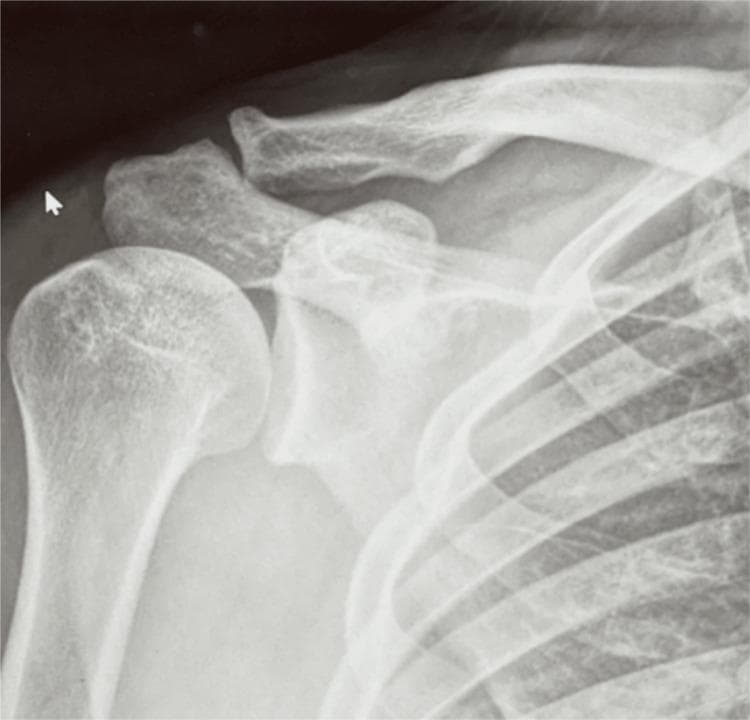
X-Ray Interpretation — Right Shoulder AP View
Patient: Mr. Mohit Jain | Age: 42 years | Date: 28 Feb 2026
View: Right Shoulder Joint, Anteroposterior (AP)
Centre: Singhal Spine Fracture & Gynae Centre
Systematic Review
Bones Visible
| Structure | Findings |
|---|---|
| Humeral head | Large, rounded — appears normally mineralized |
| Proximal humerus (shaft/neck) | No obvious fracture line or cortical disruption visible |
| Glenoid fossa | Partially visible; joint surface appears intact |
| Acromion | Present; relationship with humeral head appears maintained |
| Clavicle | Visible laterally; no obvious fracture |
| Coracoid process | Visible |
| Scapula | Body and spine visible; no gross abnormality |
| Ribs | Multiple ribs visible on the right; no obvious rib fracture |
Key Observations
-
Glenohumeral Joint
- The humeral head appears to be located within the glenoid — no obvious anterior or posterior dislocation is seen on this AP view.
- The glenohumeral joint space appears relatively preserved, though the image quality and angle should be considered.
-
Acromiohumeral Distance
- The space between the acromion and the superior humeral head does not appear grossly narrowed, though a formal measurement on a digital system would be more accurate.
-
Acromioclavicular (AC) Joint
- The AC joint region appears intact without obvious widening or step deformity that would suggest AC joint separation.
-
Bone Density & Trabecular Pattern
- Bone density appears appropriate for a 42-year-old male.
- No obvious lytic lesions or sclerotic areas noted.
-
Soft Tissues
- No gross soft tissue swelling or calcification (e.g., calcific tendinitis) is immediately apparent, though soft tissue detail on plain X-ray is limited.
Impression
No acute fracture or obvious dislocation identified on this AP view of the right shoulder. The glenohumeral and acromioclavicular joints appear grossly intact.
Limitations & Recommendations
- Single AP view is insufficient for complete shoulder evaluation. A true AP (Grashey view), axillary lateral, and scapular Y view are the standard three-view series.
- An axillary or Velpeau view is essential to rule out posterior dislocation, which can be missed on AP alone.
- If there is clinical suspicion of a Hill-Sachs lesion, Bankart lesion, or rotator cuff pathology, an MRI shoulder would be the next appropriate investigation.
- Correlation with clinical history, mechanism of injury, and physical examination is essential for definitive management.
⚠️ This is an AI-assisted interpretation for educational and supportive purposes only. Final radiological and clinical decisions must be made by a qualified physician or radiologist.
This is a shared conversation. Sign in to Orris to start your own chat.