
I have to write an answer on homeostasis along with relevant examples for positive and negative feedback system
Reading File
Finding Sources
Finding Sources
Reading File
Reading File
Finding Sources
Reading File
Finding Sources
Finding Sources
Reading File
Finding Sources
Reading File
Reading File
Now I have comprehensive material from authoritative textbooks. Let me compile a thorough, well-structured answer.
Loading Image
Loading Image
Here is a comprehensive, textbook-grounded answer on homeostasis and its feedback systems.
Homeostasis
Definition
Homeostasis is the process by which the body controls and maintains vital physiological parameters within a narrow, stable range despite continuous changes in the internal and external environment. The term was coined by Walter Cannon (derived from Claude Bernard's concept of the milieu intérieur). The body carefully controls a seemingly endless list of vital parameters — arterial blood pressure, blood volume, core temperature, and plasma levels of O₂, glucose, K⁺, Ca²⁺, and H⁺. Even at the level of a single cell, homeostasis occurs: cells regulate volume, ionic concentrations, and energy (ATP) levels.
"Homeostasis is the control of a vital parameter… the result of many homeostatic systems controlling many vital parameters is a milieu intérieur with a stable composition." — Medical Physiology (Boron & Boulpaep)
An important principle is that a well-regulated parameter is not in equilibrium — it is in a steady state, maintained by constant energy expenditure. The body matches processes that raise a parameter with processes that lower it, keeping the net value constant.
Components of a Feedback Loop
Every feedback control system has four essential elements:
| Component | Role | Example (Blood Glucose) |
|---|---|---|
| Sensor/Receptor | Detects the value of the controlled variable | β-cells of pancreas sensing blood glucose |
| Control center | Compares the sensed value against a set-point | Hypothalamus / pancreatic islets |
| Error signal (gain) | Multiplies the difference to generate an output signal | Degree of insulin release |
| Effector | Acts to restore the variable toward the set-point | Liver, muscle, adipose tissue |
Redundancy is a fundamental theme: the more vital a parameter is, the more overlapping systems the body deploys to control it. This is why some genetic knockouts fail to show the expected lethal phenotype.
Negative Feedback
Definition
Negative feedback is a mechanism in which the output of a system opposes and reverses the deviation from the set-point. It is the dominant and most common homeostatic mechanism in physiology.
"One of the most common themes in physiology is the negative-feedback mechanism responsible for homeostasis." — Medical Physiology (Boron & Boulpaep)
Mechanism
- A parameter deviates from its set-point.
- The sensor detects the deviation.
- The control center generates a corrective signal.
- The effector acts to oppose the original change, returning the parameter toward normal.
- As the parameter normalises, the corrective signal is switched off.
Examples of Negative Feedback
1. Blood Glucose Regulation (Insulin)
When blood glucose rises after a meal:
- β-cells of the pancreas detect the rise.
- Insulin is secreted.
- Insulin acts on liver, muscle, and adipose tissue → glucose uptake and storage.
- Blood glucose falls back to normal (~5 mmol/L).
- Falling glucose suppresses further insulin secretion.
Conversely, when glucose falls, glucagon (and later cortisol, epinephrine) is released to raise it back. Insulin lowers glucose; glucagon, epinephrine, and cortisol raise it — an example of antagonistic feedback loops with hierarchy (hypothalamus → anterior pituitary → adrenal cortex).
2. Blood Pressure Regulation (Baroreceptor Reflex)
- A fall in arterial blood pressure is detected by baroreceptors in the carotid sinus and aortic arch.
- Baroreceptors signal the cardiovascular control centers to activate the sympathetic nervous system.
- Heart rate increases, vasoconstriction occurs → blood pressure rises.
- As pressure returns to normal, baroreceptor firing returns to baseline and the sympathetic response is withdrawn.
3. Hypothalamic–Pituitary Axis (HPT/HPA/HPG axes)
The hypothalamus secretes a releasing hormone → stimulates anterior pituitary → pituitary hormone acts on peripheral endocrine gland → end-organ hormone "feeds back" to inhibit both the hypothalamus and pituitary:
- Long-loop feedback: end-organ hormone (e.g., testosterone, cortisol, T₃) suppresses the hypothalamus AND pituitary.
- Short-loop feedback: anterior pituitary hormone suppresses the hypothalamus.
- Ultrashort-loop feedback: hypothalamic hormone inhibits its own release (e.g., GHRH inhibits GHRH secretion).
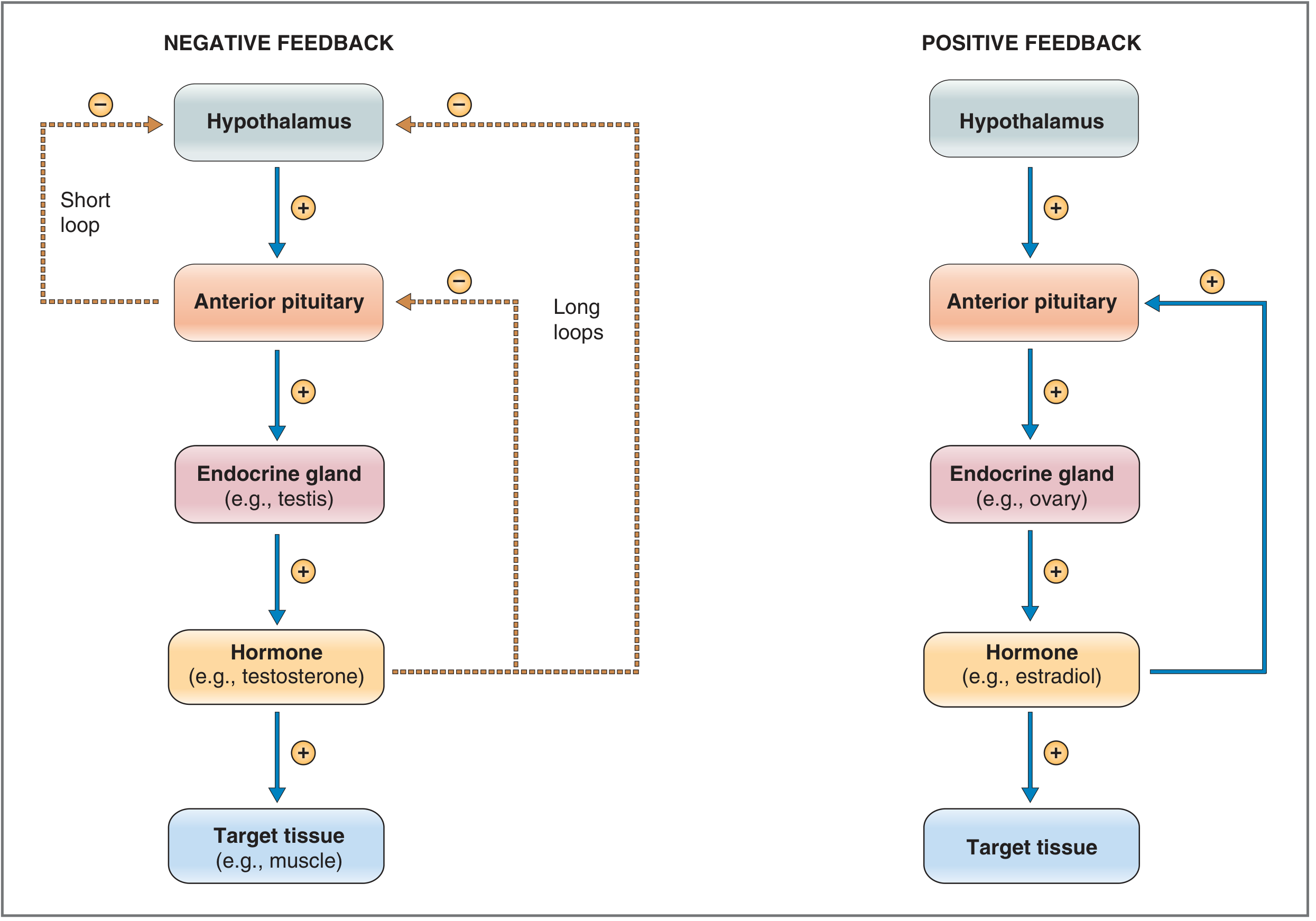
Fig. 9.3 — Negative feedback (left) and positive feedback (right) via the hypothalamic-pituitary axis. Dashed lines with (−) indicate inhibition; solid lines with (+) indicate stimulation. (Costanzo Physiology, 7th ed.)
4. Body Temperature Regulation
A rise in core temperature → hypothalamus detects it → activates sweating and cutaneous vasodilation → heat is lost → temperature returns to ~37°C → sweating stops.
A fall in temperature → shivering and vasoconstriction → heat is generated/conserved.
Positive Feedback
Definition
Positive feedback is a mechanism in which the output amplifies the original stimulus, pushing the variable further in the same direction rather than correcting it. This creates a self-reinforcing, "explosive" cycle that terminates only when the event driving the cycle is completed.
"Positive feedback leads to instability rather than stability and, in some cases, can cause death." — Guyton and Hall Textbook of Medical Physiology
Positive feedback is rare as a homeostatic tool because it inherently destabilises. However, it is exploited by the body in situations that require a rapid, all-or-nothing, self-completing event.
Key Principle
In every useful example of positive feedback, the positive feedback loop is embedded within a larger negative feedback context — i.e., once the explosive event is completed, the entire cycle shuts off via negative feedback.
Examples of Positive Feedback
1. Parturition (Childbirth) — Oxytocin Loop
- As the baby's head pushes against the cervix, cervical stretch receptors send signals to the hypothalamus.
- The posterior pituitary releases oxytocin.
- Oxytocin stimulates uterine contractions → greater cervical dilation → more oxytocin release → stronger contractions.
- This cycle escalates until the baby is delivered, after which the cervical stretch stimulus disappears and the loop terminates.
2. Ovulation — LH/Estrogen Surge
During the follicular phase of the menstrual cycle:
- Rising estrogen from the ovary acts on the anterior pituitary (positive feedback) to cause a rapid burst of LH and FSH secretion (the midcycle surge).
- LH triggers ovulation and further estrogen secretion.
- The explosive event (ovulation) ends the positive feedback; thereafter, estrogen acts via negative feedback again. (This is the only known physiological example where estrogen exerts positive rather than negative feedback on the pituitary.)
3. Blood Clotting (Coagulation Cascade)
When a blood vessel is ruptured:
- A small amount of thrombin is formed.
- Thrombin activates other clotting factors in the immediate vicinity → more thrombin is generated.
- Each activated factor amplifies the next step, rapidly propagating clot formation.
- The clot grows until the vessel breach is sealed, at which point local mechanisms (e.g., antithrombin III, protein C) switch off the cascade.
- This positive feedback is part of an overall negative feedback for blood loss: the clot stops bleeding (i.e., corrects the original deviation — loss of blood volume integrity).
4. Action Potential Generation
In neurons and muscle cells:
- Membrane depolarisation opens voltage-gated Na⁺ channels.
- Na⁺ entry further depolarises the membrane → more Na⁺ channels open → more Na⁺ entry.
- This self-reinforcing upstroke produces the explosive, all-or-nothing spike (~+30 mV).
- The event is terminated by Na⁺ channel inactivation and K⁺ efflux (negative feedback restoring resting potential).
5. Pathological Positive Feedback — Hemorrhagic Shock
Positive feedback becomes lethal when the cycle cannot be terminated:
- Severe hemorrhage (≥2 L blood loss) → ↓ arterial pressure → ↓ coronary perfusion → weakened heart → ↓ cardiac output → further ↓ arterial pressure → progressive cardiac failure → death.
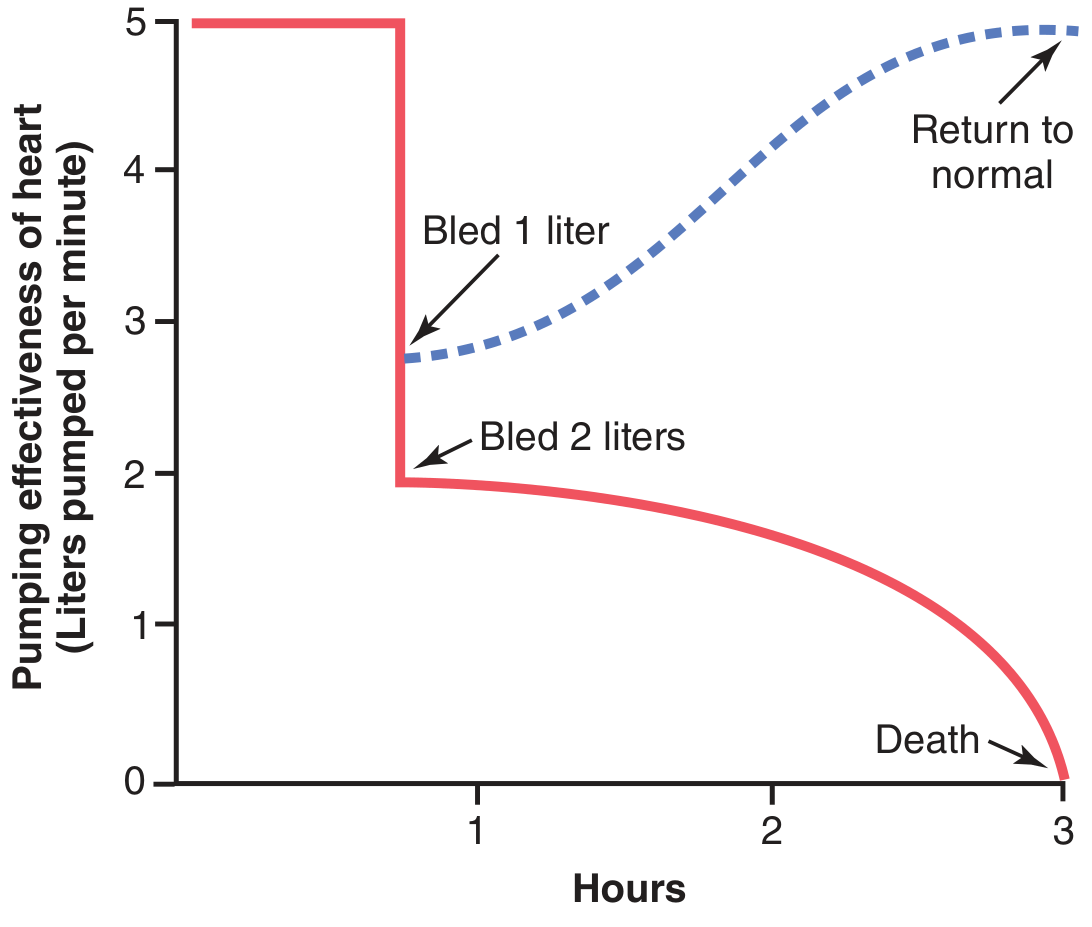
Fig. 1.4 — After 1 L of blood loss (blue dashed curve), negative feedback mechanisms restore cardiac output. After 2 L loss (red curve), a vicious positive feedback cycle leads to death. (Guyton & Hall Textbook of Medical Physiology)
Comparison: Negative vs. Positive Feedback
| Feature | Negative Feedback | Positive Feedback |
|---|---|---|
| Direction of response | Opposes the original change | Amplifies the original change |
| Effect on stability | Restores stability (stabilising) | Creates instability (destabilising) |
| Frequency | Very common | Rare |
| Outcome | Return to set-point | Explosive, self-completing event |
| Termination | Gradual, as deviation corrects | Abrupt, when driving stimulus ends |
| Examples | Blood glucose, BP, temperature, HPA axis | Parturition, LH surge, clotting, action potential |
| When harmful | Rarely (unless gain is too high → oscillation) | When explosive event cannot terminate (e.g., hemorrhagic shock) |
Summary
Homeostasis is maintained primarily through negative feedback, which constantly monitors and corrects deviations from set-points — governing virtually every physiological parameter from blood glucose to arterial pressure to body temperature. Positive feedback is used sparingly where a rapid, amplified, all-or-nothing response is advantageous (childbirth, ovulation, coagulation, action potentials), but it always requires an external termination mechanism to prevent runaway loops. The robustness of homeostasis depends on redundancy, hierarchical feedback loops, and the interaction of multiple systems acting in concert.
Sources:
- Medical Physiology, Boron & Boulpaep
- Costanzo Physiology, 7th Edition
- Guyton and Hall Textbook of Medical Physiology
- Goodman & Gilman's The Pharmacological Basis of Therapeutics
- Tietz Textbook of Laboratory Medicine, 7th Edition
Intracellular Homeostasis can u provide a small para on that
Finding Sources
Reading File
Reading File
Intracellular Homeostasis
Homeostasis does not operate only at the level of the whole body or the extracellular fluid -- it equally applies to every individual cell. Just as the body regulates arterial pressure and blood glucose, each cell regulates its own volume, the concentrations of key inorganic ions (Na⁺, K⁺, Ca²⁺, H⁺), and its energy currency (ATP). This is achieved at a continuous cost of energy: the regulated parameters are never in true equilibrium but are held in a steady state, where processes that raise a value are precisely balanced by processes that lower it.
Normal cell function and intracellular homeostasis depend on a range of fundamental "housekeeping" activities: nutrient acquisition, metabolism, communication, molecular catabolism, energy generation, and protection from environmental stressors. These functions are compartmentalized within membrane-bound organelles -- mitochondria handle ATP generation and apoptotic signaling; the endoplasmic reticulum (ER) oversees protein synthesis and folding; proteasomes degrade tagged or denatured cytosolic proteins; and lysosomes break down endocytosed material and worn-out organelles (autophagy). This compartmentalization allows potentially harmful enzymes and metabolites to be concentrated where needed without damaging the rest of the cell.
A central pillar of intracellular ion homeostasis is the Na⁺/K⁺-ATPase pump, which uses ATP to extrude 3 Na⁺ out and bring 2 K⁺ in, maintaining the steep ionic gradients across the plasma membrane that are essential for cell volume, membrane potential, and secondary active transport. Intracellular Ca²⁺ is kept extremely low (~100 nM in the cytosol) through SERCA pumps on the ER and plasma membrane Ca²⁺-ATPases, since free cytosolic Ca²⁺ is a potent signaling molecule -- any sustained elevation triggers apoptotic pathways. Biosynthesis and catabolism are also tightly coupled: the unfolded protein response (UPR) in the ER is an example of a negative feedback system that senses accumulation of misfolded proteins and activates chaperones or, if overwhelmed, initiates cell death. When any of these intracellular homeostatic mechanisms fail -- whether from ischemia (ATP depletion), toxins, or genetic defects -- the cell rapidly loses its regulated steady state and undergoes cell injury or death.
"Homeostasis also occurs at the level of the single cell. Thus, cells regulate many of the same parameters that the body as a whole regulates: volume, the concentrations of many small inorganic ions (e.g., Na⁺, Ca²⁺, H⁺), and energy levels (e.g., ATP)." -- Medical Physiology, Boron & Boulpaep
"Normal cell function and intracellular homeostasis depend on a variety of fundamental housekeeping functions... nutrient acquisition, metabolism, communication, movement, renewal of senescent molecules, molecular catabolism, energy generation, and protection from environmental stressors." -- Robbins & Cotran Pathologic Basis of Disease
This is a shared conversation. Sign in to Orris to start your own chat.