
Complete in detail about NT scan in ANC USG scan in pregnant woman
Reading File
Now let me search the medical library and PubMed simultaneously for comprehensive NT scan information.
Finding Sources
Finding Sources
Searching PubMed
"nuchal translucency" AND "first trimester screening"
Reading File
Finding Sources
Finding Sources
Reading File
Reading File
Reading File
Reading File
Reading File
Reading File
Loading Image
Loading Image
Reading File
I now have comprehensive data to write a thorough answer. Let me compile it all.
Nuchal Translucency (NT) Scan in Antenatal Ultrasound
Source: Creasy & Resnik's Maternal-Fetal Medicine: Principles and Practice; Thompson & Thompson Genetics and Genomics in Medicine; Emery's Elements of Medical Genetics and Genomics
1. Definition
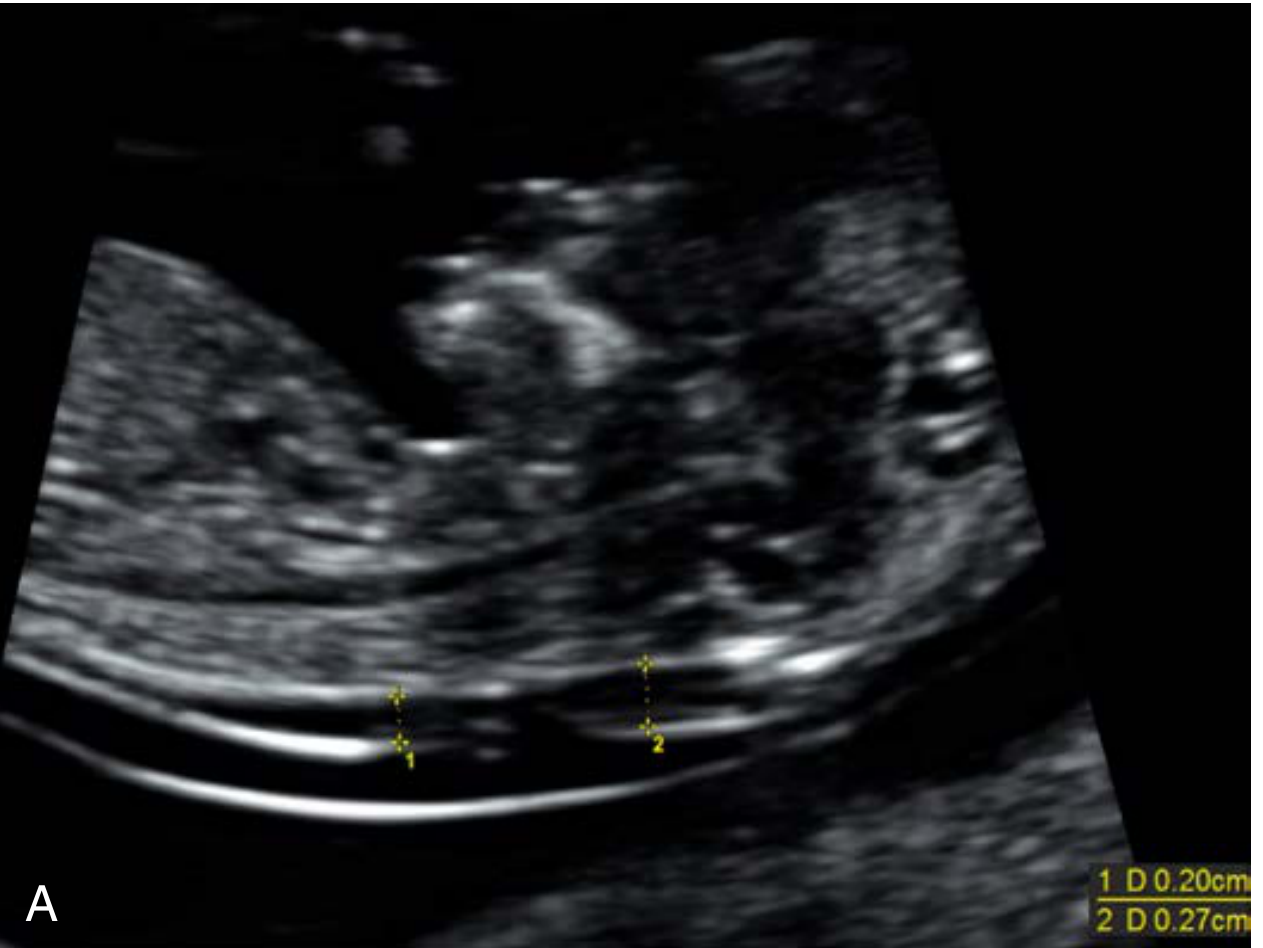
Nuchal translucency (NT) is the sonographic measurement of the subcutaneous fluid collection between the fetal soft tissue of the cervical spine and the overlying skin. It appears as a black (translucent) space at the back of the fetal neck on ultrasound.
The measurement is performed in a fetus with a crown-rump length (CRL) between 45 and 84 mm, corresponding to 11 weeks 0 days to 13 weeks 6 days gestation. It is typically combined with serum analytes to assess a patient-specific risk of chromosomal aneuploidy.
(Creasy & Resnik's Maternal-Fetal Medicine, p. 635)
2. Physiologic Basis / Pathogenesis
The lucency behind the neck is a normal physiologic space - all fetuses have some fluid here. The concern arises when this space is enlarged beyond the expected range for gestational age.
NT width increases with increasing CRL (it is CRL-dependent, not a fixed absolute cutoff). The likelihood of aneuploidy increases with increasing NT width.
Causes of an enlarged NT include:
- Abnormal or delayed lymphangiogenesis (primary lymphatic defect)
- Cardiac anomalies with abnormal ductus venosus flow
- Extracellular matrix abnormalities
- Fetal infection
- Chromosomal aneuploidy
A cystic hygroma is a severe form - a singular or multiloculated fluid collection along the fetal neck and back that may encompass the anterior portion of the fetus (septated).
3. Timing and Gestational Window
| Parameter | Range |
|---|---|
| CRL at scan | 45-84 mm |
| Gestational weeks | 11+0 to 13+6 weeks |
| Ideal timing | 12-13 weeks (CRL ~65-75 mm) |
The window is critical: before 11 weeks, the NT cannot be reliably measured; after 14 weeks, the fluid is reabsorbed as the lymphatic system matures, making the measurement invalid.
4. Technique of NT Measurement (Standardized Protocol)
Rigorous adherence to imaging requirements is mandatory for a valid screening program. Key steps:
Fetal Position and View:
- Obtain a midsagittal view of the head, neck, and upper thorax
- The view should reveal: tip of the nose, third and fourth ventricles of the brain, and the palate
- The nuchal skin must be seen posteriorly
- The orbit, zygoma, and heart should NOT be visible
- The image must be magnified so that the fetal head, neck, and upper thorax fill most of the image
Neck Position:
- The fetal head must be in line with the spine
- The neck must be in a neutral position - not flexed or extended
- Amniotic fluid must be visible between the chin and the anterior chest wall
Image Quality:
- The entire NT line must be visible and crisp (not thick or fuzzy)
- Gain is typically turned down to make the nuchal line appear sharp
- The amnion must be seen as a separate distinct line from the NT (both appear as thin membranes at this age - wait for fetal movement or ask the mother to cough to separate them)
Caliper Placement:
- Use crossbar calipers (+)
- Placed at the widest part of the NT
- Placed perpendicular to the long axis of the fetus
- Placed on the inner border of the nuchal line, immediately adjacent to the nuchal space
- The crossbar of the calipers must not protrude into the nuchal space
Reporting:
- Take multiple measurements; report the largest of several technically good measurements
- Report in millimeters to one decimal place (e.g., 1.2 mm, not 1.21 mm)
- Semiautomated measurement is acceptable if image quality requirements are met and the practitioner verifies caliper placement
Special Case - Nuchal Cord:
- If a nuchal cord is present, measure the NT above and below the cord and average the two values
- This is the ONLY situation where averaging is used
(Creasy & Resnik's Maternal-Fetal Medicine, p. 636)
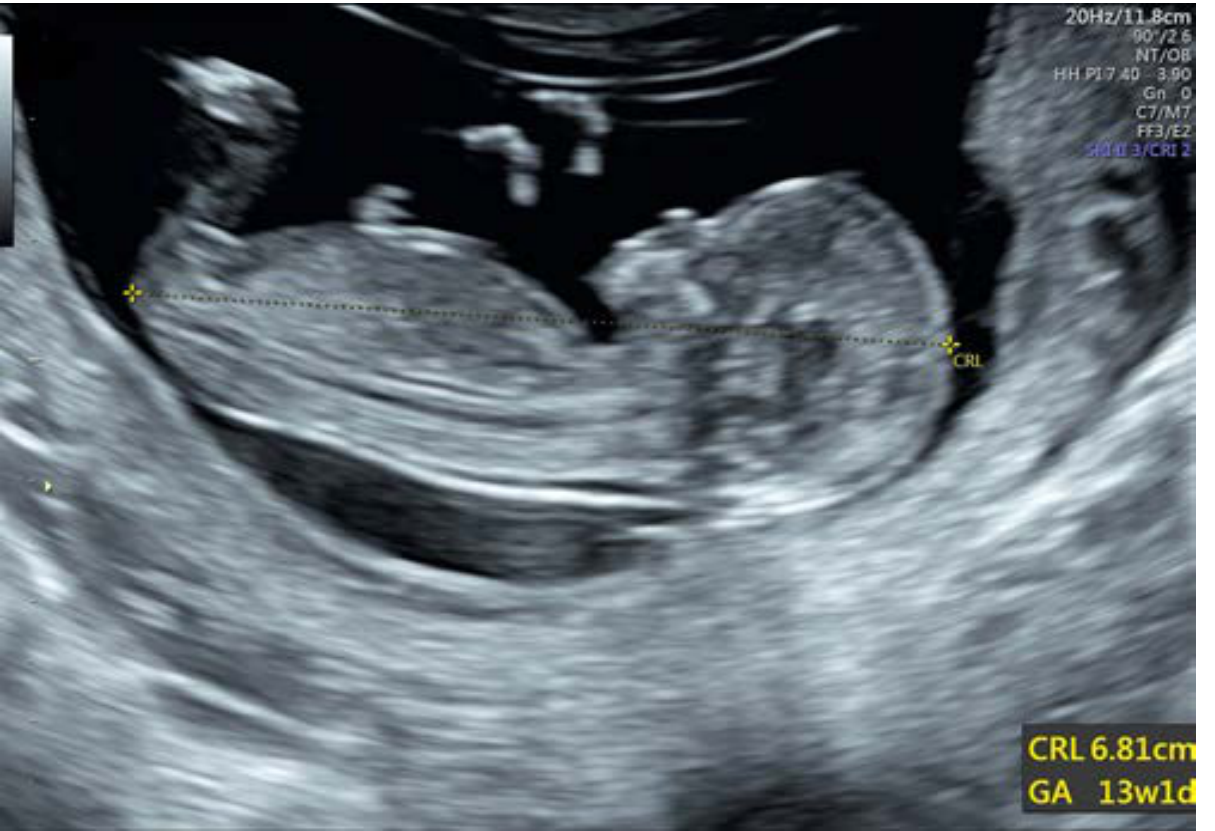
5. Crown-Rump Length (CRL) Measurement
The CRL is measured concurrently and is required for accurate NT interpretation:
- Measured on a midsagittal view of the fetus in a neutral position
- Calipers placed on the skin edge of the fetal head and rump (outer edges)
- The average of three good measurements is used in conjunction with the NT and serum analytes
- CRL determines which gestational age-specific NT normative value to compare against
6. NT Values and Interpretation
NT is reported as a multiple of the median (MoM) or compared against percentile charts for that specific CRL. A single fixed cutoff is not used because NT increases with CRL.
- Normal: below 95th percentile for CRL
- Borderline/elevated: at or above the 95th percentile (approx. 2.5-3.0 mm at 12 weeks, varies by CRL)
- Significantly enlarged: ≥3.5 mm; risk of major cardiac defects rises steeply
Prevalence of Major Cardiac Defects by NT Thickness (chromosomally normal fetuses):
| NT (mm) | n | Major Cardiac Defects | Prevalence (per 1000) |
|---|---|---|---|
| <95th percentile | 27,332 | 22 | 0.8 |
| ≥95th percentile to 3.4 | 1,507 | 8 | 5.3 |
| 3.5 to 4.4 | 208 | 6 | 28.9 |
| 4.5 to 5.4 | 66 | 6 | 90.0 |
| ≥5.5 | 41 | 8 | 195.1 |
(From Hyatt J et al., BMJ 1999; cited in Creasy & Resnik, p. 652)
7. First-Trimester Combined Screening (The Full NT Scan Protocol)
NT alone has limited sensitivity. The first-trimester combined screening test integrates:
- NT measurement (ultrasound)
- Serum PAPP-A (pregnancy-associated plasma protein-A) - reduced in Down syndrome (mean 0.4 MoM)
- Free β-hCG - elevated in Down syndrome (mean 1.8 MoM)
- Maternal age
Detection rates:
- NT alone: ~70-75% for trisomy 21 at 5% FPR
- Combined first-trimester screen (NT + PAPP-A + free β-hCG): ~85-90% for trisomy 21 at 5% FPR (some studies report >90%)
- NT + serum analytes together: detect over 90% of major autosomal trisomies at a false-positive rate of 4%
(Creasy & Resnik's Maternal-Fetal Medicine, p. 647 Key Points)
8. Additional First-Trimester Ultrasound Markers
When performed by credentialed providers, additional markers can be assessed alongside NT:
a. Nasal Bone (NB)
- Absence of ossification of the fetal nasal bone is a marker for aneuploidy
- Absent NB in:
- 69% of trisomy 21 fetuses
- 55% of trisomy 18 fetuses
- 34% of trisomy 13 fetuses
- 11% of monosomy X fetuses
- Only 0.6-2.6% of euploid fetuses
- Varies by race: absent NB in 2.2% Caucasians, 9.0% Afro-Caribbeans (euploid)
- Absence increases with larger NT measurements
b. Ductus Venosus (DV) Waveform
- Absent or reversed "a" wave in the DV suggests aneuploidy or cardiac dysfunction
c. Tricuspid Regurgitation
- Abnormal tricuspid flow is associated with cardiac defects and trisomy 21
9. Associated Chromosomal Anomalies
Enlarged NT ≥95th percentile is associated with:
- Trisomy 21 (Down syndrome) - most common; increased NT is the hallmark
- Trisomy 18 (Edwards syndrome)
- Trisomy 13 (Patau syndrome)
- 45,X (Turner syndrome / monosomy X) - often marked NT/cystic hygroma
- Triploidy
Risk for Down Syndrome by Maternal Age at 12 Weeks (selected values):
| Maternal Age | Risk at 12 weeks |
|---|---|
| 20 years | 1 in 1068 |
| 25 years | 1 in 946 |
| 30 years | 1 in 626 |
| 35 years | 1 in 249 |
| 38 years | 1 in 117 |
| 40 years | 1 in 68 |
(Creasy & Resnik's Maternal-Fetal Medicine, p. 646)
10. Enlarged NT with Normal Karyotype
When NT is enlarged but chromosomes are normal, additional causes must be considered:
Structural anomalies associated with enlarged NT:
- Cardiac defects (most common - seen in 37% of cardiac anomaly fetuses vs. 6% with normal hearts)
- Diaphragmatic hernia
- Omphalocele (abdominal wall defects)
- Skeletal anomalies
- Renal anomalies
Genetic causes beyond karyotype:
- Chromosomal microarray (CMA) shows an additional 4% yield for isolated enlarged NT; 7% when other anomalies are detected
- Most common CMA finding: 22q11.2 deletion
- Copy number variants (CNVs)
- RASopathy disorders - particularly Noonan syndrome (should be specifically tested when CMA is negative)
- Single-gene disorders
Outcome with isolated enlarged NT and normal karyotype:
- In approximately 90% of cases where NT >99th percentile but <4.5 mm with normal karyotype and normal detailed sonogram, the infant is healthy with no developmental delay
- The larger the NT, the higher the residual risk of structural or genetic disorder
11. Cardiac Follow-Up After Enlarged NT
- NT >99th percentile warrants fetal echocardiogram (typically at 20-22 weeks, but increasingly performed at 16-20 weeks given improved resolution)
- NT ≥5.5 mm: cardiac defect prevalence ~195/1000 (nearly 20%)
- Some centers perform first-trimester cardiac evaluation (detailed 4-chamber and outflow view) at the time of NT scan, identifying major cardiac defects before 14 weeks
12. Combined and Sequential Screening Strategies
The NT scan feeds into several risk calculation pathways:
| Strategy | Components | Down Syndrome Detection Rate (FPR 5%) |
|---|---|---|
| First-trimester combined | NT + PAPP-A + free β-hCG + age | ~85-90% |
| Quad screen alone (2nd trimester) | AFP + hCG + uE3 + Inhibin-A | ~75-81% |
| Integrated screening | NT + PAPP-A (1st trim) + quad screen (2nd trim) - single result at end | ~95% |
| Sequential screening | 1st trim result given, 2nd trim adds to it | ~90-95% |
| Contingent screening | Only high/borderline risk patients get 2nd trim testing | ~88-94% |
Integrated screening has the highest detection rate (~95% at 5% FPR or ~85% at <1% FPR) but requires withholding results until the second trimester, which is not acceptable to many patients as it delays options for CVS.
13. Quality Assurance in NT Scanning
Because NT measurement is highly operator-dependent, formal accreditation programs exist:
- In the United States: Perinatal Quality Foundation NT Quality Review (NTQR) program (initiated 2005)
- In the UK: Fetal Medicine Foundation (FMF) credentialing
- These programs: teach standardized mechanics, perform image review, and monitor provider performance longitudinally
- Only credentialed providers should perform and report NT measurements
14. Role of Cell-Free DNA (cfDNA) vs NT Scan
- cfDNA has very high sensitivity for trisomies 21, 18, 13 and sex chromosome aneuploidies
- However, combined first-trimester and sequential screening detect a larger proportion of ALL chromosomal aneuploidies than currently available cfDNA platforms when followed by diagnostic genetic testing (NT + serum catches broader spectrum)
- cfDNA may be falsely reassuring in the setting of structural defects - NT-based screening may detect issues cfDNA misses
- The NT scan also provides additional structural survey of the fetus that cfDNA cannot
15. NT in Multiple Gestations
- NT measurement is still performed in twins but interpretation requires care
- Monochorionic twins: enlarged NT in one or both twins may indicate twin-twin transfusion syndrome (TTTS) developing rather than aneuploidy - this reduces specificity
- NT in monochorionic twins has limited utility as a TTTS screening test in isolation
- CRL discordance in both monochorionic and dichorionic twins is associated with adverse perinatal outcome
16. Management Algorithm Based on NT Result
NT Result
    │
    ├── Normal (<95th %ile) + normal serum markers
    │       → Routine antenatal care; low risk reassurance
    │
    ├── Screen positive (risk ≥1:270 or lab threshold)
    │       → Counseling; offer diagnostic testing:
    │           - CVS (10-13 weeks) for karyotype/CMA
    │           - Amniocentesis (15-20 weeks)
    │           - cfDNA (if patient declines invasive)
    │
    ├── NT 95th %ile to 3.4 mm, normal chromosomes
    │       → Detailed anatomy scan at 18-20 weeks
    │       → Fetal echo at 20-22 weeks
    │
    └── NT ≥3.5 mm or cystic hygroma
            → Immediate genetic counseling
            → Offer CVS or amniocentesis + CMA
            → If CMA negative, consider exome sequencing (structural/hydrops)
            → Noonan/RASopathy panel
            → Fetal echocardiography
            → Serial growth scans
Summary of Key Points
- NT is the fluid behind the fetal neck measured between 11+0 and 13+6 weeks (CRL 45-84 mm)
- It is measured in a strict midsagittal plane with the neck neutral, calipers on inner borders, perpendicular to the fetal axis
- Combined with PAPP-A and free β-hCG (first-trimester combined screen): detects >90% of major trisomies at 4% FPR
- NT increases with CRL - results must be interpreted with gestational age-specific percentile charts
- Enlarged NT ≥95th percentile warrants: CMA, fetal echo, detailed anatomy scan
- Most common structural association: cardiac defects
- Most common CMA finding with isolated enlarged NT: 22q11.2 deletion
- With normal karyotype and normal detailed scan, ~90% of fetuses with NT >99th %ile but <4.5 mm have normal outcomes
- Additional markers (nasal bone, DV waveform, tricuspid regurgitation) increase detection rates when assessed by credentialed providers
- Quality assurance and sonographer credentialing are mandatory for reliable NT programs
Recent Evidence Note: A 2025 meta-analysis (PMID: 40519157, Ultrasound Obstet Gynecol) specifically examined outcomes of fetuses with early increased NT, confirming the prognostic significance and supporting the above management framework. No major contradictions to current textbook guidance were identified.
Still no answer
I provided a very detailed answer in my previous response! Let me give it to you again clearly and completely.
Nuchal Translucency (NT) Scan - Complete Guide
1. What is NT Scan?
Nuchal Translucency (NT) is the sonographic measurement of the subcutaneous fluid collection between the fetal soft tissue of the cervical spine and the overlying skin, seen as a black (anechoic) space at the back of the fetal neck on ultrasound.
- It is part of the first-trimester antenatal ultrasound (ANC USG)
- Performed between 11 weeks 0 days to 13 weeks 6 days of gestation
- CRL (Crown-Rump Length) must be between 45 mm and 84 mm
- Combined with maternal serum markers to give a patient-specific risk for chromosomal aneuploidy
2. Purpose / Why It Is Done
| Purpose | Details |
|---|---|
| Screen for chromosomal aneuploidy | Trisomy 21 (Down), Trisomy 18 (Edwards), Trisomy 13 (Patau), Turner syndrome |
| Detect structural anomalies | Cardiac defects, diaphragmatic hernia, omphalocele |
| Detect genetic syndromes | Noonan syndrome, 22q11.2 deletion |
| Assess twin complications | Twin-Twin Transfusion Syndrome (TTTS) |
| Date the pregnancy accurately | CRL measured at same time |
3. Physiology and Pathogenesis
The nuchal space is a normal physiologic structure present in all fetuses. When it becomes enlarged, causes include:
- Abnormal or delayed lymphangiogenesis (primary lymphatic defect)
- Cardiac anomalies with abnormal ductus venosus blood flow
- Extracellular matrix abnormalities
- Fetal infection
- Chromosomal aneuploidy
A Cystic Hygroma is the extreme form - a single or multiloculated fluid collection along the neck and back, sometimes encircling the entire fetus, with internal septations.
4. How the NT Measurement is Performed
Step-by-Step Technique (Standardized Protocol)
Step 1 - Obtain the correct view:
- Strict midsagittal plane of the fetal head, neck, and upper thorax
- Must see: tip of the nose, third and fourth ventricles, palate, posterior nuchal skin
- Must NOT see: orbit, zygoma, or heart
Step 2 - Magnify the image:
- Fetal head, neck, and upper thorax must fill most of the screen
Step 3 - Fetal position:
- Head in line with spine
- Neck in neutral position (neither flexed nor hyperextended)
- Amniotic fluid visible between chin and chest
Step 4 - Distinguish amnion from NT:
- Both appear as thin white lines at this age
- Wait for fetal movement, or ask the mother to cough, to separate the amnion from the fetal neck skin
Step 5 - Place calipers:
- Use crossbar (+) calipers only
- Place at the widest part of the NT
- Place perpendicular to the long axis of the fetus
- Place on the inner border of the nuchal line
- Crossbar must not protrude into the fluid space
Step 6 - Record:
- Take multiple measurements
- Report the largest technically valid measurement
- Report in mm to one decimal place (e.g., 2.4 mm, not 2.41 mm)
Special rule - Nuchal cord present:
- Measure NT above and below the cord separately
- Report the average of those two values
- This is the ONLY situation where averaging is permitted
5. CRL Measurement (Always Done Alongside NT)
| Requirement | Detail |
|---|---|
| View | Midsagittal, fetus in neutral position |
| Caliper placement | Outer skin edge of crown to outer skin edge of rump |
| Number of measurements | Average of 3 good measurements |
| Use | Combined with NT + serum markers for risk calculation |
6. Normal Values and Cutoffs
NT is CRL-dependent - there is no single fixed normal value. It must be interpreted as a percentile for that specific CRL.
| Percentile | Clinical Significance |
|---|---|
| < 95th percentile | Normal - routine care |
| 95th percentile to 3.4 mm | Borderline elevated - close follow-up |
| ≥ 3.5 mm | Significantly elevated - detailed workup |
| ≥ 5.5 mm | Very high risk - cardiac defect rate ~195/1000 |
As a rough guide at 12 weeks: NT ≥ 3.0 mm is often used as a clinical threshold in many programs, but percentile-based interpretation is more accurate.
7. First-Trimester Combined Screening
NT alone detects about 70-75% of Down syndrome cases. When combined with serum markers, detection rates increase significantly:
| Component | Finding in Down Syndrome |
|---|---|
| NT (ultrasound) | Increased |
| PAPP-A (serum) | Decreased (mean 0.4 MoM) |
| Free β-hCG (serum) | Increased (mean 1.8 MoM) |
| Maternal age | Older age = higher risk |
Detection rates of the combined test:
- ~85-90% detection of trisomy 21 at 5% false-positive rate
- >90% detection of major autosomal trisomies overall at 4% FPR
8. Additional Ultrasound Markers Assessed at NT Scan
Nasal Bone (NB)
- Absent nasal bone = marker for aneuploidy
- Absent in: 69% trisomy 21, 55% trisomy 18, 34% trisomy 13, 11% monosomy X
- Absent in only 0.6-2.6% of chromosomally normal fetuses
- Varies by race: Afro-Caribbean fetuses have higher rate of absent NB even when normal
Ductus Venosus (DV) Waveform
- Absent or reversed "a" wave = associated with aneuploidy and cardiac dysfunction
Tricuspid Regurgitation
- Abnormal tricuspid flow at NT scan = marker for trisomy 21 and cardiac defects
(These additional markers are only assessed by specially credentialed providers)
9. Chromosomal Conditions Detected
| Condition | NT Finding | Other Markers |
|---|---|---|
| Trisomy 21 (Down syndrome) | Increased NT | Low PAPP-A, high β-hCG, absent NB |
| Trisomy 18 (Edwards) | Increased NT | Low PAPP-A, low β-hCG |
| Trisomy 13 (Patau) | Increased NT | Often low PAPP-A |
| 45,X (Turner syndrome) | Large NT/cystic hygroma | -- |
| Triploidy | Large NT | Very abnormal serum markers |
10. Risk Table for Down Syndrome by Maternal Age (at 12 Weeks)
| Maternal Age | Risk at 12 Weeks |
|---|---|
| 20 years | 1 in 1068 |
| 25 years | 1 in 946 |
| 30 years | 1 in 626 |
| 35 years | 1 in 249 |
| 38 years | 1 in 117 |
| 40 years | 1 in 68 |
| 42 years | 1 in 41 |
| 44 years | 1 in 24 |
11. What Enlarged NT Means When Chromosomes Are Normal
If NT is elevated but karyotype is normal, the following must be excluded:
Structural anomalies:
- Cardiac defects (most common - found in 37% of fetuses with cardiac anomalies)
- Diaphragmatic hernia
- Omphalocele
- Skeletal dysplasia
- Renal anomalies
Genetic causes:
- Chromosomal microarray (CMA) - adds 4% additional yield for isolated enlarged NT; 7% when other anomalies present
- Most common finding: 22q11.2 deletion
- Noonan syndrome / RASopathy - test specifically when CMA is negative
- Whole exome sequencing - consider if hydrops or multiple structural anomalies
Cardiac defect prevalence by NT thickness (chromosomally normal fetuses):
| NT (mm) | Cardiac Defect Prevalence |
|---|---|
| < 95th percentile | 0.8 per 1000 |
| 95th %ile to 3.4 mm | 5.3 per 1000 |
| 3.5 to 4.4 mm | 28.9 per 1000 |
| 4.5 to 5.4 mm | 90.0 per 1000 |
| ≥ 5.5 mm | 195.1 per 1000 |
12. Prognosis with Isolated Enlarged NT + Normal Karyotype
- When NT is >99th percentile but < 4.5 mm, karyotype is normal, and detailed scan is normal:
- ~90% of these fetuses are born healthy with normal development
- Risk of adverse outcome increases steeply as NT exceeds 4.5-5.5 mm
13. Screening Strategies That Include NT
| Strategy | What It Combines | Down Syndrome Detection |
|---|---|---|
| First-trimester combined | NT + PAPP-A + β-hCG + age | ~85-90% (FPR 5%) |
| Second-trimester quad screen | AFP + hCG + uE3 + Inhibin-A | ~75-81% |
| Integrated screening | NT + PAPP-A (1st trim) + Quad (2nd trim), single result | ~95% (FPR 5%) |
| Sequential screening | 1st trim result given, 2nd trim tests added | ~90-95% |
| Contingent screening | 2nd trim only for borderline/high-risk from 1st trim | ~88-94% |
14. Management Algorithm
NT Scan Result
│
├── Normal NT + Normal serum → Routine ANC, reassure
│
├── Screen Positive (risk ≥1:250 or ≥1:300)
│     → Genetic counseling
│     → Offer: CVS (10-13 wks) OR Amniocentesis (15-20 wks)
│     → cfDNA if patient declines invasive testing
│
├── NT 95th %ile to 3.4 mm + Normal chromosomes
│     → Detailed anatomy scan at 18-20 weeks
│     → Fetal echocardiography at 20-22 weeks
│
└── NT ≥ 3.5 mm or Cystic Hygroma
      → Urgent genetic counseling
      → CVS / Amniocentesis + Chromosomal Microarray (CMA)
      → If CMA negative → Noonan/RASopathy panel
      → If hydrops/multiple anomalies → Exome sequencing
      → Fetal echocardiography
      → Serial growth and anatomy scans
15. NT in Twin Pregnancies
- NT is still measured in both twins
- Monochorionic twins: enlarged NT in one or both may represent early TTTS rather than aneuploidy - interpret with caution
- CRL discordance between twins (both mono and dichorionic) is associated with adverse perinatal outcome
- NT screening still has value in twins but has limited use as a standalone TTTS screening test
16. Quality Assurance - Why Credentialing Matters
NT measurement is highly operator-dependent. Small errors in technique cause large errors in risk calculation.
- USA: Perinatal Quality Foundation NTQR (NT Quality Review) program since 2005
- UK: Fetal Medicine Foundation (FMF) credentialing
- These programs:
- Train providers in standardized technique
- Review submitted images for quality
- Monitor each provider's measurements over time against expected values
- Require re-certification if measurements drift
Only credentialed providers should perform and report NT measurements.
17. NT vs Cell-Free DNA (cfDNA)
| Feature | NT + Combined Screen | cfDNA |
|---|---|---|
| Trisomy 21 detection | ~85-90% | ~99% |
| Detects structural anomalies | Yes (direct visualization) | No |
| Provides gestational dating | Yes | No |
| Detects CNVs/rare syndromes | Via CMA if screen positive | Limited |
| Cost | Lower | Higher |
| Best use | Universal first-line screening | High-risk or after NT positive |
- cfDNA may be falsely reassuring when structural defects are present
- Combined NT + serum screening detects a broader range of chromosomal conditions than cfDNA platforms, especially when followed by diagnostic testing
Summary of 10 Key Points
- NT = fluid behind fetal neck, measured at 11+0 to 13+6 weeks, CRL 45-84 mm
- Strict midsagittal view, neck neutral, calipers on inner borders perpendicular to fetal axis
- Combined with PAPP-A + free β-hCG: detects >90% of major trisomies at 4% FPR
- NT is CRL-dependent - always interpret with percentile charts, not a fixed cutoff
- Enlarged NT ≥95th percentile: offer CMA, fetal echo, detailed anatomy scan
- Most common structural association: cardiac defects
- Most common CMA finding with enlarged NT: 22q11.2 deletion
- Isolated enlarged NT + normal karyotype + normal scan: ~90% healthy outcome
- Additional markers (nasal bone, DV flow, tricuspid regurg) increase sensitivity
- Sonographer credentialing (NTQR/FMF) is mandatory for program reliability
This is a shared conversation. Sign in to Orris to start your own chat.