
I have black lips but I don't smoke... what can be the reason
black lips hyperpigmentation causes non-smoker
lip hyperpigmentation dark lips causes
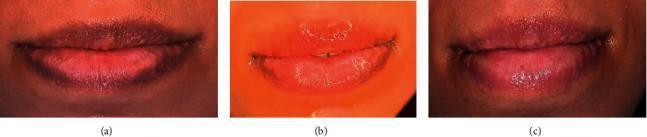
A series of three clinical photographs (a, b, and c) documenting a chronological progression of lip depigmentation treatment. Image (a) represents the baseline state, showing diffuse dark melanin hyperpigmentation on the upper and lower lips with a clearly defined vermilion border. Image (b) shows the immediate post-procedure state following laser resurfacing; the lips exhibit significant erythema, mild edema (swelling), and a glossy, exudative surface consistent with acute inflammatory response. Image (c) demonstrates the final clinical outcome after complete wound healing, typically around 14 days post-treatment. The lips show a successful reduction in melanin pigmentation, resulting in a lighter, pinker, and more uniform color. The swelling has fully resolved, and the natural vermilion border and lip contours are restored without visible scarring. This comparison serves as an educational tool for laser dermatology and aesthetic medicine, illustrating the stages of healing and efficacy of laser-assisted lip depigmentation.

This set of clinical photographs documents the progression of lip depigmentation treatment using an Er,Cr:YSGG laser. Image (a) shows the 'before' state, characterized by significant dark melanin hyperpigmentation concentrated along the vermillion border and the body of both the upper and lower lips. Image (b) represents the immediate post-procedural phase, exhibiting a 'mild crust' effect. This crusting is dark red and textured, localized primarily along the upper vermillion border, accompanied by generalized erythema and mild swelling of the labial mucosa. Image (c) displays the 'after healing' result, demonstrating successful melanin reduction. The lips show a more uniform, natural pink coloration with a smooth surface texture and the absence of scarring or residual hyperpigmentation. This series illustrates the clinical efficacy of laser resurfacing for aesthetic lip depigmentation and the typical transient inflammatory response (crusting) during the 14-day healing window.
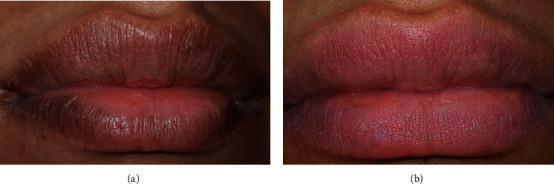
This clinical comparison photograph illustrates the outcome of laser lip depigmentation using an Er,Cr:YSGG laser system. Image (a) displays the baseline presentation, characterized by generalized hyperpigmentation of the upper and lower lips, resulting in a dark, brownish-black hue and an obscured vermillion border. The lip surface appears mildly textured with visible vertical rhytids and uneven pigment distribution. Image (b) shows the same patient 14 days following the final treatment session. There is a significant reduction in melanin density, transitioning the lip color to a more natural, uniform pinkish-red hue. The vermillion border is better defined, and the overall mucosal texture appears smoother and more hydrated. This educational visual demonstrates the efficacy of laser resurfacing for cosmetic oral melanin hyperpigmentation and the typical 14-day healing progression post-procedure.
Causes of Dark (Black) Lips in Non-Smokers
1. Sun Exposure (Most Common Benign Cause)
2. Dehydration & Lip Licking/Sucking
3. Hormonal Changes
4. Allergic Reactions / Contact Irritants
5. Nutritional Deficiencies
- Vitamin B12 deficiency - a well-documented cause of hyperpigmentation, including the lips
- Folic acid (folate) deficiency - similarly linked to skin darkening
- Iron deficiency can also alter lip color in some cases
6. Excess Caffeine
7. Medications
- Antimalarial drugs (chloroquine, hydroxychloroquine)
- Minocycline (oral antibiotic)
- Tetracyclines (with sun exposure)
- Bleomycin (chemotherapy)
- Amiodarone
8. Medical Conditions (Important to Rule Out)
| Condition | What It Looks Like | Other Clues |
|---|---|---|
| Addison's Disease (adrenal insufficiency) | Diffuse darkening of lips, gums, skin | Fatigue, weakness, low blood pressure, salt craving |
| Peutz-Jeghers Syndrome | Dark brown/black spots on lips (especially lower lip), inside mouth, fingers | Autosomal dominant; associated with GI polyps and cancer risk |
| Laugier-Hunziker Syndrome | Pigmented macules on lips and oral mucosa | Benign, no systemic disease; similar pattern to Peutz-Jeghers |
| Carney Complex | Dark lentigines on lips, perioral area | Cardiac myxomas, endocrine tumors |
| Melanoma | Asymmetric dark spot, often solitary | Needs urgent biopsy - dark spot that grows or changes |
When Should You See a Doctor?
- The darkening is sudden or recent
- It's a single growing dark spot (could be melanoma)
- You have fatigue, weight loss, dizziness, or salt cravings (think Addison's disease)
- There's family history of GI polyps or lip spots (Peutz-Jeghers)
- The darkening involves your gums or inside of your mouth too
Simple Lifestyle Fixes (for benign causes)
- Apply broad-spectrum SPF lip balm daily
- Stay well hydrated
- Stop or reduce caffeine
- Check for B12 and folate deficiency (simple blood test)
- Switch toothpaste or lipstick brands if you suspect allergy
- Avoid lip licking