
HLA and their significance
This is a medical query about HLA (Human Leukocyte Antigen). I need to invoke the medical-library skill first to get authoritative information.
Reading File
I'll search the medical library for comprehensive information on HLA (Human Leukocyte Antigens) using a broad approach to cover their structure, function, and clinical significance.
Finding Sources
Finding Sources
Finding Sources
Now let me read the detailed section on HLA from the Tietz textbook, which appears to be the most comprehensive source:
Reading File
Reading File
Reading File
Now let me fetch the HLA complex diagram to provide a visual reference, and search for clinical significance information:
Loading Image
Finding Sources
Finding Sources
Now let me get more details on clinical significance and disease associations:
Reading File
Reading File
Based on the medical textbooks, here's a comprehensive overview of HLA and their significance:
Overview
The Human Leukocyte Antigen (HLA) complex, located on chromosome 6, is the human version of the Major Histocompatibility Complex (MHC). It is fundamental to the immune system's ability to identify foreign proteins and coordinate adaptive immunity. The HLA locus contains more than 200 genes, making it one of the most gene-dense and polymorphic regions of the human genome - with over 24,000 allelic variants identified to date.
Structure
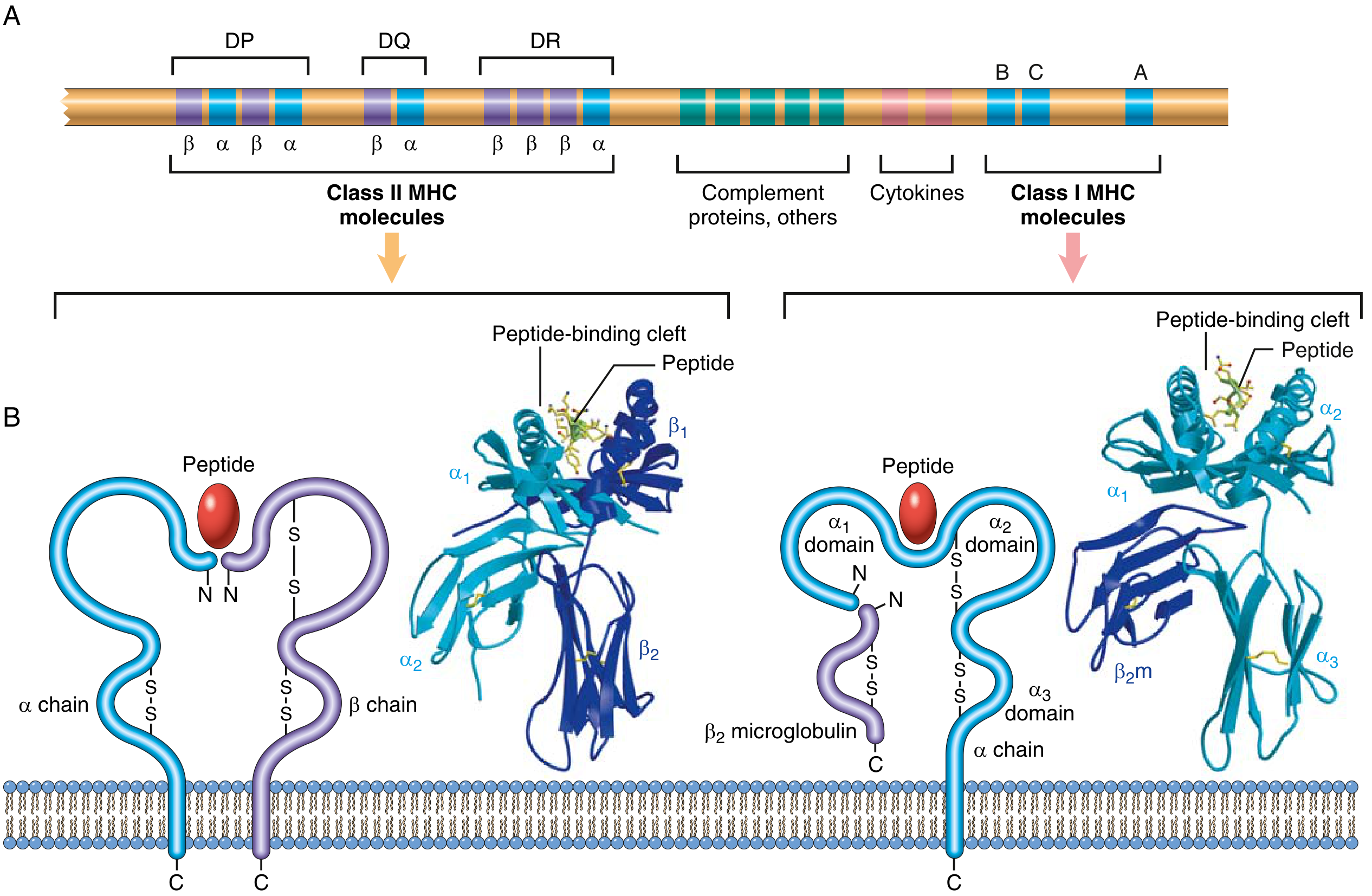
HLA proteins are categorized into three groups:
Class I HLA (HLA-A, HLA-B, HLA-C)
- Expressed on all nucleated cells
- Each molecule consists of a polymorphic α chain noncovalently associated with β2-microglobulin (encoded separately on chromosome 15)
- Contain a peptide-binding cleft where polymorphic residues are located
- Bind peptides derived from intracellular proteins (e.g., viral and tumor antigens)
- Present antigens to CD8+ T cells
Class II HLA (HLA-DP, HLA-DQ, HLA-DR)
- Expression restricted to antigen-presenting cells (dendritic cells, macrophages, and B cells)
- Heterodimers of α and β subunits
- Bind peptides derived from extracellular proteins (e.g., ingested microbes)
- Present antigens to CD4+ T cells
Class III MHC
- Encodes various other proteins with immune functions (complement proteins, cytokines)
- Not directly involved in antigen presentation
Functional Significance
Antigen Presentation and T Cell Recognition
HLA molecules display peptides on cell surfaces for recognition by T lymphocytes. This is called MHC restriction - T cells recognize only peptides displayed by that individual's own MHC molecules. Because T cells normally encounter only their own MHC molecules during development, variations in these molecules among individuals elicit strong immune responses.
The presence of multiple different HLA genes in each person allows a much broader range of peptides to be presented to the immune system than if only one molecule of each class were expressed.
Clinical Significance
1. Transplant Rejection
Because T cells recognize HLA molecules as foreign when they differ between individuals, HLA matching is critical for transplantation. Variations in HLA between donor and recipient are the primary basis of graft rejection. HLA compatibility is one of the most important factors determining graft survival.
2. Autoimmune Disease Associations
HLA alleles make the greatest genetic contribution to autoimmune disease susceptibility. Key associations include:
| Disease | HLA Association | Odds Ratio |
|---|---|---|
| Ankylosing spondylitis | B*27 | 100-200 |
| Type 1 diabetes | DRB1*0301/0401 heterozygotes | 35 |
| Rheumatoid arthritis | DRB1 (shared epitope) | 4-12 |
| Multiple sclerosis | DRB1*1501 | 3 |
| Celiac disease | DQA10501-DQB10201 | 7 |
| Systemic lupus erythematosus | DRB10301 or DRB11501 | 1.3-2 |
The strongest association is between HLA-B27 and ankylosing spondylitis, where individuals carrying this allele have 100- to 200-fold greater risk compared to those without it. However, most people with HLA-B27 never develop the disease, indicating that HLA variants are necessary but not sufficient causes of autoimmunity - other genetic and environmental factors are required.
3. Pharmacogenetics and Drug Hypersensitivity
HLA variants are strongly associated with severe cutaneous adverse reactions to certain drugs:
- HLA-B*57:01 and abacavir (antiretroviral): 100% negative predictive value; screening eliminates the hypersensitivity reaction
- HLA-B*5801 and allopurinol: associated with Stevens-Johnson syndrome (SJS) and toxic epidermal necrolysis (TEN)
- HLA-A*3101 and carbamazepine/phenytoin: associated with severe skin reactions
FDA-approved HLA testing is now recommended before prescribing select medications to prevent life-threatening reactions.
4. Disease Susceptibility Beyond Autoimmunity
HLA polymorphisms influence susceptibility to infectious diseases and affect vaccine responses. Some HLA types are associated with improved control of HIV or hepatitis C, while others confer increased risk.
Importance of HLA Diversity
The extreme polymorphism of HLA genes (over 3,000 alleles for HLA-B alone) ensures that human populations maintain diverse antigen presentation capabilities. This genetic diversity provides protection against pathogens - if a pathogen evolves to evade one HLA variant, other HLA variants in the population can still mount an immune response.
Tietz Textbook of Laboratory Medicine, 7th Edition, p. 2927; Robbins, Cotran & Kumar Pathologic Basis of Disease, p. 3421; Cellular and Molecular Immunology, p. 159
This is a shared conversation. Sign in to Orris to start your own chat.