
Fetal blood circulation flowchart
Reading File
Finding Sources
Searching Images
fetal blood circulation diagram flowchart
Reading File
Reading File
Loading Image
Loading Image
Loading Image
Loading Image
Here is a comprehensive flowchart and explanation of fetal blood circulation, based on The Developing Human (Moore) and Langman's Medical Embryology:
Fetal Blood Circulation
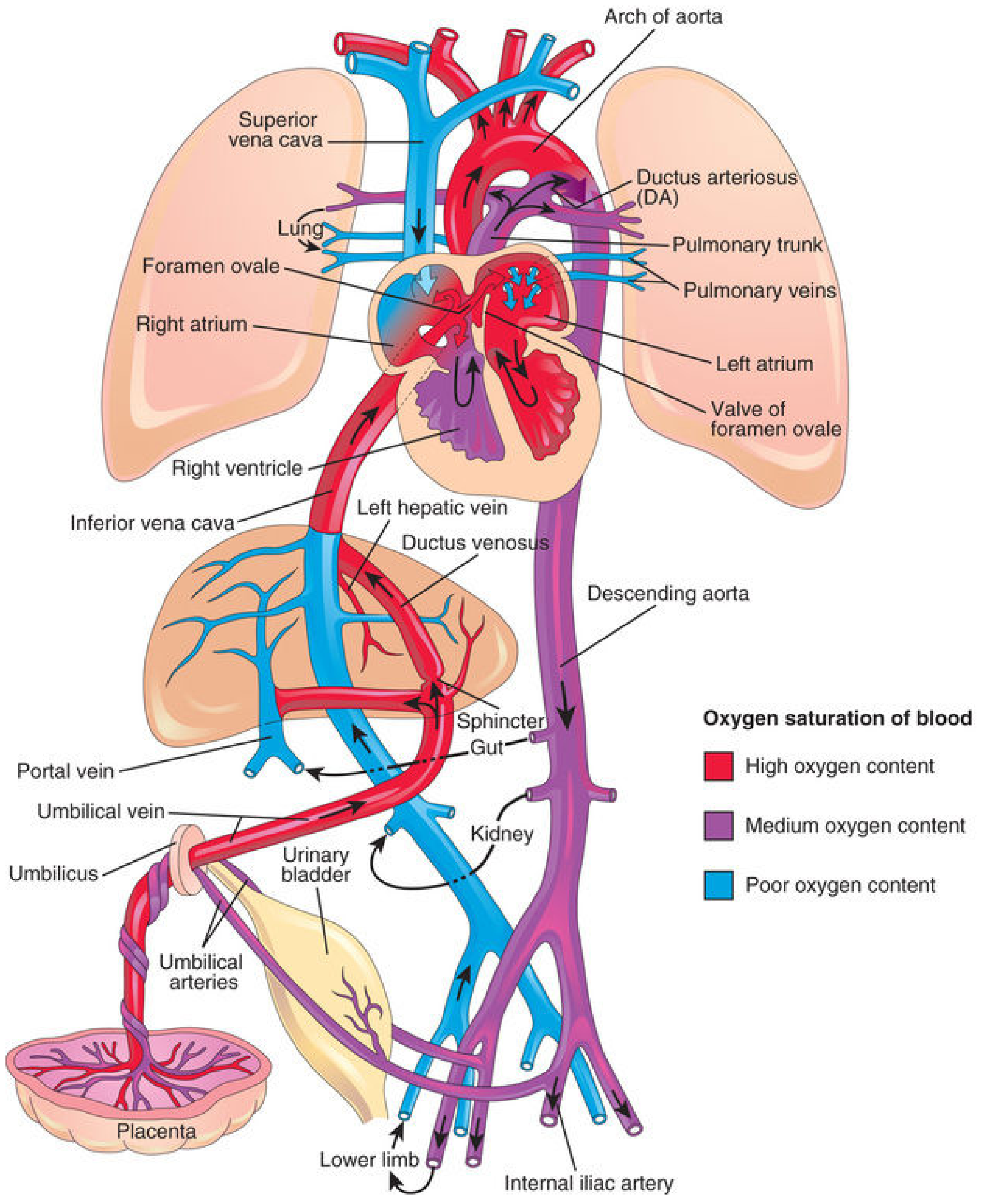
Fig. 13.46 from The Developing Human — color-coded by oxygen saturation (red = high, purple = medium, blue = poor)
Flowchart
PLACENTA
  │ (O₂-rich blood, ~80% saturation)
  ↓
UMBILICAL VEIN
  │
  ├──── ~50% → LIVER sinusoids → HEPATIC VEINS ──────────┐
  │                                                        │
  └──── ~50% → DUCTUS VENOSUS (bypasses liver) ──────────┤
                                                           │
                                              INFERIOR VENA CAVA
                                    (mixes with deoxygenated blood from
                                     lower limbs, kidneys, pelvis) [Mix Point II]
                                                           │
                                                    RIGHT ATRIUM
                                    (mixes with deoxygenated blood from
                                     SVC — head & upper limbs) [Mix Point III]
                                                           │
                       ┌───────────────────────────────────┘
                       │                                   │
          FORAMEN OVALE (most blood)          Small amount stays
                       │                      in RIGHT ATRIUM
                       ↓                            │
                 LEFT ATRIUM              RIGHT VENTRICLE
         (mixes with small amount              │
          of pulmonary venous blood)    PULMONARY TRUNK
         [Mix Point IV]                        │
                 │                  ┌──────────┴───────────┐
                 │              ~10% to LUNGS           ~90% via
                 │              (returns via         DUCTUS ARTERIOSUS
                 │           pulmonary veins         (bypasses lungs)
                 │               to LA)                    │
          LEFT VENTRICLE                       DESCENDING AORTA
                 │                        (mixes with blood from
          ASCENDING AORTA               proximal aorta) [Mix Point V]
        (supplies coronary arteries            │
         and carotid arteries first —     Body tissues (lower body,
         heart & brain get best-          gut, kidneys, lower limbs)
         oxygenated blood)                     │
                 │                             │
                 └──────────── DESCENDING AORTA
                                          │
                              INTERNAL ILIAC ARTERIES
                                          │
                              UMBILICAL ARTERIES (×2)
                                          │
                                    PLACENTA
                        (deoxygenated blood re-oxygenated;
                         ~58% saturation in umbilical arteries)
The Three Key Fetal Shunts
| Shunt | Location | Function |
|---|---|---|
| Ductus venosus | Umbilical vein → IVC | Bypasses liver; delivers oxygenated blood directly to heart |
| Foramen ovale | Right atrium → Left atrium | Bypasses pulmonary circulation; shunts well-oxygenated blood to systemic side |
| Ductus arteriosus | Pulmonary trunk → Descending aorta | Bypasses lungs (which are vasoconstricted and fluid-filled in utero) |
Five Points Where Blood Mixing Occurs
(Langman's Medical Embryology, Fig. 13.52)
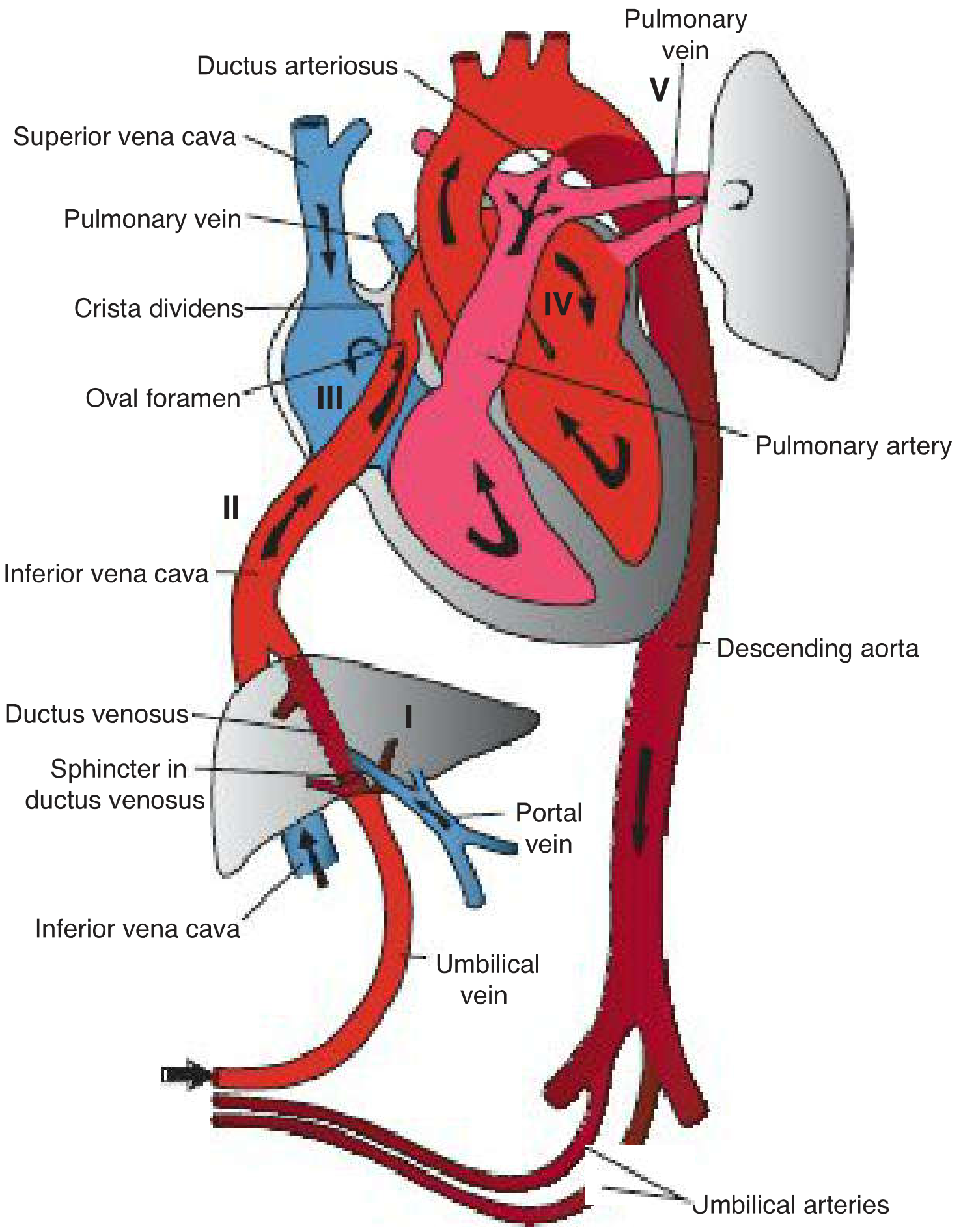
| Point | Location | Blood Mixed |
|---|---|---|
| I | Liver | Umbilical vein blood + portal venous return |
| II | Inferior vena cava | Oxygenated blood + deoxygenated blood from lower body |
| III | Right atrium | IVC blood + deoxygenated blood from SVC |
| IV | Left atrium | Blood from foramen ovale + small pulmonary venous return |
| V | Descending aorta | Blood from ductus arteriosus + blood from proximal aorta |
Key Physiological Principles
- Lungs are bypassed because pulmonary vascular resistance is high (lungs are fluid-filled and not ventilated); the ductus arteriosus diverts ~90% of right ventricular output to the aorta.
- Brain and heart are preferentially supplied with the most oxygenated blood — ascending aorta branches (coronary & carotid arteries) arise before the ductus arteriosus inflow, so they receive undiluted left ventricular output.
- Liver is partially bypassed via ductus venosus, but also receives a hepatotrophic portal blood fraction which is important for hepatic development.
- Oxygen saturation in umbilical arteries returning to the placenta is ~58% — considerably lower than the ~80% arriving via the umbilical vein, reflecting fetal oxygen consumption.
Changes at Birth
When the baby is born and takes the first breath:
- Pulmonary vascular resistance drops → blood floods the lungs
- Left atrial pressure rises → foramen ovale functionally closes
- Ductus arteriosus constricts (triggered by rising PO₂ and falling prostaglandins) → becomes ligamentum arteriosum
- Ductus venosus closes → becomes ligamentum venosum
- Umbilical vessels obliterate → umbilical vein becomes ligamentum teres hepatis; umbilical arteries become medial umbilical ligaments
Sources: The Developing Human: Clinically Oriented Embryology (Moore), 10th ed., pp. 869–872; Langman's Medical Embryology, 14th ed., pp. 236–237
This is a shared conversation. Sign in to Orris to start your own chat.