

eeec8752-c67f-4585-b854-a9fb04d3ca58.png
Decipher how shud I look and interpret thismlead serially
Reading File
This is a 12-lead ECG with a rhythm strip. Let me analyze the image carefully and search the textbook library for serial ECG interpretation guidance simultaneously.
Finding Sources
Finding Sources
Loading Image
Finding Sources
Finding Sources
Reading File
Finding Sources
Reading File
Loading Image
Now I have everything I need. Let me provide a complete, detailed analysis.
ECG Analysis - Full 12-Lead Interpretation
Settings confirmed
- Speed: 25 mm/sec | Gain: 1 cm/mV (standard)
Step-by-Step Lead-by-Lead Breakdown
RHYTHM (Lead II rhythm strip - bottom row)
- Regular rhythm, narrow QRS
- Rate: approximately 75-80 bpm
- P waves present and upright in II - normal sinus rhythm
SYSTEMATIC LEAD ANALYSIS
Limb Leads
| Lead | P wave | Q wave | ST segment | T wave |
|---|---|---|---|---|
| I | Upright | Absent/small | Isoelectric | Upright, small |
| II | Upright, tall | Deep Q wave present | Appears isoelectric or minimally elevated | T wave upright |
| III | Upright | Deep, wide Q wave | Mildly elevated or at baseline | T wave upright or biphasic |
| aVR | Inverted | - | ST depression (reciprocal) | Inverted T |
| aVL | Upright | Small Q or absent | ST depression (reciprocal) | T wave inverted/flattened |
| aVF | Upright | Deep Q wave | ST mildly elevated/isoelectric | T wave upright |
Key finding in limb leads: Deep, wide Q waves in II, III, and aVF with reciprocal ST changes in aVL. This is the hallmark pattern.
Precordial Leads
| Lead | Q wave | R wave | ST segment | T wave |
|---|---|---|---|---|
| V1 | QS pattern | Poor R | Isoelectric | Biphasic/flat |
| V2 | QS pattern | Small R | Mildly elevated | Deep T inversion |
| V3 | Small Q | Transitional | Elevated | Deep T inversion |
| V4 | Absent | Tall R | Isoelectric to slightly elevated | Upright |
| V5 | Absent | Tall R | Isoelectric | Upright |
| V6 | Absent | Tall R | Isoelectric | Upright |
Key finding in precordial leads:
- Deep T-wave inversions in V2-V3 (anterior leads)
- Possible residual ST elevation in V2-V3 zone
- R-wave progression preserved by V4-V6
- No dominant R in V1 to suggest true posterior MI
THE MAIN DIAGNOSIS
Evolving/Evolved Inferior STEMI with possible anterior extension
This ECG pattern is classic for Inferior ST-Elevation MI (STEMI) - in an evolving or post-acute phase. Here's the temporal staging:
How to Read This SERIALLY (ECG Evolution Over Time)
This is the most important part of your question. Inferior STEMI evolves through 4 phases:
Phase 1 - Hyperacute (0 to ~2 hours)
- Tall, "hyperacute" T waves in II, III, aVF (may be taller than normal)
- ST segments just beginning to elevate
- No Q waves yet
- Reciprocal ST depression begins in aVL and I
Phase 2 - Acute STEMI (2-12 hours)
- ST elevation in II, III, aVF - tombstone or convex morphology
- ST depression in aVL (reciprocal) - this is diagnostically very helpful
- Q waves beginning to appear in II, III, aVF
- T waves may still be upright
Phase 3 - Evolving (12-72 hours) - This ECG is likely here
- ST elevation is resolving back toward baseline
- Deep Q waves now established in II, III, aVF - these are pathological (>1 small square wide and >1/4 of R height)
- T wave inversion appearing in II, III, aVF - this represents ongoing reperfusion/healing
- Precordial T inversions in V2-V3 suggest extension or reciprocal changes
Phase 4 - Chronic/Old MI (days to months)
- ST fully returns to baseline
- Q waves persist (permanent scar)
- T waves may normalize or remain inverted
- R-wave amplitude may be permanently reduced
Comparing Your ECG to the Textbook Pattern
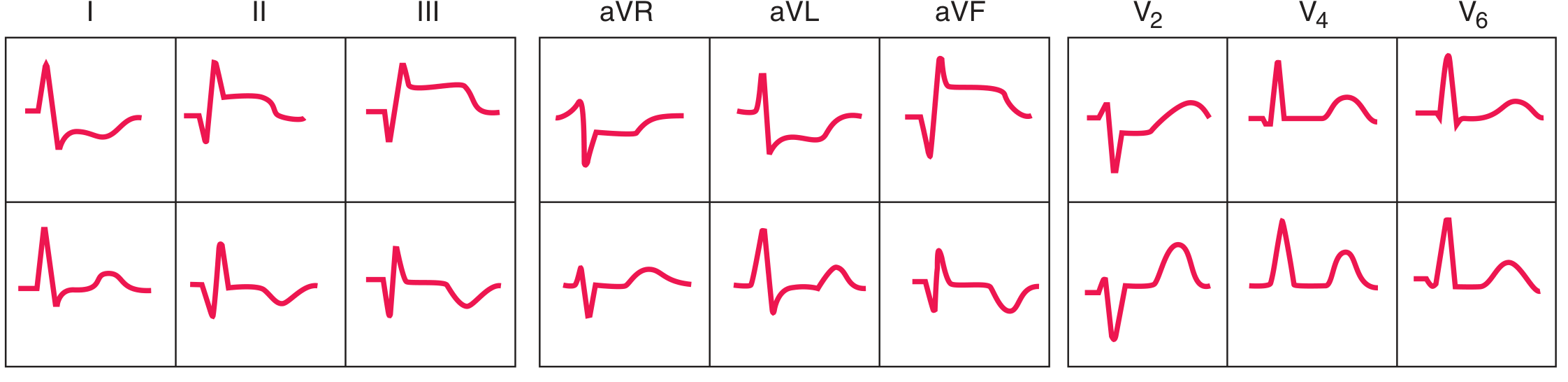
The textbook diagram above (from Harrison's, 22nd Edition, Fig. 247-13) shows exactly this: acute inferior STEMI (top row) vs evolved inferior STEMI (bottom row) - with Q waves deepening and T inversion appearing as the ECG evolves over time. Your ECG closely matches the evolving/evolved phase in the bottom row.
Summary of Abnormal Findings in Your ECG
- Pathological Q waves in II, III, aVF - indicating inferior wall necrosis
- Residual/resolving ST changes in inferior leads - suggests sub-acute phase
- Reciprocal changes in aVL (ST depression, T inversion) - confirms infero-lateral territory
- T-wave inversions in V2-V3 - may represent anterior extension or reciprocal anterior changes; also could indicate RV involvement or proximal RCA occlusion
- Normal R-wave progression V4-V6 - lateral wall spared
Territory and Likely Culprit Vessel
| Finding | Implication |
|---|---|
| Inferior Q waves (II, III, aVF) | RCA (right coronary artery) in ~80% of cases |
| ST changes also in V1-V3 | Consider proximal RCA (with RV involvement) or co-existing posterior MI |
| Reciprocal aVL changes | Confirms inferior MI, not pericarditis |
- Source: Harrison's Principles of Internal Medicine, 22E, Chapter 247 (ECG section on Myocardial Ischemia and Infarction)
How to Approach Serial ECGs in Practice
When reviewing serial ECGs in this patient, look for:
- ST elevation trending down over time (good sign - reperfusion occurring)
- Q waves deepening or persisting - indicates permanent scar
- T-wave inversion evolving - normal part of healing
- New ST re-elevation - danger sign (re-occlusion or aneurysm formation)
- Arrhythmias developing - look for VPBs, VT, heart block (common with inferior MI)
- PR interval - inferior MI can damage the AV node (supplied by RCA), so watch for 1st, 2nd, or 3rd degree AV block serially
Clinical note: This ECG does not represent an acute STEMI requiring immediate cath lab activation - the ST elevation has resolved and Q waves with T inversions are present. It represents a sub-acute or evolving inferior MI, most likely 24-72 hours old. Always correlate with troponin trend and clinical history.
This is a shared conversation. Sign in to Orris to start your own chat.