
Hba1c
I'll look up HbA1c from the medical library for you.
Searching sources...
Reading File
Finding Sources
Searching PubMed
HbA1c glycated hemoglobin diabetes
Reading File
Reading File
Finding Sources
Reading File
Reading File
Finding Sources
Reading File
Reading File
Finding Sources
Reading File
Finding Sources
Reading File
Loading Image
Here is a thorough summary of HbA1c from authoritative medical textbooks:
HbA1c (Glycated Hemoglobin / Haemoglobin A1c)
What Is It?
HbA1c is formed when blood glucose enters red blood cells and forms a covalent, non-enzymatic adduct with the epsilon-amino groups of lysyl residues and the alpha-amino group of the N-terminal valines of hemoglobin beta chains. This process is called glycation (not glycosylation - it requires no enzyme). The higher the blood glucose, the more glycation occurs.
Because red blood cells survive approximately 120 days, the HbA1c level reflects mean blood glucose over the preceding 8-12 weeks - a far more informative window than a single glucose reading. - Harper's Illustrated Biochemistry, 32nd Ed
Reference Range (in Non-Diabetic Adults)
The scatter plot below (from Tietz Textbook of Laboratory Medicine, 7th Ed) shows the population distribution of HbA1c by age and sex, with reference interval bands:
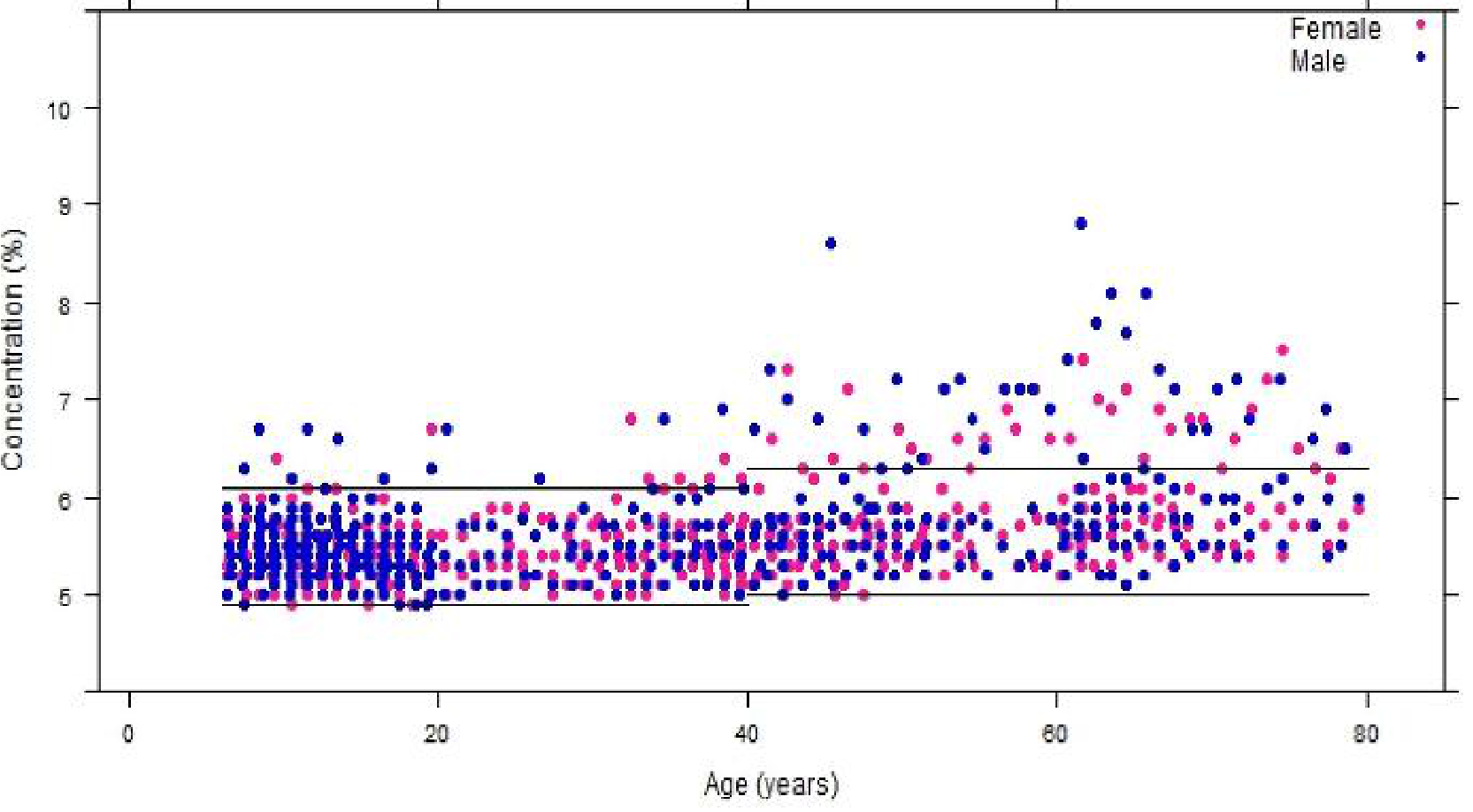
- Normal: < 5.7% (< 39 mmol/mol)
- HbA1c tends to rise slightly with age in population data
Diagnostic Cut-points (ADA Criteria)
| Glycemic Status | HbA1c (%) | HbA1c (mmol/mol) |
|---|---|---|
| Normal | < 5.7% | < 39 |
| Prediabetes | 5.7 - 6.4% | 39 - 47 |
| Diabetes | ≥ 6.5% | ≥ 48 |
- To diagnose diabetes, two abnormal results are generally required (either two different tests or two occasions), unless classic symptoms plus a random glucose ≥ 200 mg/dL are present.
- A random plasma glucose ≥ 200 mg/dL with symptoms is sufficient alone.
- Note: The WHO defines impaired fasting glucose at a slightly higher threshold (FPG > 6.1 mmol/L vs. ADA's ≥ 5.6 mmol/L).
Sources: Goldman-Cecil Medicine, Harrison's Principles of Internal Medicine 22E, Henry's Clinical Diagnosis
Treatment Targets
| Population | HbA1c Target |
|---|---|
| Most non-pregnant adults | < 7.0% (53 mmol/mol) |
| Stringent target (selected patients) | ≤ 6.5% |
| Elderly with intact cognition | < 7.0–7.5% |
| Elderly with cognitive impairment / limited lifespan | < 8.0% (to avoid hypoglycemia) |
| Dialysis patients (KDOQI/KDIGO) | ~7.0% |
The target should always be individualized - considering age, comorbidities, hypoglycemia risk, cognition, and lifestyle. Large trials (DCCT, UKPDS, ACCORD, ADVANCE) confirm that better glycemic control reduces microvascular complications, and early intensive control has lasting cardiovascular benefit. - Harrison's 22E
- The ADA recommends at least biannual HbA1c measurements for diabetes follow-up; quarterly for patients not at goal or after treatment changes. - Rosen's Emergency Medicine
Why HbA1c Can Be Falsely Low or High
Falsely Low (underestimates glucose):
- Hemolytic anemia (shorter RBC lifespan = less time for glycation)
- Hemoglobinopathies (e.g., sickle cell, thalassemia - variant Hbs may not glycate normally)
- Renal impairment (increased RBC turnover, erythropoietin therapy)
- After splenectomy
Falsely High (overestimates glucose):
- Chronic use of opioids, salicylates, or alcohol (assay interference)
- Iron deficiency anemia (older RBCs persist longer, accumulate more glycation)
In cases where HbA1c is unreliable, fructosamine (glycated serum protein) or glycated albumin can be used - both reflect mean glucose over the preceding 2-3 weeks. These are less standardized but clinically useful as alternatives. - Goldman-Cecil Medicine
Key Points in Summary
- Mechanism: Non-enzymatic glycation of Hb beta chains - proportional to mean blood glucose
- Window: Reflects ~8-12 weeks average glycemia (RBC lifespan ~120 days)
- Normal: < 5.7% | Prediabetes: 5.7-6.4% | Diabetes: ≥ 6.5%
- Therapy goal: < 7% for most adults; individualize for elderly/high-risk
- Limitations: Unreliable in hemolytic anemia, hemoglobinopathies, renal failure, iron deficiency, and certain drug use - use fructosamine/glycated albumin as backup
- Monitoring frequency: At least every 6 months; every 3 months if not at goal
How reduced hba1c
Searching sources...
Finding Sources
Finding Sources
Reading File
Finding Sources
Finding Sources
Reading File
Reading File
Reading File
Reading File
Reading File
Here is a complete, textbook-sourced breakdown of how to reduce HbA1c:
How to Reduce HbA1c
HbA1c can be lowered through lifestyle changes, oral/injectable medications, and insulin therapy. The key principle: since HbA1c reflects average blood glucose over the preceding 8-12 weeks, any intervention that consistently lowers blood glucose will reduce HbA1c.
1. Lifestyle Interventions
Diet
- Reduce total carbohydrate intake (most patients do well at ~45% of calories from carbs)
- Substitute some calories with monounsaturated fats (olive oil, nuts, avocados) - lowers triglycerides and raises HDL
- A Mediterranean-style diet (olive oil, walnuts, almonds, hazelnuts) has been shown to improve glycemic control and reduce cardiovascular endpoints
- Caloric restriction and weight loss are especially important in obese type 2 diabetics
- Katzung's Basic & Clinical Pharmacology, 16th Ed
Exercise
- Physical activity improves insulin sensitivity and reduces hepatic glucose output
- ADA recommends 150 minutes/week of moderate-intensity activity for diabetes prevention and glycemic management
- Lifestyle intervention targeting ≥7% body weight loss + 150 min/week exercise reduces diabetes incidence by 58% in high-risk individuals
- Goldman-Cecil Medicine
2. Pharmacological Agents - HbA1c Lowering by Drug Class
| Drug Class | Examples | HbA1c Reduction | Key Notes |
|---|---|---|---|
| Biguanides | Metformin | ~1.5% | First-line; reduces gluconeogenesis; also reduces macrovascular risk (UKPDS) |
| Sulfonylureas | Gliclazide, Glipizide, Glyburide | ~1.5% | Stimulate insulin secretion; risk of hypoglycemia + weight gain |
| Glinides | Repaglinide, Nateglinide | ~1.0% | Rapid-onset, short-acting insulin secretagogues |
| Thiazolidinediones (TZDs) | Pioglitazone | 0.6-1.5% | Reduce insulin resistance via PPAR-γ; risk of edema, fractures, CHF |
| DPP-4 Inhibitors | Sitagliptin, Linagliptin | 0.7-1.2% | Enhance incretin effect; weight neutral; low hypoglycemia risk |
| GLP-1 Receptor Agonists | Semaglutide, Exenatide, Liraglutide | 0.8-1.5%+ | Also cause weight loss; suppress glucagon; slow gastric emptying |
| Dual GIP/GLP-1 Agonists | Tirzepatide | >2% | Newest class; very potent; significant weight loss |
| SGLT-2 Inhibitors | Empagliflozin, Dapagliflozin, Canagliflozin | 0.5-1.0% | Cause glycosuria; also reduce BP, weight, and cardiovascular/renal risk |
| Alpha-Glucosidase Inhibitors | Acarbose, Miglitol | 0.5-0.8% | Delay carbohydrate absorption; mainly reduce postprandial spikes |
| Insulin | Basal (Glargine, Degludec), Bolus (Lispro, Aspart) | Variable (often >2%) | Most potent; required in type 1 DM; increasingly used in type 2 |
Sources: NKF Primer on Kidney Diseases, Katzung's, Harrison's 22E
Key UKPDS finding: Every 1% decrease in HbA1c = 37% reduction in microvascular complications, 21% reduction in diabetes-related death, and 14% reduction in myocardial infarction risk. - Katzung's
3. Insulin Therapy
The most potent HbA1c-lowering agent. Used in:
- All type 1 diabetes patients
- Type 2 patients who fail oral agents or have very high HbA1c (>9-10%)
- Basal insulin (glargine/degludec) added to oral agents effectively lowers HbA1c
- Intensive insulin regimens (basal-bolus) can achieve near-normoglycemia
4. Special Strategies
- Continuous Glucose Monitoring (CGM) + automated insulin delivery (AID/closed-loop pumps) allows real-time glucose correction, reducing both HbA1c and hypoglycemia
- Treating depression in diabetic patients - reduction in depression severity predicts lower HbA1c during maintenance therapy (Kaplan & Sadock's Psychiatry)
- Bariatric surgery in obese type 2 diabetics can normalize HbA1c entirely in many patients
5. Why Benefits Matter (DCCT & UKPDS Evidence)
- DCCT (type 1 DM): Reducing HbA1c from 8.9% to 7.2% cut risk of retinopathy, nephropathy, and neuropathy by ~60%
- UKPDS (type 2 DM): Reducing HbA1c from 9.1% to 7% cut microvascular complications by 25%; metformin additionally reduced macrovascular disease
- The concept of glycemic memory means early good control has lasting protective benefits even after HbA1c rises later - Katzung's
Bottom line: The most effective approach combines diet + exercise + metformin as a foundation, then adds agents based on comorbidities (e.g., GLP-1/SGLT-2 for heart disease or obesity, insulin for very high HbA1c). All strategies are individualized based on the patient's profile.
This is a shared conversation. Sign in to Orris to start your own chat.