
Epileptiform fits
Reading File
Checking Date & Time
Finding Sources
Finding Sources
Finding Sources
Reading File
Reading File
Reading File
Reading File
Reading File
Reading File
Reading File
Reading File
Reading File
Reading File
I now have comprehensive material from two authoritative textbooks (Harrison's, Adams & Victor's) covering definition, classification, pathophysiology, clinical features, EEG, and treatment. Let me compile the full answer.
Loading Image
Searching PubMed
epilepsy seizure management guidelines
Here is a comprehensive overview of epileptiform fits (seizures and epilepsy):
Epileptiform Fits (Seizures & Epilepsy)
Definition
A seizure is a transient occurrence of signs or symptoms due to abnormal, excessive or synchronous neuronal activity in the brain. The term "epileptiform fit" encompasses this concept — the word epilepsy derives from the Greek meaning "to seize upon."
Epilepsy is the condition of recurrent unprovoked seizures due to a chronic underlying process. By definition, this requires ≥2 unprovoked seizures (though a single seizure with high-risk EEG/imaging features may establish the diagnosis). The worldwide prevalence is 5–30 per 1000 persons.
A single seizure or brief burst during a medical illness (e.g., fever, electrolyte disturbance) does not necessarily constitute epilepsy. — Harrison's Principles of Internal Medicine 22E
Classification (ILAE 2017)
| Onset Type | Subtypes |
|---|---|
| Focal onset | Intact awareness / Impaired awareness; Motor or nonmotor onset; May evolve to bilateral tonic-clonic |
| Generalized onset | Motor (tonic-clonic, atonic, myoclonic); Nonmotor (absence) |
| Unknown onset | Motor, nonmotor, or unclassified |
(Note: "Partial seizures" and "simple/complex partial" terminology has been retired.)
Types of Seizures
1. Focal Onset Seizures
Arise from a discrete network in one hemisphere.
- With intact awareness: The patient remains conscious. Motor forms include tonic, clonic, or myoclonic movements contralateral to the focus (e.g., involuntary left hand movements from a right motor cortex focus). Sensory forms include numbness/tingling (parietal lobe), olfactory hallucinations ("uncinate fits" — unpleasant smells from medial temporal lobe), visual flashes (occipital lobe), or auditory phenomena (superior temporal gyrus).
- With impaired awareness (formerly complex partial): Typically temporal lobe origin. The patient stares blankly and performs automatisms (lip smacking, picking movements). There may be a prior aura (e.g., rising epigastric sensation, déjà vu, fear).
- Focal to bilateral tonic-clonic: A focal seizure that evolves into full generalized convulsion — previously called "secondary generalisation."
2. Generalized Onset Seizures
Tonic-clonic (grand mal): The classic convulsion:
- Tonic phase (10–20 s): Sudden loss of consciousness, fall, brief flexion then sustained extension of the body, forced air expulsion ("epileptic cry"), cyanosis, pupils dilated and fixed
- Clonic phase (~30 s): Rhythmic jerking at ~8/s, coarsening to 4/s, then subsiding; autonomic features prominent (tachycardia, hypertension, salivation, incontinence)
- Postictal phase: Deep stupor then gradual confusion, headache, myalgia, amnesia for the event
Absence (petit mal): Brief (~10 s) blank stare with sudden onset and offset, no postictal state. EEG shows classic 3-Hz spike-and-wave discharges. Common in childhood, often precipitated by hyperventilation.
Atonic seizures ("drop attacks"): Sudden loss of muscle tone, causing falls.
Myoclonic seizures: Brief, shock-like involuntary muscle contractions. Characteristic of juvenile myoclonic epilepsy (JME).
Infantile spasms (West syndrome): Gross flexion/extension spasms in infants <1 year; EEG shows hypsarrhythmia (chaotic high-amplitude spike-wave). Treated with ACTH or vigabatrin.
Pathophysiology
The fundamental mechanism is a disruption of the balance between excitation (glutamate) and inhibition (GABA):
- Ictal discharge initiation: Involves changes in ion channel conductance, receptor sensitivity, and extracellular ion concentrations. A paroxysmal depolarisation shift (PDS) in individual neurons, with synchronous firing in a population of neurons.
- Absence seizures: Linked to oscillatory thalamocortical circuits involving GABA_A receptors, T-type Ca²⁺ channels, and K⁺ channels. Genetic mutations in these components are well established.
- Epileptogenesis: The process by which a normal neural network becomes chronically hyperexcitable, often after an initial CNS injury (trauma, stroke, infection) with a delay of months to years before the first seizure. Structural changes include hippocampal neuronal loss and mossy fibre sprouting.
- Genetic channelopathies: Many idiopathic epilepsies are now known to involve mutations in ion channel genes — notably SCN1A (Dravet syndrome), KCNQ2, CHRNA4, and GABA receptor subunits.
Diagnosis
EEG
The key diagnostic tool. Epileptiform activity consists of spikes or sharp waves, which may appear interictally or ictally:
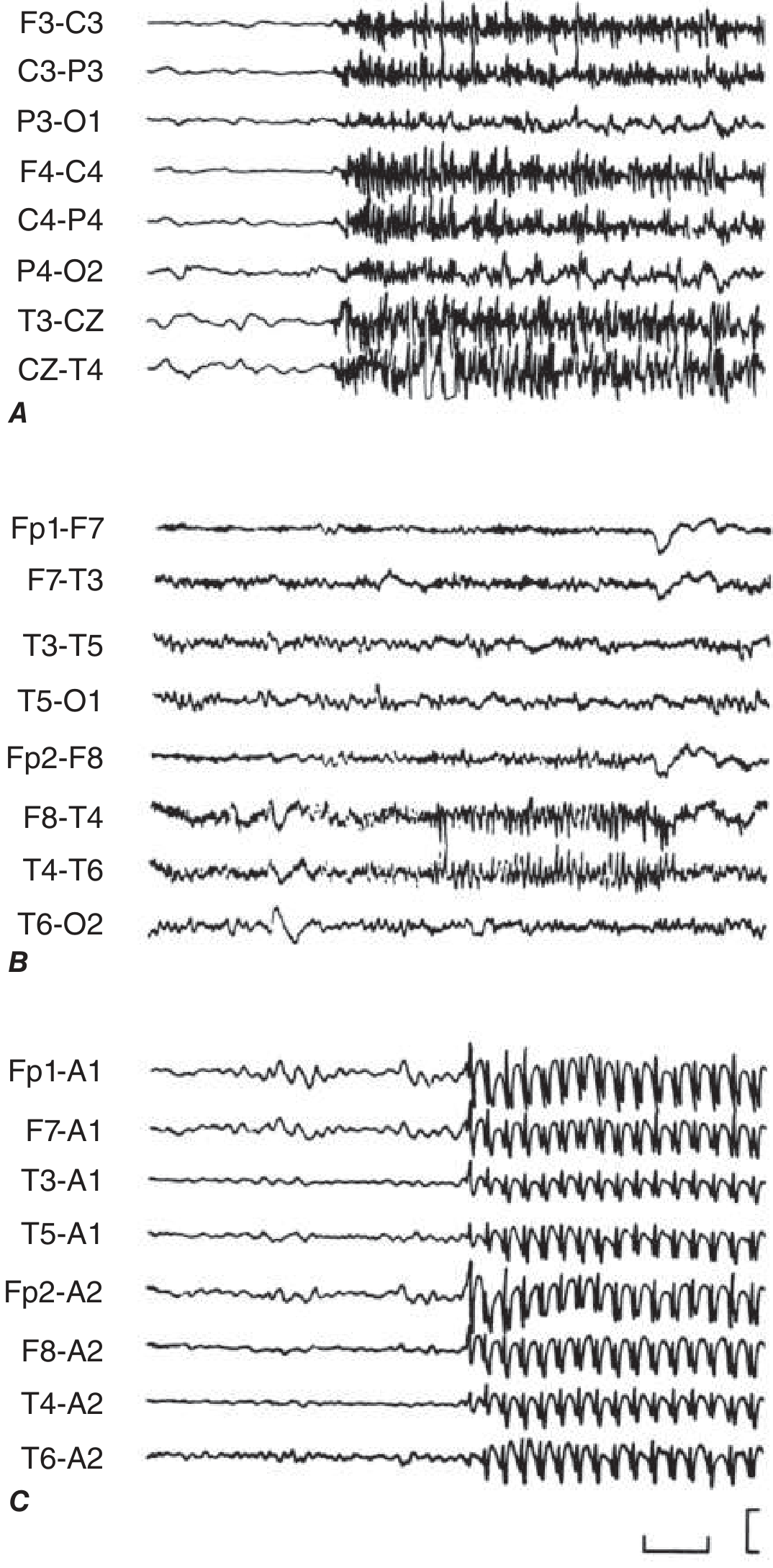
Figure: Electrographic seizures. A. Generalised tonic seizure showing synchronous sharp activity. B. Right temporal focal discharge during impaired awareness. C. 3-Hz spike-wave of absence seizure. — Harrison's 22E
- Normal interictal EEG does not exclude epilepsy
- Epileptiform spikes/sharp waves predict higher recurrence risk
- 3-Hz spike-wave: Absence epilepsy
- Video-EEG monitoring is the gold standard for seizure characterisation
- High-density EEG (up to 257 electrodes) and MEG allow source localisation for surgical planning
Neuroimaging
- MRI is preferred — detects hippocampal sclerosis, cortical dysplasia, tumours, vascular malformations
- PET/SPECT for presurgical evaluation of refractory epilepsy
Blood tests
Glucose, electrolytes (Na⁺, Ca²⁺, Mg²⁺), renal/liver function, toxicology screen — to identify reversible/provoked causes.
Aetiology
| Category | Examples |
|---|---|
| Genetic/Idiopathic | JME, childhood absence, Dravet syndrome, benign rolandic epilepsy |
| Structural | Cortical dysplasia, hippocampal sclerosis, tumour, vascular malformation, stroke, trauma |
| Metabolic | Hypoglycaemia, hyponatraemia, hypocalcaemia, uraemia |
| Infective | Meningitis, encephalitis, cerebral abscess, neurocysticercosis |
| Immune | Anti-NMDA receptor encephalitis, LGI1 antibody encephalitis |
| Provoked (acute symptomatic) | Alcohol withdrawal, drug toxicity, eclampsia, hypoxia |
Special Situations
Status Epilepticus
Seizure activity lasting >5 minutes (convulsive) or >10–15 minutes (absence/focal), or recurrent seizures without recovery between. A neurological emergency with significant mortality.
Management:
- 0–5 min: ABC, IV access, glucose check, thiamine if nutritionally at risk
- 5–20 min: IV/IM benzodiazepine (lorazepam 0.1 mg/kg IV; or midazolam 10 mg IM)
- 20–40 min: IV levetiracetam, valproate, or fosphenytoin
- >40 min (refractory): Anaesthetic agents (propofol, midazolam, thiopental) with ICU intubation
Febrile Seizures
- Simple: Single generalised tonic-clonic, <15 min, in child 6 months–5 years with fever; benign prognosis
- Complex: Focal, prolonged (>15 min), or recurrent within 24 h; higher risk of future epilepsy
- Temperature usually >38°C; herpesvirus 6 is a common precipitant
Treatment: Antiseizure Drug (ASD) Selection
| Seizure Type | First-Line Drugs |
|---|---|
| Generalised tonic-clonic | Lamotrigine, valproic acid, levetiracetam |
| Focal | Lamotrigine, carbamazepine, levetiracetam, oxcarbazepine |
| Typical absence | Valproic acid, ethosuximide, lamotrigine |
| Atypical absence, myoclonic, atonic | Valproic acid, lamotrigine, levetiracetam |
Key principles:
- Start with monotherapy; if inadequate at maximum tolerated dose, switch to another monotherapy before adding a second agent
- Initiate treatment after a second unprovoked seizure, or after a first seizure with high recurrence risk (structural lesion, abnormal EEG, nocturnal onset)
- Common dose-related side effects: sedation, ataxia, dizziness, diplopia
- Idiosyncratic risks: rash (carbamazepine, lamotrigine), hepatotoxicity (valproate), bone marrow suppression
- Valproate: teratogenic — avoid in women of childbearing age unless no alternative
- Drug-resistant epilepsy (failure of ≥2 appropriate ASDs): refer for surgical evaluation; other options include responsive neurostimulation (RNS), vagus nerve stimulation (VNS), ketogenic diet
When to Stop Driving / Lifestyle Advice
Patients should be counselled on:
- Driving restrictions (typically seizure-free for 6–12 months depending on jurisdiction)
- Avoiding unsupervised swimming, bathing, heights, and operating heavy machinery
- Sleep deprivation and alcohol as seizure triggers
- Contraception/pregnancy planning (enzyme-inducing ASDs affect oral contraceptives; folate supplementation mandatory)
Sources:
- Harrison's Principles of Internal Medicine 22E, Chapter 436 — Seizures and Epilepsy
- Adams and Victor's Principles of Neurology 12E — Epilepsy and Other Seizure Disorders
- Recent systematic review on status epilepticus management guidelines (Vignatelli et al., Epilepsia 2024, PMID: 38606469)
This is a shared conversation. Sign in to Orris to start your own chat.