
Make a image of algorithm of how to approach right iliac fossa mass by differentiating it into abdominal swelling intraperitoneal and retroperitoneal on the basis of inspection palpation percussion points add ballotment, movements on palpation
A detailed medical diagnostic algorithm flowchart titled "Approach to Right Iliac Fossa (RIF) Mass". Clean white background, professional clinical style, dark blue and teal color scheme with clear boxes and arrows. START at top: "RIGHT ILIAC FOSSA MASS" (large header box in dark navy blue) First branch downward: "CLINICAL EXAMINATION" box Then splits into 3 parallel columns labeled: "1. INSPECTION", "2. PALPATION", "3. PERCUSSION" INSPECTION column (blue): - Visible swelling visible? - Skin changes (erythema, sinus, scar) - Movement with respiration - Pulsations visible? - Peristalsis visible? PALPATION column (teal): - Surface: smooth / irregular / nodular - Consistency: soft / firm / hard / cystic - Tenderness: present / absent - Margins: well / ill-defined - Movement with respiration: YES / NO - Mobility: moves freely / fixed - BALLOTMENT: → Bimanual ballotment: can be balloted (retroperitoneal) → Cannot be balloted (intraperitoneal) - Movement on palpation: → Moves with hand / independent movement PERCUSSION column (orange): - Dull note over mass - Resonant note over mass - Band of colonic resonance ABOVE mass → retroperitoneal - Resonance OVER mass → intraperitoneal bowel - Dullness shifting with position? Below all three columns, converge into two major outcome boxes side by side: LEFT BOX (green, labeled "INTRAPERITONEAL MASS"): Features: ✓ Moves freely with respiration ✓ Cannot be balloted (bimanual) ✓ Resonant band may NOT be present above ✓ Dull on percussion (solid organ/fluid) ✓ Intraperitoneal resonance absent above mass ✓ Margins often well-felt from all sides ✓ Moves with hand movement (bowel) Common causes: Appendicular mass/abscess, Caecal carcinoma, Crohn's disease, Ovarian cyst/tumor, Mesenteric cyst, Ileal carcinoid, Intussusception RIGHT BOX (orange-red, labeled "RETROPERITONEAL MASS"): Features: ✓ Restricted/no movement with respiration ✓ BIMANUAL BALLOTMENT POSITIVE ✓ Band of colonic resonance PRESENT above mass (bowel pushed anteriorly) ✓ Dull on percussion ✓ Fixed, does not move freely ✓ Margins only felt anteriorly (posterior wall not accessible) ✓ Flanks full Common causes: Retroperitoneal lymph nodes, Psoas abscess, Iliac artery aneurysm, Retroperitoneal sarcoma, Right kidney mass (lower pole), Iliac lymphadenopathy At bottom, a reference summary table with two columns comparing INTRAPERITONEAL vs RETROPERITONEAL across rows: Inspection (movement with breathing), Palpation (ballotment, margins, mobility, movement on palpation), Percussion (resonance pattern) Title at very top in bold: "ALGORITHM: APPROACH TO RIGHT ILIAC FOSSA MASS — Differentiating Intraperitoneal vs Retroperitoneal" Subtitle: "Based on Inspection | Palpation | Percussion | Ballotment | Movement on Palpation" Professional medical infographic style, all text clearly legible, arrows connecting all steps logically, color-coded sections.
Make it please
A detailed medical diagnostic algorithm flowchart titled "ALGORITHM: APPROACH TO RIGHT ILIAC FOSSA (RIF) MASS — Differentiating Intraperitoneal vs Retroperitoneal". Clean white background, professional clinical style. TOP HEADER: Large dark navy blue box: "RIGHT ILIAC FOSSA (RIF) MASS" Arrow down to: "CLINICAL EXAMINATION" box in dark teal Then THREE parallel vertical columns with arrows from CLINICAL EXAMINATION box: ━━━━━━━━━━━━━━━━━━━━━━━━━━━━━━━━━━━ COLUMN 1 — INSPECTION (header in royal blue box): • Visible swelling / fullness in RIF • Skin changes: erythema, sinus, scar • Movement with respiration: Present / Absent • Visible pulsations • Visible peristalsis • Position of umbilicus: deviated / central ━━━━━━━━━━━━━━━━━━━━━━━━━━━━━━━━━━━ COLUMN 2 — PALPATION (header in dark teal box): • Site, size, shape • Surface: smooth / irregular / nodular • Consistency: soft / firm / hard / cystic / fluctuant • Tenderness: present / absent • Margins: well-defined / ill-defined • Movement with respiration: YES → likely intraperitoneal / NO → likely retroperitoneal • Mobility: freely mobile / fixed to deep structures BALLOTMENT (highlighted yellow sub-box): → Bimanual ballotment POSITIVE = Retroperitoneal mass (kidney, psoas) → Bimanual ballotment NEGATIVE = Intraperitoneal mass MOVEMENT ON PALPATION (highlighted sub-box): → Moves with examining hand = attached/intraperitoneal → Slips away / independent = retroperitoneal → Expansile pulsation = vascular (aneurysm) → Transmitted pulsation = overlying vessel ━━━━━━━━━━━━━━━━━━━━━━━━━━━━━━━━━━━ COLUMN 3 — PERCUSSION (header in dark orange box): • Dull note over mass • Resonant note over mass (gas-containing bowel) • BAND OF COLONIC RESONANCE ABOVE MASS → Retroperitoneal (colon displaced anteriorly) • No resonant band above → Intraperitoneal • Dullness in flanks • Shifting dullness if fluid present ━━━━━━━━━━━━━━━━━━━━━━━━━━━━━━━━━━━ All three columns converge with arrows into a DECISION DIAMOND: "Ballotable? Resonant band above? Moves with respiration?" Then two large outcome boxes side by side below: LEFT BOX — INTRAPERITONEAL MASS (bright green border, light green fill): FEATURES: ✔ MOVES with respiration ✔ Bimanual ballotment NEGATIVE ✔ NO resonant band of colon above mass ✔ Mass felt from all sides ✔ Freely mobile in some cases ✔ Percussion: dull (solid) or resonant (bowel) ✔ Moves with examining hand COMMON CAUSES: • Appendicular mass / abscess • Caecal carcinoma • Crohn's disease (terminal ileum) • Ovarian cyst / tumour • Mesenteric cyst • Intussusception • Ileal carcinoid RIGHT BOX — RETROPERITONEAL MASS (red-orange border, light orange fill): FEATURES: ✔ RESTRICTED / NO movement with respiration ✔ Bimanual ballotment POSITIVE ✔ RESONANT BAND OF COLON PRESENT ABOVE mass ✔ Posterior margin NOT accessible ✔ Fixed, does not move freely ✔ Flanks may be full ✔ Slips away on palpation COMMON CAUSES: • Retroperitoneal lymphadenopathy • Psoas abscess • Iliac artery aneurysm • Retroperitoneal sarcoma • Lower pole right kidney mass • Iliac bone tumour ━━━━━━━━━━━━━━━━━━━━━━━━━━━━━━━━━━━ BOTTOM COMPARISON TABLE (two columns, alternating row colors): Feature | Intraperitoneal | Retroperitoneal Movement with respiration | Present | Absent / Restricted Ballotment (bimanual) | Negative | Positive Resonant band above mass | Absent | Present (colon displaced) Margins palpable | All sides | Anterior only Mobility | Often mobile | Fixed Percussion over mass | Dull (solid organ) | Dull (band of resonance above) Movement on palpation | Moves with hand | Slips / independent Subtitle at top below title: "Clinical differentiation based on: Inspection | Palpation | Percussion | Ballotment | Movement on Palpation" Overall: professional surgical textbook flowchart style, navy/teal/orange/green color scheme, all text large and clearly legible, clean arrows, well-organized layout
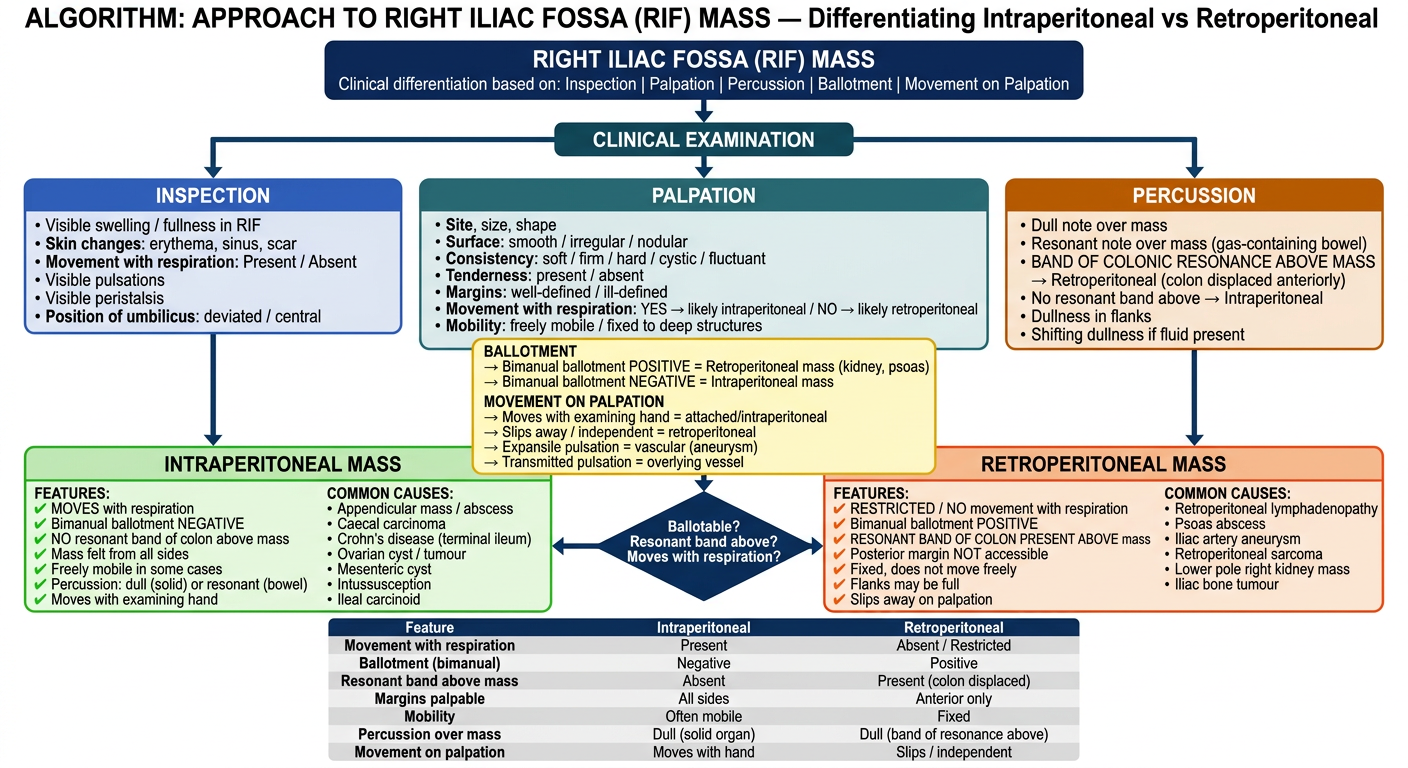
- Inspection — respiratory movement, skin changes, pulsations, peristalsis
- Palpation — surface, consistency, margins, mobility, ballotment (positive = retroperitoneal), and movement on palpation (moves with hand vs slips away)
- Percussion — key differentiator: a resonant band of colon above the mass signals retroperitoneal origin (bowel is displaced anteriorly)
| Feature | Intraperitoneal | Retroperitoneal |
|---|---|---|
| Moves with respiration | ✔ Yes | ✘ No/Restricted |
| Bimanual ballotment | Negative | Positive |
| Resonant band above | Absent | Present |
| Palpable margins | All sides | Anterior only |
| Mobility | Often mobile | Fixed |
| Movement on palpation | Moves with hand | Slips/independent |