
Pathogenesis of viral meningitis in flow chart
A detailed medical flowchart showing the pathogenesis of viral meningitis. The flowchart should have two parallel pathways at the top merging into a common pathway below. LEFT PATHWAY - Hematogenous Route (Enteroviruses): Box 1: "Virus Entry (Enteroviruses - e.g. Echovirus, Coxsackievirus)" → Box 2: "Replication in GI tract (acid-resistant) & Nasopharynx" → Box 3: "Spread to Regional Lymphatics" → Box 4: "Minor Viremia → Seeds CNS, Heart, Liver, RES" → Box 5: "Extensive Replication at Peripheral Sites" → Box 6: "Major Viremia (onset of clinical illness)" RIGHT PATHWAY - Neuronal Route (HSV): Box A: "Virus Entry (HSV-1 via oral mucosa / HSV-2 via genital lesion)" → Box B: "Local Replication at Entry Site" → Box C: "Retrograde Axonal Transport along Trigeminal / Sacral Nerve Roots" → Box D: "Latency in Ganglia (reactivation possible)" CONVERGENCE - CNS Entry: Both pathways merge into: "CNS Entry: Virus Crosses Blood-CSF Barrier at Choroid Plexus / Tight Endothelial Junctions" COMMON PATHWAY below: → "Viral Replication within Subarachnoid Space & Meninges" → "Innate Immune Activation: Pattern Recognition → Release of Cytokines (IL-1β, IL-6, TNF-α, IFN-α/β)" → "Recruitment of Mononuclear Cells (Lymphocytes, Monocytes) into CSF → Lymphocytic Pleocytosis" → "Meningeal Inflammation: Irritation of Meninges & Adjacent Pain-Sensitive Structures" → Final box with red border: "Clinical Features: Headache, Fever, Nuchal Rigidity, Photophobia, Nausea/Vomiting" with note "Consciousness preserved (no parenchymal involvement)" Use clean white background, blue boxes for hematogenous route, green boxes for neuronal route, purple for convergence/CNS entry, orange for immune response, red-bordered final box. Include bold section labels. Professional medical textbook style.
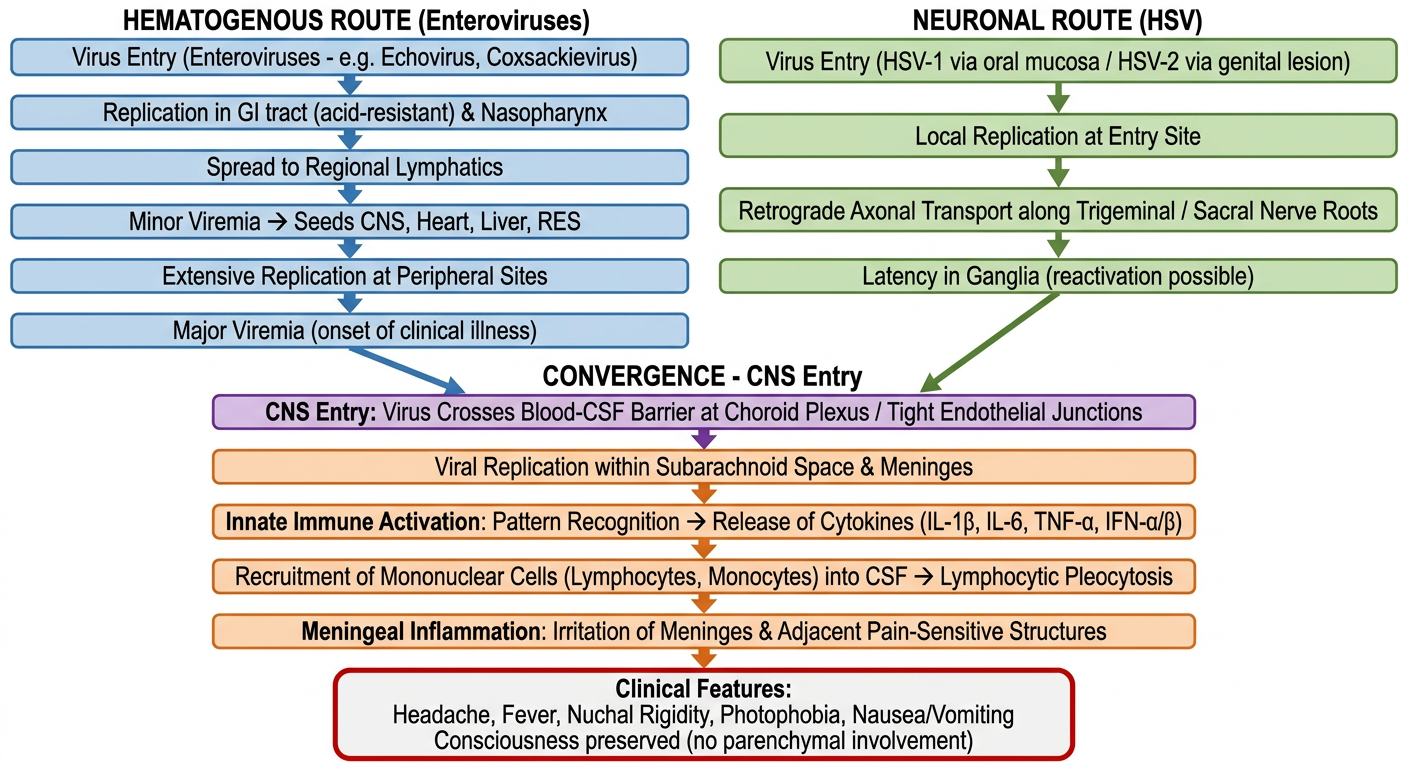
Pathogenesis of Viral Meningitis - Flowchart Explanation
Route 1 - Hematogenous (Enteroviruses: Echovirus, Coxsackievirus, EV-71)
- Virus ingested - Enteroviruses resist gastric acid and reach the lower GI tract; some replicate in nasopharynx
- Spread to regional lymphatics
- Minor viremia - Seeds CNS, heart, liver, and reticuloendothelial system (RES)
- Extensive peripheral replication (at heart, liver, RES)
- Major viremia - Coincides with onset of clinical symptoms
- CNS entry via crossing the blood-CSF barrier at the choroid plexus (tight endothelial junctions)
Route 2 - Neuronal (HSV-1, HSV-2)
- HSV-1: Primary oral infection → replication at oral mucosa
- Retrograde axonal spread along the trigeminal/olfactory nerves → reaches meninges
- HSV-2: Genital primary infection → ascends along sacral nerve roots to the meninges
- Latency established in ganglia; reactivation causes recurrent meningitis (Mollaret meningitis with HSV-2)
Common Pathway - CNS Events
| Step | Event |
|---|---|
| CNS Entry | Virus crosses blood-CSF barrier at choroid plexus |
| Viral replication | Within subarachnoid space and meninges |
| Innate immune activation | Pattern recognition receptors trigger release of IL-1β, IL-6, TNF-α, IFN-α/β |
| Mononuclear cell recruitment | Lymphocytes and monocytes recruited into CSF → lymphocytic pleocytosis |
| Meningeal inflammation | Irritation of pain-sensitive meningeal structures |
| Clinical syndrome | Headache, fever, nuchal rigidity, photophobia, nausea/vomiting; consciousness preserved (no parenchymal involvement) |
Key Points
- Normal glucose in CSF (unlike bacterial meningitis) - virus does not consume glucose as bacteria do
- Consciousness is preserved in viral meningitis; alteration suggests encephalitis
- CSF protein is normal or mildly elevated
- Enteroviruses account for >85% of identifiable viral meningitis cases