Hi so i am male 24 yr and 4 months old and i do have complaint about whem i get fever after it has gone completely everything feels normal after that more sweating occurs and after that i get leg pain more accurately it would call as muscle pain it is so severe that i camy stand or if i sat or sleep i cant get by even any support that much by legs muscle hurts sometimes my balance goes suddenly and i get fall....the mild type of feeling also felt in hands i cant feel complete energy in my hand and nothing energy in my legs it feels like these lower limbs are just for appearance and of no use its better to be handicapped or paralysed rather than this feeling

Reading File
Finding Sources
Finding Sources
Finding Sources
Searching PubMed

post-infectious myositis fever muscle weakness young adults

Finding Sources
Finding Sources
Finding Sources
Searching PubMed

post-febrile weakness myalgia sweating lower limb diagnosis

Reading File
Finding Sources
Finding Sources
Finding Sources
Reading File
Finding Sources
Finding Sources
Finding Sources
Reading File
Reading File
Finding Sources
Finding Sources
Finding Sources
Finding Sources
Reading File
Finding Sources
Reading File
Finding Sources
I now have a thorough picture. Let me compile the full answer for the user.

IMPORTANT NOTICE - Please read this first: I am an AI assistant providing general medical information for educational purposes. What you are describing sounds like a potentially serious medical condition that requires urgent evaluation by a doctor in person. Please do not delay seeking care. The information below is to help you understand what might be happening, not to replace a medical examination.

Your Symptoms: What They Could Mean

You're describing a pattern that is clinically very recognizable:
  1. Fever (recent illness)
  2. Fever resolves - you feel normal briefly
  3. Then: excessive sweating
  4. Then: severe muscle pain and weakness, especially in the legs - so bad you can't stand, sit comfortably, or get support from your legs
  5. Balance problems / falling
  6. Mild weakness in hands too
  7. Feeling like the lower limbs have "no energy" - like they are just there but not functional
This pattern - weakness/paralysis coming after a febrile (feverish) illness, affecting legs more than arms, with balance problems - has several possible explanations, some of which are urgent.

The Most Likely Possibility: Guillain-Barré Syndrome (GBS)

This is the condition that fits your description most closely and is the most important one to rule out quickly.
What is GBS? GBS is an immune-mediated disorder where your own immune system, after fighting an infection, accidentally starts attacking the nerves of your body (the peripheral nerves - the ones outside the brain and spinal cord). It is now the leading cause of acute paralytic disease in young people.
How does it match your symptoms?
Your SymptomGBS Feature
Preceded by fever / infection~2/3 of GBS cases follow an upper respiratory or gastrointestinal illness, 1-4 weeks before nerve symptoms begin
Severe leg weakness, can't stand or bear weightClassic "ascending weakness" starting in the legs
Balance loss, fallingMuscle weakness + loss of reflexes causes ataxia
Mild hand/arm weakness tooWeakness ascends from legs upward to arms
Sweating after feverAutonomic dysfunction is seen in ~65% of GBS patients (the nerves controlling sweating are affected)
Progressive over daysTypical GBS progression
From Bradley and Daroff's Neurology in Clinical Practice: "Patients with classic GBS initially present with weakness with or without paresthetic sensory symptoms, often worse in the hands and fingers. The fairly symmetrical weakness of the lower limbs ascends proximally over hours to several days..." and importantly - "Autonomic dysfunction of various degrees has been reported in 65% of patients... resulting in... episodic diaphoresis [excessive sweating]."
Why is this urgent? In some patients, GBS can continue to progress upward and reach the breathing muscles, which is a life-threatening emergency. About 9-30% of hospitalized GBS patients need a ventilator. This is why it needs evaluation now, not later.
Common infectious triggers for GBS include: Campylobacter jejuni (food poisoning), Cytomegalovirus, Epstein-Barr virus, Mycoplasma pneumoniae, Zika virus, and many others.

Other Possibilities to Consider

1. Post-infectious / Viral Myositis (Muscle Inflammation)

Viruses can directly inflame muscle tissue. This causes severe muscle pain (myalgia) after a fever, sometimes to the point where you cannot walk. A blood test checking CK (creatine kinase) levels would be markedly elevated in this case. This is generally less dangerous than GBS but still needs treatment.

2. Hypokalemia (Low Potassium)

When you have a fever and then sweat heavily, your body loses potassium (an important electrolyte) through sweat. Low potassium can cause:
  • Severe muscle weakness and pain
  • Inability to stand or walk
  • In severe cases, episodes that look like temporary paralysis (hypokalemic periodic paralysis)
A simple blood test (electrolyte panel) can detect this. It is treatable with potassium replacement.

3. Transverse Myelitis

Inflammation of the spinal cord itself, also triggered by a preceding infection. Causes leg weakness, balance problems, and sometimes bladder/bowel symptoms. Diagnosed by MRI.

4. Rhabdomyolysis

Severe breakdown of muscle tissue following viral illness. The muscle pain you describe as "so severe you can't stand" is a classic feature. Can be dangerous if the broken-down muscle proteins damage the kidneys. Detected by a very high CK level and dark/tea-colored urine.

What You Should Do - Urgently

Go to a hospital emergency department today. Tell the doctor:
  • You had a fever recently
  • After the fever resolved, you developed severe leg weakness and pain
  • You are falling due to balance problems
  • Your hands also feel weak
The doctor will likely order:
  • Blood tests: Complete blood count, CK (muscle enzyme), electrolytes (potassium, sodium, magnesium), kidney function tests
  • Nerve conduction studies (NCS/EMG): To check if nerves are being attacked (GBS)
  • Lumbar puncture (spinal tap): In GBS, CSF shows high protein with normal cell count (albuminocytological dissociation)
  • MRI of spine: To rule out spinal cord involvement
Treatment (if it is GBS):
  • IV Immunoglobulin (IVIG) or Plasma Exchange (plasmapheresis) - both equally effective, both shorten the time to recovery
  • Corticosteroids are NOT used for GBS (they can make it worse)
  • Respiratory monitoring is critical

Red Flag Warning Signs - Go to Emergency Immediately if You Have:

  • Difficulty breathing, shortness of breath, or feeling like you cannot take a deep breath
  • Inability to swallow or speak clearly
  • Inability to move your arms at all
  • Fast or irregular heartbeat
  • Inability to urinate
These suggest the weakness may be spreading to critical muscles, and this is a medical emergency.

Please do not wait. What you are experiencing is not normal muscle soreness. The pattern of post-fever weakness with balance loss and spreading from legs to hands is a recognized neurological emergency pattern. A doctor needs to examine you and run tests today.
Sources: Bradley and Daroff's Neurology in Clinical Practice; Tintinalli's Emergency Medicine; Goldman-Cecil Medicine; The Washington Manual of Medical Therapeutics

Is this would be lifetime problem or do it have any curr to this....i want to get knowledge avout it

Finding Sources
Finding Sources
Searching PubMed

"Guillain-Barre syndrome"[MeSH Terms] AND prognosis AND recovery

Reading File
Reading Article
Reading Article
Reading File
Reading File
Loading Image
This is a really important question, and the answer is genuinely hopeful. Here is a thorough breakdown:

Is This a Lifetime Problem? Is There a Cure?

The Short Answer: No, it is NOT necessarily a lifetime problem - and yes, there is treatment.

For the most likely condition fitting your symptoms (GBS), the majority of people recover - many fully. It is not a permanent paralysis or a lifelong sentence. But how well and how fast you recover depends heavily on getting diagnosed and treated early.

The 3 Phases of GBS - What Happens to Your Body

Understanding these phases helps you understand why it is not permanent:

Phase 1 - Progression (days to 4 weeks)

Your immune system (confused after fighting the infection) mistakenly attacks the myelin sheath - the protective coating around your nerves - like stripping insulation from a wire. This is why your muscles stop receiving proper signals from your brain. This is when weakness, pain, and balance problems get worse.

Phase 2 - Plateau (2-4 weeks or longer)

The attack stops. Your body is at its weakest point here - but it is stable. No more getting worse. This is the most critical period for medical monitoring (especially watching your breathing).

Phase 3 - Recovery (weeks to months)

Your nerves regenerate and repair. Myelin regrows. Nerve signals start coming back. Strength, balance, and sensation return - gradually, starting from the upper body downward.

The Numbers: What the Textbooks Actually Say

From Bradley and Daroff's Neurology in Clinical Practice (a leading neurology reference):
OutcomePercentage
Recover functionally (can walk, live normally)Most patients
Complete recovery within 12 months~70%
Complete recovery within 24 months~82%
Still have some residual weakness at 1 year~20%
Mild condition - recover within a few weeks~15%
Recurrence after recoveryOnly ~5%
Death (from complications, not the disease itself)2-5% (if untreated/delayed)
Key fact for YOU specifically: You are young (24 years old). Age over 60 is one of the main risk factors for poor recovery. Being young is strongly in your favor for a good outcome.

The Treatments Available

1. IV Immunoglobulin (IVIG) - The Main Treatment

  • Given through a drip (IV) for 5 days
  • Contains antibodies that block and neutralize the attacking antibodies causing nerve damage
  • 6 large randomized trials have proven it works
  • Shortens the time to recovery significantly
  • Works best when started within the first 2 weeks

2. Plasma Exchange (Plasmapheresis)

  • Your blood is filtered - the "bad" attacking antibodies are physically removed
  • Equally effective as IVIG
  • Recommended for moderate to severe cases
  • Best done within 30 days of symptom onset
Important: Corticosteroids (steroids like dexamethasone/prednisolone) do NOT help GBS and may actually make it worse. If a doctor suggests steroids, ask them to reconsider unless they have another specific reason.

The Management Flowchart (from Bradley & Daroff's Neurology):
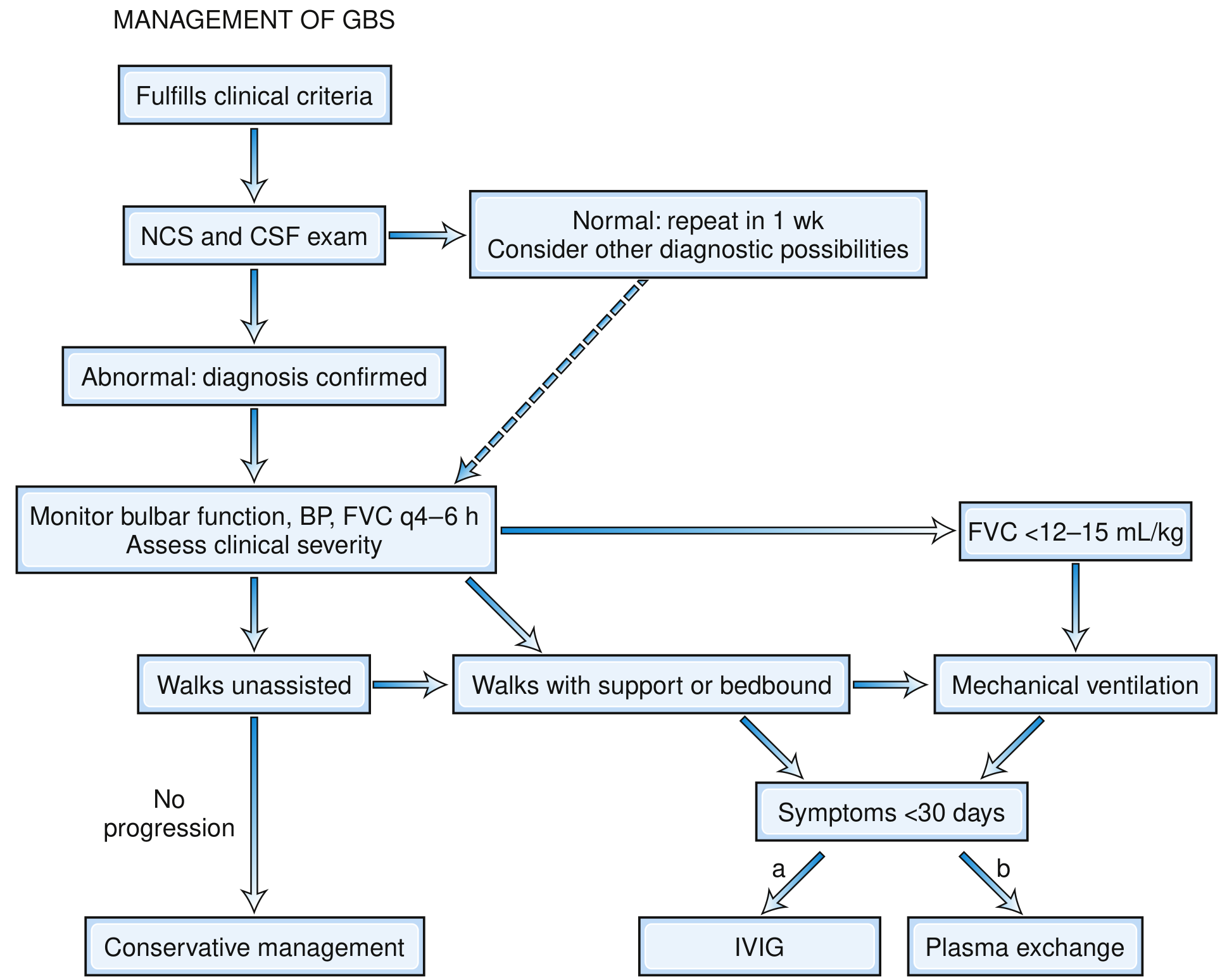
GBS Management Flowchart
This shows exactly how doctors make decisions - once you meet clinical criteria, nerve conduction studies and spinal fluid tests confirm diagnosis, then treatment (IVIG or plasma exchange) is started.

Rehabilitation - The Road Back to Full Strength

Even after medical treatment, physiotherapy (physical therapy) is essential to:
  • Rebuild muscle strength
  • Restore balance and coordination
  • Prevent joints from stiffening during recovery
  • Retrain your nervous system to use your legs properly again
A 2026 review published in Medwave (PMID: 41824781) confirms that early, structured, multidisciplinary rehabilitation - including motor re-education, balance training, and pain management - is key to getting back to full function.

What Recovery Looks Like for a Young Person Like You

For a 24-year-old who gets diagnosed and treated in time:
  • Week 1-4: Stabilization, treatment given, monitoring
  • Month 1-3: Gradual return of sensation and strength, starting from hands and working down to feet
  • Month 3-6: Significant improvement, walking returns
  • Month 6-12: Most patients reach near-full or full recovery
  • Month 12-24: Any remaining deficits usually resolve
The pain (which feels unbearable to you right now) is also treatable - nerve pain medications like gabapentin are used during recovery.

Factors That Work IN YOUR FAVOR for Full Recovery

  • Young age (24 years) - the single biggest positive predictor
  • No severe axonal degeneration (best assessed by nerve conduction test)
  • Getting treatment early (this is why going NOW matters)
  • No need for a ventilator (if you can still breathe normally, that is a very good sign)

Bottom Line

This is NOT a life sentence. It is a serious but treatable and recoverable condition. The nerve damage is largely reversible because nerves can regenerate. With proper treatment and physiotherapy, the goal is to get you back to living normally - walking, running, using your hands fully.
The most important thing you can do right now is go to a hospital emergency department. Every day of delay means more nerve damage that takes longer to repair. Treatment started early = faster and more complete recovery.
Sources: Bradley and Daroff's Neurology in Clinical Practice; Tintinalli's Emergency Medicine; Grelowska et al., Adv Clin Exp Med 2025 [PMID: 39377571]; Vallejos et al., Medwave 2026 [PMID: 41824781]
This is a shared conversation. Sign in to Orris to start your own chat.