I now have all the textbook images and content needed. Let me compile the full guide.
👂 Ear Anatomy & Physiology - Easy to Understand
Sources: Ganong's Review of Medical Physiology | Histology: A Text and Atlas | Cummings Otolaryngology | Medical Physiology (Boron)
🔷 The Big Picture - Three Parts of the Ear
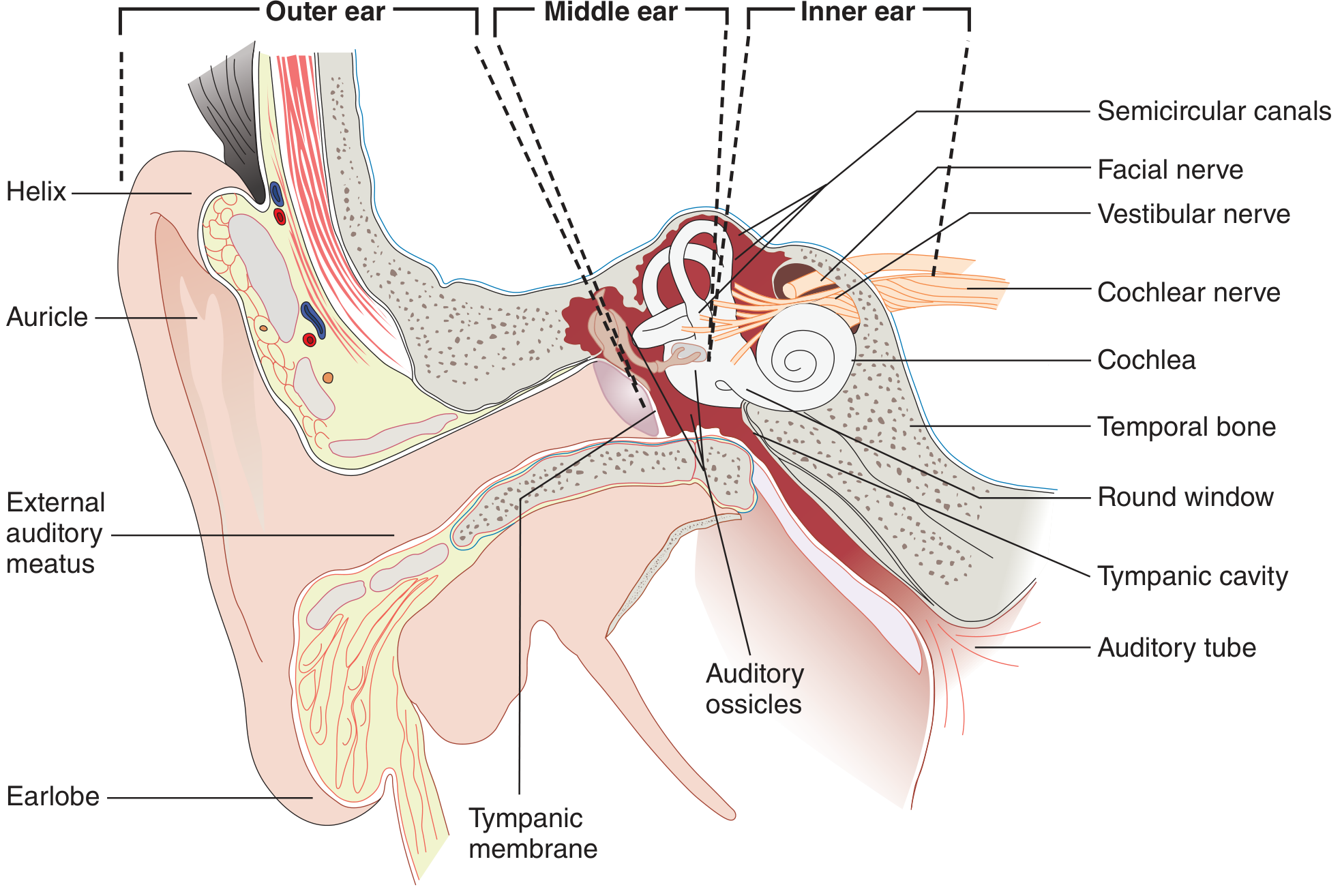
Full ear anatomy - outer, middle, and inner ear. Ganong's Review of Medical Physiology, Fig. 11-1
The ear is divided into three main sections, each with its own job:
| Section | Job |
|---|
| Outer ear | Collects sound waves from the environment |
| Middle ear | Amplifies and transmits vibrations |
| Inner ear | Converts vibrations into nerve signals (hearing) + controls balance |
🔷 PART 1: The Outer Ear
The outer ear is the part you can see and touch.
Structures:
| Structure | Description |
|---|
| Pinna / Auricle | The visible "ear flap" on the side of the head - shaped to funnel sound inward |
| Helix | The outer curved rim of the pinna |
| Earlobe | The soft, fleshy bottom of the auricle |
| External Auditory Meatus (EAM) | The ear canal - a tube about 2.5 cm long leading from the pinna to the eardrum |
| Cerumen glands | Wax-producing glands in the canal - wax traps dust and insects |
The outer ear's job is simple: funnel sound waves inward toward the eardrum.
🔷 PART 2: The Tympanic Membrane (Eardrum)
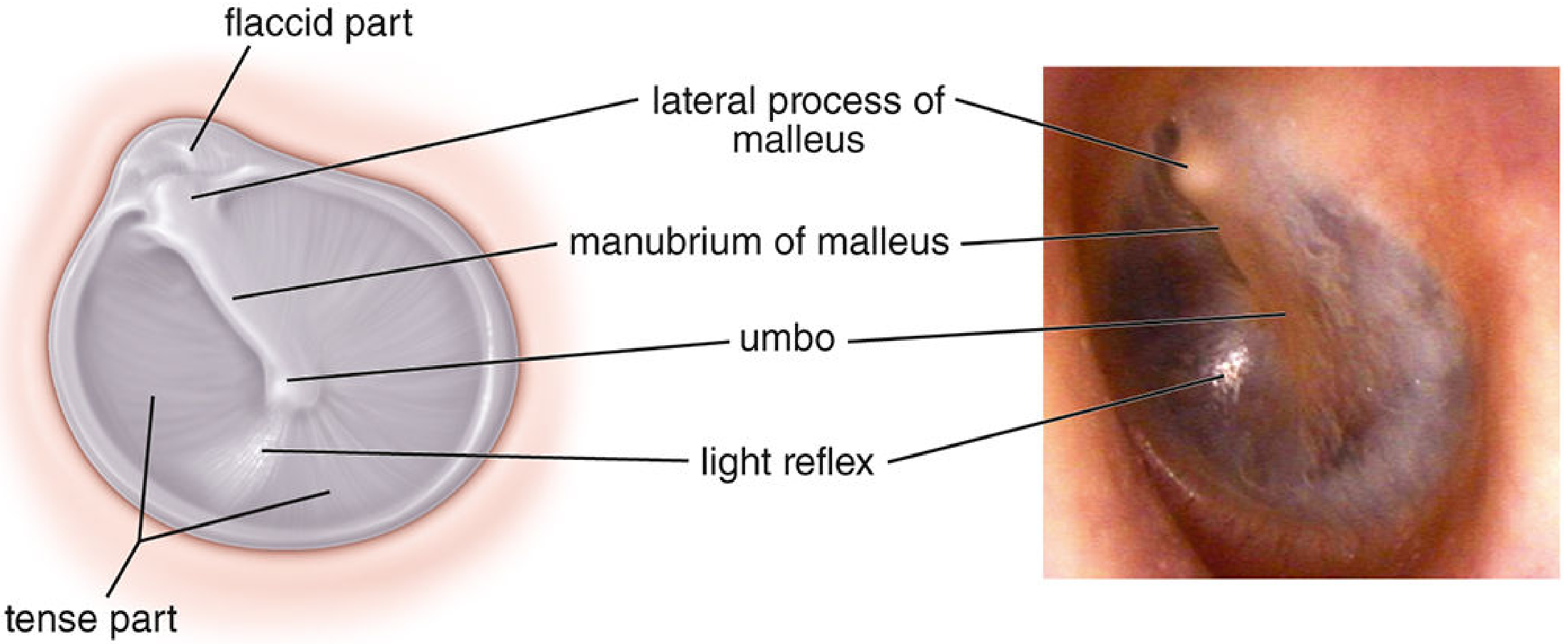
The tympanic membrane as seen through an otoscope. Histology: A Text and Atlas, Fig. 25.4
The tympanic membrane (eardrum) sits between the outer and middle ear.
- It is a thin (~0.1 mm), semi-transparent membrane about 1 cm in diameter
- Shaped like a shallow cone (like a mini satellite dish)
- Has two parts:
- Pars tensa - the large, tight, vibrating portion
- Pars flaccida - a small, looser portion at the top
- The umbo is the center point - where the malleus (first middle ear bone) attaches
- When a doctor examines your ear with an otoscope, a normal eardrum shows a cone of light (light reflex) pointing down and forward from the umbo
Function: Vibrates when sound waves hit it, passing the vibration to the middle ear bones.
🔷 PART 3: The Middle Ear
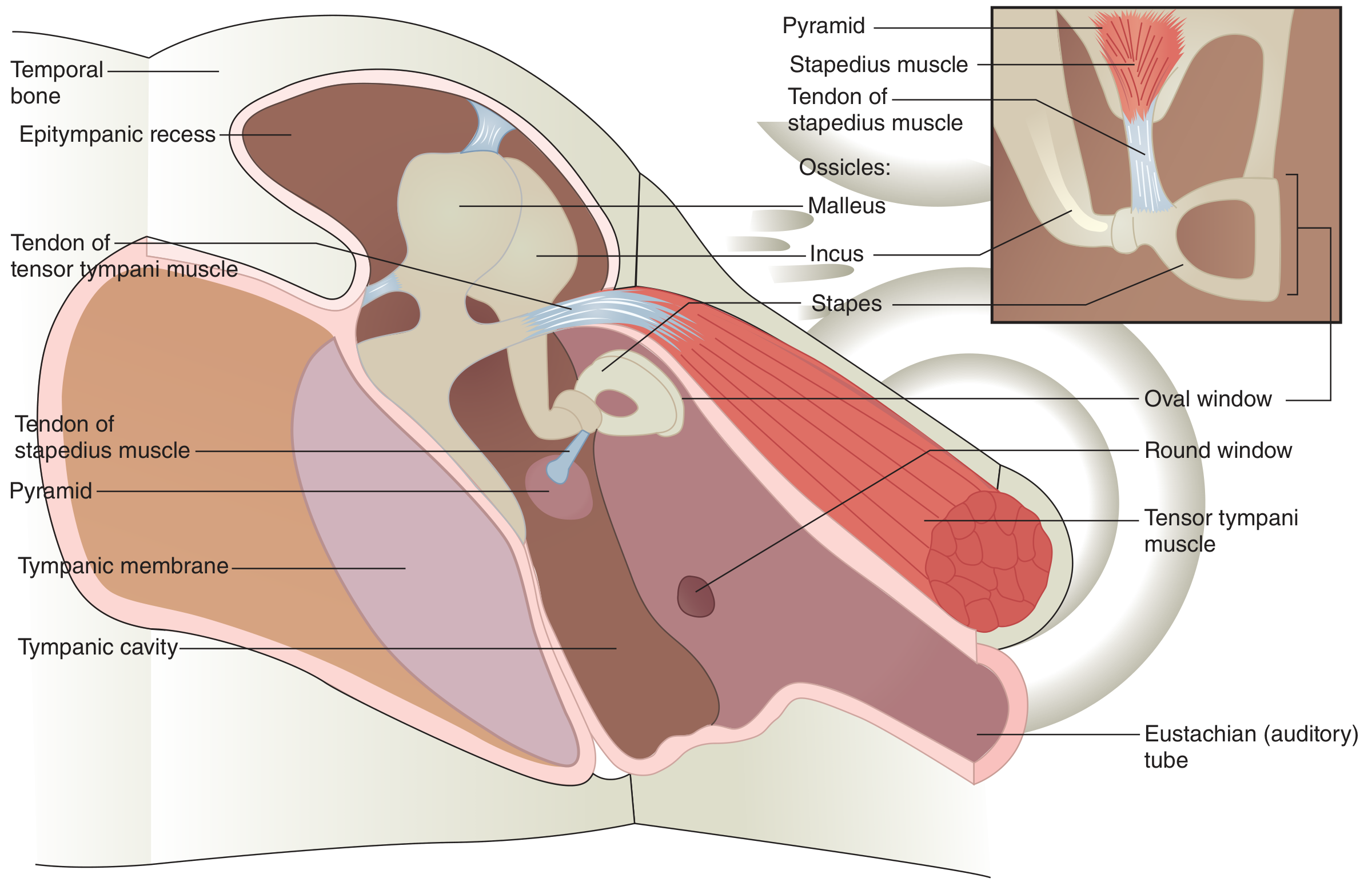
Middle ear contents - ossicles and muscles. Ganong's Review of Medical Physiology, Fig. 11-2
The middle ear is an air-filled cavity inside the temporal bone. Its main contents are:
🦴 The Three Ossicles (Tiny Bones)
The ossicles are the smallest bones in the entire human body. They form a chain that transmits vibrations from the eardrum to the inner ear:
Eardrum → Malleus → Incus → Stapes → Oval Window (Inner ear)
| Bone | Nickname | What It Looks Like | Job |
|---|
| Malleus | "Hammer" | Like a hammer | Attached to the eardrum; receives vibrations first |
| Incus | "Anvil" | Like an anvil | The middle bone - passes vibrations along |
| Stapes | "Stirrup" | Like a stirrup | Smallest bone in the body; footplate pushes on the oval window |
The ossicles amplify sound by about 22x - this is needed because sound is transferring from air (low resistance) into the fluid-filled inner ear (high resistance).
🎵 Two Middle Ear Muscles (Protection)
| Muscle | Controls | Reflex |
|---|
| Tensor tympani | Pulls malleus inward | Reduces eardrum vibration - protects from loud sounds |
| Stapedius | Pulls stapes outward | Reduces stapes movement - acoustic reflex (activated by loud noises to protect inner ear) |
🌀 The Eustachian (Auditory) Tube
- Connects the middle ear to the back of the throat (nasopharynx)
- Normally closed; opens when you swallow or yawn
- Function: equalizes air pressure on both sides of the eardrum
- Blocked Eustachian tube = "popping" ears on an airplane, or ear infections in children
🔷 PART 4: The Inner Ear (Labyrinth)
The inner ear is the most complex part - it serves two completely separate functions:
- Hearing (cochlea)
- Balance (vestibular system)
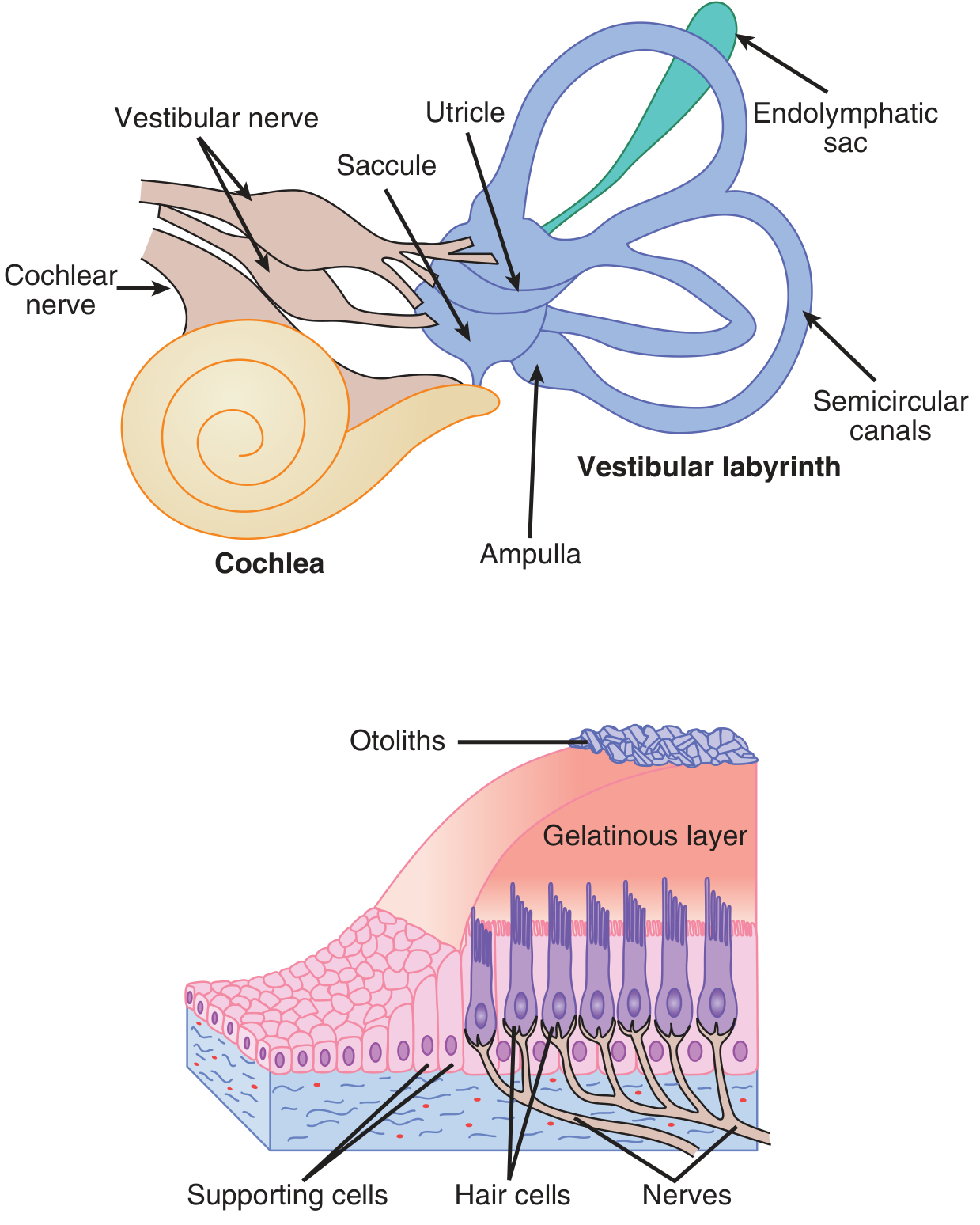
The inner ear membranous labyrinth - cochlea and vestibular system. Ganong's Review of Medical Physiology, Fig. 11-3
The inner ear has two fluid systems:
- Perilymph - fills the bony labyrinth (similar to blood plasma; low K⁺)
- Endolymph - fills the membranous labyrinth (high K⁺; critical for hair cell function)
🐚 A. The Cochlea (Hearing Organ)
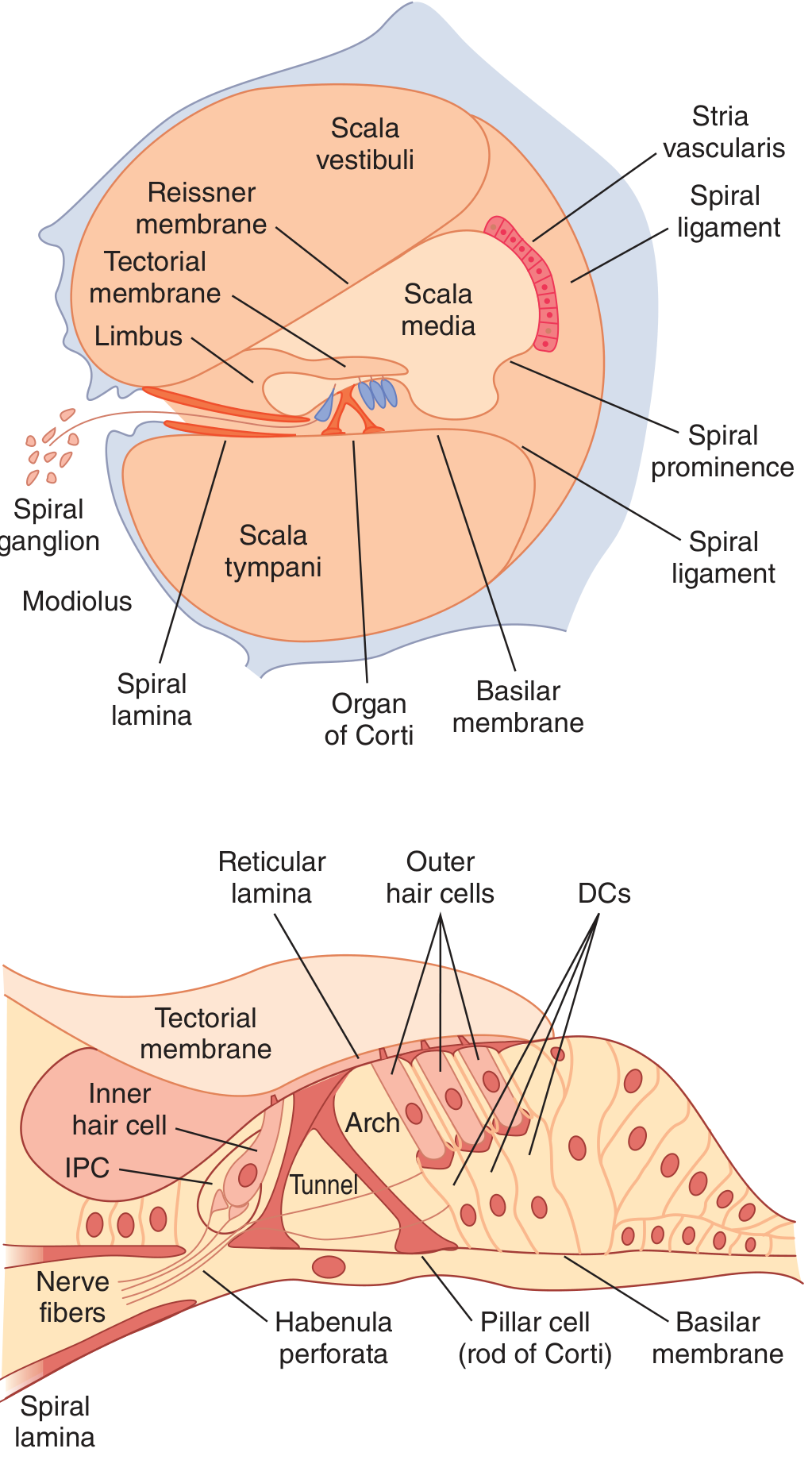
Cochlea cross-section and organ of Corti detail. Ganong's Review of Medical Physiology, Fig. 11-4
The cochlea is a snail-shaped, coiled tube (2¾ turns, 35 mm long) divided into three chambers (scalae):
| Chamber | Fluid | Connected to |
|---|
| Scala vestibuli (top) | Perilymph | Oval window |
| Scala media (middle) | Endolymph | Contains the Organ of Corti |
| Scala tympani (bottom) | Perilymph | Round window |
The top and bottom chambers connect at the tip of the cochlea via a tiny opening called the helicotrema.
The Organ of Corti - Where Sound Becomes Electricity
The Organ of Corti sits on the basilar membrane inside the scala media. It contains:
- ~3,500 Inner hair cells - one row; the true receptors of hearing; heavily innervated
- ~20,000 Outer hair cells - three rows; amplify sound by changing shape (electromotility)
- Tectorial membrane - a jelly-like "roof" that the outer hair cell tips brush against when the basilar membrane moves
- Stereocilia - tiny hair-like projections on top of hair cells; bending them opens ion channels
How the hair cell converts sound to nerve signal:
- Sound wave → stapes pushes oval window → fluid wave in perilymph
- Basilar membrane vibrates up and down
- Hair cell stereocilia brush against the tectorial membrane → bend
- Bending opens mechanically-gated ion channels → K⁺ and Ca²⁺ rush in
- Hair cell releases neurotransmitter (glutamate) → cochlear nerve fires → brain hears sound!
Tonotopic Organization (Pitch Map)
The basilar membrane is wider and more flexible at the apex and narrower/stiffer at the base:
- Base → responds to high-pitched sounds (e.g., 20,000 Hz)
- Apex → responds to low-pitched sounds (e.g., 20 Hz)
This is called tonotopy - the cochlea is a physical pitch-sorter!
🔄 B. The Vestibular System (Balance Organ)
The vestibular system has two types of sensors:
1. Semicircular Canals (3 canals - Rotation Detector)
- Three canals arranged at right angles to each other - one for each plane of space (X, Y, Z)
- Each has an ampulla (swollen end) containing the crista ampullaris with hair cells
- Hair cells are embedded in a jelly "cap" called the cupula
- When you rotate your head, fluid (endolymph) lags behind → cupula bends → hair cells fire
- Detects rotational/angular acceleration (e.g., spinning around)
2. Otolith Organs - Saccule & Utricle (Linear Motion + Gravity Detector)
- Contain the macula - a sheet of hair cells with tiny calcium carbonate crystals (otoliths/otoconia) sitting on top in a gelatinous membrane
- Utricle - horizontal orientation → detects forward/backward and side-to-side movement (horizontal linear acceleration)
- Saccule - vertical orientation → detects up/down movement and gravity
- When you tilt or accelerate, the heavy otoliths shift and pull the gelatinous layer → hair cells bend → brain detects motion
🔷 How Hearing Works - Step by Step
🔊 SOUND WAVES enter the ear
↓
👂 Pinna funnels them into the ear canal (External Auditory Meatus)
↓
🥁 Tympanic Membrane (eardrum) vibrates
↓
🦴 Malleus → Incus → Stapes (ossicles amplify the signal x22)
↓
🌊 Stapes pushes the Oval Window → fluid wave in cochlea
↓
🐚 Basilar membrane vibrates at specific location (pitch map)
↓
🦱 Organ of Corti hair cells bend → ion channels open → electrical signal
↓
⚡ Cochlear nerve (CN VIII) carries signal
↓
🧠 Cochlear nucleus → Superior olivary complex → Inferior colliculus
→ Medial geniculate nucleus (thalamus) → Auditory cortex
↓
🎵 YOU HEAR THE SOUND!
🔷 Quick Summary Table
| Structure | Location | Function |
|---|
| Pinna | Outer ear | Funnel sound |
| Ear canal | Outer ear | Conduct sound to eardrum |
| Tympanic membrane | Outer/middle boundary | Vibrates with sound |
| Malleus | Middle ear | First ossicle; attached to eardrum |
| Incus | Middle ear | Middle ossicle |
| Stapes | Middle ear | Pushes oval window; smallest bone in body |
| Eustachian tube | Middle ear | Pressure equalization |
| Cochlea | Inner ear | Hearing; converts sound → nerve signal |
| Organ of Corti | Inner ear (cochlea) | Contains hair cells - the actual hearing receptors |
| Basilar membrane | Inner ear | Pitch map (tonotopy) |
| Semicircular canals | Inner ear | Detects head rotation |
| Utricle & Saccule | Inner ear | Detects gravity, linear motion |
| CN VIII (Vestibulocochlear) | Nerve | Carries both hearing and balance signals to brain |
⚠️ Common Ear Disorders Explained by Anatomy
| Disorder | What Goes Wrong |
|---|
| Otitis media | Middle ear infection - fluid/pus builds up behind eardrum (often due to blocked Eustachian tube) |
| Otosclerosis | Stapes bone fuses to oval window → cannot vibrate → conductive hearing loss |
| Sensorineural hearing loss | Hair cells in cochlea are damaged (by noise, aging, drugs) → permanent hearing loss |
| Tinnitus | Ringing in ears - often from damaged hair cells firing spontaneously |
| Vertigo (BPPV) | Otoliths fall into semicircular canals → abnormal balance signals → spinning sensation |
| Ménière's disease | Excess endolymph → episodes of vertigo, hearing loss, and tinnitus |
| Acoustic neuroma | Benign tumor on CN VIII → progressive hearing loss and balance problems |
The ear is like a mechanical amplifier + frequency analyzer + gyroscope, all built into a space smaller than a marble! 🧠