
/generatehandwrittenimages A 63 year old male is brought to the emergency with increased tone of extensors, extension and external rotation of the limbs. MRI reveals the haemorrhage in basilar artery. In the given clinical scenario, describe all the postural reflexes that can be elicited in this patient. for md physiology 10 marks theory question. You can make many images and not just one for completing the answer
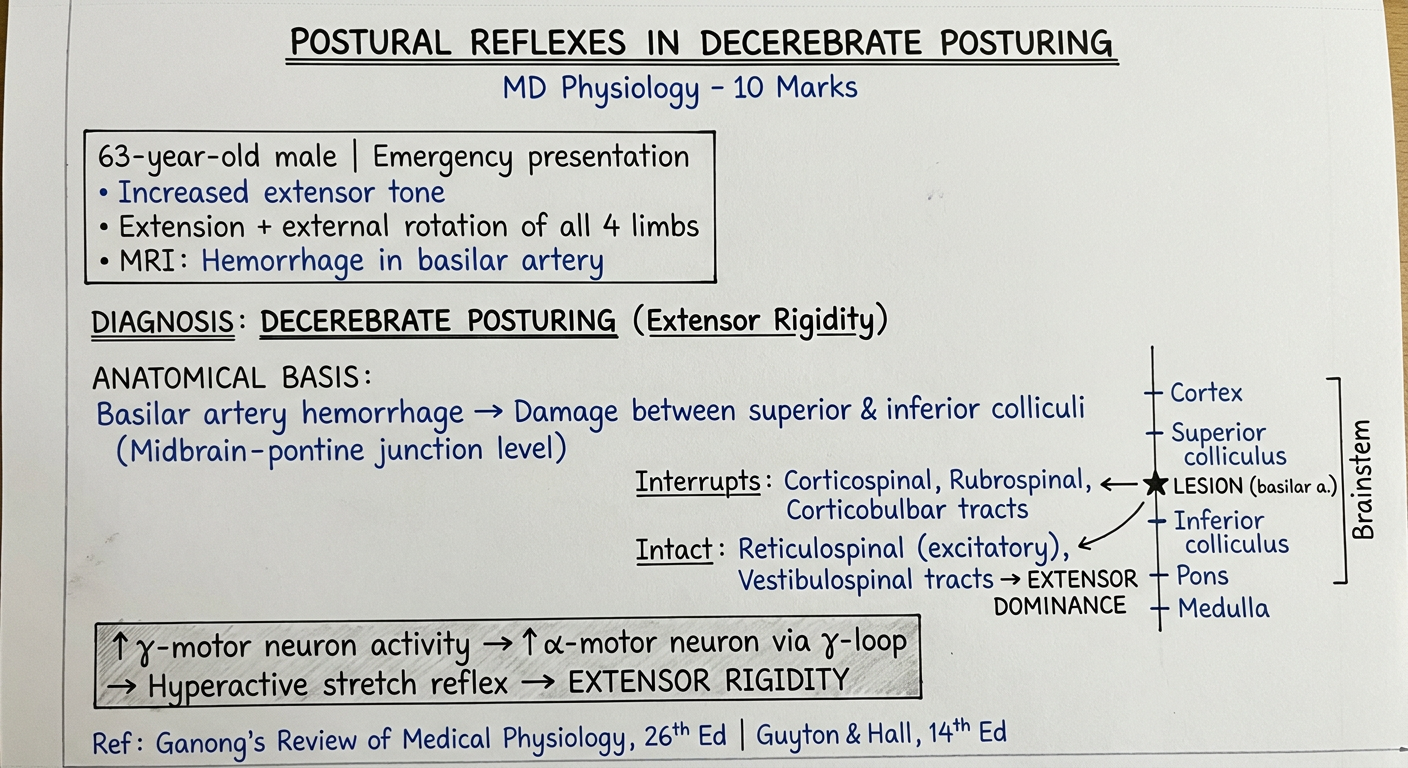
Handwritten medical exam answer sheet on white lined paper with faint blue lines, in blue and black pen, neat medical student handwriting. The page shows: TITLE (bold, underlined): "POSTURAL REFLEXES IN DECEREBRATE POSTURING" Subtitle: "MD Physiology - 10 Marks" CLINICAL SCENARIO BOX (drawn rectangle): "63-year-old male | Emergency presentation" "• Increased extensor tone" "• Extension + external rotation of all 4 limbs" "• MRI: Hemorrhage in basilar artery" DIAGNOSIS (bold, underlined): "DECEREBRATE POSTURING (Extensor Rigidity)" ANATOMICAL BASIS: "Basilar artery hemorrhage → Damage between superior & inferior colliculi" "(Midbrain-pontine junction level)" Small drawn diagram on right side: - Vertical line labeled "Brainstem" - Marks from top to bottom: "Cortex", "Superior colliculus", "★ LESION (basilar a.)", "Inferior colliculus", "Pons", "Medulla" - Arrow pointing to lesion: "Interrupts: Corticospinal, Rubrospinal, Corticobulbar tracts" - "Intact: Reticulospinal (excitatory), Vestibulospinal tracts → EXTENSOR DOMINANCE" RESULT BOX (shaded): "↑ γ-motor neuron activity → ↑ α-motor neuron via γ-loop → Hyperactive stretch reflex → EXTENSOR RIGIDITY" Footer note in small writing: "Ref: Ganong's Review of Medical Physiology, 26th Ed | Guyton & Hall, 14th Ed"
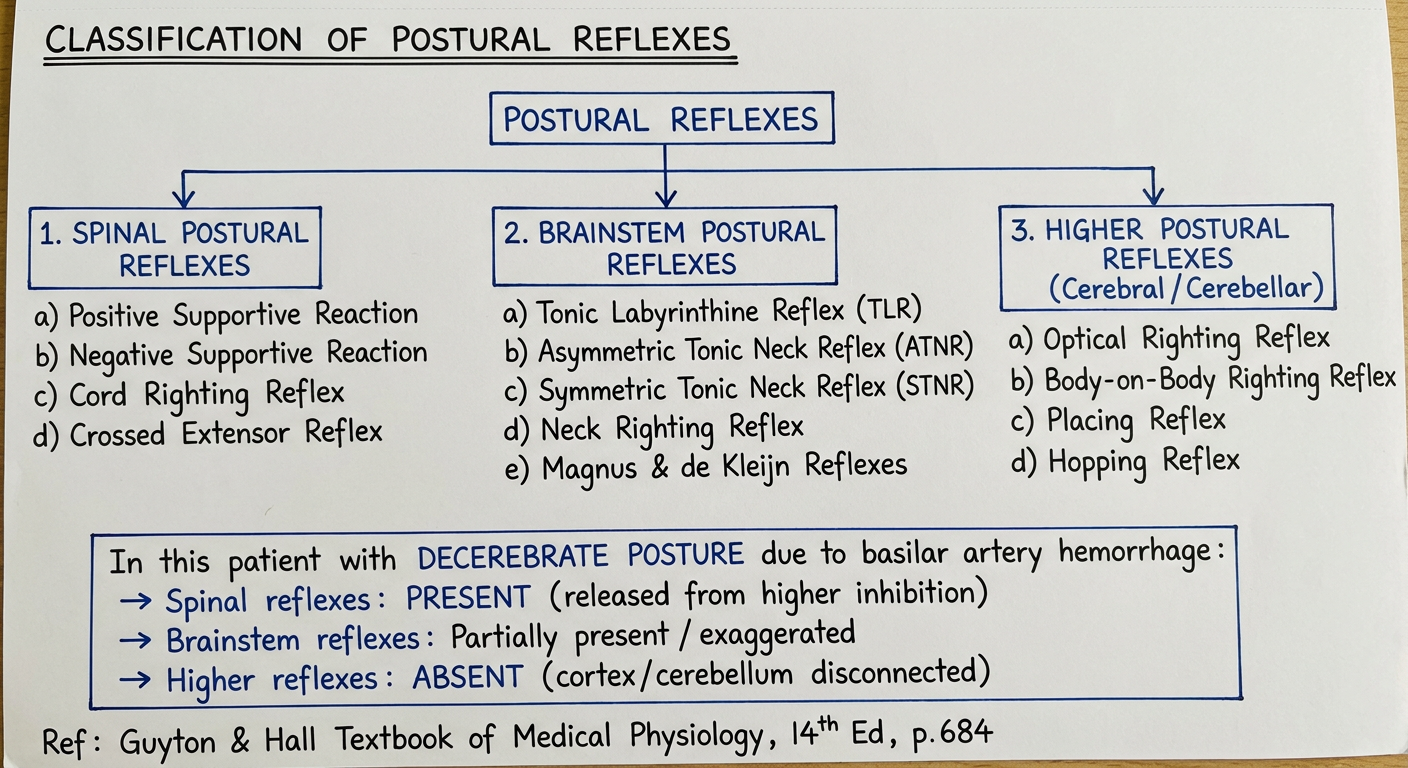
Handwritten medical exam answer sheet on white lined paper with faint blue lines, in blue and black pen, neat medical student handwriting. The page shows: HEADING (bold, underlined): "CLASSIFICATION OF POSTURAL REFLEXES" A neat hand-drawn hierarchical table/chart: Main box: "POSTURAL REFLEXES" Three branches drawn with arrows: BRANCH 1 (box): "1. SPINAL POSTURAL REFLEXES" Sub-items listed: "a) Positive Supportive Reaction" "b) Negative Supportive Reaction" "c) Cord Righting Reflex" "d) Crossed Extensor Reflex" BRANCH 2 (box): "2. BRAINSTEM POSTURAL REFLEXES" Sub-items listed: "a) Tonic Labyrinthine Reflex (TLR)" "b) Asymmetric Tonic Neck Reflex (ATNR)" "c) Symmetric Tonic Neck Reflex (STNR)" "d) Neck Righting Reflex" "e) Magnus & de Kleijn Reflexes" BRANCH 3 (box): "3. HIGHER POSTURAL REFLEXES (Cerebral/Cerebellar)" Sub-items listed: "a) Optical Righting Reflex" "b) Body-on-Body Righting Reflex" "c) Placing Reflex" "d) Hopping Reflex" Below the chart, a note in a small box: "In this patient with DECEREBRATE POSTURE due to basilar artery hemorrhage:" "→ Spinal reflexes: PRESENT (released from higher inhibition)" "→ Brainstem reflexes: Partially present / exaggerated" "→ Higher reflexes: ABSENT (cortex/cerebellum disconnected)" Footer: "Ref: Guyton & Hall Textbook of Medical Physiology, 14th Ed, p.684"
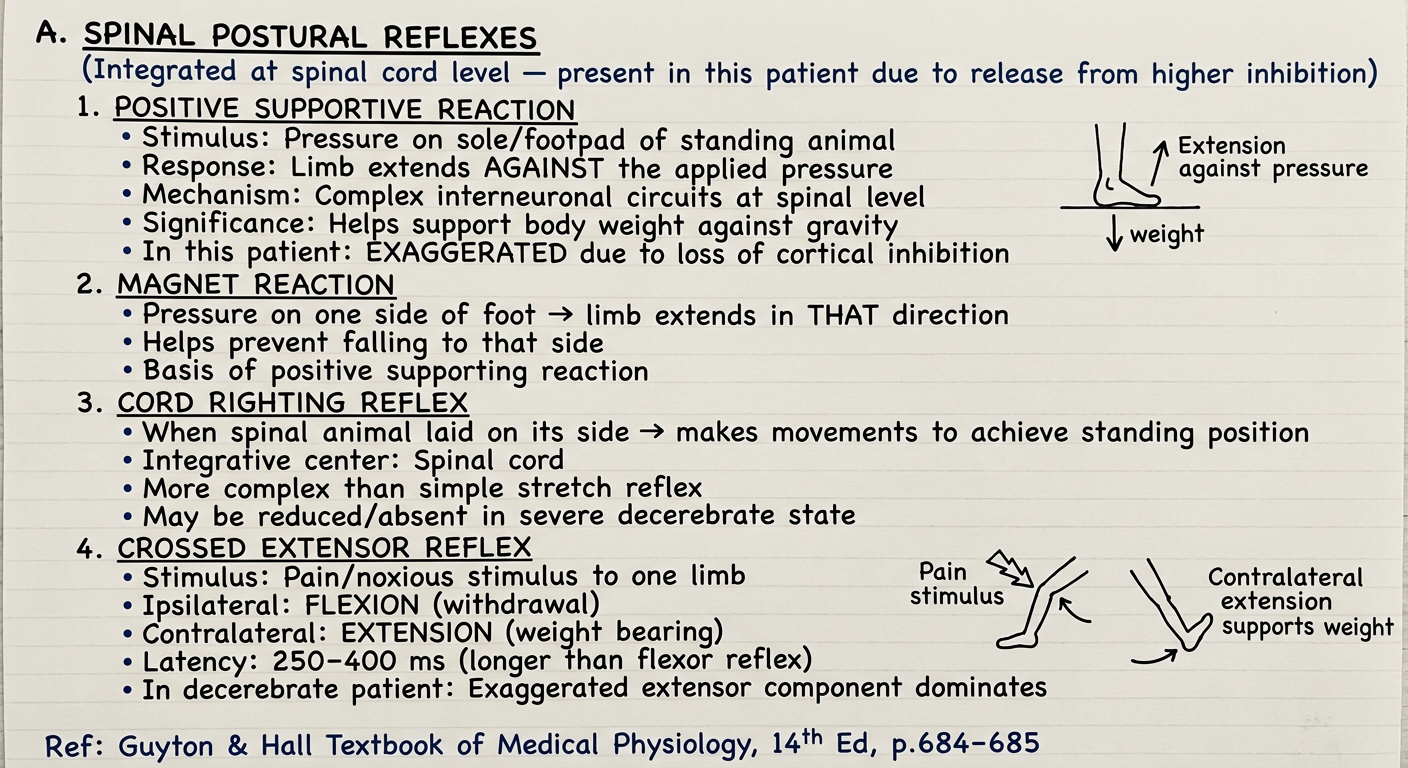
Handwritten medical exam answer sheet on white lined paper with faint blue lines, blue and black pen, neat medical student handwriting. HEADING (bold, underlined): "A. SPINAL POSTURAL REFLEXES" Note: "(Integrated at spinal cord level — present in this patient due to release from higher inhibition)" 1. POSITIVE SUPPORTIVE REACTION (underlined, numbered) "• Stimulus: Pressure on sole/footpad of standing animal" "• Response: Limb extends AGAINST the applied pressure" "• Mechanism: Complex interneuronal circuits at spinal level" "• Significance: Helps support body weight against gravity" "• In this patient: EXAGGERATED due to loss of cortical inhibition" Small stick figure diagram on right: foot on ground, arrow pointing down (weight), arrow pointing up (limb extension) labeled "Extension against pressure" 2. MAGNET REACTION (underlined, numbered) "• Pressure on one side of foot → limb extends in THAT direction" "• Helps prevent falling to that side" "• Basis of positive supporting reaction" 3. CORD RIGHTING REFLEX (underlined, numbered) "• When spinal animal laid on its side → makes movements to achieve standing position" "• Integrative center: Spinal cord" "• More complex than simple stretch reflex" "• May be reduced/absent in severe decerebrate state" 4. CROSSED EXTENSOR REFLEX (underlined, numbered) "• Stimulus: Pain/noxious stimulus to one limb" "• Ipsilateral: FLEXION (withdrawal)" "• Contralateral: EXTENSION (weight bearing)" "• Latency: 250-400 ms (longer than flexor reflex)" "• In decerebrate patient: Exaggerated extensor component dominates" Small diagram: Two limbs, left limb with pain stimulus → flexion; right limb → extension, label "Contralateral extension supports weight" Footer: "Ref: Guyton & Hall Textbook of Medical Physiology, 14th Ed, p.684-685"
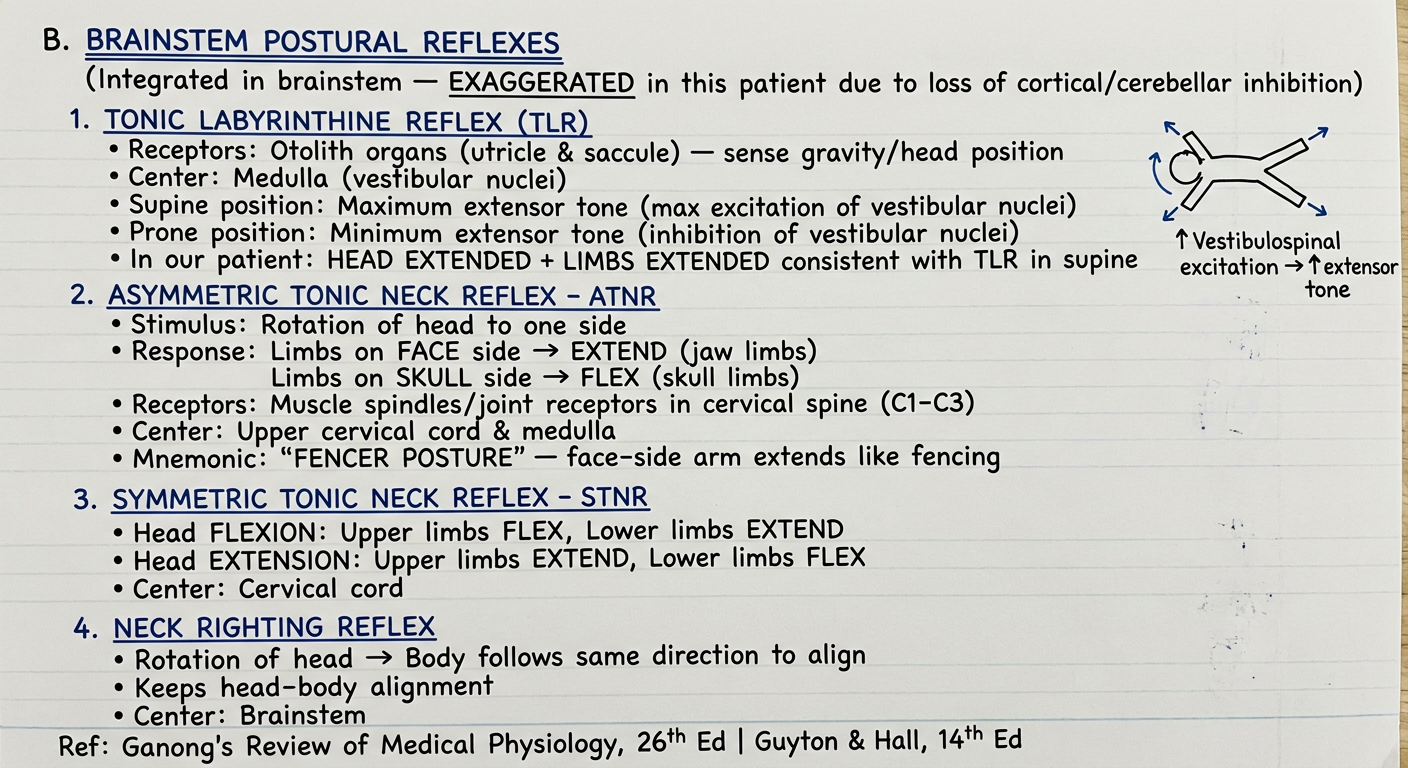
Handwritten medical exam answer sheet on white lined paper with faint blue lines, blue and black pen, neat medical student handwriting. HEADING (bold, underlined): "B. BRAINSTEM POSTURAL REFLEXES" Note: "(Integrated in brainstem — EXAGGERATED in this patient due to loss of cortical/cerebellar inhibition)" 1. TONIC LABYRINTHINE REFLEX (TLR) (underlined, numbered) "• Receptors: Otolith organs (utricle & saccule) — sense gravity/head position" "• Center: Medulla (vestibular nuclei)" "• Supine position: Maximum extensor tone (max excitation of vestibular nuclei)" "• Prone position: Minimum extensor tone (inhibition of vestibular nuclei)" "• In our patient: HEAD EXTENDED + LIMBS EXTENDED consistent with TLR in supine" Small diagram: - Head tilted back (supine) → All 4 limbs extended (arrows pointing outward) - Label: "↑ Vestibulospinal excitation → ↑ extensor tone" 2. ASYMMETRIC TONIC NECK REFLEX - ATNR (underlined, numbered) "• Stimulus: Rotation of head to one side" "• Response: Limbs on FACE side → EXTEND (jaw limbs)" " Limbs on SKULL side → FLEX (skull limbs)" "• Receptors: Muscle spindles/joint receptors in cervical spine (C1-C3)" "• Center: Upper cervical cord & medulla" "• Mnemonic: 'FENCER POSTURE' — face-side arm extends like fencing" 3. SYMMETRIC TONIC NECK REFLEX - STNR (underlined, numbered) "• Head FLEXION: Upper limbs FLEX, Lower limbs EXTEND" "• Head EXTENSION: Upper limbs EXTEND, Lower limbs FLEX" "• Center: Cervical cord" 4. NECK RIGHTING REFLEX (underlined, numbered) "• Rotation of head → Body follows same direction to align" "• Keeps head-body alignment" "• Center: Brainstem" Footer: "Ref: Ganong's Review of Medical Physiology, 26th Ed | Guyton & Hall, 14th Ed"
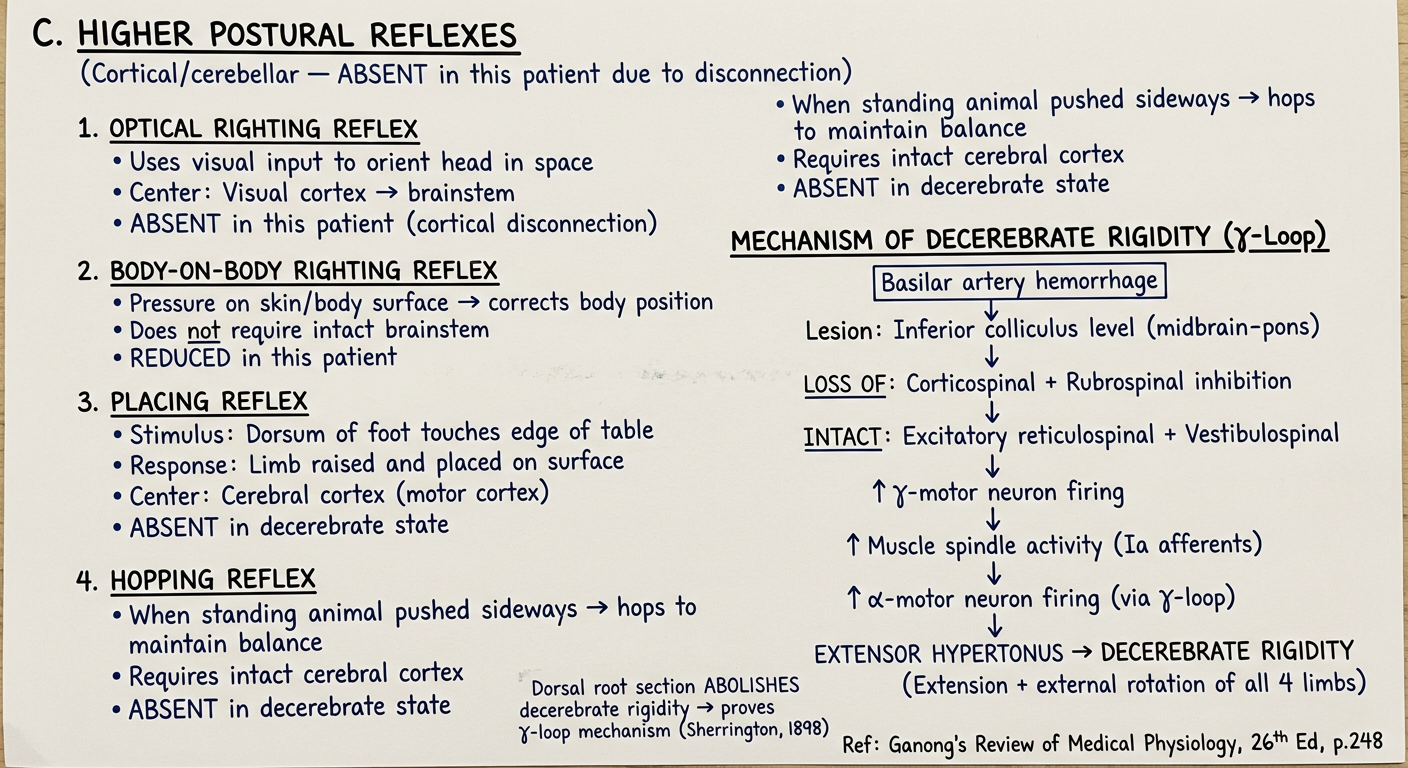
Handwritten medical exam answer sheet on white lined paper with faint blue lines, blue and black pen, neat medical student handwriting. HEADING (bold, underlined): "C. HIGHER POSTURAL REFLEXES" Note: "(Cortical/cerebellar — ABSENT in this patient due to disconnection)" 1. OPTICAL RIGHTING REFLEX (underlined, numbered) "• Uses visual input to orient head in space" "• Center: Visual cortex → brainstem" "• ABSENT in this patient (cortical disconnection)" 2. BODY-ON-BODY RIGHTING REFLEX (underlined, numbered) "• Pressure on skin/body surface → corrects body position" "• Does not require intact brainstem" "• REDUCED in this patient" 3. PLACING REFLEX (underlined, numbered) "• Stimulus: Dorsum of foot touches edge of table" "• Response: Limb raised and placed on surface" "• Center: Cerebral cortex (motor cortex)" "• ABSENT in decerebrate state" 4. HOPPING REFLEX (underlined, numbered) "• When standing animal pushed sideways → hops to maintain balance" "• Requires intact cerebral cortex" "• ABSENT in decerebrate state" HEADING (bold, underlined): "MECHANISM OF DECEREBRATE RIGIDITY (γ-Loop)" Flow diagram drawn with arrows: "Basilar artery hemorrhage" "↓" "Lesion: Inferior colliculus level (midbrain-pons)" "↓" "LOSS OF: Corticospinal + Rubrospinal inhibition" "↓" "INTACT: Excitatory reticulospinal + Vestibulospinal" "↓" "↑ γ-motor neuron firing" "↓" "↑ Muscle spindle activity (Ia afferents)" "↓" "↑ α-motor neuron firing (via γ-loop)" "↓" "EXTENSOR HYPERTONUS → DECEREBRATE RIGIDITY" "(Extension + external rotation of all 4 limbs)" Small note: "Dorsal root section ABOLISHES decerebrate rigidity → proves γ-loop mechanism (Sherrington, 1898)" Footer: "Ref: Ganong's Review of Medical Physiology, 26th Ed, p.248"
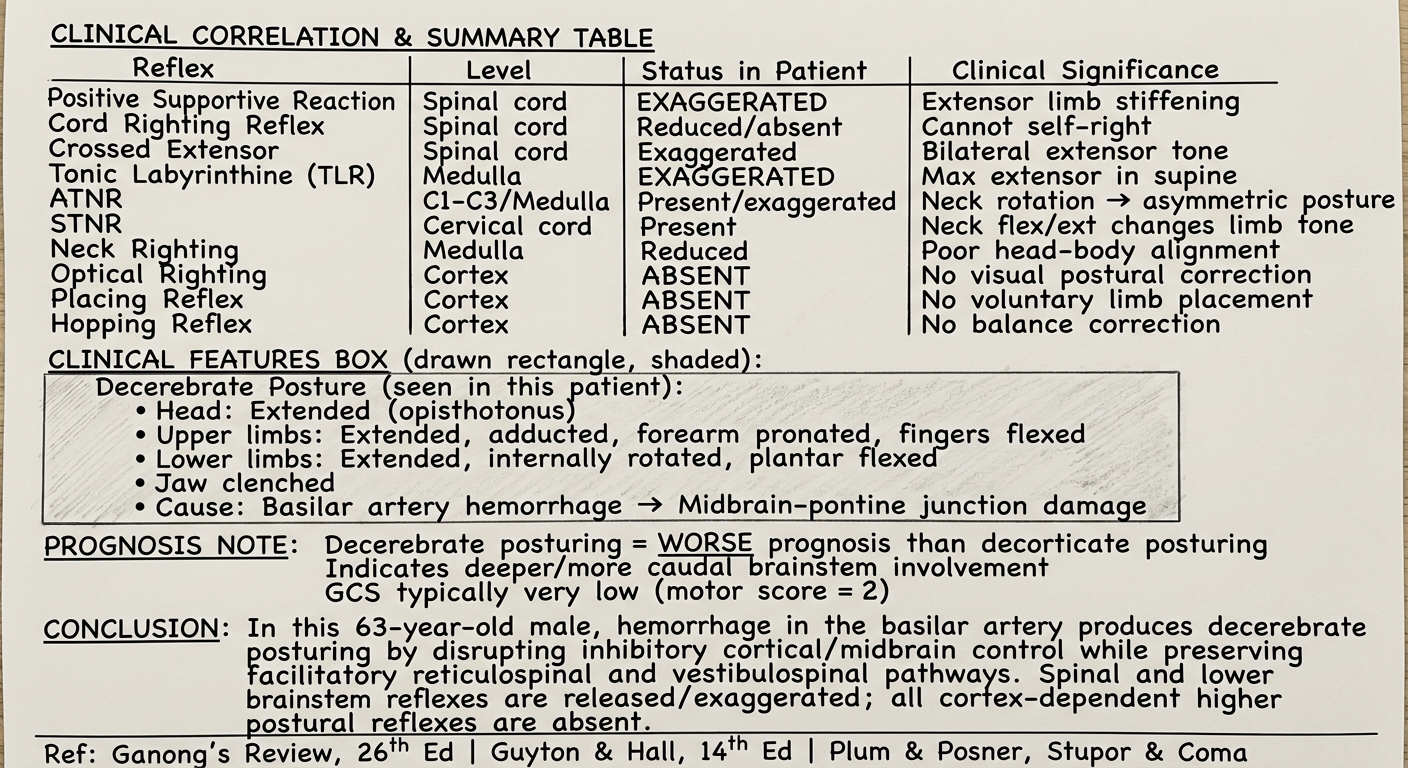
Handwritten medical exam answer sheet on white lined paper with faint blue lines, blue and black pen, neat medical student handwriting. HEADING (bold, underlined): "CLINICAL CORRELATION & SUMMARY TABLE" SUMMARY TABLE drawn with hand-drawn lines, 4 columns: Headers: "Reflex | Level | Status in Patient | Clinical Significance" Row 1: "Positive Supportive Reaction | Spinal cord | EXAGGERATED | Extensor limb stiffening" Row 2: "Cord Righting Reflex | Spinal cord | Reduced/absent | Cannot self-right" Row 3: "Crossed Extensor | Spinal cord | Exaggerated | Bilateral extensor tone" Row 4: "Tonic Labyrinthine (TLR) | Medulla | EXAGGERATED | Max extensor in supine" Row 5: "ATNR | C1-C3/Medulla | Present/exaggerated | Neck rotation → asymmetric posture" Row 6: "STNR | Cervical cord | Present | Neck flex/ext changes limb tone" Row 7: "Neck Righting | Medulla | Reduced | Poor head-body alignment" Row 8: "Optical Righting | Cortex | ABSENT | No visual postural correction" Row 9: "Placing Reflex | Cortex | ABSENT | No voluntary limb placement" Row 10: "Hopping Reflex | Cortex | ABSENT | No balance correction" CLINICAL FEATURES BOX (drawn rectangle, shaded): "Decerebrate Posture (seen in this patient):" "• Head: Extended (opisthotonus)" "• Upper limbs: Extended, adducted, forearm pronated, fingers flexed" "• Lower limbs: Extended, internally rotated, plantar flexed" "• Jaw clenched" "• Cause: Basilar artery hemorrhage → Midbrain-pontine junction damage" PROGNOSIS NOTE (underlined): "Decerebrate posturing = WORSE prognosis than decorticate posturing" "Indicates deeper/more caudal brainstem involvement" "GCS typically very low (motor score = 2)" CONCLUSION (underlined): "In this 63-year-old male, hemorrhage in the basilar artery produces decerebrate" "posturing by disrupting inhibitory cortical/midbrain control while preserving" "facilitatory reticulospinal and vestibulospinal pathways. Spinal and lower" "brainstem reflexes are released/exaggerated; all cortex-dependent higher" "postural reflexes are absent." Footer: "Ref: Ganong's Review, 26th Ed | Guyton & Hall, 14th Ed | Plum & Posner, Stupor & Coma"
Page 1 - Introduction & Anatomical Basis
Page 2 - Classification of Postural Reflexes
Page 3 - Spinal Postural Reflexes
Page 4 - Brainstem Postural Reflexes (TLR, ATNR, STNR)
Page 5 - Higher Reflexes & γ-Loop Mechanism
Page 6 - Summary Table & Conclusion
Answer Outline (Quick Reference)
- Positive Supportive Reaction - foot pressure → limb extension against gravity
- Magnet Reaction - pressure on one side → extension toward that side
- Cord Righting Reflex - attempts to achieve standing position
- Crossed Extensor Reflex - ipsilateral flexion + contralateral extension (extensor component dominates)
- Tonic Labyrinthine Reflex (TLR) - otolith-mediated; supine position maximally excites vestibular nuclei → all-limb extensor tone (explains clinical picture)
- Asymmetric Tonic Neck Reflex (ATNR) - head rotation → face-side limbs extend, skull-side limbs flex
- Symmetric Tonic Neck Reflex (STNR) - head flexion → UL flexion + LL extension; head extension → reverse
- Neck Righting Reflex - head rotation → body follows
- Optical righting reflex
- Placing reflex
- Hopping reflex
- Body-on-body righting reflex